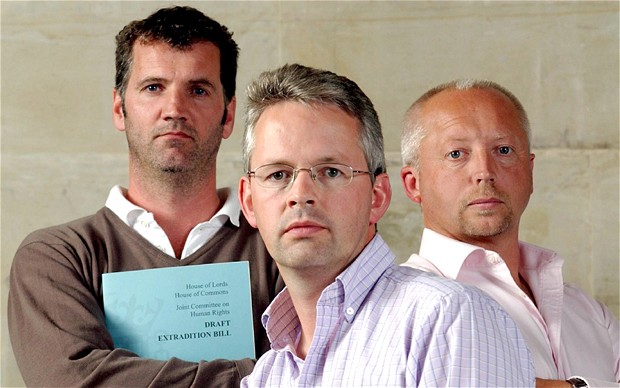
Can the NatWest Three receive a fair trial in Houston?

Barry Turner, lecturer in criminal law and criminal evidence at Leeds Law School, makes the following declaration in this Times Online blog post regarding the NatWest Three, who are presently awaiting a bond hearing in Houston in regard to the Enron-related criminal case against them:

“It is . . . absurd to suggest that the men will not get a fair trial in a country that uses exactly the same legal system as we do.”

H’mm. Better check the facts, Mr. Turner. Kevin Howard and Ken Lay are stark reminders that the suggestion is not absurd at all.

By the way, a friend who is prominent in the media business was vacationing in England when Ken Lay died. He passes along the following observation regarding the British media coverage of Mr. Lay’s death:

“The coverage [of Mr. Lay’s death] on the domestic BBC service was interesting.

Close to the top of the report, the journalist noted that Ken Lay continued to maintain that he had done nothing wrong. The report then went on to entertain the idea that this might actually be true.

The extensive coverage of the Natwest Three added to the sense that, in Britain at least, there is now as much questioning of the Department of Justice as there is of ex-Enron officers.”

“On Teaching” by Ross M. Lence

This has been a weekend of reflection for me as I contemplate the life of one of Houston’s finest teachers — Professor Ross M. Lence (previous post here) of the University of Houston — who died this past week.

Over a hundred former students, colleagues and friends gathered this past Thursday evening to laugh, cry and reminisce about Ross at the visitation, and then those friends and hundreds more gathered on Friday morning for the Requiem Mass for Ross at St. Anne Catholic Church. The mass was profoundly moving, with St. Anne’s soloist Kay Kahl providing beautiful singing and UH Honors College Dean Ted Estess — one of Ross’ best friends and closest colleagues — absolutely hitting the ball out of the park with a poignant eulogy that conveyed perfectly Ross’ extraordinary combination of teaching brilliance, humor and humanity.

A particularly nice touch of the services for Ross was his family’s decision to provide a copy of one of Ross’ essays to everyone who attended. The essay — entitled “On Teaching” — was written by Ross a decade or so ago while collecting his thoughts on teaching in connection with the effort of his former students and friends to raise the funds that eventually endowed the Ross M. Lence Distinguished Teaching Chair at the University of Houston.

Ross never published “On Teaching,” but by passing it along below, I hope that each teacher who happens upon this special essay will take a moment to read and reflect on it, and then use it as inspiration to provide the type of warm, thoughtful and rich mentoring to their students that is Ross Lence’s legacy to his:

I shall not shock anyone, but merely subject myself to good-natured ridicule, if I profess myself inclined to the old way of thinking that the primary concern of teaching and teachers is the student.

While such an observation may seem elementary, it should be noted that for those who define the function of a university as the discovery, preservation, and transmission of knowledge,î the role of teaching (presumably the transmission of knowledge) is formulated in such a way as to avoid mentioning either the teacher or the student. Indeed, when confined to the transmission and preservation of knowledge alone, teaching would seem to be little more than the transmission of decaying sense, entombed in that graveyard of knowledge, the notes of the teacher’s students.

Teaching necessarily involves the highest forms of discovery, the awakening of the students’ minds and souls to the world of creativity and imagination. A good teacher challenges students to join in the continuous, meticulous, and solitary questions of the mind. I myself prefer important questions partially answered to unimportant questions fully answered.

Who could doubt that those students were blessed who witnessed the phenomenal mind of Enrico Fermi as he unleashed the power of the universe on that cold, winter day under the bleachers of Stagg Field at the University of Chicago? There, with only the assistance of a slide rule and his hands, Fermi managed to do what it now takes two computers to replicate: to produce man’s first nuclear reaction.

There, a great teacher, who in the tongue of his native Italy and understood by hardly anyone present, managed to convey to his peers the desperate need to insert the carbon rods into the nuclear mass, thereby saving not only themselves, but the city of Chicago.

No doubt everyone remembers the teacher who most influenced his or her thoughts, person, and soul. No one is perhaps more aware of the best teachers than teachers themselves. That person who most influenced my own thinking was the Sage of Goose Creek, Charles S. Hyneman, Indiana University’s Distinguished Service Professor and President of the American Political Science Association.

That man did for me something that few teachers have ever done for a student. In a desperate effort to teach this kid from the wilds of Montana about the American Regime, Charles Hyneman took me on a 15,000 mile, 5-year trip across America, where he introduced me to every site where an Indian had died, every sausage factory in American and even Alvin, Texas, home of Nolan Ryan.

Today I attempt to lead my students on such a journey of the mind. Some days are good; some days are not so good. But every day I remind myself that teaching is like missionary work, and that I am the messenger, not the message. I constantly strive to bring others to see the excitement, as well as the limits, offered by the life of the mind. I encourage all students to be bold in their thoughts, moderate in their actions, and courageous in their pursuit of truth, wherever it is and however it can be known.

As I now come to my own golden age, I often think of my teacher. Of his incredible kindness, his depth of soul, and the power of his imagination. My real hope is that I, too, will be remembered by those who come after me with the same fondness.

This, then, is my philosophy of teaching: teachers love their own teachers, and they are loved in turn.

Ross M. Lence
Houston, Texas

Update: Ted Estess eulogized Ross and the Abbeville Institute provides a touching tribute.

Agency costs of big-time college football

auburn.tigers.jpgCollege football is a big and competitive business, so it’s no surprise that the issue of agency costs has reared its head with frequency over the past century of the sport. This NY Times article reports on the latest incident of apparent academic fraud — an Auburn University sociology professor arranged to have 18 members of the 2004 Auburn football team, which went undefeated and finished No. 2 in the nation, take a combined 97 hours of the “directed-reading courses” which required no classroom instruction whatsoever. More than a quarter of the students in the professor’s directed-reading courses were Auburn University athletes. The usual NCAA investigation is to follow while serious academics at Auburn must be shaking their heads over it all.
As noted in this previous post, big-time college football and basketball are caught in a vicious cycle of uneven growth, feckless leadership from many university presidents and obsolescent business models. As the previous post notes, it’s an unfortunate situation because big-time college football and basketball would likely not suffer a bit from reform that required universities to compete with true student-athletes, as opposed to minor league professional players. Given the hyprocrisy of many state universities subsidizing minor league football and basketball at the same time as grappling with funding issues for core academic programs, one would think that expensive and mostly unprofitable system of big-time college football and basketball would be ripe for reform. However, powerful and wealthy special interests continue to support the current system despite the implications to the universities’ academic responsibilities.
Is there any hope for true reform of intercollegiate athletics as well as minor league football and basketball? Or is the current system so entrenched in concentrated wealth and regulation that it is impervious to reform?

Not so fast, Mr. Eisenstat

yukos-houston2.jpgAs noted in a number of these previous posts, the Russian government’s dismemberment and effective nationalization of the assets of OAO Yukos last year has dire implications generally for Western business interests hoping to engage in reasonably free commercial investment in Russia, the recent Rosneft IPO notwithstanding.
In this WSJ ($) op-ed, former Carter and Clinton admnistration official Stuart Eizenstat observes that the Yukos affair has had broad and negative implications to the world economy, and contends that the Bush Administration and other free-market governments’ failure to call Russian Prime Minister Putin to task for his trashing of free-market business interests has contributed substantially to that negative impact. Eisenstat makes a number of good points, including the following:

Mr. Putin should also be put on notice that . . . the continued incarceration of Messrs. [former Yukos CEO Michael] Khodorkovsky and [Russian financier Platon] Lebedev, who is ill and suffering unnecessarily in a prison north of the Artic Circle, limits Russia’s prospects of being viewed as a member in good standing of the world’s group of leading nations.

Unfortunately, based on this and this, Mr. Putin could quite appropriately respond “say what?” to such a notice.

Nice gesture, but what about these folks?

hempleaf-746083.gifThis NY Times article reports on Utah Senator Orrin G. Hatch’s intervention recently on behalf of Dallas Austin, a 35-year-old, black record producer who had been arrested, convicted and sentenced to four years in prison in Dubai for possession of about a gram of cocaine. Kudos to Senator Hatch for helping prevent a talented man from enduring an injustice over a victimless crime.
But as noted in this previous post, the American criminalization of drug possession is a costly nightmare on many fronts. Currently, over 350,000 people languish in American prisons for drug possession. Commenting on Senator Hatch’s intervention on behalf of Austin, David Boaz over at the Cato @ Liberty blog observes:

Surely Hatch thinks regular old Americans are due the same consideration as a Grammy-winning singer. Heíd advocate the release of any American convicted of possessing 1.26 grams of cocaine, right?
Or are politicians hypocrites? Could it be that they think average Americans like Richard Paey should go to jail for using large amounts of painkillers, but not celebrities like Rush Limbaugh? Could it be that they laugh about their own past drug use while supporting a policy that arrests 1.5 million Americans a year, as a classic John Stossel ìGive Me a Breakî segment showed? (Not online, unfortunately, but you can read a commentary here.)
Putting people in jail for using drugs is bad enough. Putting the little people in jail while politicians chortle over their own drug use and pull strings to get celebrities out of jail is hypocrisy on a grand scale.

Dolphins and Capers scam Texans

capers_dom.jpgIn this previous post, I speculated that former Houston Texans head coach and current Miami Dolphins defensive coordinator Dom Capers will be particularly incentivized to have his Dolphins defensive unit ready for the Dolphins’ game with the Texans this coming October.
Well, the following blurb in this MiamiHerald.com article indicates that Texans owner Bob McNair has reason to have his troops reciprocate with some spirited play in the upcoming game:

Dom Capers won’t have the defensive coordinator title, but that essentially is his job. ”Maybe some day he’ll be that, but not this year,” coach Nick Saban said. Miami is saving a bundle by withholding that title. Now Houston, which fired him as head coach, must pay Capers $2 million in 2006, and Miami only $300,000.

Rice Press revived online

RICE_TMS_translogo2.GIFLooks as if the Chronicle missed this local item of media news.
Houston’s Rice University — one of the nation’s most prestigious universities — is reviving its defunct academic press online in a bold move that will undoubtedly reignite the discussions over over who will ultimately profit from Web publishing. Rice University Press was a money-losing proposition when it went out of business about a decade ago. However, under its new all-digital format, the press will instead post works online at a new Web site where people can read a full copy of the book free. Customers will be able to order a regular, bound copy from an on-demand printer at a cost far less than picking up the book in a store.
Rice’s bold move comes as many book publishers are struggling to figure out how to modify their business models to the new publishing world of the Worldwide Web. Although innovative, Rice’s initiative faces challenges because some universities — Stanford comes to mind — have already experimented with the online format and found lackluster demand for online books, which has been a chronic problem for online books generally.
However, Rice’s program is ambitious in that it will publish all of its books online through Connexions, which will absorb the press’s editing and transmission costs. Readers can freely view the online works under a special online publishing license and will be charged only a small fee for downloading the works to a computer. Inasmuch as all the books will be in digital form, authors will be able to amend their works online, add links to other website materials and sources, and communicate with readers of the works. Books on the Rice site will never go out of print and Rice officials are even considering asking authors whether they want to allow “derivatives” of their works to be created online — the Connexions site will operate under an “open-source” model that allows readers to update online course material.

Harmless error?

Former Enron Broadband executive Kevin Howard’s motion for new trial in the re-trial of the Enron Broadband criminal case is based on serious allegations of juror misconduct and ex parte communications between the trial judge and the jury during deliberations.

In its filed earlier this week, the Enron Task Force takes the expected position that the allegations of juror misconduct were “internal” and not the product of “external forces” and, thus, do not justify a new trial.

However, in response to Howard’s allegations that U.S. District Judge Vanessa Gilmore had at least two sessions in which she improperly discussed the case with jurors outside the earshot of Howard and the attorneys involved in the trial, the Task Force contends only that such communications constitute “harmless error.”

A trial judge discussing the case ex parte with jurors while the jury in a highly-publicized, related trial is delivering its verdict amidst a media firestorm is “harmless error?”

Looks to me as if Mr. Howard has a pretty good shot at reversal if that’s the best the Task Force can come up with on that issue.

The Huff deal and the state of the Stros

Huff.jpgDoes anyone else get the impression that there is some serious gripping going on over in the Stros management offices?
What prompted the latest evidence of discontent was the Stros announcement yesterday that they had traded a couple of marginal minor league prospects for Tampa Bay 1B/3B/OF Aubrey Huff and about $1.65 million in cash.
Huff had been on the Devil Rays’ trading block for the past two seasons and it’s reasonably clear that the Rays’ management waited too long to pull the string on a trade. As a result, my sense is that the Stros got the better of this trade. Huff is a 29 year-old, six year player who had a mediocre rookie season in 2001, but then had three solid seasons from 2002-2004 (successive runs created against average [RCAA] of 20, 26, and 28). A lousy third baseman defensively, the left-handed hitting Huff was caught up in a logjam of Tampa Bay outfielders last season (-5 RCAA) and he has been mediocre this season (2 RCAA/.343 OBP/.477 SLG/.819 OPS). Nevertheless, at his age, Huff is a good bet to bounce back with a change of scenery and he certainly has the incentive to do so — he is a free agent at the end of this season. Besides, even at his current level of production this season, he is the fourth most productive hitter on the Stros behind Berkman, Ensberg and Lamb. Huff’s career stat line is 53/.343/.477/.819, which is nicely above the league average of 0/.335/.430/.765 for the time he has been in Major League Baseball.

Continue reading

Another strange turn in the NatWest Three case

Natwest three16.jpgNeil Coulbeck, former chief of North American financial markets for NatWestís corporate bank who provided evidence to the F.B.I. and the Justice Department about Enron-related transactions involving three former NatWest Bank colleagues, was found dead in an East London park Tuesday less than two days before the politically-charged extradition of his former colleagues to Houston to stand trial. Although the death is still under investigation, early speculation is that Coulbeck committed suicide. Previous posts on the case of the NatWest Three are here.
Earlier today, American marshals took the NatWest Three ó David Bermingham, Giles Darby and Gary Mulgrew ó into custody in London in preparation for flying them to the Houston. The Enron Task Force indicted the three over a transaction involving the sale of NatWestís stake in an Enron-related asset that prosecutors contend was structured by the former bankers to give NatWest less profit than it should have had while personally benefiting the bankers and several former Enron executives, principally former CFO Andrew Fastow. The three former bankers deny any criminal conduct and the successor to NatWest Bank ó Royal Bank of Scotland ó has not pressed either criminal or civil charges against the men.
The fate of the bankers has generated a political firestorm in the UK over the past year as British politicians and business executives have criticized their extraditon to the United States as the product of overzealous American prosecution of business interests after the bursting of the late 1990’s stock market bubble. The political controversy centers on a treaty between the US and UK that was signed soon after the 9/11 attacks to facilitate the extradition of suspected terrorists. The treaty permits either country to extradite citizens of the other on more limited evidence than previously required, and US is now using the treaty to facilitate prosecutions against business interests rather than just suspected terrorists despite the fact that the US has not ratified the treaty (the UK ratified it 2004). On Tuesday, the House of Lords passed a resolution to overturn the treaty and the treaty was debated Wednesday in Parliament.
Interestingly, during the Wednesday debate in Parliament, British Prime Minister Tony Blair ó who supports the extradition ó stated that the three bankers would probably to be granted bail in Houston. Given the strict conditions for release on bail that has been required in previous Enron-related prosecutions, I wonder if Mr. Blair knows something that we don’t?