How on earth did Florida Democratic Congressman Robert Wexler’s staff allow him to do an interview with Stephen Colbert without first advising him what he was getting into?
Colbert strikes again
1

How on earth did Florida Democratic Congressman Robert Wexler’s staff allow him to do an interview with Stephen Colbert without first advising him what he was getting into?
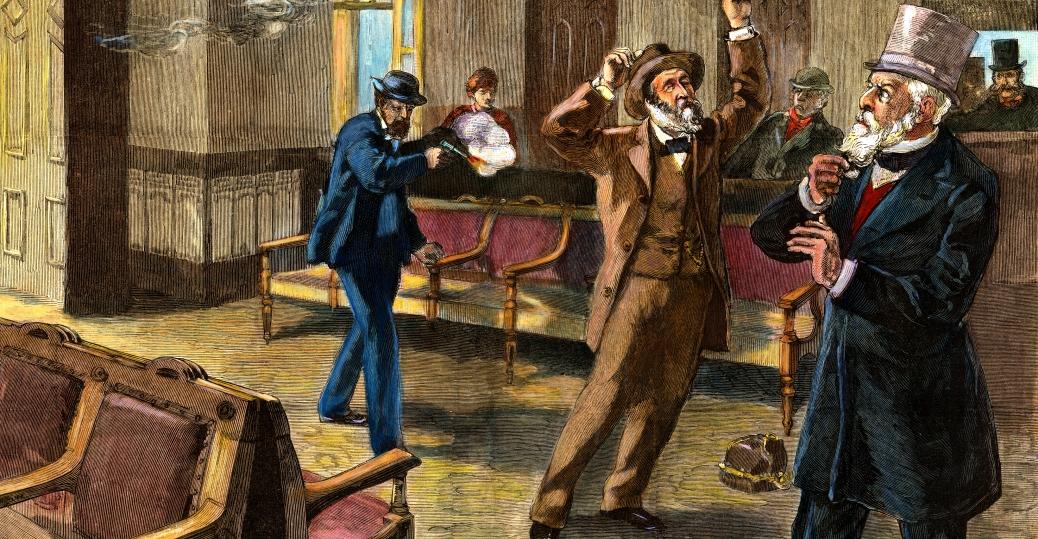 This NY Times article tells the fascinating story about the assassination of President James A Garfield in 1881 an exhibit commemorating the 125th anniversary of Garfield’s assassination at the National Museum of Health and Medicine at Walter Reed Army Medical Center.
President Garfield was shot in Washington by a disgruntled federal job-seeker, Charles J. Guiteau, who made his move while Garfield was waiting for a train. What is not as well-known is that neither of the shots that hit Garfield should have fatal even by the more primitive medical standards of the 1880’s.
As my late father once observed to me in a discussion of Presidential assassinations, “Garfield’s assassin just shot him. Garfield’s doctors killed him.”
The Times article reminds me of another interesting medical case that Dr. Donald J. DiPette, chair of the Department of Internal Medicine at Texas A&M University Medical School, presented earlier this year during the annual Walter M. Kirkendall Lecture that the University of Texas Medical School conducts in honor of my father.
Dr. DiPette’s lecture was about how advances in clinical research on hypertension had contributed to our understanding and knowledge of related chronic illness. He used a case study of a man in his mid-50’s in the late 1930’s who was showing signs of acute hypertension as an example of how that understanding can change the world.
The negative impact of hypertension on an individual’s health was not well-understood in the late 1930’s and 40’s. Dr. DiPette showed how the patient’s health in the case study deteriorated at an accelerated rate as his blood pressure readings increased markedly from 1937 to 1945. One evening in early 1940, the subject in the study fainted at the dinner table. The patient’s doctors at the time were unsure why.
By 1945, the patient — who was still working in an important and high-pressure job — had blood pressure that was off the charts and was experiencing a combination of associated medical problems that would have landed him in a hospital these days.
Nevertheless, the patient continued to work and, a couple of months after a particularly important work-related meeting, the patient died of a massive stroke.
Most times, the subjects of medical case studies are anonymous. But at the end of his lecture, Dr. DiPette revealed the name of the subject of this particular case study — President Franklin D. Roosevelt.
Dr. DiPette’s point was that President Roosevelt’s acute hypertension clearly affected his performance. Our lack of knowledge about hypertension in 1945 — which finally began to be better understood in the decade after FDR’s death — changed the course of the 20th century. That “important work-related meeting” that Dr. DiPette referred to was the Yalta Conference of early February 1945 that doomed Eastern Europe to over a generation of tyranny.
Remember that the next time you hear someone complain about the cost of advancing medical research.
 The NY Times Damon Hack, who is writing some of the best articles on golf in the mainstream media, weighs in on Tiger Woods’ British Open victory with this article that summarizes where Tiger stands in relation to the greatest golfers in history.
Woods, who is 30, won his 11th professional major championship (14th if you include his three straight US Amateur championships), which tied him with Walter Hagen and places him seven professional major victories behind Jack Nicklaus’ record of 18 majors. No one else stands between Woods and Nicklaus, and Nicklaus did not win his 11th professional major until he was 32.
After Nicklaus won seven professional majors by 1967, he had his biggest lull in his prime when he went the next 12 majors without a win, from the last two of ’67 through the first two of 1970. Nicklaus came back to win 10 more by the end of 1980, and then added on his sixth Masters in 1986 for his 18th.
In the best stretch of his professional career, Woods won seven majors in less than three years from the 1999 P.G.A. Championship at Medinah Country Club to the 2002 United States Open at Bethpage Black. Then, Woods went 10 majors without a victory between 2002 and 2005 as he went through an extensive swing change that flattened his swing plane, but with the victory over this past weekend, Woods has now won three of the last seven majors and will enter the final major of the year — the P.G.A. at Medinah in August — as the odd’s-on favorite again.