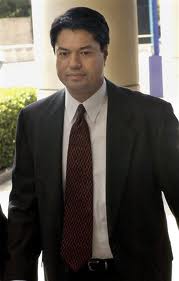
Somewhat lost amidst Phil Mickelson, Colin Montgomerie and Jim Furyk’s train-wrecks at the final hole of last weekend’s U.S. Open is the fact that Geoff Ogilvy, the winner of the tournament, is a quite interesting fellow and one of the rising stars on the PGA Tour.
As John Huggan observes in this excellent interview of the 29 year-old Austrailian, “Ogilvy has the potential to be just the sort of wise, high-profile spokesman the professional game needs if it is to rescue itself from the technological black hole into which it is currently headed.” For example, Huggan provides the following analysis from Ogilvy on the state of the modern game:
Two important aspects of golf have gone in completely the wrong direction. Most things are fine. Greens are generally better, for example. But the whole point of golf has been lost. Ben Hogan said it best. His thing was that you don’t measure a good drive by how far it goes; you analyse its quality by its position relative to the next target. That doesn’t exist in golf any more.
The biggest problem today is tournament organisers trying to create a winning score. When did low scores become bad? At what point did the quality of your course become dependent on its difficulty? That was when golf lost the plot. The winning score should be dictated by the weather.
The other thing is course set up. Especially in America there is too much rough and greens are way too soft. Then, when low scores become commonplace, they think how to make courses harder. So they grow even more long grass.
But that misses the point. There is no real defence against a soft green. Today’s players with today’s wedges can stop the ball from anywhere. The angle of attack and the shape of the shot mean nothing. It doesn’t matter where you hit it as long as it is between the out of bounds stakes or between the trees. And so the game becomes a one-dimensional test of execution, time after time after time.
And, as usual in matters pertaining to golf, there is a Houston connection to Ogilvy’s win at the U.S. Open. As you can see from the picture of Ogilvy’s swing above, Ogilvy has what is referred to in golf swing circles as a “one-plane swing,” while each of his main competitors in the U.S. Open — Mickelson, Montgomerie and Furyk — all use “two-plane swings” (Furyk’s idiosyncratic swing might be more like six planes). As noted in this earlier post, long-time Houston golf teaching pro Jim Hardy authored a ground-breaking golf swing instructional book last year that differentiated the one plane and two plane swings and explained that key principles of the two swings are much different. Although Hardy teaches both types of swing in his book, he prefers the one-plane swing for better players because it has fewer moving parts than the two-plane swing and, thus, is less dependent on timing and more consistent under the intense pressure of tournament golf. No better example of that observation could have been provided than the final hole of last weekend’s U.S. Open, where Ogilvy’s swing held up brilliantly while both Mickelson and Montgomerie’s swings broke down under the intense pressure of the moment.
Finally, you know that Ogilvy has finally arrived when he is the subject of David Letterman’s Top Ten List “Top Ten Things That Went Through Geoff Ogilvy’s Mind After Winning The U.S. Open.” My favorite is no. 10: “This is one of those things you never forget, like seeing John Daly in the locker room naked.”