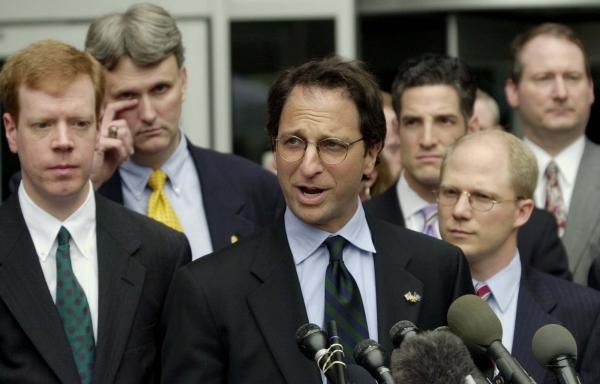
 In a development that is intriguing by its timing, Andrew Weissmann is resigning as director of the Justice Department’s Enron Task Force, reportedly to enter private practice, although that report has not been confirmed. Another Task Force prosecutor — Sean Berkowitz — replaces Mr. Weissman as the director of the Task Force. Mary Flood’s Chronicle article on Mr. Weissman’s resignation is here.
Mr. Weissman joined the Task Force three years ago to lead the prosecution team in the Task Force’s controversial prosecution of Arthur Andersen, which led to the giant accounting firm’s demise and the loss of 30,000 jobs in the United States alone. He has been head of the Task Force since early March, 2004 when he replaced Leslie Caldwell, who resigned to enter private practice.
Since its inception in early 2002, the Enron Task Force has been particularly adept at generating propaganda demonizing Enron and bludgeoning former Enron executives into plea bargains. Such bludgeoning is most commonly carried out through the Task Force’s threat of seeking absurdly long prison sentences for former Enron executives if they elect to defend themselves in a highly-charged atmosphere against anything having to do with Enron that the Task Force has flamed to its advantage.
The Task Force has been much less effective at actually proving its charges against former Enron executives in court, as only one former Enron executive — a mid-level manager in the Nigerian Barge case — has actually been tried and convicted of a crime in the Task Force’s three and a half year existence. The only other former Enron executive prosecuted in that trial — former mid-level accountant Sheila Kahanek — was acquitted.
The timing of Mr. Weissman’s resignation is unusual because it was announced as jury deliberations are ongoing in the first trial involving primarily former Enron executives, the Enron Broadband trial. That trial has not gone well for the the Task Force and that unexpected turn of events has occurred against a backdrop of recent setbacks and several troubling incidents of apparent prosecutorial misconduct within the Task Force.
The first blow to the Task Force came in the sentencing hearings of the four former Merrill Lynch executives and one former Enron executive who were convicted of fraud and conspiracy in the Nigerian Barge trial, a trial in which the Task Force chilled dozens of defense witnesses from testifying by its questionable tactic of fingering the witnesses as either unindicted co-conspirators or targets of the Enron criminal investigation.
During the sentencing hearings, U.S. District Judge Ewing Werlein, Jr. firmly denied the Task Force’s dubious arguments for draconian sentences against the barge defendants based on the alleged market effect of the relatively small transaction involved in that case. Judge Werlein was clearly disturbed by the fact that the Task Force’s arguments on the market effect of the transaction contradicted the position that the Justice Department had taken before the U.S. Supreme Court well before the Nigerian Barge sentencing hearings in the case that the Supreme Court later decided in Dura Pharmaceuticals v. Broudo.
The second setback for the Task Force came in the Supreme Court’s stunning reversal in a unanimous decision of the Task Force’s conviction of Arthur Andersen, which brought into clear focus the dubious nature of both the Task Force’s decision to put Andersen out of business and the specious arguments that the Task Force used in criminalizing Andersen’s legitimate docket retention policy.
Next, during the Enron Broadband trial, a series of almost brazen examples of prosecutorial misconduct began to to unfold. First, the Task Force elicited false testimony from its key witness, former Enron Broadband co-CEO Ken Rice. Then, after that mistake, two witnesses (Beth Stier and Lawrence Ciscon) testified that, based on discussions with the Task Force before their testimony, they both felt threatened by a possible indictment if they testified on behalf of the Broadband defendants.
Finally, toward the close of the trial, U.S. District Judge Vanessa Gilmore sharply rebuked an Enron Task Force prosecutor for asking a question on cross-examination of Broadband defendant Kevin Howard that, if not in direct violation of a pre-trial order directing attorneys not to refer to certain subjects during the trial, at least violated the judge’s prior instructions to the Task Force prosecutors.
Finally, in arguably the most serious indication of prosecutorial misconduct within the Enron Task Force, U.S. District Judge Sim Lake recently issued an ex parte order in the Task Force’s “legacy case” against former Enron chairman Ken Lay, former CEO Jeff Skilling and former chief Enron accountant Richard Causey based on an ex parte motion that Messrs. Lay, Skilling and Causey had filed filed with the court under seal.
Without revealing the contents of the ex parte motion, Judge Lake ruled that he had concluded that the defendants had established a prima facie case of entitlement to subpoena under Fed. R. Crim. P. 17(c) all evidence relating to communications between the Enron Task Force and the 15 former Enron employees who have pled guilty under plea arrangements with the Enron Task Force.
Although the contents of the ex parte motion is a closely-guarded secret of the defense teams of Messrs. Lay, Skilling and Causey, speculation is rampant among Houston attorneys involved in the Enron case that the defendants had provided Judge Lake with compelling evidence that the Enron Task Force was threatening potential defense witnesses in the Lay-Skilling-Causey trial with criminal charges that could result in long prison sentences if the witnesses testified on behalf of the defendants. In a separate recent court filing, the Skilling defense team observed that “[t]he Task Force has taken control of the witnesses in this case to an unprecedented and impermissible degree. Witnesses will not meet or speak with us for fear of reprisal.”
Consequently, count me as tad skeptical of the “official” reason given for Mr. Weissman’s resignation during jury deliberations in the Broadband trial. In view of the foregoing setbacks and prosecutorial misconduct it would not be surprising if the Task Force’s superiors at the Department of Justice had simply decided that Mr. Weissman’s removal was advisable and that any further delay in naming a new director could adversely affect the Task Force’s preparations for its legacy case against Messrs. Lay, Skilling and Causey.
If that move results in a more judicious Task Force approach to the remaining Enron-related prosecutions, then perhaps at least a small part of the serious injustice that the Enron Task Force’s demonization of Enron has heaped on innocent businessmen and their families can still be corrected.
Like this:
Like Loading...

 President Bush’s selection of D.C. appellate judge John G. Roberts Jr. to replace Sandra Day O’Connor on the U.S. Supreme Court is a solid one and should not lead to much of a confirmation fight. As noted in this post from earlier this year, Judge Roberts was my favorite candidate for one of the Supreme Court openings, a superb thinker and writer while on the D.C. Court of Appeals.
 In
In 