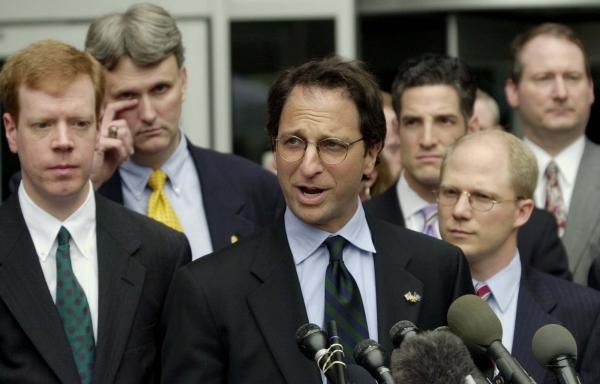
 I was at the Federal Courthouse yesterday for a late morning hearing and decided to stick around and pop into an early afternoon status conference in the government’s biggest Enron-related criminal case — that is, the case against former Enron chairman Ken Lay, former Enron CEO Jeff Skilling and former Enron chief accountant Richard Causey. As with my decision to attend this earlier hearing, I’m glad I decided to stick around. What appeared to be a routine status conference turned out to be anything but.
Midway through the conference, U.S. District Judge Sim Lake announced from the bench that he had received an ex parte motion from the defendants that had been filed under seal. Without revealing the contents of the motion, Judge Lake stated that he had concluded that the defendants had established a prima facie case of entitlement to the relief that they were requesting in the motion, which he disclosed was the right to subpoena under Fed. R. Crim. P. 17(c) all evidence relating to communications between the Enron Task Force and the 15 former Enron employees who have pled guilty under plea arrangements with the Enron Task Force.
Judge Lake stated that he would first review all documents and records produced in camera and then turn over to both defendants and the prosecution copies of all documents and records that are relevant to the issues raised by the motion.
As a clearly unsettled Enron Task Force prosecution team looked on, Judge Lake went on to authorize the defendants specifically to issue subpoenas for evidence of all communications with the Task Force to the 19 attorneys who have represented the 15 former employees in negotiating their plea arrangements with the Task Force.
When the Task Force prosecutor raised a flustered objection to the ruling and requested an opportunity to respond to the defendants’ ex parte motion, Judge Lake summarily overruled the objection and stated that he was persuaded by the defendants’ motion that the relief was justified. Chronicle Enron reporter Mary Flood’s article on the status conference is here.
So, the $64,000 question is this — what on earth is in the ex parte motion of Messrs. Skilling, Lay and Causey that would prompt Judge Lake to grant this rather extraordinary relief without so much as a response from the Enron Task Force?
Although the motion remains under seal and is not available for public review, my speculation is that the motion is focused on the Enron Task Force’s dual tactics of threatening potential defense witnesses in the Enron-related criminal trials with indictment if they testify and bludgeoning former Enron employees to enter into plea arrangements under which they would provide favorable but false testimony in prosecutions of other Enron-related defendants.
That speculation is supported by recent revelations in connection with Enron-related criminal cases. First, several key defense witnesses in the Nigerian Barge case declined to testify on Fifth Amendment grounds because the Task Force had fingered them as targets of the Enron criminal investigation. Then, former Enron Broadband engineer Lawrence Ciscon dramatically testified earlier in the ongoing Enron Broadband trial that Enron Task Force prosecutors had repeatedly threatened him and had fingered him as a target of an indictment in attempting to dissuade him from testifying on behalf of the five Enron Broadband defendants.
Moreover, former Enron Broadband co-CEO Ken Rice testified falsely during the prosecution’s case-in-chief in the Broadband trial after entering into a plea arrangement with the Task Force, and that false testimony was followed by testimony from another witness that she felt threatened by the Task Force in connection with her testimony regarding Rice’s false testimony.
Finally, the Task Force has set a dubious record by naming 114 co-conspirators in the Skilling-Lay-Causey case, which is just another transparent attempt to chill potential defense witnesses from testifying during the upcoming trial in that case.
Consequently, watch this development closely. The Enron Task Force has been quite successful in the court of public relations in painting anyone having anything to do with Enron as a criminal.
However, in actually having to prove its allegations in court (as Professor Ribstein notes in this post from yesterday), the Task Force has been far less successful and now it appears that at least one federal judge is openly skeptical of the tactics that the Task Force has been using to deter defense witnesses from testifying and to generate dubious testimony under plea arrangements.
That government prosecutors believe that they cannot prevail in their prosecutions of Enron-related criminal defendants without engaging in such troubling tactics is more strong evidence that the government’s policy of criminalizing business transactions has gone seriously awry.
Like this:
Like Loading...

 With Supreme Court Justice Sandra Day O’Connor’s resignation announcement this morning, the SCOTUSblog provides the following handy profiles of some of the leading replacement candidates: