
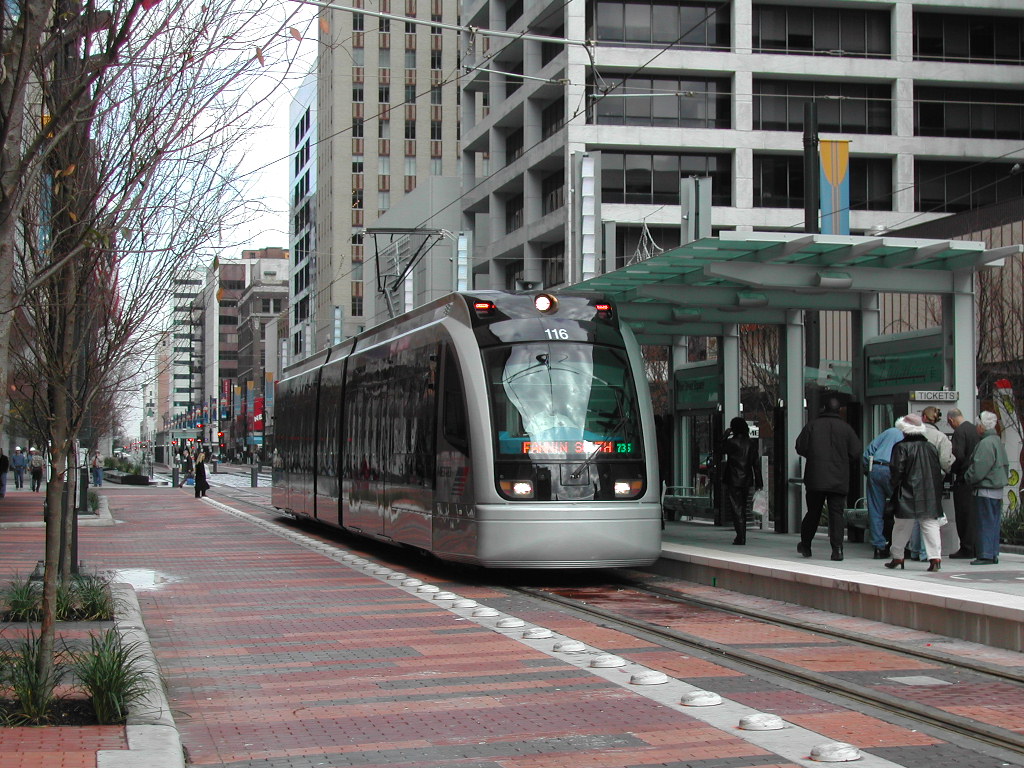
 Tory Gattis (Houston Strategies) recently authored this insightful post that explores the vexing question of why many people passionately support light rail in the face of the overwhelming economic arguments against it?
Tory concludes that it has something to do with an unexpressed human psychological need to be liked — sort of like, “Here, check out and play with my light rail toy, and you will probably think better of me.”
Tory is clearly on to something in that there appears to be an element of a civic inferiority complex underlying some folks’ support for light rail. However, Tory’s point still does not explain why people who need mass transit the most — i.e., folks who cannot afford the cost of buying and maintaining a car — support light rail, which certainly does not improve their mobility and, by drawing resources away from mobility projects that would, probably harms it.
My sense is that that question lies somewhere between the human demand for entitlement and lack of viable choices.
As previously noted on this blog, the true economic benefit of light rail is highly concentrated in only a few interest groups — political representatives of minority communities who tout the political accomplishment of shiny toy rail lines while ignoring their constituents need for more effective mass transit, environmental groups that are striving for political influence, construction-related firms that feed at the trough of light rail projects, and private real estate developers who enrich themselves through the increase in their property values along the rail line.
Inasmuch as none of these reasons for mass transit appeal to the part of the electorate who actually need mass transit, this amalgamation of interest groups continues to disguise their true interests behind amorphus claims that the uneconomic rail lines reduce traffic congestion (they do not), curb air pollution (they do not), or improve the quality of life (at least debatable). The literature on all this is public and volumnious — check out demographia.com, cascadepolicy.org, and americandreamcoalition.org.
So, how do these interest groups get away with this? The costs of such systems are widely dispersed among the local population of an area such as Houston, so the many who stand to lose will lose only a little while the few who stand to gain will gain a lot.
As a result, these small interest groups recognize that it is usually not worth the relatively small cost per taxpayer for most citizens who do not use mass transit to spend any substantial amount of time or money lobbying or simply taking the time to vote against an uneconomic rail system.
Meanwhile, the light rail interest groups garner support for light rail from the part of the electorate that actually needs mass transit by simultaneously limiting the mass transit choices and threatening that part of the electorate with loss of the governmental funds for mass transit if they fail to support light rail.
Thus, a referendum on mass transit issues is never promoted with choices between alternatives such as a light rail system, one one hand, and a cheaper and more effective bus-based system system, on the other. It’s simply an “all or nothing” choice, and folks who need mass transit will understandably vote in favor of getting their share of public transportation funds even if it does not improve their mobility one iota.
Indeed, given the cost of light rail systems, one wonders how those citizens who actually need mass transit would vote if the alternative were a light rail system, on one hand, and a new Toyota Prius for each such citizen, on the other? Frankly, the cost of the latter alternative would likely be cheaper than most any light rail plan.
So, at the end of the day, where does that leave us? Is it wrong that people who need mass transit vote in favor of something that does not really address their needs? No, it does not, but it troubles me when they are misled in doing so.
As Anne Linehan and Kevin Whited (blogHouston.net) have repeatedly pointed out, a part of Metro’s pitch for its light rail plan was that light rail would enhance Metro’s bus system and service. Inasmuch as that representation has turned out to be patently false, it seems reasonable that our public officials should at least be required to point out publicly that Metro’s most utilized and efficient mass transit system — i.e., the bus system — will likely continue to erode as Metro continues to invest heavily in light rail.
In the meantime, it would also be nice if public officials would admit publicly that the usual economic justifications for light rail are also dubious. If mass transit users and other citizens want to allow Houston’s public officials to continue to throw money at a light rail system in the face of the economic truth about such a system, then I can live with that result despite my compassion for those citizens who are not being provided the mass transit that they need.
But at least let’s require truth in advertising in connection with having citizens vote on such matters.
A similar sentiment is shared in this interesting Owen Courreges post (Lone Star Times) in which he takes the Chronicle to task for suggesting that Metro’s political opposition — rather than Metro itself — is misleading the public about Metro’s expanded light rail plan.
Finally, Tory points out that we should take some comfort in the fact that Houston’s light rail plan is at least not as big an economic boondoggle as similar plans proposed for Seattle and Denver. Similarly, a couple of commentators to Tony’s post chime in that the marginal cost of the light rail system to Houston area citizens is relatively small for a civic asset that will impress citizens and visitors alike for many years to come. That latter point may have some validity, but let’s make sure that we are talking about the correct marginal cost.
A big difference between the light rail system and the publicly-funded stadiums that Houston has built over the past several years are that the stadiums have tenants who pay the vast majority of the cost of maintaining the facilities.
In comparison, Metro’s light rail system does not come close to generating enough revenue to pay its ongoing costs, as was brought home by Metro’s recent announcement of desultory operating results coupled with the expenditure of $104 million more on the three-year-old rail line to fix problems caused by construction errors and add more rail cars.
In that regard, even the $1.5 million that Harris County spends annually to mothball the Astrodome pales in comparison to underwriting the ongoing cost of the light rail system.
The bottom line is that light rail systems eat voraciously, and any analysis of the true marginal cost of such a system to citizens has to take into consideration the high cost of feeding that appetite.

