President nominates a Clear Thinkers favorite for the Supreme Court

supreme court building4.jpgPresident Bush’s selection of D.C. appellate judge John G. Roberts Jr. to replace Sandra Day O’Connor on the U.S. Supreme Court is a solid one and should not lead to much of a confirmation fight. As noted in this post from earlier this year, Judge Roberts was my favorite candidate for one of the Supreme Court openings, a superb thinker and writer while on the D.C. Court of Appeals.
Stuart Buck passes along notes that, before Judge Roberts took the bench, Justice Scalia told one of Stuart’s friends that he and several other Supreme Court Justices thought that Roberts was the best Supreme Court litigator in the country. The reason? Because he never became flustered during questioning and was always able to answer any question calmly while skillfully weaving in the substantive points that he wanted to make in the first place. As usual, the SCOTUS Blog has a fine compendium of resources on the Roberts nomination, including this post that reviews some of his decisions while on the D.C. Court of Appeals.
My sense is that the nomination of Judge Roberts means that there is a good chance that President Bush intends to nominate a woman to replace Chief Justice Rehnquist when he retires as expected in the near future. Hopefully, Houstonian and Fifth Circuit Judge Edith H. Jones will be in the running for that nomination.

The Illusory Attorney-Client Privilege

In this timely post, White Collar Crime Prof Peter Henning notes a recent Fourth Circuit decision that bears on an increasingly knotty issue in this post-Enron era of criminalizing business — that is, an employee’s waiver of the attorney-client privilege for statements made during a conference with an employer’s attorneys.

In this particular case, the employees contended that their employer’s lawyers led them to believe that they had entered into an attorney-client relationship with the employer’s lawyers so that the employer’s subsequent waiver of the privilege did not affect their personal right to maintain the confidentiality of their statements made to the lawyers. At the outset of the employees’ interviews with the employer’s lawyers, each of them received the following reassurance — er, I mean “warning” — from the employer’s lawyers:

“We represent the company. These conversations are privileged, but the privilege belongs to the company and the company decides whether to waive it. If there is a conflict, the attorney-client privilege belongs to the company. We can represent [you] until such time as there appears to be a conflict of interest, [but] . . . the attorney-client privilege belongs to [the employer] and [the employer] can decide whether to keep it or waive it.”

As Professor Henning notes, the second part of the above instruction is incorrect in that a client under a valid joint representation continues to hold the privilege and another party to that joint representation cannot waive it unilaterally. At any rate, after completing its investigation, the employer waived its attorney-client and attorney work product privileges in attempting to obtain a deferred prosecution agreement and avoid the fate of Arthur Andersen (see also AIG, Berkshire Hathaway and KPMG for recent examples of this dubious corporate trend).

At any rate, the Fourth Circuit rejected the employees’ argument that they had entered into an attorney-client relationship with the employer’s lawyers by reasoning essentially that a statement that the employer’s lawyers “can” represent the employees is not the same as actually representing them.

Thus, employees beware. Even though the assertion of the Fifth Amendment privilege in connection with an employer’s internal investigation will likely result in the employee being fired, the alternative could be far worse — that is, your employer giving prosecutors of questionable judgment your statements to use in prosecuting you for an alleged crime that you performed while performing your job for your employer.

The sad case of Jamie Olis is a stark example of the damage to employees’ lives and their families that can result from an employee unwittingly waiving his attorney-client privilege.

The Lord of Regulation’s turf wars

Spitzer30.jpgAs noted in earlier posts here and here, New York attorney general Eliot Spitzer does not take kindly to other governmental agencies infringing on his various crusades to demonize wealthy business interests in his seemingly unending quest to promote his political career. But at least he previously maintained the public front of cooperation with other governmental investigators.
But now, as this Washington Post article notes, the Lord of Regulation is no longer maintaining even the pretense of cooperation with other governmental investigators. Apparently, the interagency squabbles were intensified by news leaks from Mr. Spitzer’s office of a high-profile April 11 interview of Warren E. Buffett. Mr. Buffett’s Berkshire Hathaway, Inc., is the parent of General Re Corp., which is the company that — along with AIG and other insurers — is the subject of a criminal investigation into structured finance transactions known as finite risk reinsurance. Here are the previous posts on the various investigations into AIG and Berkshire’s General Re.
Mr. Spitzer did not help relations with his federal counterparts when, as a part of his usual propaganda campaign that parallels his various criminal investigations, he blasted the Department of Justice in a speech on May 2 for failing to investigate allegedly illegal practices in the insurance industry. Now, the feud between Mr. Spitzer’s office and federal investigators has heated to the point where prosecutions of various targeted executives could be compromised.
It would be sweet justice if Mr. Spitzer’s ambition and pride undermines criminal investigations and prosecutions of business executives that never should have been inititated in the first place.

Weissman steps down as Enron Task Force chief

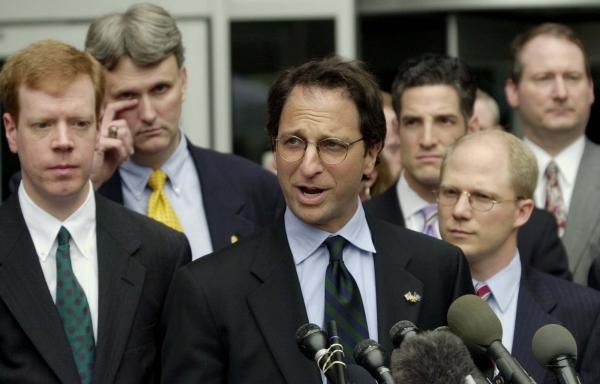
In a development that is intriguing by its timing, Andrew Weissmann is resigning as director of the Justice Department’s Enron Task Force, reportedly to enter private practice, although that report has not been confirmed. Another Task Force prosecutor — Sean Berkowitz — replaces Mr. Weissman as the director of the Task Force. Mary Flood’s Chronicle article on Mr. Weissman’s resignation is here.

Mr. Weissman joined the Task Force three years ago to lead the prosecution team in the Task Force’s controversial prosecution of Arthur Andersen, which led to the giant accounting firm’s demise and the loss of 30,000 jobs in the United States alone. He has been head of the Task Force since early March, 2004 when he replaced Leslie Caldwell, who resigned to enter private practice.

Since its inception in early 2002, the Enron Task Force has been particularly adept at generating propaganda demonizing Enron and bludgeoning former Enron executives into plea bargains. Such bludgeoning is most commonly carried out through the Task Force’s threat of seeking absurdly long prison sentences for former Enron executives if they elect to defend themselves in a highly-charged atmosphere against anything having to do with Enron that the Task Force has flamed to its advantage.

The Task Force has been much less effective at actually proving its charges against former Enron executives in court, as only one former Enron executive — a mid-level manager in the Nigerian Barge case — has actually been tried and convicted of a crime in the Task Force’s three and a half year existence. The only other former Enron executive prosecuted in that trial — former mid-level accountant Sheila Kahanek — was acquitted.

The timing of Mr. Weissman’s resignation is unusual because it was announced as jury deliberations are ongoing in the first trial involving primarily former Enron executives, the Enron Broadband trial. That trial has not gone well for the the Task Force and that unexpected turn of events has occurred against a backdrop of recent setbacks and several troubling incidents of apparent prosecutorial misconduct within the Task Force.

The first blow to the Task Force came in the sentencing hearings of the four former Merrill Lynch executives and one former Enron executive who were convicted of fraud and conspiracy in the Nigerian Barge trial, a trial in which the Task Force chilled dozens of defense witnesses from testifying by its questionable tactic of fingering the witnesses as either unindicted co-conspirators or targets of the Enron criminal investigation.

During the sentencing hearings, U.S. District Judge Ewing Werlein, Jr. firmly denied the Task Force’s dubious arguments for draconian sentences against the barge defendants based on the alleged market effect of the relatively small transaction involved in that case. Judge Werlein was clearly disturbed by the fact that the Task Force’s arguments on the market effect of the transaction contradicted the position that the Justice Department had taken before the U.S. Supreme Court well before the Nigerian Barge sentencing hearings in the case that the Supreme Court later decided in Dura Pharmaceuticals v. Broudo.

The second setback for the Task Force came in the Supreme Court’s stunning reversal in a unanimous decision of the Task Force’s conviction of Arthur Andersen, which brought into clear focus the dubious nature of both the Task Force’s decision to put Andersen out of business and the specious arguments that the Task Force used in criminalizing Andersen’s legitimate docket retention policy.

Next, during the Enron Broadband trial, a series of almost brazen examples of prosecutorial misconduct began to to unfold. First, the Task Force elicited false testimony from its key witness, former Enron Broadband co-CEO Ken Rice. Then, after that mistake, two witnesses (Beth Stier and Lawrence Ciscon) testified that, based on discussions with the Task Force before their testimony, they both felt threatened by a possible indictment if they testified on behalf of the Broadband defendants.

Finally, toward the close of the trial, U.S. District Judge Vanessa Gilmore sharply rebuked an Enron Task Force prosecutor for asking a question on cross-examination of Broadband defendant Kevin Howard that, if not in direct violation of a pre-trial order directing attorneys not to refer to certain subjects during the trial, at least violated the judge’s prior instructions to the Task Force prosecutors.

Finally, in arguably the most serious indication of prosecutorial misconduct within the Enron Task Force, U.S. District Judge Sim Lake recently issued an ex parte order in the Task Force’s “legacy case” against former Enron chairman Ken Lay, former CEO Jeff Skilling and former chief Enron accountant Richard Causey based on an ex parte motion that Messrs. Lay, Skilling and Causey had filed filed with the court under seal.

Without revealing the contents of the ex parte motion, Judge Lake ruled that he had concluded that the defendants had established a prima facie case of entitlement to subpoena under Fed. R. Crim. P. 17(c) all evidence relating to communications between the Enron Task Force and the 15 former Enron employees who have pled guilty under plea arrangements with the Enron Task Force.

Although the contents of the ex parte motion is a closely-guarded secret of the defense teams of Messrs. Lay, Skilling and Causey, speculation is rampant among Houston attorneys involved in the Enron case that the defendants had provided Judge Lake with compelling evidence that the Enron Task Force was threatening potential defense witnesses in the Lay-Skilling-Causey trial with criminal charges that could result in long prison sentences if the witnesses testified on behalf of the defendants. In a separate recent court filing, the Skilling defense team observed that “[t]he Task Force has taken control of the witnesses in this case to an unprecedented and impermissible degree. Witnesses will not meet or speak with us for fear of reprisal.”

Consequently, count me as tad skeptical of the “official” reason given for Mr. Weissman’s resignation during jury deliberations in the Broadband trial. In view of the foregoing setbacks and prosecutorial misconduct it would not be surprising if the Task Force’s superiors at the Department of Justice had simply decided that Mr. Weissman’s removal was advisable and that any further delay in naming a new director could adversely affect the Task Force’s preparations for its legacy case against Messrs. Lay, Skilling and Causey.

If that move results in a more judicious Task Force approach to the remaining Enron-related prosecutions, then perhaps at least a small part of the serious injustice that the Enron Task Force’s demonization of Enron has heaped on innocent businessmen and their families can still be corrected.

Feinstein on Nicklaus and Woods

nicklaus.jpgIn this Washington Post column, noted author and columnist John Feinstein comments on Jack Nicklaus’ farewell to the British Open and, in so doing, observes that 2005 British Open champion Tiger Woods — while likely to break Nicklaus’ record of winning 18 major championships — has a much more difficult task ahead of him in equaling Nicklaus’ qualities as a champion:

Woods seems to think that Nicklaus’s legacy is only about numbers, that winning golf tournaments is the only thing that measures a champion. Nothing could be further from the truth, especially in golf.
Woods already holds many records. One of them, which is unofficial, is that he has been fined for using profanity publicly more than any player in history. While using profanity in the crucible of competition is hardly a great crime, it is indicative of Woods’s attitude that, rather than try to curb his use of language, he has complained that he is being treated unfairly since there are always microphones following him when he plays. Last month, during the U.S. Open, Woods missed a putt and childishly dragged his putter across the green, damaging it as he did so. When he was asked about the incident later, he shrugged and said, “I was frustrated,” (no apology) as if he was the only player among 156 dealing with frustration. In recent years he has allowed his caddie, Steve Williams, to frequently treat spectators and members of the media rudely, not only defending him but also appearing to sanction his misbehavior.

Continue reading

Why they hate us

Faith at War.jpgYaroslav Trofimov is a Wall Street Journal reporter from the Ukraine who is fluent in Arabic. While carrying an Italian passport, Mr. Trofimov traveled through the Middle East recently interviewing Muslims for his new book, Faith at War : A Journey on the Frontlines of Islam, from Baghdad to Timbuktu (Henry Holt and Co. 2005).
In this NY Times Book Review, reviewer Philip Caputo notes that many of Mr. Trofimov’s encounters led him to the conclusion that poverty is not the root cause of Islamic extremism. More often than not, the most radical ideas regarding Western civilization came from the relatively wealthy and privileged who had experience with the West, not the downtrodden who are typically cast as the primary source of Muslim animus toward the West. One anecdotal experience is particularly telling:

On [Mr. Trofimov’s] first stop, Cairo, undergraduates dining in a McDonald’s a few days after 9/11 demonstrate that it’s possible to delight in a Big Mac and in the fiery deaths of 3,000 Americans at the same time. “Everyone celebrated,” an 18-year-old university student gushes as she dips her fries into ketchup, “cheering that America finally got what it deserved.”

DFW’s new Terminal D

Terminal D.jpgThis U.S.A. Today article does a nice job of reporting on the opening later this week of Dallas/Fort Worth International Airport’s massive new international Terminal D, a $1.4 billion, 28-gate terminal that includes a Grand Hyatt Hotel and the latest features designed to move passengers with comfortable efficiency.
However, as the article points out, whether the new terminal is actually needed is far from a settled issue. The Terminal D project is part of a massive $2.7 billion airport expansion that is the biggest Texas airport construction project ever, and the tenant airlines’ cost per passenger will nearly double when the terminal opens. Although that’s about an average increase in comparison with other increases resulting from recent terminal construction projects at major airports, it’s still no bargain.
If that’s not enough, the new terminal is opening at a time in which DFW has an excess-capacity problem. When construction started five years ago, but now 19 of 37 gates in DFW’s terminal E are empty, and more will be emptied when some remaining carriers there move into the new Terminal D. Even though airlines will use nearly all of terminal D’s gates when it opens, the terminal will initially operate at only about 50% of capacity.
All of which makes me very appreciative of Houston’s relatively efficient and far less costly airports.

That’s one helluva hangover

hangover.jpgWith Enron and other business scandals, it’s been a bit difficult to keep up with the ongoing grand jury investigation in Boston into whether mutual fund employees improperly accepted gifts or entertainment from brokers. Fidelity Investments has already disciplined 16 traders over matters relating to the investigation and five employees have left the company.
But even a grand jury investigation is merely a prelude for this Wall Street Journal ($) article that reports on the grand jury’s investigation into the details of the bachelor party of former Fidelity star trader Thomas Bruderman, who happened to be marrying the daughter of former Tyco International CEO Dennis Kozlowski. Small world, eh?

Continue reading

Professor Hamilton reviews the week in oil prices

oil_well5.jpgEven before he started his smart blog recently, Professor James D. Hamilton of the University of California at San Diego was one of my favorite experts on the economics of energy prices (previous posts here).
In this post, Professor Hamilton reviews several interesting tidbits of information that affect oil prices, which declined 5% last week. Of particular note — the futures market currently allows for a purchase of oil for delivery in December, 2011 for under $55 a barrel.

The risk of rising U.S. debt

foreign debt.gifAwhile back, this post made the point that, rather than focusing on CNOOC’s bid to overpay for a second tier U.S. oil & gas company such as Unocal, the real issue that needs to be addressed is that American society is currently impoverishing future generations of Americans by accumulating more debt.
Picking up on that issue, James D. Hamilton provides this insightful analysis that explains why the issue is not the amount of debt that foreigners hold, but the low U.S. saving rate. As noted earlier, the effect of Unocal’s bid on Chevron and Unocal is a much narrower issue.
