
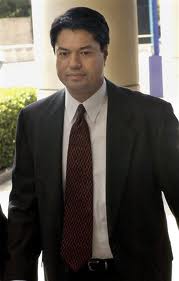
Jamie Olis Seeks Another Chance

A little over a month after I started this blog back in early 2004, former Dynegy executive Jamie Olis was sentenced to over 24 years in prison for allegedly cooking Dynegy’s books.

That shocking sentence aroused my interest in the Olis case, so I have followed Olis’ ordeal closely for going on four years.

The tremors from the Olis sentence have been enormous, not the least of which was its impact on various defendants who entered into plea bargains in the Enron-related criminal cases rather than risk a similar quasi-life sentence.

Despite my interest in the Olis case, I have been somewhat frustrated over the years by the lack of available public information regarding the evidence of Olis’ alleged criminal acts. Olis had already been convicted before I even found out about his case, so I didn’t follow his trial and don’t know much about what was presented during it.

However, I do know that the structured finance transaction that was the basis of the charges against Olis — nicknamed “Project Alpha” — was not a particularly unusual transaction for a large company such as Dynegy at the time. I also knew that the transaction had been approved by dozens of accountants and lawyers both inside and outside of Dynegy.

From my experience in defending several former Enron executives, I also knew that government prosecutors neither understood nor cared much to understand the complex structured finance transactions in which companies such as Enron and Dynegy commonly engaged.

Rather, prosecutors knew that obtaining a conviction against business executives in the aftermath of Enron was like shooting fish in a barrel, so it became common for them to criminalize legitimate business transactions where it was far from clear that anything was wrong with the transaction in the first place.

To the extent such transactions should have been subject to litigation at all, they should have been subject solely to civil litigation where the liability for the alleged wrongdoing could be allocated fairly among the dozens of individuals or companies commonly involved in approving such transactions.

So it was with great interest that I read a legal memorandum in support of a motion to set aside Olis’ conviction that a new group of lawyers (including, interestingly, Houston plaintiffs’ lawyer, John O’Quinn) representing Olis filed late last week with U.S. District Judge Sim Lake (Chronicle business columnist Loren Steffy published a copy of the memorandum in a blog post over the weekend and Chronicle legal columnist Mary Flood followed up with a Monday blog post here).

The memorandum is the first document that has been filed in the Olis case that lucidly explains how — as I’ve long suspected — it was far from clear that there was anything wrong with Project Alpha and even farther from clear that Olis had anything to do with any alleged criminal conduct.

Knowing this, the prosecution veered away from its original charges against Olis and ultimately prosecuted him at trial over a “hide the real deal” theory that was entirely different from the one contained in the Olis indictment.

As it turns out, Olis didn’t really hide anything and there is substantial evidence to support his disclosures. However, the Olis’ defense at trial was limited when Dynegy quit funding it as a result of the government’s threat “to go Arthur Andersen” on the company.

Thus, Olis’ defense counsel was overwhelmed and did not find the exculpatory evidence, which the Olis team did not discover until Olis’ lawyer sued Dynegy and recovered a substantial money judgment for failing to fulfill its obligation to fund the Olis criminal defense. The ordeal that Olis and his family have suffered over the past four years is the result of this travesty.

Credit Steffy for getting it right in his blog post calling for Olis’ release from prison (related column here).

However, Steffy’s call for justice in the Olis case is ironic in that he bears a substantial portion of the responsibility for flaming the poisonous anti-business climate in Houston that led to brutal injustices such as the Olis case in the first place.

Let’s remember that the next time someone starts inciting an angry mob.

Kolata on Good Calories, Bad Calories

Good%20calories%2C%20bad%20calories.jpgNY Times nutrition columnist Gina Kolata (previous posts here) reviews Gary Taubes’ new book, Good Calories, Bad Calories: Challenging the Conventional Wisdom on Diet, Weight Control and Disease (Knopf September, 2007), which was previewed earlier here. Kolata observes:

His thesis, first introduced in a much-debated article in The New York Times Magazine in 2002 challenging the low-fat diet orthodoxy, is that nutrition and public health research and policy have been driven by poor science and a sort of pigheaded insistence on failed hypotheses. As a result, people are confused and misinformed about the relationship between what they eat and their risk of growing fat. He expands that thesis in the new book, arguing that the same confused reasoning and poor science has led to misconceptions about the relation between diet and heart disease, high blood pressure, cancer, dementia, diabetes and, again, obesity. When it comes to determining the ideal diet, he says, we have to ìconfront the strong possibility that much of what weíve come to believe is wrong.î [. . .]
Taubes convincingly shows that much of what is believed about nutrition and health is based on the flimsiest science. To cite one minor example, thereís the notion that a tiny bit of extra food, 50 or 100 calories a day ó a few bites of a hamburger, say ó can gradually make you fat, and that eating a tiny bit less each day, or doing something as simple as walking a mile, can make the weight slowly disappear. This idea is based on a hypothesis put forth in a single scientific paper, published in 2003. And even then it was qualified, Taubes reports, by the statement that it was ìtheoretical and involves several assumptionsî and that it ìremains to be empirically tested.î Nonetheless, it has now become the basis for an official federal recommendation for obesity prevention.
But the problem with a book like this one, which goes on and on in great detail about experiments new and old in areas ranging from heart disease to cancer to diabetes, is that it can be hard to know what has been left out. [. . .[
. . . I kept wondering how he would deal with an obvious question. If low-carbohydrate diets are so wonderful, why is anyone fat? Most people who struggle with their weight have tried these diets and nearly all have regained everything they lost, as they do with other diets. What is the problem?
On Page 446, he finally tells us. Carbohydrates, he says, are addictive, and weíve all gotten hooked. Those who try to break the habit start to crave them, just as an alcoholic craves a drink or a smoker craves a cigarette. But, he adds, if they are addictive, that ìimplies that the addiction can be overcome with sufficient time, effort and motivation.î
Iím sorry, but Iím not convinced.

John Tierney comments, too.

An interesting variation on the Nigerian email scam

luciano-pavarotti1.jpgI’ve had my email address for a long time, so I get a receive a lot of spam, which I ignore.
However, I thought I’d already seen every possible variation of the Nigeriam email scam imaginable, but I have to admit the one below that I received a few days ago is more imaginative than most:

From: rebzxxxxxxxxxxxx@peoplepc.com
Luciano Pavarotti (Next Of Kin)
Dear Sir,
My writing to you should be surprising but itís not a mistake because I believe that I could confide in you on this business deal which would be highly beneficial to both of us only that you should promise me that you would not disappoint me at the conclusion of this deal. The main reason why I am contacting you today is to seek your assistance but firstly let me introduce myself before proceeding to the purpose of this letter.
I am Graham Robson Wallace from London in the United Kingdom and I worked as a personal assistant and attorney to one Luciano Pavarotti who died of pancreatic cancer on the September 06, 2007. I was so close to him that on the 27th of June 2005, before his untimely death, he deposited the sum of Thirty-Seven Million Dollars (US$37M) in the custody of a Security Company in London and Holland and this deposit was made known to me alone. The problem now is that these Security Company has written to me few days ago requesting that I provide the beneficiary and next of kin to the deposited fund hence the real depositor is dead.
I would have claimed the money but the company already knows me as the late Luciano Pavarotti’s attorney and personal assistant. So that is why I am contacting you just to present you as the bonafide beneficiary and next of kin to the said fund and I would provide all necessary documents to back up the claim but you must promise me that you wonít disappear into tin air by the time the fund is remitted into you account and also bare in mind that you would be entitled to 35% of the said fund, though the percentage sharing is negotiable.
Please signify your interest by providing me the following: This is to enable me commence immediate preparation of all legal document that will back up our claim.
1. Full Name :
2. Your Telephone Number and Fax Number
3. Your Contact Address.
Your urgent response will be highly appreciated.
Best regards,
Mr. Graham R. Wallace

Based on this earlier post about the late Pavarotti, it doesn’t sound as if he had $37 million laying around to give to Mr. Wallace. ;^)