2007 Weekly local football review

Jones-Drew.jpg(AP Photo/Phil Coale)(previous weekly reviews here)
Jaguars 37 Texans 17

The conventional mainstream media wisdom coming into the Texans’ (3-3) game this weekend at Jacksonville (4-1) was that the Texans’ lagging rushing attack would be revived by the return of injured RB Ahman Green. Well, after Green ran for a total of 44 yards on 16 carries and failed to get in the end zone twice from the 2 yard line on the Texans’ opening drive of the game, so much for that theory.
As noted earlier here and here, despite the local media’s love affair with Texans head coach Gary Kubiak, there is actually much to question regarding the direction of his team, particularly the offense. Green appears to be an overpaid, fragile has-been and the play of the offensive line has not been substantially upgraded since Kubiak’s arrival as head coach. Moreover, even though Texans QB Matt Schuab is a decided improvement over former QB David Carr (faint praise, given the latter’s incompetence), Schaub failed to get the Texans in the end zone against the Jags after doing it only once against a bad Miami team last week, he had a fumble returned by the Jags for a touchdown and he threw an interception that set up another Jags’ TD.
The Texans face former UT star QB Vince Young (injured Sunday, so he may not play) and the Titans (3-2) next week at Reliant before heading on a West Coast swing with games against the Chargers (3-3) and Raiders (2-3) in the following two weeks heading into the team’s off week. After a 2-0 start, it’s looking as if an above .500 record as of the open week is a longshot for the Texans.

Houston Cougars 56 Rice 48

As noted in several previous weekly football reviews, Houston Cougar games are simply different from typical college football games.
This one was actually three different games in one. Over the 1st quarter, the Coogs dominated the game and led 28-14. But then, from the beginning of the 2nd quarter through about five minutes or so of the 3rd quarter, the Owls pasted the Coogs, 26-0. Finally, the Cougars regrouped behind the phenomenal waterbug RB Allen Alridge and a couple of Rice turnovers to win the latter part of the 3rd quarter and the 4th quarter, 28-8, to pull out the victory.
Although the Cougars rolled up 748 yards total offense, this one was closer than it should have been because of five Cougar turnovers and the Houston defense’s inability to stop Rice QB Chase Clement, who threw for a career high 355 yards on 24 of 44 passes. But Alridge (4 TD’s, 205 yds on 24 carries, with 111 of those yards and two of the TD’s coming in the 4th quarter) and WR Donnie Avery (a record setting 427 total yards, including 346 receiving) were simply too much for the injury-depleted Owl defense to overcome.
The Cougars (3-3/2-1) now go on the road for games against UAB (2-4/1-1) and UTEP (4-3/2-1) over the next two weeks, while the Owls (1-5/1-1) attempt to regroup at home against Memphis (2-4/1-1). Houston’s success in its remaining games will likely be related directly to the team’s ability to control its turnovers, while I’m mildly optimistic that Rice’s improving offense will be able to compensate for the Owls’ porous defense by outscoring several foes during the second half of the season.

Texas Tech 35 Texas Aggies 7

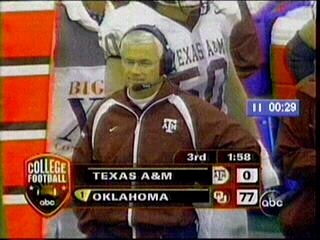
The only question remaining after this debacle is whether A&M (5-2/2-1) head coach Dennis Franchione will actually make it through the rest of the season. Based on the Aggies’ sorry performance against Tech, don’t bet on it.
Remarkably, the Aggies took a 7-0 lead in this one on an opening drive entirely on the ground and were driving for a second TD in Tech territory when the Red Raiders coaching staff decided to stick nine defensive players in the box to slow down the Ags’ rushing attack. In an incredible display of coaching incompetence, the Aggies’ passing game was so insipid that QB Stephen McGee could not force the Raiders’ defenders to take the forward pass seriously. Tech’s high-powered offense finally got untracked and the Raiders pulled away to win easily. The Franchione Termination March next travels to Nebraska (4-3/1-2), which is going through a similar meltdown to what the Aggies are experiencing. NU may just be the Aggies’ best chance for a victory in their final five games of the season.

Texas Longhorns 56 Iowa State 3

As you may recall, I questioned (here and here) the wisdom of Iowa State’s (1-6/0-3) decision at the end of last season to replace my friend Dan McCarney with former UT defensive coordinator Gene Chizik as the Cyclones’ head coach. Chizik’s first ISU team looked utterly rudderless against the Horns (5-2/1-2), who have another scrimmage next week against Baylor (3-4/0-3).
Meanwhile, my friend is making a substantial contribution to the nation’s new no. 2 ranked team.
Big-time college coaching is a wacky business.

What is Joel Osteen’s message?

osteen%20101507.jpgThe Chronicle’s Tara Dooley is breathless in this Sunday Chronicle article on the ever-expanding financial empire of Joel Osteen, pastor of Houston megachurch, Lakewood Church (previous posts here):

Osteen and Free Press, an imprint of Simon & Schuster, will release the pastor’s second book, Become a Better You on Monday. It debuts with at least 2.5 million copies, the largest first run in Free Press’s more than 60-year history.
With an initial printing of 136,000, Osteen’s first book, Your Best Life Now, attracted an audience just waking up to Osteen and his growing Houston church. The book, which came out in 2004, eventually sold about 5 million copies in the United States and was translated into 25 languages.
Become a Better You meets a public that has grown accustomed to Osteen’s face. Taking his place with Brad Pitt and Angelina Jolie as one of the 10 Most Fascinating People of 2006 ó according to Barbara Walters ó Osteen’s national profile has made him an A-list Christian celebrity.
“I’m starting to realize it,” Osteen said in an interview. “It wasn’t until about a year or so ago that I thought, ‘This is something unusual and God has given us a lot of favor.’ Sometimes you think it’s just people flattering you, but I think it’s starting to hit home.”

But on Sunday night’s segment of 60 Minutes, Michael S. Horton, J. Gresham Machen Professor of Systematic Theology and Apologetics at Westminster Seminary California, raised substantial questions regarding the theological substance — or lack thereof — of Osteen’s basic message:

In the Wal-Mart era of religion and spirituality, every particular creed and any denominational distinctives get watered down. We donít hear (at least explicitly) about our being ìlittle gods,î ìpart and parcel of God,î or the blood of Christ as a talisman for healing and prosperity. The strange teachings of his fatherís generation, still regularly heard on TBN, are not explored in any depth. In fact, nothing is explored in any depth. Osteen still uses the telltale lingo of the health-and-wealth evangelists: ìDeclare it,î ìspeak it,î ìclaim it,î and so forth, but there are no dramatic, made-for-TV healing lines. The pastor of Lakewood Church . . . does not come across as a flashy evangelist with jets and yachts, but as a charming next-door-neighbor who always has something nice to say.
Although remarkably gifted at the social psychology of television, Joel Osteen is hardly unique. In fact, his explicit drumbeat of prosperity (word-faith) teaching is communicated in the terms and the ambiance that might be difficult to distinguish from most megachurches. Joel Osteen is the next generation of the health-and-wealth gospel. This time, itís mainstream. [. . .]
This is what we might call the false gospel of ìGod-Loves-You-Anyway.î . . . God is our buddy. He just wants us to be happy, and the Bible gives us the roadmap.
I have no reason to doubt the sincere motivation to reach non-Christians with a relevant message. My concern, however, is that the way this message comes out actually trivializes the faith at its best and contradicts it at its worst. In a way, it sounds like atheism: Imagine there is no heaven above us or hell below us, no necessary expectation that Christ ìwill come again with glory to judge the living and the deadî and establish perfect peace in the world. In fact, one would be hard-pressed to find anything in this message that would be offensive to a Unitarian, Buddhist, or cultural Christians who are used to a diet of gospel-as-American-Dream. Disneyís Jiminy Cricket expresses this sentiment: ìIf you wish upon a star, all your dreams will come true.î
To be clear, Iím not saying that it is atheism, but that it sounds oddly like it in this sense: that it is so bound to a this-worldly focus that we really do not hear anything about God himselfóhis character and works in creation, redemption, or the resurrection of the body and the age to come. . . . Despite the cut-aways of an enthralled audience with Bibles opened, I have yet to hear a single biblical passage actually preached. Is it possible to have evangelism without the evangel? Christian outreach without a Christian message? [. . .]
. . . ìHow can I be right with God?î is no longer a question when my happiness rather than Godís holiness is the main issue. My concern is that Joel Osteen is simply the latest in a long line of self-help evangelists who appeal to the native American obsession with pulling ourselves up by our own bootstraps. Salvation is not a matter of divine rescue from the judgment that is coming on the world, but a matter of self-improvement in order to have your best life now.

Horton’s collection of essays on Joel Osteen’s ministry is here and Tim Challies provides this critical review of Osteen’s new book.

Governor Perry annoys John Daly?

rick%20perry.jpgRegular readers of this blog know about the rich Texas legacy in golf (for example, see here, here, here, here, and here). However, it doesn’t look as if Texas Governor Rick Perry is doing much to facilitate that grand heritage. Seems that Governor Perry played golf last week in the PGA Tour’s Frys.com Open in Las Vegas, where he was the amateur partner of John Daly during the first round. Apparently, “Long John” was not particularly pleased with the pairing:

Daly favors the softer Maxfli Fire but says he has been receiving a much harder ball, which he attributed to a first-round 3-over-par 74 at TPC at The Canyons.
(It was either that or the fact Daly continued losing focus waiting for amateur Rick Perry to reach the green in a timely fashion on most holes. I’m pretty convinced Texas today is by far our nation’s most efficiently run state, because it’s impossible to believe its governor spends much time playing golf.
Perry did, however, bring along a security contingent complete with those Secret Service-type ear pieces, which would have been interesting if it wasn’t so laughable given the only thing most knew about him was that he was the guy you backed up 20 yards from each time he addressed a shot.)

Ouch! H/t to Bogey McDuff.

For your Sunday enjoyment . . .

First, the somewhat geeky but very funny Yoram Bauman, the Standup Economist:

And clarifying the differences between Persians and Arabs, the quite clever Maz Jobrani:

Mistrial declared in the Slade case

slade%20101307.jpgThe criminal trial of former Texas Southern University president Priscilla Slade (previous posts here) ended in a mistrial Friday afternoon after four days of jury deliberations could not break a deadlocked jury that was essentially evenly split. The trial had lasted a little over a month and a half.
The mistrial was a remarkable achievement for Slade defense attorneys Mike DeGeurin and Paul Nugent, who probably concluded that a hung jury was their best shot at avoiding a conviction of their client after they decided not to allow Ms. Slade to testify in her own defense.
The mistrial increases the likelihood that the venue of the retrial will be changed from Harris County. The defense will hoping for a venue change to a location such as Austin or the Rio Grande Valley, but definitely not New Braunfels or San Angelo. Prosecutors and defense counsel are scheduled to appear before District Judge Brock Thomas on Friday to determine details of the retrial.
Meanwhile, the chronic problem of what to do about TSU continues unaddressed. So it goes.

As the Aggie Football World Turns

Franchione OUWhat is it about Texas A&M University that the institution cannot fire a football coach correctly?

The slowly disintegrating status of A&M head football coach Dennis Franchione has been a frequent topic on this blog for almost two years now. Although yesterday’s development in the saga was bizarre — A&M Athletic Director Bill Byrne holding a press conference to announce in the middle of the football season essentially that Coach Fran is kaput as A&M’s head coach after this season — it was not particularly unusual in view of A&M’s rather dubious tradition in dealing with its football coaches.

Take what happened in 1978, for example.

A&M head coach Emory Bellard, the originator of the Wishbone offense while serving as Darrell Royal’s offensive coordinator at Texas in the late 1960’s, had been hired by A&M in 1972 to resurrect the floundering Aggie football program.

By the 1978 season, Bellard had led the Aggies to three straight bowl games and the Aggies seemed poised to become a national power that season.

By week five of the 1978 season, Bellard’s Aggies were rolling at 4-0 and were rated no. 6 in the Associated Press Top 20 poll.

Bellard was reaching the pinnacle of his popularity at A&M as the Ags prepared to face Houston, which had not been particularly impressive and had lost in their first game of the season to a Memphis State team that the Ags had crushed at home 58-0 a couple of weeks earlier. Moreover, the week before, the Coogs had barely beaten winless Baylor, 20-18.

Thousands of Aggies descended on Houston’s Astrodome fully expecting the Aggies to continue their winning ways over the underdog Cougars.

Unfortunately for the Ags, Houston head coach Bill Yeoman, one of the brightest and most creative college football coaches of his time, had put together a brilliant game plan for this particular game.

Taking advantage of the Aggies unbridled over-aggressiveness, Yeoman devised a series of traps, draw plays and screen passes to supplement his famous Veer option attack that utterly befuddled the Aggies. In the meantime, an aroused Cougar defense stuffed the vaunted Aggie Wishbone and never allowed it to get untracked.

By halftime, the unranked Cougars led the no. 6 team in the country 33-0 and the large Aggie contingent in the Astrodome was absolutely stunned. Neither team scored in the 2nd half and the game ended, Houston 33 Texas A&M 0.

Back in those days, most head coaches supplemented their salaries by conducting a show the day after the game in which they went over the film highlights of the previous game. Bellard’s show the Sunday after the Houston upset was absolutely brutal.

Bellard addressed the camera by himself with no studio host to toss him some softball questions to defuse the anxiety of the humbling defeat. With literally no highlights of Aggie plays from the debacle, Coach Bellard was left to reviewing various Houston highlights from the game and explaining what the Aggie players did wrong in allowing the Cougar players to perform such feats. Coach Bellard looked haggard and utterly demoralized.

After watching the show with me, my late father turned to me and observed: “I hope Mrs. Bellard has removed all guns and sharp objects from their home for awhile.”

At any rate, the Ags dropped to no. 12 after the Houston game and began preparations for their next game against an 0-5 Baylor team that had played one of the toughest schedules in the country.

In arguably one of the worst games in the history of Kyle Field, that winless Baylor squad hammered the listless Aggies 24-6, as a previously unheralded freshman running back named Walter Abercrombie ran over and through the Aggies for 207 yards.

In the span of two weeks, what had been the no. 6 team in the land had been outscored 57-6.

Coach Bellard resigned the next day under intense pressure (one large sign hanging from an A&M dorm window at the time urged “Make Emory a Memory”).

In only two weeks, he had gone from being the King of Aggieland to quitting the job that he had always coveted.

To this day, Bellard’s demise and Texas A&M’s reaction to it over those two weeks is one of the more fascinating sociological events that I have witnessed during my 45 years in Texas.

So, placed in that context, yesterday’s developments regarding Coach Franchione are not all that unusual in Aggieland.

But what is interesting is that the Aggies (5-1/2-0) currently lead the Big 12 South Division as they travel to Lubbock this Saturday to meet their high-powered nemesis, Texas Tech (5-1/1-1).

Although the Red Raiders have beaten the Aggies regularly during Coach Fran’s tenure and are 8 point favorites to do so again on Saturday, my sense is that the Ags actually have a better chance than usual to beat Tech this time.

The Aggies have the type of ball control offense to keep Tech’s high-powered offense off the field and Tech’s defense is in such utter disarray that Coach Mike Leach recently fired his best defensive assistant coach. So, this might just be the year that Coach Fran’s Aggie team breaks through against Tech at Lubbock.

But will such a win save Coach Fran’s job?

Don’t count on it.

Even if the Ags upset Tech, they play at Nebraska next, then host a revived Kansas team before playing difficult games at Oklahoma and Missouri.

And, oh yeah, don’t forget about that traditional final game of the season the day after Thanksgiving against a Texas team that will be looking for revenge after last year’s A&M upset of the Horns that may have saved Franchione’s job for this season.

Heck, Gordon Smith even thinks that A&M may have a decent case for terminating Franchione’s contract for cause, which would relieve A&M from the requirement of “buying out” the contract if A&M were to terminate the contract “without cause” or, stated another way, for simply not winning enough football games.

That would be unusual because the Aggie way normally is to fire football coaches for not winning enough football games.

The Achilles Heel of Health Care Finance Reform

medical%20finance%20101207.jpgIn an interview years ago, the late Milton Friedman summed up the basic problem with a nationalized system of health care finance:

There are four ways in which you can spend money. You can spend your own money on yourself. When you do that, why then you really watch out what you’re doing, and you try to get the most for your money.
Then you can spend your own money on somebody else. For example, I buy a birthday present for someone. Well, then I’m not so careful about the content of the present, but I’m very careful about the cost.
Then, I can spend somebody else’s money on myself. And if I spend somebody else’s money on myself, then I’m sure going to have a good lunch!
Finally, I can spend somebody else’s money on somebody else. And if I spend somebody else’s money on somebody else, I’m not concerned about how much it is, and I’m not concerned about what I get. And that’s government. And that’s close to 40% of our national income.

However, even more troublesome than the illusion that A will get top-flight service from B when C is forced by government to pay the bills, who is going to provide the health care under such a system?

Thinking about think tanks

AEI.jpgOn the announcement of his retirement next year as president of the American Enterprise Institute, Chistopher DeMuth provides a large dose of common sense in this OpinionJournal op-ed:

Think tanks are identified in the public mind as agents of a particular political viewpoint. It is sometimes suggested that this compromises the integrity of their work. Yet their real secret is not that they take orders from, or give orders to, the Bush administration or anyone else. Rather, they have discovered new methods for organizing intellectual activity–superior in many respects (by no means all) to those of traditional research universities.
To be sure, think tanks–at least those on the right–do not attempt to disguise their political affinities in the manner of the (invariably left-leaning) universities. We are “schools” in the old sense of the term: groups of scholars who share a set of philosophical premises and take them as far as we can in empirical research, persuasive writing, and arguments among ourselves and with those of other schools.
This has proven highly productive. It is a great advantage, when working on practical problems, not to be constantly doubling back to first principles. We know our foundations and concentrate on the specifics of the problem at hand. We like to work on hard problems, and there are many fertile disagreements in our halls over bioethics, school reform, the rise of China, constitutional interpretation and what to do about Korea and Iran.
Think tanks aim to produce good research not only for its own sake but to improve the world. We are organized in ways that depart sharply from university organization. Think-tank scholars do not have tenure, make faculty appointments, allocate budgets or offices or sit on administrative committees. These matters are consigned to management, leaving the scholars free to focus on what they do best. Management promotes the scholars’ output with an alacrity that would make many university administrators uncomfortable.
And we pay careful attention to the craft of good speaking and writing. Many AEI scholars do technical research for academic journals, but all write for a wider audience as well. When new arrivals from academia ask me whom they should write for, I tell them: for your Mom. That is, for an interested, sympathetic reader who may not know beans about the technical aspects of your work but wants to know what you’ve discovered and why it makes a difference.

Read the entire piece.

Justice Thomas on oral argument

Clarence%20Thomas.jpgJan Greenburg passes along a portion of an interview with U.S. Supreme Court Justice Clarence Thomas in which Justice Thomas explains why, unlike some of his colleagues, he chooses not to participate much during Supreme Court oral arguments. He thinks they are largely overrated:

There’s a way that we do business and it is very methodical, and it’s something that I’ve done over the past 16 years.
I have four law clerks. We work through the case, as I read the briefs, I read what they’ve written, I read all of the cases underlying, the court of appeals, the district court. There might be something from the magistrate judge or the bankruptcy judge. You read the record.
And then we sit and we discuss it, that’s with my law clerks. So by the time I go on the bench, we have an outline of our thinking on the case. So I know what I think without having heard argument or anything else. Argument is really not a critical part of the process, the oral argument.
The real work is in the documents, the submissions that we get from counsel. And when you do your work in going through that, it makes the oral argument sort of almost an afterthought.

Oral argument is stimulating and fun, but you’ve probably already lost the appeal by the time of oral argument unless you have won the battle of the briefs.

Texas’ inexhaustible supply of hog

feral%20hog%20101107.JPGAnyone who has spent any time in rural Texas understands the havoc that the burgeoning feral hog population (previous posts here) has caused in almost every area of Texas. Chronicle outdoors columnist Shannon Tompkins has been studying the problem for quite some time and, in this article from this past weekend, he puts the hog problem in perspective:

Texas is awash in a rising tide of feral hogs. And Texans appear as impotent as King Canute in stopping that tide from climbing up the beach. [. . .]
Texas has about half as many feral hogs as it does white-tailed deer ó perhaps 2 million hogs and about 4 million deer. [But] almost all the growth in the hog population has occurred over the past 20 years. Once limited to a few thousand pigs in small pockets of East and South Texas, feral hogs infest all but a half-dozen or so of Texas’ 254 counties.
This is an incredible rate of expansion. And with it has come millions of dollars of damage to agriculture, land, water and native wildlife.
What’s behind the expansion?
We Texans did this to ourselves. People hauled live-trapped feral hogs all over the state and released them, thinking they would create good hunting opportunities.
Those infections spread.
Also, changing land-use practices ó everything from what grows on land, who owns it, average size of tracts, who has access to that land and what they do there ó gave feral hogs the conditions they needed to become established and thrive.
Will feral hogs become more populous in Texas than whitetails?
Could happen. Texas’ deer population is stable, and deer live on just about every acre that can support them; the herd isn’t going to grow.
But the feral hog population continues mushrooming as the animals pioneer into new corners and herds expand to fill the newly infested habitat.
Feral hogs can outcompete and outreproduce deer.
Hogs are omnivores. Deer are browsers. Deer depend on a small suite of plants for food. Hogs can live on almost anything, and in places that will not support deer.
A doe deer doesn’t breed until she’s a year old, then produces one fawn most years and twins in really good years. On average, half those fawns survive to their first birthday.
A sow feral hog can breed for the first time when she’s 8 months old or so, and throw litters of four to eight piglets twice a year, and almost all survive.
Do the math.
It appears impossible to eradicate feral hogs once they have become established at the level we have them in Texas.
Yes, extreme methods ó intense trapping, aerial gunning ó can clear an area of feral hogs. But it’s expensive, time-consuming and only a temporary solution. If intense control is not maintained ó constant trapping, brutally efficient gunning over a large area ó new hogs migrate to fill the vacuum.
Look; Texas has the most liberal hog-killing regulations in the nation. Feral hogs can be killed by any method other than poisoning. They can be shot from the air or ground. They can be trapped. They can be run down by packs of hounds. Day and night. No limits.
No one has a dependable estimate of how many feral hogs are killed in Texas each year. But it has to be in the neighborhood of a quarter-million or more. Heck, the state’s two commercial processing plants that butcher feral hogs for the retail market are annually handling an estimated 100,000 wild swine. Maybe twice that many are taken by recreational hunters and trappers.
Still, the pig population climbs.
Feral hogs are the four-legged equivalent of fire ants, tallow trees, salt cedar, water hyacinth and all the other non-native, invasive species that are damaging Texas’ biota. Their only positive qualities are that they provide hunting opportunity, and they are great on the table.
I kill feral hogs whenever I can, even though I understand that assassinating one every now and again from a deer stand or even trapping a dozen or two a year from the deer lease has the same impact as trying to dip out the ocean using a coffee cup.
It’s not particularly satisfying work. But I like to think the deer and the quail, squirrel and turkey and every other native creature in the woods appreciates the effort.

Feral hogs have even been seen roaming in parts of Houston’s Memorial Park near Buffalo Bayou. And markets are developing for feral hog meat. But the population continues to grow steadily. Any ideas?