Not looking good for Merck

vioxx10.jpgIn the ongoing wrongful death civil trial against Merck involving its pain reliever drug Vioxx, the mainstream media tends to focus on seemingly important expert testimony such as that described in this article.
Being more a student of the courtroom, however, I tend to focus in such trials on jury dynamics, such as those described in this Fortune Magazine article:

Speaking in state court in Angleton, Texas, without notes and in gloriously plain English, and accompanying nearly every point with imaginative, easily understood (if often hokey) slides and overhead projections, (plaintiff’s lawyer Mark) Lanier, a part-time Baptist preacher, took on Merck and its former CEO Ray Gilmartin with merciless, spellbinding savagery . . .
But in contrast to Lanier . . . (Merck defense lawyer David Kiernan) seemed to read much of his presentation and illustrated it only with stodgy, corporate headshots of Merck officials or hard-to-read excerpts from documents whose meaning was shrouded in medical jargon . . .
The trial offers jurors a stark choice between accepting Lanier’s invitation to believe simple, alluring and emotionally cathartic stories versus Merck’s appeals to colorless, heavy-going, soporific Reason.

H’mm. On one hand, an interesting story told through a lively presentation given without notes using colorful images. On the other hand, a bland recitation of prepared remarks given with boring images of hard-to-read text in documents.
Translated: This is not looking good for Merck.

The essential problem with third party payor health care finance

medicare.jpgThis outstanding Washington Post article (first in a series of three) on Medicare nails the key problem with reliance on third party payor health care finance systems:

In Medicare’s upside-down reimbursement system, hospitals and doctors who order unnecessary tests, provide poor care or even injure patients often receive higher payments than those who provide efficient, high-quality medicine. . .
Researchers at Dartmouth Medical School, who have been studying Medicare’s performance for three decades, estimate that as much as $1 of every $3 is wasted on unnecessary or inappropriate care. Other analysts put the figure as high as 40 percent.
Medicare has difficulty controlling waste because of deficiencies in the way it monitors and enforces quality standards. Its oversight system is fragmented, underfunded and marred by conflicts of interest, records and interviews show . . .

Read the entire article, including the sidebar containing related articles and graphs and the subsequent articles here and here. It’s a first rate series.

City Hall, San Diego style

San Diego logo.gifA couple of former City of Houston aides have had a rough spot lately, but frankly our corruption is blase’ compared to what’s going on at City Hall in San Diego recently.
First, the San Diego mayor resigned a couple of weeks ago amidst a pension fund scandal. Then, after about 60 hours on the job, the mayor’s interim successor — along with another member of the San Diego City Council — was convicted of conspiracy, extortion, and fraud in connection with a scheme to receive money for changing a city law to benefit strip club owners. With a new interim mayor and another mayor to be elected in a special election, that makes four mayors by my count in the space of just a few months. All of which prompted economist and San Diego resident James Hamilton to observe:

Forgive me if this sounds paranoid, but isn’t this the same crowd to whom the Supreme Court gave the power to kick me out of my home in order to hand it to some developer? Not that any City Council members would ever let how much money they got from that developer influence their decision on something like that.

Judge Roberts in action

John_G._roberts.jpgOrin Kerr over at the Volokh Conspiracy refers us to this recent D.C. Circuit decision in which U.S. Supreme Court nominee John G. Roberts, Jr. wrote a lively dissent and, in so doing, provides a glimpse of why he was one of my favorites for nomination to the Supreme Court.
The decision involves a search and seizure case. The defendant was driving a car with the license plate light out. After police stopped him, it turned out that he did not have a driver’s license on him, that his license had been suspended, and that the car had stolen tags. During the stop, the police could find not find anything that indicated that the car was properly registered. Thus, the police arrested the defendant and then they searched the car’s trunk, where they found a gun. Wallah! The defendant was charged with a gun possession crime and we now have a search and seizure case.

Continue reading

The changing Houston golf scene

golfer2.jpgThis Sunday Chronicle article reviews the status of Houston’s municipal golf course system, which has run a deficit for the past five years, including a cool $620,000 for the most recent fiscal year. Although rounds are down at all muni courses other than the City’s crown jewel at Memorial Park, Brock Park was responsible for over 75% of the losses in the most recent fiscal year.
Frankly, the City of Houston needs to phase out of the golf business entirely. Although providing golf courses for citizens made sense a generation ago, the proliferation of a wide-variety of private daily fee courses in the Houston area have made most of the muni courses not only unattractive by comparison, but also unnecessary. Such a marketplace of private golf courses did not exist when the City of Houston developed its municipal golf system, but given the development of that private marketplace over the past 30 years, there is simply no longer any reason for the City of Houston to subsidize golf operations for a relatively small number of its citizens.
Here is a “thinking outside the box” suggestion for the Houston City Council on the golf course operation. Other than Memorial Park and Hermann Park golf courses, sell the remainder of the golf courses, including a sale or donation of the Gus Wortham Course to the University of Houston, which could then invest the funds necessary to renovate that tract into a potentially fine university course close to the University’s Central Campus. With a portion of the funds generated from the sale of the courses, the City could then fund an endowment to be administered by the Houston Golf Association to promote golf to underprivileged children and citizens of Houston.
The foregoing would be a “win-win” situation for the City of Houston and its citizens. Not only would the City shed the cost of its unprofitable golf operation and provide the city’s main public University with a convenient home for its storied golf program, the City would maintain two very good, profitable and well-located municipal golf courses, and provide its citizens who need it the recreational opportunity to enjoy the game of golf.

Chronicle follows up on Harris County Jail story

jail2.jpgThe Chronicle’s Steve McVicker and Bill Murphy follow up their earlier story on the chronically abysmal condition of the Harris County Jail facilities with this story that reports that Harris County officials have ignored repeated warnings regarding the unsanitary and over-crowded condition of the jails.
To make matters even more egregious (if that were possible), a Sam Houston State University report warned Harris County officials almost two years ago of a looming explosion in the county jail population. Despite that report, the Harris County Criminal Justice Committee — which was created in 1995 in response to a jail-overcrowding lawsuit that resulted in the jail being under a federal judge’s oversight for 23 years — has not met to review the report or the conditions at the jail.
By strange coincidence, the Criminal Justice Committee is now scheduled to meet this Friday. I’m sure the previous Chronicle article has nothing to do with that.

Continue reading

Stros 2005 Review: Checking in on the Stros

Bruntlett.jpgWhen journeyman Eric Bruntlett (-5 RCAA/.262 OBP/.333 SLG./.595 OPS) jacks a three run yak in the 14th inning to pull out a Sunday afternoon win and finish off a 7-4 roadie, you know it’s time to check in on the Stros (51-47).
Somehow, the Stros find themselves only three and a half games behind the Nationals (55-44) for the lead for the NL Wild Card Playoff spot, but my sense is that the Nationals are sinking and will not be in contention any longer by Labor Day. Accordingly, it’s looking as if the Stros’ competition for the Wild Card spot is going to be the NL East teams other than the Nationals — the Braves (55-44), Phillies (52-47), Mets (51-47) and Marlins (49-47) — and the Cubs (49-48) in the NL Central.

Continue reading

The Chron Interviews Outgoing Enron Task Force Director

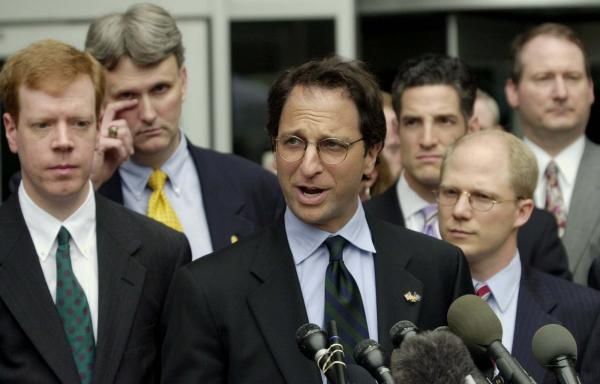
Andrew Weissman.jpgThe Chronicle’s Mary Flood, who has done a fine job of covering the Enron case for the local newspaper, interviews Andrew Weissmann, the former Enron Task Force director who resigned as director of the Task Force this past week amidst widespread allegations of prosecutorial misconduct.

Overall, the interview is a disappointing fluff piece. Ms. Flood — who, as the Chronicle’s lead reporter on Enron, is not the best person to be ruffling feathers with the Task Force — asks Mr. Weissman only a general question about prosecutorial misconduct and fails to follow that up with questions about specific instances of misconduct, such as the following:

The Task Force’s questionable public relations campaign demonizing anything having to do with Enron;

The Task Force’s poor trial record involving former Enron executives (one conviction of a mid-level manager out of seven Enron executives tried to date) compared with the Task Force’s bludgeoning former Enron executives into plea bargains;

The Task Force’s dubious policy of fingering potential defense witnesses as either unindicted co-conspirators or targets of the Enron criminal investigation to deter such witnesses from testifying for defendants in the Enron criminal trials;

The Task Force’s disingenuous market loss arguments in connection with the sentencings of the five convicted Nigerian Barge defendants, which argument contradicted the Justice Department’s position before the U.S. Supreme Court;

The questionable nature of the Task Force’s prosecution of the Merrill Lynch executives in the Nigerian Barge case, particularly Daniel Bayly (note posts here and here) and William Fuhs.

The overreaching nature of the Task Force’s prosecution of Arthur Andersen which the Supreme Court noted in its unanimous reversal of that conviction;

The Task Force’s elicitation of false testimony from Ken Rice, its key witness in the Task Force’s miserably failed Enron Broadband prosecution;

The Task Force threats toward two witnesses in the Broadband trial — Beth Stier and Lawrence Ciscon — who testified favorably for the defense in that trial;

A Task Force prosecutor’s violation of the judge’s instruction not to question witnesses on certain subjects during the Broadband trial; and

The strong evidence that the Task Force has been chilling witnesses favorable for the defense in the upcoming trial of former Enron key executives, Ken Lay, Jeff Skilling, and Richard Causey.

Given the extent of the foregoing instances of misconduct, if I would have been allowed one question of Mr. Weissman, it would have been the following:

“Do you believe that the end of convicting former Enron executives of crimes justifies the means by which you obtain such convictions?”

My sense is that most Chronicle readers would have been far more interested in Mr. Weissmann’s answer to that question than his answer to the question of how has he enjoyed his time in Houston.

Watch out!

metrocar4.jpgThe Chronicle’s Rad Sallee reports on one category in which Houston’s Metropolitan Transit Authority is surely leading among the country’s transit systems:

MetroRail logged its third collision in four days Friday, making 29 this year and 96 since fall 2003, when testing of the rail line began.
Before that, the last collision was July 5. The last string of three accidents in four days was March 13-16. Metro recorded three light rail collisions in two days Jan. 26-27 and five in eight days March 22-29, 2004.

Who boy, Kevin Whited and Anne Linehan at blogHouston.net are going to have fun with this one. BlogHouston.net’s Houston Transit category and Kevin’s PubliusTX.net Danger Train category are the two best sources for information on the seemingly unending foibles of Houston Metro.
By the way, is it just me or does Mr. Sallee’s analysis of MetroRail’s many crashes seems eerily similar to the way in which one would evaluate a Major League Baseball player’s career statistics?

Spitzer fights payola with a little payola

Spitzer32.jpgMy two teenage daughters and their friends just laugh at me whenever I observe to them that most of the noise that they listen to on the radio is so bad that the only way the “music” could ever make the airwaves is through bribery.
Well, my view was vindicated today as this NY Times article reports that New York Aspiring Governor Eliot Spitzer will announce a settlement that will involve at least a $10 million fine with Sony BMG Music Entertainment as part of an 11-month investigation into how music companies get radio stations to play songs. As is typical in such investigations these days, the big four global music companies — Sony BMG, Vivendi Universal SA’s Universal Music Group, EMI Group PLC, and Warner Music Group Corp. — have apparently been cooperating with Mr. Spitzer’s investigation out of fear of a criminal indictment that would be potentially devastating to the companies’ U.S. business.
The investigation apparently relates to the companies’ use of so-called “independent promoters,” who are brokers who are paid to plug new songs to radio stations. The practice is similar to payola — direct payment in exchange for airplay of specific songs — which has been illegal under federal law since the payola scandals of the 1950s. Inasmuch as the line is often a tad fuzzy between merely persuading a radio station executive to play noise and offering the executive a quid pro quo for doing so, representatives of Mr. Spitzer and Sony BMG have apparently been haggling over mutually acceptable guidelines for future conduct between the music company and radio stations.
Although I am usually wary of government attempts to criminalize these types of business transactions, I could make an exception in this case if the settlement contains a prohibition against playing the noise of this “artist.” Despite such social benefits, Larry Ribstein notes that there are strong economic arguments in favor of payola and that the governmental prohibition against it only made the market less transparent.