
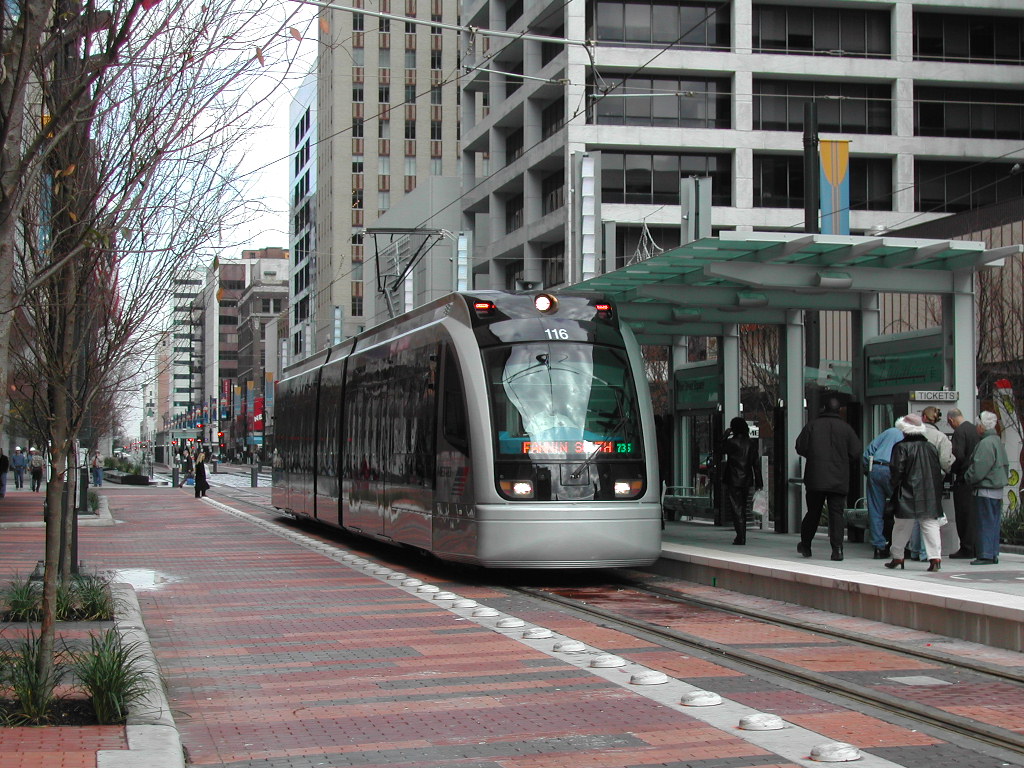
The Psychology of Light Rail

Tory Gattis (Houston Strategies) recently authored this insightful post that explores the vexing question of why many people passionately support light rail in the face of the overwhelming economic arguments against it?

Tory concludes that it has something to do with an unexpressed human psychological need to be liked — sort of like, “Here, check out and play with my light rail toy, and you will probably think better of me.”

Tory is clearly on to something in that there appears to be an element of a civic inferiority complex underlying some folks’ support for light rail. However, Tory’s point still does not explain why people who need mass transit the most — i.e., folks who cannot afford the cost of buying and maintaining a car — support light rail, which certainly does not improve their mobility and, by drawing resources away from mobility projects that would, probably harms it.

My sense is that that question lies somewhere between the human demand for entitlement and lack of viable choices.

As previously noted on this blog, the true economic benefit of light rail is highly concentrated in only a few interest groups — political representatives of minority communities who tout the political accomplishment of shiny toy rail lines while ignoring their constituents need for more effective mass transit, environmental groups that are striving for political influence, construction-related firms that feed at the trough of light rail projects, and private real estate developers who enrich themselves through the increase in their property values along the rail line.

Inasmuch as none of these reasons for mass transit appeal to the part of the electorate who actually need mass transit, this amalgamation of interest groups continues to disguise their true interests behind amorphus claims that the uneconomic rail lines reduce traffic congestion (they do not), curb air pollution (they do not), or improve the quality of life (at least debatable). The literature on all this is public and volumnious — check out demographia.com, cascadepolicy.org, and americandreamcoalition.org.

So, how do these interest groups get away with this? The costs of such systems are widely dispersed among the local population of an area such as Houston, so the many who stand to lose will lose only a little while the few who stand to gain will gain a lot.

As a result, these small interest groups recognize that it is usually not worth the relatively small cost per taxpayer for most citizens who do not use mass transit to spend any substantial amount of time or money lobbying or simply taking the time to vote against an uneconomic rail system.

Meanwhile, the light rail interest groups garner support for light rail from the part of the electorate that actually needs mass transit by simultaneously limiting the mass transit choices and threatening that part of the electorate with loss of the governmental funds for mass transit if they fail to support light rail.

Thus, a referendum on mass transit issues is never promoted with choices between alternatives such as a light rail system, one one hand, and a cheaper and more effective bus-based system system, on the other. It’s simply an “all or nothing” choice, and folks who need mass transit will understandably vote in favor of getting their share of public transportation funds even if it does not improve their mobility one iota.

Indeed, given the cost of light rail systems, one wonders how those citizens who actually need mass transit would vote if the alternative were a light rail system, on one hand, and a new Toyota Prius for each such citizen, on the other? Frankly, the cost of the latter alternative would likely be cheaper than most any light rail plan.

So, at the end of the day, where does that leave us? Is it wrong that people who need mass transit vote in favor of something that does not really address their needs? No, it does not, but it troubles me when they are misled in doing so.

As Anne Linehan and Kevin Whited (blogHouston.net) have repeatedly pointed out, a part of Metro’s pitch for its light rail plan was that light rail would enhance Metro’s bus system and service. Inasmuch as that representation has turned out to be patently false, it seems reasonable that our public officials should at least be required to point out publicly that Metro’s most utilized and efficient mass transit system — i.e., the bus system — will likely continue to erode as Metro continues to invest heavily in light rail.

In the meantime, it would also be nice if public officials would admit publicly that the usual economic justifications for light rail are also dubious. If mass transit users and other citizens want to allow Houston’s public officials to continue to throw money at a light rail system in the face of the economic truth about such a system, then I can live with that result despite my compassion for those citizens who are not being provided the mass transit that they need.

But at least let’s require truth in advertising in connection with having citizens vote on such matters.

A similar sentiment is shared in this interesting Owen Courreges post (Lone Star Times) in which he takes the Chronicle to task for suggesting that Metro’s political opposition — rather than Metro itself — is misleading the public about Metro’s expanded light rail plan.

Finally, Tory points out that we should take some comfort in the fact that Houston’s light rail plan is at least not as big an economic boondoggle as similar plans proposed for Seattle and Denver. Similarly, a couple of commentators to Tony’s post chime in that the marginal cost of the light rail system to Houston area citizens is relatively small for a civic asset that will impress citizens and visitors alike for many years to come. That latter point may have some validity, but let’s make sure that we are talking about the correct marginal cost.

A big difference between the light rail system and the publicly-funded stadiums that Houston has built over the past several years are that the stadiums have tenants who pay the vast majority of the cost of maintaining the facilities.

In comparison, Metro’s light rail system does not come close to generating enough revenue to pay its ongoing costs, as was brought home by Metro’s recent announcement of desultory operating results coupled with the expenditure of $104 million more on the three-year-old rail line to fix problems caused by construction errors and add more rail cars.

In that regard, even the $1.5 million that Harris County spends annually to mothball the Astrodome pales in comparison to underwriting the ongoing cost of the light rail system.

The bottom line is that light rail systems eat voraciously, and any analysis of the true marginal cost of such a system to citizens has to take into consideration the high cost of feeding that appetite.

Daniel Yergin comments on energy prices

oil_well7.jpgDaniel Yergin — energy economist and author of the 1992 Pulitzer Prize winner, The Prize: The Epic Quest for Oil, Money, and Power — writes this sensible Washington Post op-ed in which he reminds us that the current relatively high prices of energy do not mean that the end of the oil age is right around the corner:

Prices around $60 a barrel, driven by high demand growth, are fueling the fear of imminent shortage — that the world is going to begin running out of oil in five or 10 years. This shortage, it is argued, will be amplified by the substantial and growing demand from two giants: China and India.
Yet this fear is not borne out by the fundamentals of supply. Our new, field-by-field analysis of production capacity, . . . is quite at odds with the current view and leads to a strikingly different conclusion: There will be a large, unprecedented buildup of oil supply in the next few years. Between 2004 and 2010, capacity to produce oil (not actual production) could grow by 16 million barrels a day — from 85 million barrels per day to 101 million barrels a day — a 20 percent increase. Such growth over the next few years would relieve the current pressure on supply and demand.

Read the entire op-ed, and then recall Exxon/Mobil CEO Lee Raymond’s observation during a Wall Street Journal interview earlier this year regarding Chevron’s bet of continued high energy prices that underlies the high price it is paying for Unocal:

WSJ: What do you think of ChevronTexaco’s decision to acquire Unocal?
Mr. Raymond: I can never remember an industry consolidating at high prices. But I can remember an industry consolidating at low prices.
WSJ: Some people think prices will keep going up.
Mr. Raymond: Maybe. I’ll bet they’ll be lower at some point.

More Spitzer mischief

Spitzer34.jpgWhen one door for a misguided investigation closes for Aspiring Governor Eliot Spitzer, he just opens another one. Although misdirected, no one can say that Mr. Spitzer is not persistent.
On Thursday, U.S. District Judge Sidney Stein of the Southern District of New York denied Mr. Spitzer’s request for more information from the Office of the Comptroller of the Currency as a deadline approaches for Mr. Spitzer to respond to the OCC’s recent lawsuit against him. The OCC is seeking an injunction against the Lord of Regulation from using his subpoena power to obtain nonpublic credit score and loan information from national banks that are involved in the sub-prime mortgage market.

Continue reading

Lakewood and Houston’s other big churches

LakewoodInternonalCenter.jpgThis Church Report articleThe 50 Most Influential Churches — examines the fifty largest churches in the United States based on a survey that was sent to 2,000 church leaders with the goal of ranking the nation’s fastest growing churches and churches with more than 2,000 weekend attendance.
Houston is well-represented on the list, with Lakewood Church ranking fifth (are there really four churches that are larger than one that holds its services in a renovated basketball arena?), Fellowship of The Woodlands at no. 17, Second Baptist Church at no. 33, and Windsor Village United Methodist at no. 43. The common thread through all of these mega-churches is that each of them is closely associated with a charismatic leader, and that is certainly true of the Houston contingent — Joel Osteen at Lakewood, Kerry Shook at Fellowship, Ed Young at Second Baptist, and Kirbyjon Caldwell at Windsor Village.

Continue reading

Trouble in Nuevo Laredo

border map2.gif
Following on earlier posts on the same topic here and here, this article reports on an ominous development that flies under radar screen of most Texans and Americans — the increasing violence in the Mexican border towns along the Texas-Mexico border.
Tony Garza, the U.S. ambassador to Mexico, ordered the closure of the U.S. Consulate in Nuevo Laredo for a week Friday night to assess the security situation just hours after rival drug cartels engaged in a gunfight with machine guns, grenades and rocket launchers in an upscale Nuevo Laredo neighborhood. The battle was fought Thursday night at a single-story house near a country club, which is about five blocks from the Nuevo Laredo’s main drag.
The Texas-Mexico border area of Texas — called the Rio Grande Valley or simply “the Valley” — has always been a fascinating and troubling part of Texan culture. The area is among the lowest in terms of per capita income in the United States, yet even the chronically depressed economy of the Texas side of the border is a fantasy of riches for many of those living in the poverty of the teeming Mexican border towns. The following is the way I characterized the area’s problems in this earlier post:

The region’s problems are complex and difficult, which makes the area prone to being ignored. The increased violence of late is the natural result of such neglect, and the usual response to such spikes in violence along the border — i.e., heightened law enforcement — is only a short term solution that often contributes to the animus that many of the Hispanic citizens of the area have toward the state. The area is desperate for leadership and a vision for solving its problems, yet those intractable problems tend to repel those in government who are in a position to do something about them. In short, the Valley needs statesmen, which are in short supply in the polarized American political landscape of the early 21st century.

With some politicians calling for the creation of state militia units to combat the increasing problems on the border, it’s high time for federal and state leaders to address the problems facing the Valley and devise short and long-term plans to address them. For if they do not, expect to see what happened in Nuevo Laredo on Thursday night to spill over to the Texas side of the border soon.

Eric Andell gets probation

andell2.jpgFormer Houston district and appeallte judge Eric Andell — who formerly served as deputy undersecretary under fellow Houstonian Rod Paige at the U.S. Education Department — was sentenced to one year of probation and fined $5,000 Friday after pleading guilty to charges that he intentionally had the federal government pay about $9,000 for travel in which he conducted personal business and worked as a visiting judge while still employed at the Department of Education. Here is a previous post on the matter and here is the Chronicle story on the sentencing.
One of the most popular local Democratic politicians, Mr. Andell is a genuinely good man who made a mistake and owned up to it in a responsible manner. That he avoided any prison time is a just result.

Stros 2005 Review: The Stros are streaking again

Astros-Logo6.jpgLast season, after falling to a season-worst 56-60 record on August 14th, the Stros won 36 out of their next 46 games, a run that included 12 and seven game winning streaks, the latter of which ended the regular season and clinched the National League Wild Card playoff spot. That club went on to get within a few outs of the World Series.
With another win in last night’s game, this Stros club — after falling to a season-worst 15-30 record on May 24th — has gone 41-17, won six games in a row and won 12 of their last 13. The Stros now lead in the National League Wild Card race by one game and are in second place in the NL Central, 8.5 games behind the Cards. Given the way the NL Central race has gone the past couple of seasons, that equates to a pennant race.
Given this club’s weak hitting, the Stros will not be able to sustain this level of play for the remainder of the season. But make no mistake about it, this has been an incredible run, even more remarkable than last season’s.

More on the gas trader cases

traders.jpgThis Southern District U.S. Attorney Office press release announces that two former gas traders — former Dynegy trader Michelle Valencia and former El Paso trader Greg Singleton — had counts added to their pending indictments in connection with a series of criminal cases in which the government alleges that the traders reported bogus trades to industry newsletters to affect the price of natural gas. Here is a previous post on Ms. Valencia’s case and other posts on the gas trader prosecutions may be reviewed here, here, here, here, here and here.
These particular trader cases involve alleged efforts to manipulate the trading indexes, which are used to value billions of dollars in gas contracts and derivatives. Industry publications, such as Inside FERC Gas Market Report, use data from traders to calculate the index price of natural gas. Accordingly, movement in index prices often affects the level of profits that traders can generate. In these particular cases, it remains unclear in what context the allegedly false information was provided or whether the publication actually used any such false information. However, the government is contending that it needs only to prove that fake trades were reported to the publications and not that the trades were actually published or affected the markets.
Ms. Valencia and Mr. Singleton were originally charged with “conspiracy, false reporting, and wire fraud related to the transmission of allegedly inaccurate trade reports to industry newsletters which used the reported trades to calculate the ‘index’ price of natural gas in August 2000,” and the superseding indictment adds “additional counts of false reporting and wire fraud relating to inaccurate trade reports used to calculate the ‘index’ price of natural gas in July 2000.”
As noted in this previous post, it would appear that this is a fairly transparent effort by the government to increase the alleged market loss attributable to the alleged false reporting for purposes of seeking longer jail terms against Ms. Valencia and Mr. Singleton. Justice Department lawyers have been making some fairly preposterous positions on that particular issue in other cases recently.

Conglomerate forum on the corporate case of the decade

disney2.JPGGordon Wood over at the Conglomerate blog has put together an impressive list of expert contributors for an upcoming forum on the widely-anticipated decision of the Delaware Chancellory Court in the corporate case of the decade — i.e., the civil lawsuit over The Walt Disney Co. board’s decision to pay Michael Ovitz a rather generous severance package for essentially doing nothing during his short stay at Disney (earlier posts on the case are here, here, and here).
As Professor Wood notes, now all we need is a decision, which was expected before the end of July, but has now apparently been pushed back. My speculation is that the decision was close to completion when Professor Ribstein posted his recent prediction on the decision, which sent Chancellor Chandler and his clerks scampering back to the drawing board. ;^)
Seriously, though, the Conglomerate forum is yet another example of the way in which the blogosphere is redefining the way in which information is delivered to the public. Prior to the blogosphere, the only way that one could obtain the type of expert analysis that such a forum delivers would be to luck upon an op-ed in a newspaper or dig through stodgy law review articles. Now, that analysis is delivered in an efficient and effective manner for the world to peruse. That’s a remarkable development, and one that all of us should be careful not to take for granted.

Judge Roberts and Rome

John_roberts4.jpgOver time, politicians will manage to stand just about any issue in American politics on its head.
Houston played host to one of the most important speeches of John F. Kennedy‘s 1960 Presidential campaign. Conventional political wisdom at the time was that a Catholic could not be elected President of the United States because of Protestants’ perception that a Catholic would have to obey the Pope’s commands over those of the U.S. Constitution. Mr. Kennedy finally decided to address the issue head-on, and on September 12, 1960, he delivered this statement to the Greater Houston Ministerial Association, in which Theodore White observed that “he knocked religion out of the campaign as an intellectually respectable issue.”

Continue reading