The Cream reunion concert

cream.jpg61 year old Bass player Jack Bruce has had a liver transplant and 65 year old drummer Ginger Baker suffers from arthritis, but Eric Clapton’s first big rock group — Cream (you know, Sunshine of Your Love, Badge, White Room, etc)– lives on.
Craig Newmark points us to Fark.com‘s comment on this article about the reunion concert of the 1960’s rock band:

Cream reunites in concert. For those of you under 40: Cream was Eric Clapton’s old band. Under 30: Clapton was once a big rock star. And for you under 20: Rock was a kind of music they used to play on the radio.

And don’t miss Banjo Jones’ musings on what happened to Cream after Clapton heard The Band.

It’s hard to pull the plug on an airline

airline industry.jpgAs noted in previous posts here, here, here, here and here, it is extremely difficult to liquidate even an insolvent airline. Rather, such companies seem to go out to pasture in chapter 11 for an indefinite period until creditors approve some debt for equity swap that cleans up the balance sheet enough for exit financiers to risk the capital necessary to give the airline another swing at the plate.
In that regard, this US Today article examines the question of why it is so difficult to put an airline out of its misery, and essentially concludes that creditors, government, employees, and politicians have created such barriers to exiting the industry that it’s almost impossible for an airline’s owners simply to liquidate the damn thing and be done with it. This is too bad because the relatively scarce airline gates — which remain the main barrier of entry into the airline market — need to be allocated to savvy companies that are positioned to succeed. As Professor Ribstein reminds us here and here, airlines such as United, U.S. Air “and their ilk are starting to resemble nothing so much as Amtrak.” Professor Ribstein follows up with these typically insightful comments on today’s article.
By the way, speaking of Amtrak, Professor Gordon has comments and has helpful links on that black hole for money.

OTC.05

OTC.05.jpgThe grand ol’ dame of Houston conventions — the Offshore Technology Conference — is winding down over at Reliant Park.
The OTC covers state-of-the-art technology for offshore drilling, exploration, production, and environmental protection, and it is the world energy industry’s foremost event for the development of offshore resources. This is the 36th straight year that industry engineers, technicians, executives, operators, scientists, and managers have gathered in Houston for the OTC, and the conference’s exhibit floor on the floor of Reliant Stadium — including massive and specialized equipment and technological devices used in the extraction of oil and gas from offshore locations — is one of the more fascinating that you will ever see at any convention.
Although an industry conference rather than one that caters to the masses, the OTC has always been interesting in that it tends to mirror the state of the local Houston economy. During the early 1970’s through the early 1980’s, the conference boomed as increased global demand for energy and Middle East embargoes ratched up the price of oil. After conference attendance topped out at almost 110,000 in 1982, the prolonged bust in the energy industry in the mid-1980’s resulted in substantially decreased attendance. In 1984, the conference was held without an exhibition of equipment and technology at all, and the late 1980’s brought speculation that the expense of putting on the conference may have become an overpriced luxury for industry participants.
Nevertheless, over the past 15 years or so, the OTC has grown steadily to regain its stature as one of the key oil and gas industry conferences held each year, and last year’s attendance of almost 50,000 was the highest since the 1982 record. A pass to the exhibit hall is usually easy to obtain and a visit is well worth it. The conference winds up today, so hurry.

“You guys scare me to death”

Following this development from Monday, the Enron Task Force prosecution is now clearly in serious damage control mode in the ongoing criminal trial against five former Enron Broadband Services executives in Houston federal court.

As this Mary Flood Houston Chronicle story reports, the prosecution hurriedly changed course after the prosecution’s key witness — former EBS CEO Ken Rice — was forced on Monday to admit during cross-examination that he had falsely testified on direct examination that defendant Rex Shelby had made certain statements to an analysts’ conference in 2000.

After Mr. Rice was finally excused on Tuesday after eight days of increasingly grueling testimony, the prosecution departed from its pre-trial witness list and called Beth Stier, who works for a company that previously provided independent contractor video services for Enron. That company continues to maintain a large library of Enron-related videos, and the company is currently providing consultant services for the criminal defense team of former Enron CEO Jeff Skilling.

The source of confusion in Mr. Rice’s testimony was a videotape of the analysts’ conference that the prosecutors used in examining Mr. Rice. That particular video contained a segment of Mr. Shelby’s comments that Mr. Rice contended had been shown at the analysts’ conference.

However, the defense revealed this past Friday that the prosecution had used the wrong video and that the raw footage video of the analysts’ conference clearly showed that the segment containing Mr. Shelby’s comments had not been played for the conference.

On Monday, the defense was allowed to show the jury the raw footage video that proved that the segment containing Mr. Shelby’s comments had not been played for the conference.

Ms. Stier testified on Tuesday that she had originally taped the segment with Mr. Shelby for the conference, but that the segment was not used during the conference and that she had later inserted the segment into an edited version of the videotape at the request of Enron’s investor relations department.

Ms. Stier also admitted that she had given the prosecution a copy of both the edited videotape that the prosecution ended up using in examining Mr. Rice and also the raw footage videotape that the defense team used on cross-examination to impeach the credibility of Mr. Rice’s testimony.

During her testimony, Ms. Stier then revealed that the Enron Task Force prosecutors had hauled her down to the Federal Courthouse over this past weekend to question her over the videotapes after they first became aware of video mixup during cross-examination of Mr. Rice last Friday.

During the weekend questioning, Ms. Stier apparently hedged her answers to prosecutors’ questions regarding the work she has done for the Skilling defense team. Accordingly, when the prosecution asked her today on the witness stand whether she had lied to the prosecution in answering those questions over the weekend, Ms. Stier admitted that she had been very careful about her answers and then added:

“You guys scare me to death. I do not want to lie to you.”

As noted in this earlier post, the damage from the prosecution’s use of the wrong video on Mr. Rice’s direct examination could have been limited by the prosecution’s forthright admission of its mistake.

However, from the report of today’s proceedings, the prosecution not only failed to adopt that approach, but inexplicably compounded the damage from its previous error by attempting to shift the blame to a frightened woman on the witness stand before a predominantly male jury. Such a major tactical blunder is a clear sign of a panicked prosecution.

Consequently, a trial that formerly looked like a sure-fire winner for the Enron prosecution has now turned into a real horse race. Stay tuned, for this trial is has just become very interesting.

This is really not going well

Kozlowski2.jpgFollowing on this earlier post about former Tyco International CEO Dennis Kozlowski’s handling of his cross-examination during his ongoing criminal trial in New York City, this NY Times article doesn’t make it sound as if yesterday’s testimony went much better for Mr. Kozlowski.
The following is an exchange between the prosecutor and Mr. Kozlowski that apparently occurred yesterday:

“This proxy statement, signed by you, has to be honest and complete?”
“Yes.”
“It can’t be misleading?”
“Correct.”
“There’s nothing in there about the $32 million in loan forgiveness for you?”
“That’s correct.”

Mr. Kozlowski’s first trial, in which he did not testify, ended in a hung jury. If he is convicted in this second trial, then Mr. Kozlowski’s performance during cross-examination will almost certainly transform him into the poster boy for white collar criminal defendants who should not testify during trial.

Checking in on the Enron Broadband trial

An interesting development occurred last Friday during the ongoing Enron Broadband trial, and the development is turning into the first genuine problem for the Enron Task Force prosecution based on Mary Flood’s report of today’s testimony.

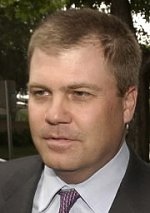
Here’s what happened on Friday. Tony Canales, a former United States Attorney in Houston from 1977-80 who is a defense attorney for one of the Broadband defendants, was cross-examining the key prosecution witness and former Enron Broadband CEO, Ken Rice (pictured above).

Mr. Canales attempted to offer into evidence the raw footage video of an analysts’ conference that Mr. Rice testified about on direct examination from another video that the prosecution used. U.S. District Judge Vanessa Gilmore would not allow Mr. Canales to show the raw footage video to the jury on Friday afternoon because the prosecution had not yet had an opportunity to review it on Friday, which was a rather odd ruling given that the prosecution had given the video to the defense in the first place.

At any rate, the defense’s raw footage video came into evidence this morning, and the defense showed the raw footage video side-by-side to the prosecution’s video from which Mr. Rice had previously testified during direct examination.

It turns out that the prosecution video of the analysts’ conference is different in material respects from the raw footage video and that the prosecution’s video — contrary to Mr. Rice’s testimony on direct — contained footage of defendant Rex Shelby making statements that was not shown to the analysts at the conference.

Well, as you might expect, Mr. Rice is in full retreat today as Mr. Canales and other defense attorneys hammer him on why he previously testified that Mr. Shelby had made statements at the analysts’ conference that he actually did not make. According to Mary Flood’s Chronicle article, Mr. Rice appeared to be rather confused:

Rice said he’d seen the government’s video before testifying and when prosecutor Ben Campbell showed it to him in court Tuesday, Rice testified that he was surprised that Shelby was talking about the network operating system as up and running when it wasn’t.

“The government represented that the tape that included Shelby came from Enron and was played at the analysts conference,” Rice said.

In questioning from defense attorney Tony Canales, Rice said he knew Shelby had taped the segment in question and knew it was slated to be shown to the analysts.

Under questioning today, Rice said he thought about this a lot of over the weekend and even talked to his lawyer about whether he’d been shown the wrong tape and convinced himself he did see the Shelby segment at the analyst conference.

“He wasn’t any help to you then?” Canales asked Rice.

“All that money, no,” Rice said smiling back.

It was one of several light moments in the day when Rice acknowledged being somewhat overwhelmed by the circumstances.

Of note, Mr. Rice is testifying under a cooperation agreement in which he has pleaded guilty to one count of securities fraud in return for the prospect of a reduced sentence. However, the government’s support for that reduced sentence is conditioned upon Mr. Rice testifying truthfully during the Broadband trial. He is in his seventh day of questioning.

Even inside the courtroom — much less outside it — it’s notoriously difficult to evaluate how much any of this affects the jury. If the prosecution handles it correctly on re-direct, then the Enron Task Force prosecutors will take the blame for using the wrong video, apologize to the jury for their mistake, and simply have Mr. Rice re-confirm his opinion that certain of the statements made on both the raw footage video and the prosecution’s video were false. So long as the prosecutors take such an approach in a forthright manner, the jurors may view the prosecution’s use of the wrong video as an honest mistake and not think much about the erroneous part of Mr. Rice’s testimony.

On the other hand, if not handled well on re-direct, this is the type of mistake that could blow up in the prosecution’s face. Mr. Rice will almost certainly be called a liar by future witnesses for the defense during this trial, so his credibility will be a key issue for the jury.

The prosecution’s mistake in using the wrong video — and Mr. Rice’s failure to catch it — opens him up to the age-old defense tactic of arguing to the jury that “telling the truth is easy, but lying without making mistakes is hard.” In short, Mr. Rice was lying and the best evidence of it is that he was willing to lie about what statements were made at the analysts’ conference in return for the promise of government support of a shorter prison sentence.

So, watch this part of the trial closely. Three of the defendants in the Broadband trial have to overcome a huge elephant in the courtroom — i.e., the multi-millions that they made on selling Enron stock during an 18 month period. However, discrediting the government’s key witness is a nice start to deflating the prosecution’s case. Let’s see whether the prosecution can minimize the damage to their witness in the jurors’ eyes and move on to refocusing their case against the defendants on that elephant.

Texas Pacific goes after Neiman’s

Neiman logo.gifFt. Worth-based Private equity firm Texas Pacific Group and its partner Warburg Pincus are close to a deal to acquire luxury retailer Neiman Marcus Group Inc. for about $5 billion ($100 a share). The deal would be the latest in a trend of recent big buyouts in the U.S. retail industry.
The deal includes 35 Neiman Marcus stores and two Bergdorf Goodman stores in New York. The Texas Pacific-Warburg venture apparently beat rival bids from Blackstone Group LP and Thomas H. Lee Partners LP and from Kohlberg Kravis Roberts & Co. and Bain Capital. Interestingly, no retailers made a bid on Neiman’s.
According to my wife — who is a shopping expert — Neiman’s is one of the most valuable brand names in American retail circles. Texas Pacific has experience in retailing after acquiring 85% of clothing retailer J.Crew in 1997, which my wife points out has become a first rate retailer since that time.

Daily negative AIG report

aiglogo160.gifFollowing on Friday’s negative report, American International Group Inc. announced late Sunday that it would restate more than four years of financial statements and reduce its net worth by $2.7 billion, which is about 3.3% of AIG’s net worth. Although the report does not name names, the report concedes that former AIG executives — including embattled former CEO Maurice “Hank” Greenberg — had been able to “circumvent internal controls over financial reporting” and that the company’s auditors, PricewaterhouseCoopers LLC, will issue an adverse opinion regarding AIG’s defective internal controls over financial reporting. Here are the posts over the past several months involving AIG and Berkshire Hathaway.
In addition to admitting certain reinsurance deals such as the one between AIG and General Re (Berkshire Hathway’s unit) involved insufficient risk transfer to qualify for favorable insurance accounting, AIG’s Sunday public statement conceded widespread use of trades in and out of hedge funds as one of several improper company strategies to convert capital gains into investment income toward the end of reporting periods to impress the market. With regard to the accounting for those and other transactions, the report concludes as follows:

The restatement will correct errors in prior accounting for improper or inappropriate transactions or entries that appear to have had the purpose of achieving an accounting result that would enhance measures important to the financial community. In certain instances, these transactions or entries may also have involved misrepresentations to members of management, regulators and AIG’s independent auditors.

The statement admitted that the company used accounting tactics to change the timing and characterization of gains and losses, but it does not address the alleged improper characterization of worker’s comp insurance premiums that surfaced last week. Here is the Wall Street Journal ($) copy of the company’s statement.
Meanwhile, the Oracle of Omaha — in addressing his Berkshire Hathaway subjects . . er, I mean, shareholders over the weekend — stated that he is confident that Berkshire’s General Re unit will survive the current regulatory scrutiny and continue to contribute to Berkshire’s earnings.

Stros 2005 Review: Checking in on the Stros

Astros-Logo.jpgLast time we checked in on them, the Stros were coming off a successful homestand and feeling pretty good about themselves. However, after an atrocious roadie in which they lost five straight (including three shutouts) to the division-leading Cardinals (15-8) and the pathetic Pirates (8-15), the Stros (10-13) came home licking their wounds. And after frittering away yet another strong Rocket pitching performance in the Friday night opening game of the weekend homestand against the Cubs (12-12), things just didn’t look good at all.
However, the Stros’ bats finally came alive against the Cubs’ sore aces Wood and Prior in the Saturday and Sunday games, and the club won both games comfortably. So, the Stros come into their upcoming three game set against the Pirates feeling at least competitive at the plate again.
BerkmanRR.jpgDespite last week’s losing streak and a 1-10 road record, the Stros are only a game or two below where I thought they would be one month into the “B.B.R” (“before Berkman returns”) portion of the season (Berkman is pictured left on a rehab assignment at AAA Round Rock). One month into the season, the Stros hitters have not hit quite as well as I thought they would, but their pitchers have pitched even better than I thought they would. Except for some managerial malpractice by Phil Garner in hitting Everett (.240 AVE/.326 OBP/.400 SLG) at lead-off for most of the season and in inexplicably giving Lamb (.262/.354/.571) — whose grand salami off of Prior was the key hit in Sunday’s win over the Cubs — roughly half the at bats of Luke Scott (.154/.250/.205) to date, the Stros probably would have won a game or two more.
As expected, hitting has been the problem for this Stros club. As measured by the all-important statistic of runs created against average (“RCAA” explained here), the Stros are tied with the Brewers (11-13) as the second-to-last hitting team in the National League through the first month of the season, above only the utterly incompetent Pirates. Only Lane (.295/.330/.557) Lamb and Bags (.263/.366/.434) have positive RCAA’s, although frankly CF Taveras (.267/.333/.387) has to be rated a pleasant surprise at being able to maintain a -2 RCAA through the first month of the season given that his defense has been generally superior (he threw out three Cubs at the plate over during the weekend series). Similarly, the -2 RCAA of SS Everett — whose defense has been typically superior and who has shown signs of becoming at least an average National League hitter this season — is probably acceptable at this stage of the season. Finally, after a hot start, Bidg (.265/.322/.434) has tailed off to a -1 RCAA, but at least his track record indicates that he will improve as the season progresses.
On the other hand, Ausmus (.231/.310/.269), Burke (.238/.289/.262), Ensberg (.246/.342/.377) and Scott have all have -4 RCAA, meaning that each of them have produced four fewer runs than an average National League hitter would have produced so far this season using the equivalent number of outs that each player used. Ausmus has been particularly awful, even by his notoriously low standards. In 57 plate appearances, Ausmus has had 10 singles, two doubles and five walks — it’s clearly time to give the newly-acquired Quintero a chance with the big club. It is almost certain that he could not be worse than Ausmus.
Although getting Berkman back will certainly help, the Stros hitting problems are more than one great hitter can cure. Bags’ power drain — his slugging percentage last season and this season is down over .100 points from the 2001 season — appears to be permanent. Ensberg still has not regained the stroke from his breakout 2003 season, and at age 39, Bidg is certainly no sure bet to hit much better than an average National League hitter this season. Moreover, the Stros’ top hitting prospects at AAA (LF Todd Self) and AA (CF Josh Anderson) have shown little power in the minors. Consequently, absent a trade for another slugger to complement Berkman, the Stros are likely stuck with this group of generally unproductive hitters for the remainder of the season.
Meanwhile, the Stros’ pitching has been nothing short of remarkable so far this season. Ranking fourth best in the National League behind only the Marlins (14-9), Braves (15-10), and Cardinals, every pitcher on the Stros’ staff except for “Home Run” Duckworth and Backe have a positive runs saved against average (“RSAA” explained here), and Backe has actually pitched reasonably well except for this adventure in St. Louis. The ageless Clemens leads the National League in RSAA through the first month of the season and the remainder of the staff members appear to be on their way to solid seasons. Accordingly, if the Stros can simply figure out a way to be an average National League team in hitting, the Stros’ pitching is good enough to carry the club into contention for at least the Wild Card playoff spot.
Some food for thought — is it time for the Stros to use some of their pitching talent in a trade to acquire more hitting? The Stros are loaded with at least five top pitching prospects at AAA Round Rock (Astacio, Wandy Rodriguez, and Jared Gothreaux) and AA Corpus Christi (Fernando Nieve and Jason Hirsch). Perhaps dangling Burke with one of two of those prospects would generate interest from a pitching starved club such as the Reds so that they would dangle one of their young slugging outfielders. Adam Dunn, Austin Kearns, or Wily Mo Pena would sure look good in a Stros uniform.
The Stros need to make some hay during the upcoming home series against the hapless Pirates because that series is followed by a seven game road trip to Atlanta and Miami, two places where wins are rare. Pettitte pitches the Monday game before Ezequiel Astacio gets his first Major League start in the Tuesday game. After the following seven game roadie, the Stros return to MinuteMaid Park on Thursday, May 12th for a seven game homestand against the Giants (13-11) and the Diamondbacks (14-10). If the Stros come into the San Francisco series with at least a 16-17 record, then my sense is that they would still be on course for this season.