
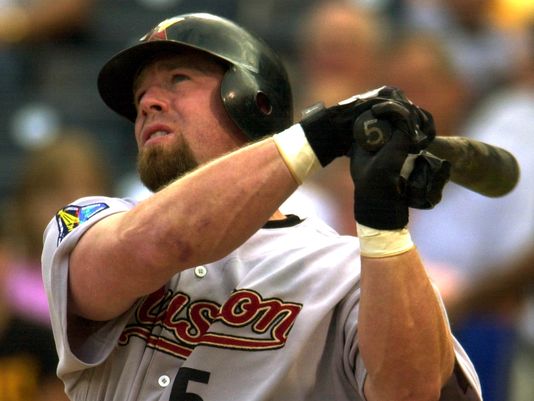
Bags opts for shoulder surgery

In a last ditch effort to salvage another season or two of his career, longtime Stros 1B Jeff Bagwell has decided to undergo surgery on the arthritic right shoulder that has been deteriorating over the past several years.

Bags’ move to the disabled list and this surgery are probably both necessary steps toward the Stros working out a settlement with the disability insurer on Bags’ contract. Such a settlement would assist the Stros financially in paying off the balance of the $39 million or so that the club owes Bags over the remaining two years of his contract. My bet is that Bags will not be able to regain enough strength in his surgically repaired shoulder to withstand the rigors of playing Major League Baseball.

Bags’ impending retirement has generated an gratingly stupid discussion in the mainstream media about whether Bags should be elected to the Baseball Hall of Fame. On both talk radio and in the print media, supposed “experts” (with the notable exception of Charlie Pallilo) opine almost daily as to the pros and cons of whether Bags should be elected. In many respects, the discussion reflects the truth of what Bill James examined in his book about the Hall, Whatever Happened to the Hall of Fame — that is, that election to the Hall is largely an arbitrary political process that has little to do with a player’s performance during his baseball career.

Frankly, Mr. James’ book is one of the reasons why I prefer Lee Sinins‘ much better conceived Baseball Immortals website in which each member of that group is selected solely on the basis of their performance as a baseball player. It is quite illuminating to see how many members of the Hall of Fame do not come close to meeting the standard of performance of membership in Baseball Immortals, and how many of the members of the performance-based Baseball Immortals group still have not been elected to the Hall.

In short, Bags should be elected to the Hall of Fame on the first ballot, and it is not even a close call. For his career, Bagwell has an incredible 680 RCAA (RCAA explained here) in 2,135 games (meaning that he has created 680 more runs than an average National League hitter would have created in those games), a .297 batting average, a gaudy .408 on-base percentage (to put that in perspective, an average National League hitter had about a .340 OBP last season), a slugging percentage of .541, and a monstrous .949 career OPS (on-base percentage + slugging percentage) compared to the league average OPS during Bagwell’s career of .763!

In addition to the foregoing, Bagwell holds the modern NL record for career RCAA by a 1B:

1 Jeff Bagwell 680
2 Johnny Mize 638
3 Willie McCovey 536
4 Bill Terry 425
5 Todd Helton 406
6 Stan Musial 399
7 Keith Hernandez 371
8 Dolph Camilli 353
9 Will Clark 331
10 Frank Chance 330

Indeed, Bags’ running mate — Craig Biggio — has “only” a .810 career OPS (compared to his league average of .756) and 357 RCAA in 2447 games. The fact that Bidg should be a surefire Hall of Famer underscores the fact that Bags should be, too.

And as if the foregoing stats were not enough, Bags was among the best defensive first basemen in the game until his shoulder injury robbed him of his throwing ability over the past several seasons, and he remains — despite average speed — one of the best and most instinctive baserunners in the game during his career.

Just to underscore the foregoing, Mr. James — who knows more about baseball in his pinky than most of us can comprehend — rates Bags as the fourth best firstbaseman of all-time in his New Bill James Historical Abstract, behind only Lou Gehrig, Jimmie Foxx, and Mark McGwire.

So, please. Whenever you hear someone take the ignorant position that Bags was not good enough to be in the Hall of Fame, please refer them to this post. Bags may not make it into the Hall because of arbitrary and capricious bias. However, such a non-selection would have nothing to do with his performance. He is truly one of baseball’s greats.

More favorable date for the Shell Houston Open?

pga_tour_logo.gifAs noted in this previous post, the Shell Houston Open has suffered for years because it is played two weeks after The Masters Tournament when most of the best players are taking a break before gearing up for the U.S. Open in June.
However, the PGA Tour is currently negotiating a new television contract and, in that connection, is considering a revamped schedule that would move the Players Championship’s current late March date to a more favorable date in May. This Florida Times-Union article on the subject sets forth the following tournament schedule model that is being considered as an alternative to the current one, and this schedule would give the Shell Houston Open a much more favorable date the week before the Players Championship:


January

Mercedes Championship, Hawaii
Sony Open, Hawaii
Buick Invitational, La Jolla, Calif.
Bob Hope Chrysler Classic, Palm Desert, Calif.
February
FBR Open, Scottsdale, Ariz.
AT&T Pebble Beach National Pro-Am
Nissan Open, Los Angeles
Chrysler Classic of Tucson
March
Ford Championship at Doral, Miami
Honda Classic, Palm Beach Gardens
Bay Hill Invitational, Orlando
Accenture Match Play, Innisbrook
April
BellSouth Classic, Atlanta
Masters, Augusta, Ga.
MCI Heritage, Hilton Head, S.C.
Shell Houston Open
May
Players Championship
Wachovia Championship, Charlotte, N.C.
EDS Byron Nelson Championship, Irving, Texas
MasterCard Colonial, Fort Worth, Texas
FedEx St. Jude Classic, Memphis, Tenn.
June
Memorial, Dublin, Ohio
Booz Allen Classic, Potomac, Md.
U.S. Open
Barclays Classic, Westchester, N.Y.
July
Western Open, Lemont, Ill.
American Express Invitational
British Open (B.C. Open, Endicott, N.Y., the same week)
U.S. Bank Championship, Milwaukee
August
Buick Open, Warwick Hills, Mich.
International, Castle Rock, Colo.
PGA Championship
NEC Invitational (Reno-Tahoe Open the same week)
September
Deutsche Bank Championship, Norton, Mass.
Tour Championship, Atlanta (John Deere Classic, Silva, Ill., same week).
End of official money season and beginning of next official money season.

September
Bell Canadian Open
84 Lumber Classic, Farmington, Pa.
Southern Farm Bureau Classic, Annandale, Miss.
October
Valero Texas Open
Chrsyler Classic of Greensboro
Michelin Championship of Las Vegas
Funai Classic at Disney World
End of official money events for calendar year

Senate report implicates Bayoil with helping Kremlin in Oil for Food Scandal

UN Oil for Food Scandal2.jpgThis Washington Post article reports that a Senate Permanent Subcommittee on Investigations investigation into the U.N.’s oil-for-food program has concluded that Houston-based oil trading company, Bayoil, “paid millions of dollars in illegal, under-the-table surcharges” to the Iraqi regime of Saddam Hussein regime under the program and that Hussein used the illicit proceeds from the oil sales to buy weapons, among other things. The Senate Subcommittee report was made public last night in advance of a hearing today on the matter. Here are earlier posts on the oil-for-food scandal.
The report concludes that the Bayoil payments were part of a scheme under which Iraq sought to influence and reward the Russian government for supporting the Hussein regime in U.N. Security Council deliberations regarding sanctions against the Iraqi government. The Senate report contends that Bayoil played a key role in numerous transactions with the Iraqi government, and that Bayoil arranged transactions between Iraq and former prominent Russian politician Vladimir Zhirinovsky under which a Russian entity would purchase the oil and, without ever taking possession, sell it to Bayoil. Apparently, the Senate report includes a copy of a letter from Bayoil described how the company paid an “agreed premium” to Mr. Zhirinovsky for his cut of the transaction.

“And those legacy airlines are doing just great, too”

Greenspan.jpgFederal Reserve chairman Alan Greenspan gave the commencement address at Wharton yesterday and was quoted as saying the following: “I am surprised that the Sarbanes-Oxley Act, so rapidly developed and enacted, has functioned as well as it has.”
H’mm. This earlier post notes Mr. Greenspan’s rather dubious views on criminalizing negligence of business executives. But if you want a detailed analysis of the error in Mr. Greenspan’s opinion on the Sarbox legislation, Professor Ribstein’s archive of Sarbox posts is an excellent resource.