Why rich folks go broke

george Foreman grilling.gifHoustonian, former heavyweight boxing champ and now successful businessman George Foreman is featured in this Timothy O’Brien/New York Sunday Times article from last weekend that explores the question of why many prominent people are incapable of maintaining their wealth and end up wrestling with insolvency.
Foreman, who is a remarkable and fascinating fellow, tells the story in the article of how he blew his first fortune from winning the heavyweight championship the first time around and how that experience drove him to make the attempt to win it again at the age of 45. Big George rebounded from his insolvency experience by earning several multimillion-dollar purses during his brief return to boxing in the early-1990ís and then making millions more by reinventing himself as a good-natured entrepreneur and pitchman, cleverly peddling the popular hamburger grills that bear his name.
Interestingly, Foreman’s flirtation with insolvency did not involve the usual story of corrupt managers taking advantage of a young, uneducated and unsophisticated boxer. Rather, Foreman experienced insolvency the right way, taking risks and learning from them:

Mr. Foreman, unlike most entertainers and athletes, had homegrown financial antennae, and his budgetary acumen surfaced at a relatively early age. He slugged his way into prominence by winning a gold medal at the 1968 Olympics, and a year later, when he was 20, he turned pro. Schooled, he said, in the perils of errant spending by the financial predicament of the boxing legend Joe Louis, he decided to form the George Foreman Development Corporation in 1971.

Continue reading

Steven D. Levitt on gangs and crack cocaine

levitt.jpgIn this clever and lively lecture, University of Chicago Economics Professor Steven D. Levitt of Freakonomics (Morrow 2005) fame explores his research into the economics of gang members selling crack cocaine. Levitt’s description of the way in which some gang members added the correct answer to the initial multiple choice question that the field researcher posed to them is priceless.
Hat tip to Greg Mankiw for the link to Levitt’s lecture.

Duck Soup

OU-Oregon onside kick 092206.jpgTo say that college football is a passion in Oklahoma is an understatement, which has been reflected this week as many supporters of the University of Oklahoma football team are undergoing psychotherapy over a blown call by a replay official on an onsides kick that allowed the University of Oregon Ducks to nip the Sooners at the end of their game last Saturday in Eugene, Oregon.
Well, Oregon apparently has had enough of the OU criticism over the blown call and is now fighting back. Don’t miss this hilarious news conference as the Oregon Duck explains with White House Press Secretary-style clarity that the replay official’s call was actually the correct one.

The Fastow sentencing memorandum

Fastow18.jpgAs Jamie Olis awaits his resentencing for working on a transaction for which he did not profit, Andrew Fastow’s lawyers (one of whom is Olis’ attorney — small world, isn’t it?) filed a sentencing memorandum earlier this week that claims that Fastow has “stepped up to take responsibility,” has expressed “full remorse” for his role in Enron’s demise and “is a changed man.” WaPo’s Carrie Johnson reports on the memorandum here and a copy of the Fastow sentencing memo can be downloaded here.
Before you become convinced that Fastow has turned his back on his evil ways and become a paragon of virtue, take a moment to review the following:

How Fastow served up his wife as a sacrifical lamb for his effective embezzlement of funds from Enron;
How Fastow used the NatWest Three to hide his embezzlement of funds from Enron and then turned on the bankers to save his skin;
How Fastow may have forged Richard Causey’s initials on the Global Galatic “agreement”;
Fastow’s bizarre testimony in the Lay-Skilling trial; and
Fastow’s involvement in ruining the careers of four innocent Merrill Lynch executives in order to lessen his prison sentence.

Changed man? Heck, it looks to me as if Fastow has manipulated the Enron Task Force in the same manner as he manipulated many of his colleagues at Enron.

The resentencing of Jamie Olis

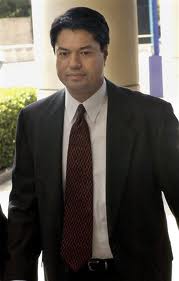
Jamie Olis.jpgUS District Judge Sim Lake announced yesterday that Jamie Olis will be resentenced on Friday at 2 p.m., almost a year after the Fifth Circuit Court of Appeals reversed Judge Lake’s previous 24+ year sentence.

As we await another chapter in what has emerged as one of the most egregious injustices of the government’s criminalization of business interests during the post-Enron era, the following are a sampling of my posts on the Olis saga since I began following the case two and a half years ago:

My first post on the sad case of Jamie Olis (March 24, 2004), a little over a month after the beginning of this blog;

The WSJ’s Holman Jenkins notices the sad case of Jamie Olis (March 31, 2004);

Larry Ribstein addresses the Olis case for the first time, marking the beginning of this fine scholar’s writings in the blawgosphere on the dubious nature of the government’s regulation-of-business-through-criminalization policy (April 7, 2004);

Olis is ordered to report to prison on May 20, 2004 (May 5, 2004);

The Wall Street Journal runs its first thorough article on the Olis case (May 20, 2004);

Novelist and former prosecutor Mark Costello decries the Olis sentence and the increasing criminalization of business interests in the New York Times (June 7, 2004);

The Los Angeles Times weighs in with a thorough article on the Olis case (July 12, 2004);

Sentencing scholar Douglas Berman takes up the Olis case, beginning his excellent blawgosphere analysis of the unjust nature of the sentence (July 16, 2004);

The sad case of Olis gets even sadder as he is transferred to a prison far away from his wife and young daughter (January 31, 2005);

The government’s misrepresentation of the market losses in the Enron Nigerian Barge trial mirrors the prosecution’s misrepresentation of the market loss involved in the Olis case (April 20, 2005);

Would Olis have fared better had he been tried and sentenced in Russia? (June 1, 2005);

While Theodore Siphol goes home, Bill Fuhs and Jamie Olis go to jail (June 24, 2005);

The Olis case is lost amidst the myopia of the NY Times (September 16, 2005);

Embezzling $43 million and copping a plea is better than embezzling nothing and asserting one’s innocence at trial (October 16, 2005);

Finally, some justice for Jamie Olis as the Fifth Circuit reverses his 24+ year sentence (November 1, 2005);

The Chronicle’s business columnist Loren Steffy — who generally supports the government’s regulation-of-business-through-criminalization policy — says that the government has gone too far in the Olis case (November 24, 2005);

The Justice Department’s initial reaction to the reversal of Olis’ sentence is that he should be resentenced to “only” 15 years (December 21, 2005);

The Justice Department drags its feet in regard to the Olis resentencing (January 18, 2006);

Short-selling and the genesis of the case against Olis (February 4, 2006);

Hope for Olis on the key market loss issue (February 27, 2006);

Martin Frankel’s sentence exposes the absurdity of Olis’ original sentence (March 24, 2006);

Prison time is slow time” (June 22, 2006);

More hope for sanity in the resentencing of Olis (August 1, 2006);

Professor Grundfest takes on the market loss issue in the Olis case (August 22, 2206);

The Justice Department continues misrepresenting the market losses in the Olis case (September 6, 2006) while The Economist weighs in on the market loss issue (September 19, 2006);

The prosecution asked Professor Grundfest what? (September 13, 2006); and

The Olis resentencing hearing concludes (September 14, 2006).

Update: As usual, Larry Ribstein has a most insightful observation about the Olis resentencing:

The government has built much of its scheme for putting business in jail on this unfortunate young father. For more than two years, prosecutors could use the Olis example to soften up defendants for pleas and cooperation, sort of like a murdering despot pointing to his display of his enemies’ spiked heads. A significant reduction in Olis’s sentence would not only be a welcome bit of justice for Jamie Olis, but an important symbolic turn in the government’s questionable campaign.

Update 2: Olis was resentenced to six years.

Update 3: Olis’ ordeal continues (December 10, 2006).

Update 4: Did the Bureau of Prisons forget about Olis (February 1, 2007)? And Olis finally receives a ticket to Bastrop (February 11, 2007).

Update 5: Troubling information is revealed regarding the DOJ’s interference with the Olis defense (May 28, 2007).

Update 6: The Olis connection to the KPMG criminal case (June 13, 2007).

Update 7: Information on what really happened during Olis’ criminal trial finally starts to come out (October 9, 2007).

Update 8: Did the prosecution violate its Brady obligation to turnover exculpatory evidence to the Olis defense (December 4, 2007)?

Update 9: Why is the United States imprisoning people such as Jamie Olis (April 27, 2008)?

Update 10: This is criminal justice (Aug 9, 2008)?

Update 11: People who live in glass houses . . . (Aug 26, 2008).

Update 12: But what about the case in which the threat worked? (December 5, 2008).

Update 13:Olis as a casualty of the criminalization-of-business lottery (January 13, 2009).

Update 14: Reflecting on astonishing abuses of power (August 10, 2009).

Update 15: Jamie Olis and the trial penalty (October 27, 2009).

Update 16: The incalculable cost of a misguided criminal prosecution (January 5, 2010).

Wasting talent

Skilling22.jpgSo, a tortured Jeff Skilling is back in the news as a result of being cited for public intoxication while visiting Dallas a week or so ago.
While many await with anxious anticipation the imposition of the harsh prison sentence that Skilling will almost certainly receive, I continue to think about the great waste that results from the government’s criminalization policy toward risk-taking businesspersons and Skilling’s legacy of beneficial risk-taking.
This is not the product of a rational criminal justice system.

You just knew this was coming

amaranth.jpgThe business news was awash with articles over the past couple of days about how Amaranth Advisors, LLP lost $5 billion or so by making wrong bets that natural gas prices would rise. Inasmuch as Monday morning quarterbacking is much easier than actually making money in placing such bets, it’s fairly clear what happened. As gas prices fell precipitously because of a storage glut, Amaranth increased bets that would pay off exponentially only if natural-gas prices rebounded in anticipation of a cold winter or as a result of a hurricane hammering natural-gas facilities. That hasn’t happened and so prices have continued to erode.
Meanwhile, Amaranth’s risk management systems apparently did not accurately measure how much downside risk the company faced and did not provide an effective mechanism for hedging that risk. Amaranth’s bets went bad because the company misjudged the spread, which is the movement of the difference between prices for different month contracts. The institutions and wealthy investors that invested with Amaranth knew about that risk, but they took it because of the potential for big gains if Amaranth bet right. Nothing too unusual about that.

Continue reading

A story that Bill O’Reilly would love

oreillyconfused6.jpgOil prices kept falling yesterday as the October crude contract on the New York Mercantile Exchange dropped $2.14 to settle at $61.66 a barrel, which is the lowest price for a front-month crude contract in six months. A couple of weeks ago, Pejman Yousefzadeh wrote this TCS Daily op-ed in which he observed that, despite such declining prices, the Bill O’Reilly-type claims of manipulation of oil markets continue to persist.
As if on cue, this NewsBusters post reports on a recent installment of the CNN show, “The Situation Room,” in which CNN reporter Bill Schneider speculated ominously that the current decrease in energy prices has been timed to help Republicans in the midterm elections:

“The drop in prices may last a couple of months, long enough to get through the November election. Could that be what the oil companies want?”

Schneider’s observation was then “buttressed” with the insight of one Tyson Slocum, a “consumer advocate:”

“Eighty-one percent of their money goes to members of the Republican Party. I cannot say for sure whether or not they are influencing prices to assure that outcome, but it is, I think, more than just a coincidence that we’re seeing an easing of prices at a time of running up to a very, very important election.”

That’s a helluva consumer advocate who argues that lower prices for consumers is a dark conspiracy of the Republican Party and big energy companies. Does that mean that the far lower energy prices that existed in the run-up to the 2000 election were the result of an equally dark conspiracy of the Democratic Party and big energy companies?

KPMG continues to play rough with its former partners

kpmg logo53.jpgIn this earlier post, I noted that KPMG’s resistance to paying its former employees’ defense costs in the KPMG tax shelter criminal case could end up being an element in prompting US District Judge Lewis Kaplan to dismiss the charges because of the government’s prosecutorial misconduct in coercing the firm into that position.
Now, it looks as if KPMG has gone one step further. According to this Lynnlee Browning/NY Times article, KPMG is now suing several of its former employees who are also defendants in the criminal case for damages resulting from their alleged embezzlement from the firm and breach of fiduciary duty to the firm in regard to their involvement with the tax shelters.
That lawsuit — along with the firm’s continued refusal to pay their employees’ defense costs in the criminal case — must be giving current KPMG partners a warm and fuzzy feeling, don’t you think? Also, a note to KPMG — such civil suits have a little process called “discovery,” which often leads to the publication of embarrassing information. As if the firm needs any more bad publicity from this seemingly endless debacle.
Meanwhile, this Wall Street Journal editorial ($) reports that two previously undisclosed IRS memos to KPMG from 2003 and 2004 confirm that the Service didn’t think there was anything wrong with the shelters. The defendants in the criminal case are understandably demanding all government documents relating to such memos, and the prosecution — as is typical in this era of criminalizing business — is resisting those demands. In short, the legality of the KPMG tax shelters was a subject of debate within the IRS, but the Justice Department brought the criminal case anyway before the IRS had even won a court ruling declaring the shelters to be illegal.
So much for due process, eh?

Awaiting the Jamie Olis Sentence

As we await U.S. District Judge Sim Lake’s decision on the re-sentencing of Jamie Olis later this week, this Economist article does an excellent job of summarizing the issues that are at play in determining the all-important market loss issue with regard to Olis re-sentencing.

I particularly enjoyed the last sentence of the article:

“If Judge Lake has been spending the summer getting up to date on economics, perhaps Mr Olis will be out of prison much sooner than he must once have feared.”