 Under mounting criticism over its dubious tactics in regard to threatening to go Arthur Andersen on KPMG in the prosecution of the firm’s promotion of questionable tax shelters, the Justice Department is now making nice in Congress.
Yesterday, deputy attorney general, Paul J. McNulty testified during a hearing of the Senate Judiciary Committee and, while defending such dubious tactics as criminalizing a potential defendant’s rights to counsel and to assert the privilege against self-incrimination, suggested that the DOJ might consider some changes on the margin to its corporate crime guidelines such as the odious Thompson Memo. Here is a link to McNulty’s testimony and to that of other witnesses at the hearing.
But McNulty’s arrogance in defending the Justice Department’s campaign to criminalize business in the post-Enron era was not even the most appalling part of the hearing.
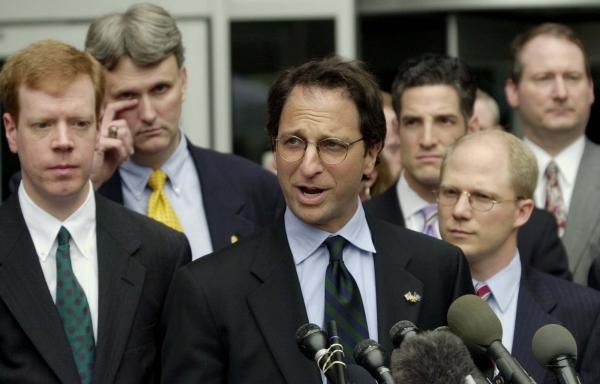
That occurred when Andrew Weissmann, the former chief of the Enron Task Force, presented a written statement in which he calls for revision of the Thompson memo and a “rethinking of corporate criminal liability.”
According to the Weissmann, who parleyed his Enron Task Force job into a partnership at Jenner & Block, the Thompson memo “should be revised so that it no longer encourages an environment where employees risk losing their jobs or legal defense merely for exercising their constitutional right not to speak to the government . . . ” He went on to observe the following:
In determining whether to indict a company, the Department of Justice should not permit consideration of the company’s treatment of an employee who has asserted her Fifth Amendment right. This factor should simply not come into play in the analysis of whether a corporation has or has not cooperated. Although a company itself can properly fire an employee or cut off legal fees based on whether she cooperates with an investigation, the Department of Justice should not weigh in on this determination ñ and not because a court may ultimately deem the company’s actions as government conduct. Rather, for policy reasons, the Department of Justice should simply not base its decision to prosecute a company on whether a person has been punished by her employer for asserting a constitutionally guaranteed right.
And then Weissmann — appearing to be far more open-minded than he was during his prosecutor days — calls for a “rethinking of corporate criminal liability:”
Although the Thompson Memorandum has recently received significant negative attention, and is in some ways an easy target, it is not the real source of the problem. The root cause that renders the Thompson Memorandum such a sharp weapon is the standard for criminal corporate liability and the absence of systemic checks to restrict the government’s power to charge corporations whenever an employee strays. The current standard for corporate criminal responsibility affords prosecutors enormous and unduly disproportionate leverage and power. In this climate, a corporation has little choice but to conform its conduct to the Thompson Memorandum factors, even in the absence of a prosecutor’s overt threats.
Of course, Weissmann then proposes a feckless change for the standard for corporate criminal liability in which the government would be required to take into account “a companyís attempts to deter the criminal conduct of its employees”:
Holding the government to the additional burden of establishing that a company did not implement reasonably effective policies and procedures to prevent misconduct would both dull the threat inherent in the Thompson Memorandum as well as help correct the imbalance in power between the government and the corporation facing possible prosecution for the acts of an errant employee. A more stringent criminal standard, one that ties criminal liability to a company’s lack of an effective compliance program, would have the added benefit of maximizing the chances that criminality will not take root in the first place since corporations will be greatly incentivized to create and monitor a strong and effective compliance program. The objectives of law-abiding society, the criminal law, and even of the Department of Justice’s Thompson Memorandum itself, would then be well served.
So, in short, unless a company has what the DOJ deems as a satisfactory compliance program to deter bad conduct, Weissmann contends that it is acceptable for the government to go Arthur Andersen on companies that pay for the defense costs of employees who assert such fundamental rights as the privilege against self-incrimination.
Neither mentioned nor challenged is Weissmann’s dubious judgment in contributing to billions of dollars in economic loss and inestimable human hardship from pre-emptively prosecuting Arthur Andersen out of business, Weissmann’s continual threats to go Arthur Andersen on Merrill Lynch because of its payment of defense costs for the four former Merrill executives involved in the equally reprehensible Nigerian Barge prosecution and the long line of serious prosecutorial abuses that Weissmann was involved in with regard to the Enron criminal cases.
That the Senate Judiciary Committee is seeking guidance from someone such as Weissmann with a questionable background in abusing fundamental principles of our justice system speaks volumes regarding the unlevel playing field that business interests face in defending against the government’s increasing regulation-through-criminalization policy.
As Geoffrey Manne appropriately asked awhile back, “Where’s the outrage?“

 Although not as bad a public relations blunder as last year’s decision to roast their fans during their first home game, the Texans were not particularly hospitable to the high school band that performed at this past Sunday’s opening game of the 2006 season. In addition to being subjected to NFL-mandated pat downs before entering the stadium, Houston-based public relations expert John Wagner reports that the band members were not even allowed to watch one play of the game!
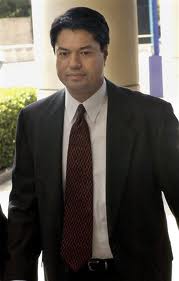 The hearing phase of the re-sentencing of former Dynegy executive Jamie Olis involving the key market loss issue is taking place yesterday and today before U.S. District Judge Sim Lake, and the Chronicle’s Tom Fowler files