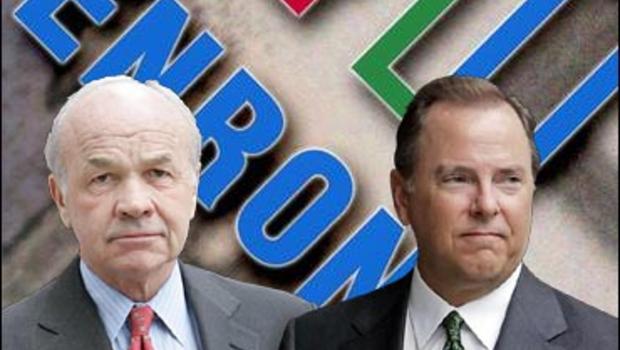
 Remember that point I made in the previous week summaries about the predisposition of the leaders on the jury determining the outcome of the trial of the corporate criminal case of the decade?
Well, in a strong indication that this trial was already over after the jury was selected, the jury in the Lay-Skilling trial concluded its relatively short deliberation (less than five days) before the long holiday weekend and returned a verdict of guilty on most counts against the two key former Enron executives.
The jury convicted former Enron chairman Ken Lay on all six conspiracy, wire fraud and securities fraud charges, and then U.S. District Judge Sim Lake piled on by finding Lay guilty of four more charges of bank fraud in connection with Lay’s bench trial over his self-admitted violation of Regulation U in using bank lines of credit improperly in buying stock in publicly-owned companies.
Former Enron CEO Jeff Skilling was convicted on 18 counts of conspiracy and securities fraud, but the jury convicted Skilling on only one of ten counts of insider trading, prompting Larry Ribstein to ask “does this mean that the jury thought he didn’t know enough about what was happening to bar him from trading, but that he did know enough to go to jail for fraud?”
Ah, the vicissitudes of criminalizing corporate agency costs.
Most followers of the case agree that the jury’s verdict is not particularly surprising. As noted here many times during the trial, the Enron Task Force prosecutors did an effective job of presenting a fundamentally weak case against Lay and Skilling, emphasizing time and time again the real presumption upon which the Task Force’s entire legacy case was based — that Lay and Skilling are rich and Enron collapsed, so they must be guilty of something in connection with Enron’s descent into bankruptcy.
Despite the transparent nature of that presumption, the harsh reality of defending wealthy business executives is that most jurors are just ordinary folks with nominal experience in complex business matters who readily accept such a presumption.
That presumption — coupled with an overwhelming public bias, particularly in Houston, against anything having to do with Enron — was in the end simply too much for Lay and Skilling to overcome.
Although I did not attend nearly as much of the trial as many other observes, I read the entire trial transcript, so I have a reasonably good understanding of the testimony and the evidence.
It’s always a hard call to say when a case as long and arduous as this one may have turned in favor of the prosecution, particularly given the probability that the leaders on the jury were predisposed in favor of the Task Force’s case from the beginning.
However, my sense is that the Lay-Skilling defense was in reasonably good shape after completion of the Task Force’s case-in-chief — there had been no defining moment during that presentation that would have appeared to compel the jury to convict.
Even as late in the trial as completion of Skilling’s testimony during presentation of the defense’s case, no one incident had occurred that appeared to undermine either side’s position in the trial.
However, if there was a defining moment in the trial that sealed the defendants’ fate, then it likely came in Week Fourteen during Task Force prosecutor John Hueston’s cross-examination of Lay over the use of his company line of credit.
Although Lay’s line of credit was legal and the company disclosed his use of it in accordance with applicable law, Lay’s repayment of the large draws on the line with Enron stock at a time when he was encouraging employees and the market to buy company stock was an apparent contradiction that the jurors could easily grasp.
Similarly, Lay’s decision to draw down $1 million on the line five days before Enron’s bankruptcy was a disastrous decision for the defense.
Although done on advice of counsel, Lay’s last-minute draw as the company was sinking into insolvency looked so bad that reference to that testimony by leaders of the jury during deliberations was probably enough to seal any wavering non-leader juror’s view on whether to convict.
If I’m right on that speculation, then one of the most fascinating “wonder if’s” of this trial is whether Skilling would have done better had Lay’s motion for a separate trial early in the case been granted rather than denied?
More time for reflection is needed before the true impact of this trial on business interests can be properly assessed, but the initial signs are not good.
Beyond the waste involved in such prosecutions, it’s hard to fathom how any CEO of a publicly-owned corporation after Lay-Skilling could feel comfortable about doing anything more than making the most banal public statements about the CEO’s company.
Indeed, little incentive exists for a CEO to say anything publicly about the CEO’s company at this point other than “everything you need to know is in our regulatory filings, so go read those.”
The Lay-Skilling saga will quite likely represent yet another disincentive for business executives running emerging businesses to tap public equity markets, while another quite probable effect is to reduce the supply of innovative business executives who will be willing to take on the increasingly risky CEO position in a publicly-owned company at all.
Given that none of that is good for the health of public equity markets, those are decidedly incongruous results for a prosecution that was supposedly premised on protecting investors in those markets.
Even more troubling for business interests is the disingenuous nature of the Task Force’s theory of the case against Lay and Skilling. The Task Force pitched the case to the jurors as one in which Lay and Skilling misled unsuspecting investors by touting Enron during a period in which it was a much more troubled than they were really letting on.
As Jeff Matthews pointed out during the trial, since when did it become a crime in America for business executives to be overly optimistic about their company?
Any investor who did who did any meaningful investigation of Enron over the final half-decade of its existence easily discovered that the company was a relatively highly-leveraged but innovative business with a low credit rating that was experiencing explosive growth in its trading operation.
As such, it was never anything more than a speculative play for investors and, as such, one that should have been hedged. Jim Johnston of the Heartland Institute noted the same thing recently in this post:
[Investors in Enron stock] should have hedged their risk exposure. If they did not, they were like motorists who have accidents while driving without automobile insurance. We generally do not feel sorry for those people. Moreover, not being hedged is an indicator that those folks did not understand Enronís basic business model and therefore did not deserve the run up in Enronís stock price in 2000 and 2001. They gambled. For a while they won, but eventually lost. This is hardly any different from going to Las Vegas. Except, the federal government is not being asked to prosecute the casinos for fraud.
Stephen Bainbridge noted a similar dynamic in his initial blog post on the verdict:
One of the curious things about this case is the documented evidence that “a number of people were contradicting Enron’s own rosy view of itself long before the middle of 2001.” At what point does a lie by top management cease to matter if the market doesn’t believe it? Presumably the government convinced the jury that people believed the lies Skilling and Lay told, but did the market really do so?
In short, the Task Force presented the jury with the convenient Enron morality play that has become so engrained in the American psyche over the past five years rather than the more nuanced truth. The morality play is easier to tell and understand, but the truth is much more likely to result in justice.
As far as appeal points go, there are a couple of obvious grounds. The first is Judge Lake’s denial of the Lay-Skilling defense team’s repeated motions to change the venue of the trial from Houston.
Although that issue will be determined on appeal under the formidable abuse-of-discretion standard, the Lay-Skilling team will still be able to mount compelling evidence of five years of relentlessly negative local media reporting on Enron, as well as Lay and Skilling. Also, they will be able to show pre-trial polling reflecting a jury pool that was overwhelmingly predisposed to believe that Lay and Skilling must have done something wrong.
Even during the trial, the Houston Chronicle — which did a commendable job of blending traditional news reporting with blogs in providing a trendsetting framework for covering an important news event — featured its lead business columnist on its online Enron news page, who regularly mocked Lay and Skilling in blog posts and columns.
If there ever was a case that begged for a change of venue, then this was it.
But the second obvious appeal point is the most troubling aspect of the entire case — the Task Force’s unprecedented designation of over 100 former Enron executives as unindicted co-conspirators with Lay and Skilling.
Never before has such a wide-ranging conspiracy been alleged in a federal prosecution, and the transparent Task Force motive for doing so became apparent as the prosecution essentially punted on presenting any meaningful case involving a conspiracy of those unindicted co-conspirators during the trial.
The massive unindicted co-conspirator designation was vitally important to the Task Force’s prosecution for two reasons. First, the designation allowed the Task Force to introduce hearsay statements of those unindicted co-conspirators through the testimony of the Task Force’s cooperating witnesses. The Task Force elicited such hearsay statements from its cooperating witnesses frequently during the trial.
But even more importantly, the designation of unindicted co-conspirators effectively precluded dozens of former Enron executives with exculpatory testimony for Lay and Skilling from disputing those hearsay statements or even testifying in the trial because of the threat that a waiver of the Fifth Amendment privilege against self-incrimination would likely lead to criminal charges against such a witness if he or she were to testify contrary to the Task Force’s theory of the case.
The Task Force has used that dubious tactic in each of its Enron-related prosecutions and — as with the other cases — the impact on the Lay-Skilling trial cannot be underestimated.
The Task Force presented the jury with testimony against Lay and Skilling from around 15 or so cooperating witnesses who were former Enron executives. Inasmuch as the Lay-Skilling defense was hamstrung from calling former Enron executives who would have provided exculpatory testimony for the defendants, the jury could have reasonably concluded that the testimony of the former Enron executives who were cooperating with the Task Force was credible because that testimony was not counterbalanced with exculpatory testimony from other Enron executives.
For example, what would the impact have been on this jury if several former Enron executives had testified that key Task Force witness Ben Glisan had repeatedly lied during his testimony? At least one juror in post-trial comments noted that the jury relied heavily on Glisan’s testimony against Lay and Skilling. Would that reliance have been as great had Glisan’s testimony been challenged by not just the defendants, but numerous other — and potentially more credible — former Enron executives?
Reasonable people can differ over the issue of whether criminalizing corporate agency costs is sound public policy. However, there is simply no serious question that the Task Force’s effective preclusion of exculpatory testimony for Lay and Skilling from this trial is a serious affront to the principles of justice and the rule of law upon which our criminal justice system is based.
As Sir Thomas More reminds us, “do you really think you could stand upright in the winds that would blow” if such a prosecution tactic were turned on you?
The parties and their attorneys in this titanic struggle now take a well-deserved breather for a couple of months until the sentencing hearing in early September, a week or so after Labor Day.
Prosecutors Sean Berkowitz, Hueston and Kathy Ruemmler all performed effectively during the trial and carved a path for further success within either the Justice Department or a more lucrative job in private practice.
On the defense side, lead Skilling attorney Daniel Petrocelli and his entire O’Melveny & Myers team were brilliant in defeat, and Lay attorney Mac Secrest did an admirable job under extremely adverse circumstances in picking up a substantial part of the Lay defense when Mike Ramsey was incapacitated by health problems during the trial.
On the bench, Judge Lake was his usual steady presence in handling the unwieldly case and he now becomes the focal point as the case turns to its sentencing phase.
While operating under mandatory sentencing guidelines, Judge Lake was reportedly not pleased with what he considered to be his obligation to sentence former Dynegy mid-level executive Jamie Olis to a draconian 24-year prison sentence.
Shortly thereafter, U.S. District Judge Ewing Werlein rejected Task Force calls for severe 15-year sentences against the four Merrill Lynch executives who were convicted in the currently unraveling Nigerian Barge case, and Judge Lake will almost certainly be confronted with Task Force requests for even longer sentences against the 64-year-old Lay and the 52-year-old Skilling.
Nevertheless, the sentencing guidelines are no longer mandatory, so Judge Lake will have more flexibility in fashioning punishment for the two men than he previously believed that he had in the Olis case. In thinking about what Judge Lake ought to do in this case, I cannot improve on Larry Ribstein’s observation in concluding his post on the Lay-Skilling verdict:
Many people think that there was so much loss associated Enron that the guys at the center of it must have been villains. But they weren’t villains. The jury is saying they weren’t even insider traders, as if that would have made a difference. They lost as much as anybody, and that’s what drove them to lie, if they did lie. This doesn’t make them saints, but it should make even the most hardcore anti-business types queasy with the denouement of this tragedy. Locking these guys up for pretty much the rest of their adult lives for being unable to face the fact that their dream had ended is not the way a civilized society would deal with this case.
Speaking of that supposedly civilized society, amidst the media barrage over the Lay-Skilling verdict, two men and their families in a much different Enron-related case cling to the faint hope that the jury in that case can ignore the rabble and render a fair verdict.
A faint hope indeed.

 Where have you gone, Roger Rocket?