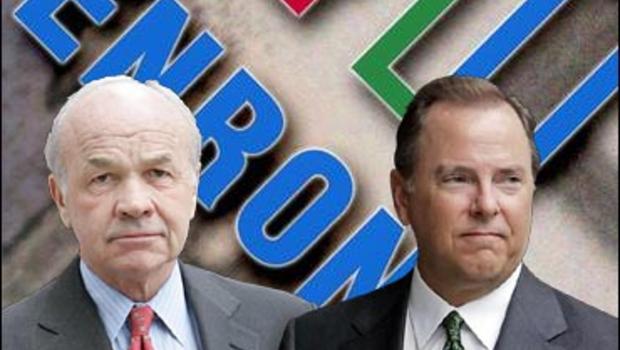
 Week 14 of the corporate criminal case of the decade is in the books and the biggest news is that U.S. District Judge Sim Lake has issued an edict that he does not want the case to go beyond Week 16.
So, it presently looks as if the Lay-Skilling defense will wrap up its case-in-chief next early next week, the Enron Task Force will present a short rebuttal case, and then the reading of the jury charge and the closing arguments will begin on Monday, May 15th with the jury to get the case on Wednesday, May 17th.
So, yes, it does appear that this long slog is really coming come to an end.
The first part of Week 14 was the last chapter of the Ken Lay phase of the trial, and the cross-examination of Lay this week was not much different from last week’s.
Prosecutor John Hueston wasted little time addressing the actual business fraud charges against Lay, choosing again to spend far more time attempting to equate humiliation with guilt in hammering Lay over his personal financial affairs.
Although not particularly persuasive substantively, Hueston’s approach was at least consistent with the Task Force’s strategy of masking a fundamentally weak case through reliance on the real presumption that underlies the Task Force’s theory of the case — i.e., that Enron went bust and Lay and Skilling are rich, so Lay and Skilling must be guilty of some crime.
No corporate criminal trial in recent memory (perhaps ever) has had the extensive media coverage of the Lay-Skilling trial. Multiple blogs and major newspapers cover the trial daily, and the coverage is generally helpful in attempting to keep up with whatís going on in the trial.
However, just as the media coverage generally of Enron from the beginning has been overwhelmingly slanted against the company and its executives, the media coverage of the Lay-Skilling trial has not been particularly insightful in the depth of its analysis of the substance of the Task Forceís business fraud case against the two former executives.
Interestingly, a good dose of the vacuity that passes for analysis of the Lay-Skilling trial comes from the media’s various legal “experts,” some of whom have little or no experience in complex business cases and who appear to be competing with each other to have the most colorful comment of each day.
One such expert even pulled out the Watergate card this week by comparing Lay to the late former president, Richard Nixon.
Really penetrating analysis, eh?
Meanwhile, the media reported breathlessly this week on Hueston’s questioning of Lay regarding his relatively lavish lifestyle and use of Enron stock to pay his company line of credit while attempting to reassure employees and the market that Enron was still a fundamentally strong company.
During and after that testimony, the media covering the trial reached a virtually unanimous consensus that Lay and his defense team had performed poorly.
However, none of the media reports or legal experts raised a key fact relating to the Task Force’s focus on Lay’s personal finances — i.e., that the Task Force has not charged Lay with any crime relating to either his use of Enron stock to pay his company line of credit or his lavish lifestyle.
Sort of an important point, don’t you think?
In reality, the entire line of credit issue smacks of a red herring.
Lay traditionally took a substantial part of his compensation from Enron in stock, which was a good thing for both the company and him. As an accommodation to Lay, Enron’s board approved a line of credit — eventually reaching $7.5 million — that allowed Lay to monetize the stock efficiently by borrowing on the line and then repaying it with his Enron stock.
Each year, Lay and Enron complied with the requirement under S.E.C. rules and regulations to disclose Lay’s use of stock to pay the line.
That arrangement probably wouldn’t have made any difference in this trial except that Lay made what turned out to be a bad financial decision in regard to his personal financial affairs well before the time that the Task Force contends he was involved in wrongdoing at Enron.
Because his $300 million-plus net worth was almost entirely invested in Enron stock, Lay and his financial advisers decided that he should diversify his portfolio.
However, Lay continued to believe that Enron stock was the best value in his portfolio, so rather than selling the stock and using the proceeds to buy other securities, Lay borrowed $100 million from third party financial institutions, pledged his Enron stock as collateral and began buying other assets with the loan proceeds.
In so doing, Lay was exhibiting an optimism and confidence in the underlying value of Enron, a fact that the Task Force conveniently ignores in blithely alleging that Lay knew that Enron was a sinking ship.
Unfortunately for Lay, the steady decline in Enron stock price during 2001 undermined the value of the Enron stock collateral for the $100 million in personal loans that he had used to diversify his portfolio.
Thus, as the collateral value fell and margin calls resulted, Lay used the most efficient facility at his disposal to repay about $70 million of debt in 2001 — i.e., the proceeds from draws on his company line of credit, which he repaid with his Enron stock.
Despite the straightforward nature of the Lay’s line of credit arrangement, the Task Force spent more time on Lay’s handling of it than any other subject during his cross-examination.
Hueston hammered Lay relentlessly over the fact that Lay did not disclose to Enron employees in late October, 2001 that he was using Enron stock to repay the line of credit, on one hand, while advising the employees at the same time that he was purchasing Enron stock and that the stock remained a good value, on the other.
Similarly, Hueston skewered Lay for his draw of a final $1 million on the line of credit roughly five days before Enron filed its bankruptcy case and Lay’s application of those proceeds to pay the remaining balance on the mortgage on his multi-million dollar homestead at the tony Huntington condominiums near River Oaks.
Although the Task Force has not charged Lay with any crime regarding his handling of the line of credit, Hueston repeatedly asserted that Lay’s conduct in regard to it reflects that he is a hypocrite who lacks credibility on other issues.
Lay’s eve-of-bankruptcy draw on the line of credit was clearly ill-advised, but the Task Force is simply wrong in its contention that Lay was largely dumping Enron stock at a time when he was advising employees and the market that it was a good value.
For example, in September, 2001, Lay accepted $10 million in cash and another $10 million in Enron stock when he agreed to step back into the CEO role after Skilling resigned, and Lay used the $10 million in cash to repay a portion of his margin loans.
In so doing, Lay effectively bought $10 million in Enron stock, meaning that Lay acquired over $20 million in Enron stock roughly a month before he made the statements to Enron employees of which the Task Force complains.
Consequently, even though Lay was also paying his line of credit with Enron stock at the same time, his acquisition of another $20 million in Enron stock is consistent with the optimistic view about Enron that Lay was communicating to employees and the public.
In its quest to demonize Lay, the Task Force simply ignores that salient fact.
In view of the Task Forceís emphasis on Lay’s handling of his line of credit, I suspect that the prosecution may attempt to morph Lay’s non-disclosure regarding his use of Enron stock to pay the line of credit into an alleged basis for either a wire fraud or securities fraud charge against Lay.
As noted above, there is nothing in the indictment about any of this being the basis of criminal charges against Lay, so it will be interesting to see how Judge Lake deals with that issue if the Task Force indeed seeks to make such a case to the jury.
However, the underlying weakness of the Task Force’s business fraud case against Lay and Skilling is perhaps best reflected by comparing the number of questions that the Task Force prosecutors asked Lay and Skilling over such titillating issues as PhotoFete and Lay’s handling of his personal finances (literally hundreds) versus the number of questions that the prosecution asked on such core business fraud issues as the alleged Global Galactic agreement and the alleged huge conspiracy at Enron (zero).
Just to underscore the weakness of the prosecution’s case on those points, the Task Force announced on Thursday that it was not going to call former Enron chief accountant and Lay-Skilling co-defendant Richard Causey as a rebuttal witness. So much for the Global Galactic and conspiracy issues.
Accordingly, at the Week 14 pole, the corporate criminal case of the decade appears to be boiling down to PhotoFete and whether Lay should have disclosed that he was using Enron stock to pay his company line of credit while he was touting Enron.
Despite the media’s fixation on Hueston’s hammering Lay regarding his personal finances, Lay actually acquitted himself reasonably well on cross-examination regarding the issues relating to the Task Force’s core business fraud charges.
Moreover, as most of the media fled the courtroom as Lay’s testimony on the lives of the rich and famous ended, a series of expert witnesses continued to poke holes in the foundation of the Task Force’s business fraud charges over the latter part of the week.
For example, I was able to sit in for a couple of hours during Wednesday afternoonís testimony as Skilling accounting expert Walter K. Rush schooled Task Force chief Sean Berkowitz — who does not let a disadvantage in specialized knowledge deter him from lengthy cross-examination — on the validity of Enron’s accounting for its reserves and the resegmentation of the EES retail unit.
Rush was clear and convincing, and explained application of relevant accounting principles to the jury in a clearer manner than any witness to date. Berkowitz was no match for him.
How all of this is going over with the jury is anyone’s guess.
Could a jury convict either or both of the defendants based on such a weak case? Sure, it happens all the time.
However, Skilling and Lay have presented — under extraordinarily adverse circumstances — a compelling defense that they were not involved in any criminal wrongdoing at Enron and that the company’s failure was, at worst, the result of business misjudgments, such as maintaining too low a credit rating and too much leverage for a company with a huge trading operation to endure the post-bubble and post-9/11 market’s reaction to the negative Fastow/Kopper-fraud disclosures during the fall of 2001.
Can a jury immersed in anti-Enron publicity for the past five years see through beguiling theories of massive frauds, conspiracies and high lifestyles to grasp that simple truth?
That’s the key question still to be answered in Houston as the corporate criminal case of the decade enters its final two weeks.

 The 132nd running of the Kentucky Derby takes place Saturday afternoon and this year’s race has a definite Houston flavor. Bob and John — owned by Texans owner Bob McNair and his wife, Janice — goes off as one of three horses in the race with 12-1 odds, behind only Brother Derek (3-1) and Barbaro (4-1) and Lawyer Ron (4-1). The Chronicle’s John Lopez has more on the McNairs and Bob and John.