The effects of criminalizing auditors

accounting.jpgThis Wall Street Journal ($) article picks up on the theme of this post from late last year — i.e., that the government’s regulation of accounting firms through criminalization of their services is contributing to the shortage of accounting firms that have sufficient resources to provide the specialized services that big companies need:

Intel Corp. is one of the many big companies now bumping up against the limitations. After using Ernst & Young LLP as its auditor for more than three decades, the semiconductor maker considered switching recently for a fresh look at its financials. But it stuck with Ernst after receiving proposals from the other Big Four firms: Deloitte & Touche LLP, KPMG and PricewaterhouseCoopers LLP. That is because federal regulations bar the three other firms from serving as Intel’s independent auditor unless they give up valuation, computer-software and other work they do for Intel.
Worries about the shrinking number of top-tier auditing firms began mounting with the collapse of Arthur Andersen LLP in 2002, after its conviction for obstruction of justice tied to its audits of Enron Corp. (The conviction was reversed last month by the Supreme Court.) The Sarbanes-Oxley corporate-governance act, passed by Congress in response to the accounting scandals at Enron and elsewhere, has complicated the situation, as well, by forbidding auditors from providing certain nonaudit-related services to audit clients. The restrictions, aimed at enhancing the independence of auditors, have led some companies to distribute nonaudit work to the other Big Four firms. But that puts these companies in a bind if they want to switch auditors.

Meanwhile, KPMG is learning that playing nice with the Justice Department may not be all that it’s cracked up to be. As noted here last week, the threat of an indictment has KPMG pursuing a settlement of the government’s criminal investigation into its promotion of tax shelters under a deferred-prosecution agreement. As a part of that effort, KPMG issued a well-publicized admission of wrongdoing and public apology last week regarding its involvement in the tax shelters.
However, as a result KPMG’s public admission, this NY Times article reports KPMG is now a sitting duck for damages in the myriad of civil lawsuits involving the tax shelters and even unrelated accounting issues, and that KPMG’s co-defendants in the tax shelter civil cases are furious over the financial implications to them of KPMG’s public admission of wrongdoing.
All of this is having a devastating effect on KPMG financially. KPMG reported earlier this year that it had revenue of $4.1 billion last fiscal year, but that “practice protection costs” — i.e., insurance, legal fees and litigation settlements — were running at the staggering amount of more than $400 million annually, or more than 10 percent of the firm’s revenue.
Thus, the cost of avoiding an indictment might just cause KPMG to meltdown anyway. At very least, the cost of cooperation will cause substantial financial damage to the firm, resulting in job loss and less competition for audit services for big companies. And let me get this right — this is a “business-friendly” Republican Administration pursuing these policies?

SCOTUS declines to clarify sentencing guidelines decision

supreme court building2.jpgIn a surprising development, the U.S. Supreme Court yesterday declined to clarify its its decision earlier this year in U.S. v. Booker (previous posts here), in which the Court struck down the mandatory nature of the federal criminal sentencing system. Without comment, the Supreme Court declined to hear a new case — Rodriguez v. U.S. — even though the Justice Department had recommended last week in a parallel case (U.S. v. Barnett) that the Court adjudicate the issue in the case, which is whether a criminal sentence that violates Booker’s constitutional principle is “plain error” and must be overturned.
U.S. v. Booker limits federal judges in punishing convicted defendants for aggravating factors that were not proven to a jury or that the defendant did not admit. That decision threw the federal sentencing system into a bit of a kerfuffle as thousands of inmates challenged their sentences and many petitioned for earlier release dates. In Booker, the Supreme Court did not specify how the decision should be should be applied, so the federal circuit courts of appeal have been supervising application of the decision.
Four circuits have ruled that any sentence longer than the maximum allowed under the jury’s findings of fact or the defendant’s admissions usually would require a new sentences. One circuit decided that the trial courts would have to decide whether resentencing was needed, and two other circuits concluded that defendants would not be entitled to a rehearing on their sentences unless they could show that the trial court would have handed down a lighter sentence had the federal sentencing guidelines been deemed to be advisory rather than mandatory. Consequently, there is a clear conflict at this point among the circuit courts on how Booker is to be applied to previous sentences.
The best source for detailed analysis of these Booker-related decisions and issues is Professor Berman’s blog, where he has already commented on yesterday’s developments here and here.

More on the City of Houston’s troubled hotel investments

Magnolia.jpgAnne Linehan over at blogHouston.net alerts us to this Chronicle article that updates the situation facing the City of Houston in regard to its investment in two downtown Houston hotels, The Magnolia and the Crowne Plaza. This earlier post examined the City’s problem investments in the hotels, while this post addressed the soft market for hotel rooms in downtown Houston.
As Anne notes, not much has changed in regard to the situation since the prior report on the hotels’ financial problems. The hotels are still not generating enough revenue to service the City’s subordinated debt on the hotels, and it is not at all clear from the article that the hotels are even generating positive cash flow from operations exclusive of debt service. Thankfully, the City’s total investment in both hotels is under $15 million, which is a drop in the bucket compared to this other dubious investment.
Nevertheless, after throwing a few $15 millions around, you could be talking about some real money, so the City needs to address the situation responsibly. As noted in the earlier post, despite its notes on the properties, the City is really just a preferred equity investor in these hotels. Consequently, the main issue at this point is whether the hotels are being managed properly and whether there is a reasonable chance that they can generate enough revenue to break even from an operations standpoint. Assuming a “yes” answer to those two questions, then the City simply needs to look at these properties as long-term (make that very long-term) investments that need to be monitored as a part of its long-term investment portfolio. The hotels could also be productively used as poster children from time to time whenever some City official floats the idea that it is good economically for the City to loan money on a project that private financing will not support.
On the other hand, if either of the answers to the foregoing questions is “no,” that raises additional issues that a City government is institutionally incapable of handling well. In that event, some second or third buyer of one of these hotels might just be able to turn a profit on the City’s dime.

$60 a barrel oil

oil_well.jpgOil prices surged almost 10% last week and are widely expected to top $60 a barrel this week. The recent price gains show a sharp turn in the short term market since only a month ago, when reports of steady growth in U.S. oil inventories drove oil down to $46.20 a barrel on May 20.
Meanwhile, even as short term oil prices escalated, the price of the December 2011 oil futures contracts fell, which increased what is referred to as the “backwardation” of oil prices — i.e., when futures prices are below current spot prices.
The mainstream media always seems to struggle with the economic implications of volatility in oil prices, so cruise over to this Econbrowser post, in which University of California at San Diego economics professor James D. Hamilton — an insightful specialist in oil price fluctuations — analyzes the current situation. This earlier post notes Mr. Hamilton’s views on why the current run-up in oil prices is unlike those that occurred during the 1970’s and early 80’s.
Finally, here is an excellent Forbes Magazine graph that shows the real and nominal price of oil over the past century and a half.

Updated roster of Supreme Court Justice candidates

supreme court building.jpgFollowing on the NY Times list contained in this post from earlier this year, this Washington Post article reviews the likeliest pool of candidates that President Bush would draw from in nominating a new justice to replace any of the several elderly Justices who could retire in the near future from the U.S. Supreme Court.
The WaPo list is the same as the earlier NY Times list, except that the WaPo list includes Fifth Circuit Judge Emilio Garza as one of the candidates.
My personal favorite in this group remains John J. Roberts, who has been a clear thinker and superb writer while on the D.C. Court of Appeals.

The increasing criminalization of business

marlon brando.jpgThis Wall Street Journal ($) article examines the increasing criminalization of business in the post-Enron era, which has been a frequent topic on this blog. Although the article does a reasonably good job of summarizing the troubling trend, it comes up somewhat short on analyzing the key implications of the trend, such as the disincentive to take risks resulting from regulating business through criminalization and the degradation of the rule of law resulting from the government’s overly broad application of criminal laws in its quest to convict business interests. For more analysis in that regard, review this thread of blog posts over the past year and a half.
The money quote in the article come from Joseph Grundfest (earlier post here), the Stanford University business law professor and former SEC commissioner who is currently researching the implications of the government’s growing power to bludgeon business interests into cooperating with a criminal investigation even if those business interests do not believe that they have done anything wrong:

“It’s a lot like the scene in ‘The Godfather’ where Marlon Brando explains how he’s going to make an offer they can’t refuse.”

Along those same lines, this WSJ ($) article reviews the prison sentences that have been and are expected to be handed down in the latest string of criminal prosecutions of business executives, while this article examines the unusual arrangement in which the Newark, N.J. U.S. Attorney has inserted himself into the management of Bristol-Myers Squibb Co.. The company’s board agreed to the arrangement in order to stave off a large fine stemming from a criminal investigation into an alleged $2.5 billion fraud at the company.
American International Group Inc.’s board should get ready for the same type of arrangement with the Lord of Regulation. And don’t miss Professor Ribstein’s cogent analysis of the situation, in which he notes the big difference between prosecuting agency costs — such as sloppy corporate controls over executive compensation — and prosecuting a more clear-cut crime where the thief robs the victim at gunpoint.
By the way, Professor Ribstein’s point about the arbitrary nature of prosecuting agency costs is perhaps best reflected by the irony that the key prosecution witness against Messrs. Kozlowski and Swartz — Tyco outside counsel David Boies — is simultaneously defending Maurice “Hank” Greenberg against Mr. Spitzer’s criminal assault on AIG’s agency costs.
It does all get quite confusing, doesn’t it?

Remembering a Special Father

Inasmuch as I am one of ten children of the marriage of Walter M. and Margaret Kirkendall, I have a large number of family members (over 30 nieces and nephews at last count), many of whom are regular readers of this blog.

This particular blog post is primarily for those family members and our family friends, but even if you are not a member of those groups, feel free to read on and learn about a special father and a remarkable Houstonian.

The memory of where I was when my father died remains indelibly etched on my mind.

Shortly after 8:00 a.m. on Saturday morning, July 13, 1991, I was preparing to play golf in Iowa City, Iowa at Finkbine Golf Course during my 20th high school reunion. Unexpectedly, the pro shop summoned me from the first tee that I had a telephone call. When I reached the phone, my brother Matt was on the line with terrible news.

Our father, Walter M. Kirkendall had suffered a serious heart attack moments earlier in a Chicago-area hotel room while preparing to attend our cousin and his niece Sarah’s wedding with our mother.

At the time of the call, Matt did not know whether our father had survived the attack. Minutes later, after I had quickly returned to my hotel room to gather my things for a hurried trip to Chicago, Matt called again. Our father had died that morning in Chicago at the age of 74, probably before I had left the golf course in Iowa City.

Consequently, my memories of Walter Kirkendall’s death are inextricably intertwined with golf. To a large degree, that is utterly appropriate because, over the final 15 years of his life, Walter and I spent countless hours together golfing.

These regular golf games began in 1976 when I entered law school at the University of Houston. Back then, we would rise early most weekend and holiday mornings to play the back nine at the venerable Memorial Park Golf Course in Houston.

In 1982, we transferred those weekly games at Memorial to several Houston-area clubs, concluding at Lochinvar Golf Club. The final time I saw Walter alive was the Sunday morning before his death when we played golf together at Lochinvar. Inasmuch as he played quite well that day, one of my enduring memories of Walter is his chortling in the clubhouse as he collected his golf bets from me.

Thus, my golfing memories of Walter are surrounded by an aura of good fortune and warm appreciation. Good fortune because golf allowed me to enjoy many hours of Walter’s wisdom, insight, and humor. Warm appreciation because golf allowed me to give something back to this man who premised his life on giving to others.

You see, despite his love of golf, Walter never became an active member of a private golf club. Walter gladly sacrificed something that would have been primarily for his enjoyment — that is, golf on a private course — for what he considered the more important needs of his large (ten children!) family.

Accordingly, as I joined several golf clubs over the final decade of Walter’s life, I made a point to give Walter an opportunity to play golf at those clubs as much as he wanted. His pure enjoyment of our golf outings is one of my life’s greatest satisfactions.

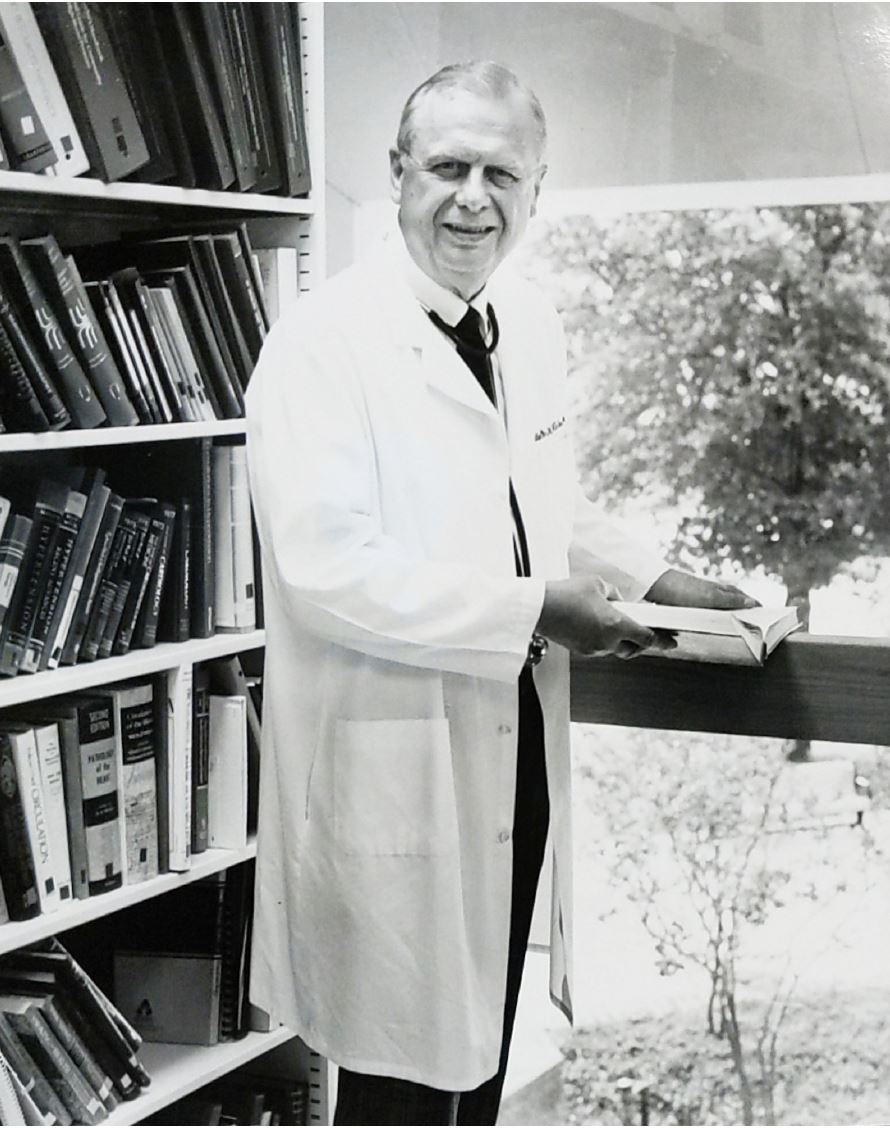
In addition to being a special father, Walter Kirkendall was a remarkable doctor and teacher.

Born in 1917 and raised in Louisville, Kentucky, Walter graduated from the University of Louisville Medical School in 1941 and then went to the University of Iowa in Iowa City for an internship the following year.

As with many men of his generation, Walter finished his internship and residency at Iowa just in time to serve three years as an Army medical officer in North Africa and Italy during World War II, after which he returned to Iowa City to complete his training in medicine.

In 1949, Walter joined the University of Iowa Medical School Faculty and — along with esteemed colleagues such as Jack Eckstein, William Bean, Lew January, Frank Abboud and many others — proceeded to play a major role in the development of the University of Iowa’s fine medical school over the next 23 years.

Walter and his colleagues were at the forefront of the post-WWII doctors who embraced the optimistic view of therapeutic intervention in the practice of medicine, which was a fundamental change from the sense of therapeutic powerlessness that pre-WWII medical professors widely taught to medical students.

Several of Walter’s colleagues have told me that Walter’s attitude of therapeutic optimism was his greatest contribution to the education of his students.

Over his 40+ year academic career, Walter developed a program of teaching and research in hypertension and renal disease for which he received national and international recognition.

His first professional publications were on renal disease, but by the mid-1950’s, he was publishing papers on hypertension and the effects of drugs in patients. After 1960, almost all of his 85 abstracts and 72 papers involved research on the clinical pharmacology of hypertension.

In addition to his teaching, research, and service on multiple professional committees, Walter also directed the Cardiovascular Research Laboratories at the University of Iowa from 1958-70 and the Renal-Hypertension Division from 1970-72. Iowa honored Walter for his contributions to the University by awarding him the Distinguished Achievement Award in 1986.

Perhaps most remarkably, however, is that Walter in 1972 — at the age of 55 when most other academics are settling into comfortable surroundings while preparing to retire — decided to uproot his large family and move to Houston where he became the first Chairman of the Department of Medicine at the then-new University of Texas Medical School in Houston’s famed Texas Medical Center.

In Houston, Walter continued his professional passions — teaching, research and clinical medicine — for the remainder of his life at UT-Houston. In addition to being the first Chairman of the Department of Medicine, Walter was director of UT-Houston’s Hypertension Unit from 1976 and director of the General Medicine Division from 1982 until his death.

During his 20 years at UT-Houston, Walter became the patriarch of UT-Houston’s faculty and student body, reflected by the UT-Houston alumni awarding him the first Benjy F. Brooks Medal in 1991 as the outstanding clinical faculty member, the school’s naming of it’s internal medicine library and suite in Walter’s honor, and the Walter M. Kirkendall Endowed Lecture Series that UT-Houston sponsors each year.

So, the foregoing outlines Walter’s remarkable professional legacy — two institutions served for over 20 years each while teaching and pursuing cutting edge research in a key area of medicine throughout his career. The late James T. Willerson, M.D., former president and medical director of the Texas Heart Institute, observed the following in his eulogy at UT-Houston’s memorial service for Walter:

Dr. Frank Abboud called me two days ago, wanted to come join me yesterday, early in the morning to visit and talk about Dr. Kirkendall, and then go to his funeral with me. . . Dr. Abboud told me that people in Iowa at the Medical School had never felt that Dr. Kirkendall had left. He was still there.

What he had given, what he represented, what he continued to give was part of Iowa. Can you imagine having that impact on an institution, and people years after you’ve left? Dr. Kirkendall did. How many of us could claim the same thing, ever?

But the foregoing doesn’t adequately convey Walter’s truly endearing qualities. He was a devoted teacher to his medical students and residents, and was constantly interested in the development of their careers. Patients appreciated his thoroughness, fairness and profound concern for them and their families. Many conversations with Walter invariably turned to stories about his aversion to wastefulness, the clutter in his office, his sense of humor, his competitiveness, and his suspicion that the sodium ion is bad for one’s health.

The following eulogies that were given at Walter’s funeral and memorial service elaborate on these qualities: the eulogy of my brother Bud, who is a district judge in Seguin, TX; my eulogy; the eulogy of my brother Matt, who is an internist in Dubuque, Iowa; the memorial service closing of my sister Mary, who is a pediatric emergency room physician in San Antonio; the eulogy of Dr. Willerson; the eulogy of the late Dr. Chevis M. Smythe, and the eulogy of Dr. Philip Johnson.

I close with two of my favorite stories about Walter. One is recounted by Tom S. McHorse, M.D., former president of the Travis County, Texas (Austin) Medical Association. Dr. McHorse recalls vividly his experience with Walter in examining a patient while in medical school:

The setting is the University of Iowa Hospital staff service ward one February morning.

For physicians who graduated after 1980, ward is defined as a large room with eight to ten patient beds separated by curtains, as many emergency rooms currently have.

As medicine was practiced in 1968, acute MIs, bacterial endocarditis, and other illnesses were treated in hospital for six weeks or more. The patient in bed four was such an extended stay patient.Dr. Kirkendall was rounding with his entourage of residents and nurses.

As we approached this frequently examined patient, a distinct change was obvious from the day before. The patient truly had the worst “soup bowl” haircut you can imagine. At bedside, Dr. Kirkendall addressed his first question to the patient:

“Who cut your hair?”

“The hospital barber,” replied the patient, somewhat taken aback.

Dr. Kirkendall was clearly not pleased as he turned to his residents and declared:

“Incompetence at any level should not be tolerated.”

I have no memory of the patient’s diagnosis or anything else Dr. Kirkendall taught us that week, but I have long remembered that statement of Dr. Kirkendall.

The second story was passed along by Dr. Smythe in his eulogy during UT-Houston’s memorial service for Walter, in which he recounted a particularly personal experience with Walter:

Now, at this time, I want to skip ahead to something very personal.

1975-76 was also not a bed of roses at this institution. And, when I was bounced out of the Dean’s Office, I was profoundly hurt, very profoundly hurt, and, I was also puzzled. Since those who were relatively active in my demise had been the people to whom I was closest, I was also alone and considerably puzzled as to whom to turn.

Now, Dr. Kirkendall himself was under no mean pressure at that same time. And indeed, the forces that were playing on us were pretty much identical.

But Walter is the person who said “Cheves, come to my office every Thursday at 11:00 o’clock.” And, he was a person who said “I will help you retrain yourself as a physician.”

And, he did. And that episode illustrated this man’s extraordinary generosity of spirit more than anything that I’ve ever seen. I will be grateful to him for the rest of my life.

Walter’s understanding of the importance of service to others is the thread that binds the fabric of families, friendships, schools, professions, communities, and, ultimately, societies.

In his quiet and confident manner, Walter understood the importance of his life’s work, and this understanding formed the cornerstone of his unshakable sense of fulfillment and contentment in his personal and professional life.

In my book, that’s quite a fine legacy, and I am taking this Father’s Day to appreciate my blessing to have been touched by it.

Observations on the Tyco verdict

tyco.jpgThe morning brings several interesting obserations regarding yesterday’s guilty verdict in the trial of former Tyco International, Ltd. executives, L. Dennis Kozlowski and former Tyco finance chief Mark H. Swartz.
Over at Conglomerate, Professor Hurt (a former Houstonian, by the way) notes insightfully in this post that, on one hand, the case against Messrs. Kozlowski and Swartz differs from most other corporate crime prosecutions because of its relative simplicity, but that — on the other hand — such simplicity insures that no amount of regulation will ever prevent such actions from occurring again.
Meanwhile, over at the White Collar Crime Prof Blog, Professor Henning makes a key technical point about the way in which the prosecution handled the more recent prosecution after the first trial ended in a mistrial:

The government made its case in about 25% less time (13 weeks as opposed to 18 weeks in the first trial), and kept the accounting and reporting issues front-and-center. Going technical is usually a recipe for disaster (see the Enron Broadband Services prosecution for an example of mind-numbing detail), but in this case the Manhattan D.A.’s office concentrated on what was truly important.

Finally, in this remarkable analysis, Professor Ribstein questions the wisdom of unleashing the power of the state based upon the human frailties that drive most prosecutions of questionable business conduct:

Not merely envy (one’s discomfort at comparing oneself with another), or wanting to have what another person has, but disliking that person for having it and believing that his good fortune is undeserved. The resenter wants to lower the envied person to his level.
This is the common element in Tyco, Martha Stewart, Mike Milken and many other cases of this ilk, despite the facial dissimilarity of the offenses being tried.
Resentment is pernicious enough in itself because it seeks to degrade human achievement. But it’s worse when it leads to criminal prosecutions for what amount to agency costs — failure to get the requisite corporate approval for expenditures. The marginal criminality of these offenses is what leads to months of hugely expensive trials.
The supposed social payoff is deterrence. But the Kozlowskis of the world probably will keep doing this stuff while the legitimate sorts will be ever more afraid of taking chances. Not that the conduct in Tyco was particularly worth encouraging, but Mike Milken was a different case, in my view, and I don’t see much chance of politically ambitious prosecutors being able or willing to tell the difference.
So white collar prosecutions become a sort of lottery. If the prosecution can come up with something colorful, it wins, or maybe loses if it’s too colorful (Sardinia). These are not the elements of a rational criminal justice system.

Nor is it rational to base corporate criminal prosecutions on the timing of going bust.

The Lord does not enjoy competition in the regulation market

Spitzer23.jpgFollowing on the heels of this earlier post, this NY Times article reports on the lawsuits that the Office of the Comptroller of the Currency and the Clearing House Association filed on Thursday in Manhatten U.S. District Court to enjoin the Lord of Regulation from using his subpoena power to obtain nonpublic credit score and loan information from national banks such as HSBC Holdings, J. P. Morgan and Wells Fargo. Here is an earlier post on Mr. Spitzer’s latest attempt to injure a productive part of the national economy, this time the sub-prime mortgage market.
Not pleased with competition in the regulation market that infringes on his demagogic ways, Mr. Spitzer commented as follows about the lawsuits:

“While such a move was expected from the banks, it is shameful that a federal regulator would join in an effort to shield the banks from scrutiny by state regulators.”

To which I wish the Comptroller of the Currency would respond:

“While we understand that Mr. Spitzer enjoys undertaking investigations that will provide publicity for his political purposes, we do not expect him to undertake investigations into areas that are the province of federal regulation and that will harm the ability of low-income families to climb the ladder to prosperity through home ownership.”

New Chron blog reports on medical research funds

medical research.jpgThe Houston Chronicle has added another blog — Eric Berger’s SciGuy — to its impressive and expanding Chronicle bloglist that Chronicle tech writer Dwight Silverman has spearheaded. Kudos to Dwight and the Chronicle editors for being pioneers in this emerging method of delivering their product to customers.
In this post, Mr. Berger notes the National Institutes of Health annual ranking of U.S. medical schools by the amount of research funding, which is a key indicator of a medical school faculty’s research capabilities. Here is a listing of medical schools of local interest:
1. John Hopkins University, Baltimore, Md., $449 million
11. Baylor College of Medicine, $248 million
21. UT Southwestern Med. Center, Dallas, $172 million
35. Cornell Univ. Medical School (Methodist Hospital) $124 million
39. UT Medical Branch at Galveston, $104 million
48. UT Health Science Center at San Antonio, $80 million
64. UT Health Science Center at Houston, $51 million
In addition, although not a medical school, UT’s M.D. Anderson Cancer Center in the Texas Medical Center generated another $145 million in research last year. Consequently, as Mr. Berger notes, the institutions in the Texas Medical Center pump almost half a billion of research funds into the local economy.
By the way, the NIH list dovetails nicely with the ranking of university endowments that was noted in this earlier post. Given the size of Baylor Medical School’s endowment and annual research funding, one has to respect the risk that Baylor took in ending its longtime partnership with the even better-endowed Methodist Hospital ($2.3 billion endowment). Hopefully, the competition between the two institutions for research funds will enhance the amount and quality of research being performed at the Texas Medical Center.