Spitzer’s $18 million footnote theory

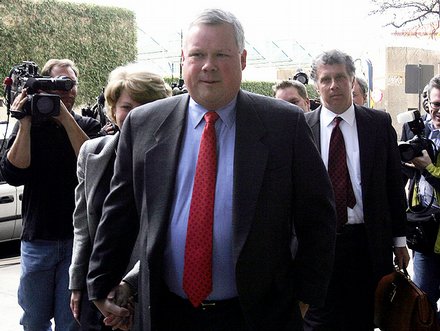
Spitzer54.jpglangone2.jpgIn this Aaron Lucchetti piece($), the Wall Street Journal continues its fine coverage (see Peter Lattman posts here, here and here) of the Lord of Regulation‘s ongoing lawsuit against Home Depot co-founder Kenneth Langone and former New York Stock Exchange chairman Richard Grasso over Grasso’s supposedly excessive NYSE compensation package and Langone’s support of it.
Lucchetti reports today that Spitzer and Langone are preparing for Langone’s deposition next week (wouldn’t you like to be a fly on the wall of that one), and notes that Spitzer’s already dubious case against Langone is now boiling down to whether Langone misled fellow NYSE directors by including a part of Grasso’s compensation plan in a footnote of a memo to directors rather than in the body of the memo:

“The footnote on this work sheet could be more clear, but I do believe the committee understood,” [former NYSE human-resources director Frank] Ashen said in the deposition regarding the $18 million in bonus payments. Those payments were made in a “Capital Accumulation Plan” that was established for several NYSE executives in addition to Mr. Grasso.
Mr. Spitzer’s complaint argues that the CAP awards never should have been put into a footnote but should have been included in the work sheet’s “total compensation” column. The complaint specifically cites the compensation work sheet for 1999, saying it doesn’t make clear that the CAP award for that year was paid in addition to the figure identified on the work sheet as Mr. Grasso’s total compensation. . .
Mr. Spitzer’s lawsuit calls for Mr. Langone to “make restitution” to the NYSE for the amount paid to Mr. Grasso that the suit alleges he didn’t properly disclose — in other words, the $18 million. Mr. Langone’s response, in a statement yesterday: “He hasn’t laid a glove on me.”

The trial of the Grasso-Langone case is currently scheduled for late October, so stay tuned. Larry Ribstein comments here on the corporate governance implications of the lawsuit.

Futch gets five

Futch.jpgAmidst a flurry of sealed pleadings and orders denying his attempt to withdraw his guilty plea, former Reliant Energy natural gas trader Jerry Futch was sentenced to almost five years in prison yesterday by U.S. District Judge David Hittner based on Futch’s guilty plea on charges that he provided false information on natural gas trades to publications that produce indexes used to value natural gas contracts.
Here is an earlier post on Futch’s case, which raises troubling questions regarding his employer and its counsel’s derogation of Futch’s self-incrimination and attorney-client privileges.

Where is Waldo?, er, I mean Causey?

The mainstream media covering the criminal trial of former key Enron executives Ken Lay and Jeff Skilling continues mostly to miss the point that the prosecution’s case over almost seven weeks now has been extraordinarily weak for a case of this magnitude.

Virtually all of the substantive testimony has come from prosecution witnesses testifying under draconian plea deals, most of the testimony alleging wrongdoing has been uncorroborated, and documentary evidence to back up claims of wrongdoing has been almost non-existent.

Of course, no one knows what effect any of this is having on the jurors, some of whom may already have been swayed to convict simply by the overwhelming media bias against Lay and Skilling.

Yesterday’s testimony was a case in point. Three witnesses testified and not one of them came close to implicating either Lay or Skilling in a crime.

Vince Kaminski, a former high-level Enron risk analyst, testified that he warned that some of Enron’s special purpose entity structures were inherently risky, but that management went ahead with the deals, anyway.

Johnnie Nelson, a colorful former Enron pipeline worker who was offered by the prosecution for the transparent purpose of entertaining the jury, testified that he was angry with Lay because he, like Lay, invested virtually all of his personal savings in Enron stock that turned out to be worthless.

Finally, Chris Loehr, a seemingly nice young man who worked for one of the special purpose entities that Fastow managed, confirmed that Fastow told him about Fastow’s secret “Global Galactic” agreement that supposedly guaranteed that the SPE’s would not lose money on a number of their deals with Enron, but could not corroborate Fastow’s testimony that Skilling knew about it.

Now, there is a prosecution witness who could corroborate Fastow’s testimony about the Global Galactic agreement — former Enron CFO and former Lay-Skilling co-defendant, Richard Causey. Fastow claimed that he worked out the terms of the Global Galactic deal with Causey, who Fastow claimed disclosed it to Skilling. Causey entered into a plea deal with the Enron Task Force on the eve of trial and, thus, is readily available to testify.

But in a stunning development that has gone largely unreported in the media covering the trial, it now appears that the Enron Task Force will not call Causey as a witness to corroborate Fastow’s testimony. The NY Times’ Alexei BarrionuevoKurt Eichenwald‘s colleague who is one of the few reporters covering the trial expressing increasing skepticism regarding the prosecution’s case — reports on this development in his latest dispatch on the trial:

A looming question is when, or if, Richard A. Causey, Enron’s former chief accounting officer, will testify in the case. He could be crucial to supporting Mr. Fastow’s claims that Mr. Skilling was shown a list of side deals that Mr. Fastow kept track of.

Mr. Causey is not on the government’s witness list. But prosecutors say that does not preclude them from calling him in a rebuttal that would follow the expected testimony of Mr. Skilling and Mr. Lay. Mr. Causey pleaded guilty to fraud in December, just one month before the trial started.

Mr. Fastow testified for four days about the partnerships and about secret side deals he said he made with Mr. Skilling that guaranteed the partnerships would profit from purchasing distressed Enron assets. But during three days of cross-examination by defense lawyers, Mr. Fastow admitted to stealing tens of millions of dollars from Enron while deceiving his bosses and even his own wife about much of his illicit activity.

The government knew that calling Mr. Fastow brought inherent risks, but chose to call him anyway.

Barrionuevo is spot on. If the Task Force does not call Causey, then that means he cannot corroborate the key testimony of the primary prosecution witness in the trial to date. That would blow a huge hole in what is already a shaky prosecution case and — if the jurors have not already made up their minds to convict — could well be the basis of reasonable doubt about the prosecution’s entire case.

Where is Waldo?, indeed.

Fukuyama’s pivot on Iraq

fukuyama_bio.jpgFrancis Fukuyama is a professor at the Paul H. Nitze School of Advanced International Studies at Johns Hopkins, an award-winning author and a former neoconservative supporter of the Bush Administration’s Iraq policy (previous post here).
As a result, Fukuyama’s new book — America at the Crossroads (Yale 2006) — that summarizes Fukuyama’s views on neoconservatism, why he parted ways with other neocons on the Iraq war, and where we go from here is causing quite a stir in foreign policy circles. The NY Times’ Michiko Kakutani has this favorable review of Fukuyama’s book while the Wall Street Journal’s Bret Stephens weighs in with this critical one. Finally, in this NPO piece, Victor Davis Hanson makes the case for holding the line in Iraq.

Don’t tell Metro about this

Kelo.jpgThis NY Sunday Times article (hat tip to Peter Lattman) reports on the efforts of the wealthy Long Island enclave of North Hills’ efforts to use the power of eminent domain — following last year’s controversial U.S. Supreme Court decision in Kelo v. New London (related posts here) — to condemn the exclusive (and private) Deepdale Golf Club and turn it into a public golf course for the village.
Inasmuch as Deepdale is one of the best golf courses on Long Island, we’re not talking about a blighted piece of property. Nevertheless, the village mayor’s reasoning for the possible eminent domain action is a truly amazing expression of governmental power:

[Village Mayor Marvin] Natiss has said that a village golf course would be a wonderful amenity for residents. Mr. Lentini once said that making Deepdale a village club would “make North Hills that much more desirable, which would make the properties that much more valuable, which will bring in that many more affluent people.”

Left unsaid is that such transparent reasoning could be used to justify the governmental taking of virtually any property.
At any rate, it appears that a part of the village’s purpose in going after the club property is that Deepdale is so exclusive that only one of North Hills’ 1,800 wealthy residents is a member and, according to Mayor Natiss, “my residents could not get in if they applied” even if they could afford the six-figure initiation fee and annual dues of about ten grand. And, just to make matters more complicated, the land on which the Deepdale course sits is actually owned by a private company that leases the land to the the club at a below-market rate. Inasmuch as at least one of the minority shareholders in the private company wants the private company to sell the land to cash in on his interest, the minority shareholder is supporting the village’s effort to acquire the club.
Let’s hope that this department is not getting any ideas from North Hills’ plans for Deepdale.

The Bush Administration’s pro-business ruse

anti-business.jpgEarlier posts here, here, and here — among others — question the conventional wisdom that the Bush Administration is particularly pro-business in its orientation.
Consistent with that theme, Larry Ribstein notes that the Bush Administration’s stance on Sarbanes-Oxley has reflected an appalling lack of leadership in regard to business issues:

The Democrats’ position on [modification of] SOX doesn’t go far enough, but at least it goes somewhere. It’s not that I’m ready to conclude that the Democrats can be trusted as the party of business. But somebody has to defend business’s interest, and on the critical issues concerning SOX, it hasn’t so far been the Republicans.

Professor Ribstein follows up that post with this one that summarizes his presentation to the American Enterprise Institute on Sarbanes-Oxley.
Meanwhile, Professor Ribstein’s skepticism of the Bush Administration’s true orientation toward business is mirrored in Bruce Bartlett’s new book on Bush Administration fiscal policy, Impostor: How George W. Bush Bankrupted America and Betrayed the Reagan Legacy (Doubleday 2006), which Publisher’s Weekly describes as follows:

Bartlett’s attack boils down to one key premise: Bush is a shallow opportunist who has cast aside the principles of the “Reagan Revolution” for short-term political gains that may wind up hurting the American economy as badly as, if not worse than, Nixon’s did. As part of a simple, point-by-point critique of Bush’s “finger-in-the-wind” approach to economic leadership, Bartlett singles out the Medicare prescription drug bill of 2003ó “the worst piece of legislation ever enacted”óas a particularly egregious example of the increases in government spending that will, he says, make tax hikes inevitable. Bush has further weakened the Republican Party by failing to establish a successor who can run in the next election, Bartlett says. If the Reaganites want to restore the party’s tradition of fiscal conservatism and small government, he worries, let alone keep the Democrats out of the White House, they will have their work cut out for them.

Interestingly, the Bush Administration does not appear particularly enthusiastic to challenge Bartlett on this thesis.

A different kind of favorites list

prison golf.jpgThe ever-observant Ellen Podgor points us to this interesting Paul Wenske/Kansas City Star article that reports on the increasing role of advisors to indicted business executives providing advice on the preferred location for the executives to serve their prison sentence. According to the article, the following are the top five-preferred locations for serving a white collar prison sentence in the federal system:

Yankton, S.D. A stand-alone federal prison camp that is a converted college campus.
Englewood, Colo. Just outside Denver, it is a satellite camp to the federal correctional institution there.
Texarkana, Texas. Has drug and alcohol treatment and offers adult continuing education and correspondence courses.
Sheridan, Ore. In the heart of the south Yamhill River Valley near Portland. Offers college programs.
Pensacola, Fla. Inmates can work during the day at a nearby naval base.

The Enron Task Force’s unraveling Nigerian Barge case

Bayly10.jpgfuhs4c.jpgEarly last week, oral arguments were heard in the Fifth Circuit Court of Appeals on the appeal of the four Merrill Lynch executives who were convicted of wire fraud and conspiracy charges in November 2004 in the trial of the Enron-related case known as the Nigerian Barge case.
Reports from those who attended the oral argument indicate that it went well for the appellants, but it may have gone even better had counsel for the Merrill Four known about former Enron CFO Andy Fastow’s testimony from this past Thursday afternoon in the ongoing criminal trial of former key Enron executives Ken Lay and Jeff Skilling.
The Enron Task Force contended in the Nigerian Barge case that the Merrill Four were guilty of conspiring with Enron executives to mislead Enron investors in connection with Merrill’s purchase of a dividend stream attributable to an ownership interest in some power-generating barges moored off the coast of Nigeria. On a threshold basis, the Task Force’s case against the Merrill Four was bizarre because it was Enron, not Merrill, that may have improperly accounted for the transaction, although even that issue was never proven at trial. For its part, Merrill was simply buying a relatively small asset that Enron wanted to sell in Merrill’s ongoing effort to ingratiate itself to a potentially good customer of Merrill’s investment banking services.
Fastow14.jpgkopper2A.jpgThe prosecution’s case against the Merrill Four rested almost entirely on the testimony of former Fastow henchmen, Michael Kopper and Ben Glisan, both of whom were deeply involved with Fastow in effectively embezzling money from Enron in connection with Fastow’s management of certain special purpose entities. Kopper and Glisan both testified on the key issue in the trial — i.e., that Fastow made during a December 1999 telephone call a legally unenforceable oral inducement to Bayly that Enron would either buy Merrill’s interest in the barges back or broker the interest to a third party, such as LJM2, an Enron SPE — despite the fact that neither Kopper nor Glisan participated in the telephone call. Inasmuch as Fastow’s oral inducement allegedly constituted a “hidden side deal” for Enron to “buy-back the barges,” the Task Force argued that Enron’s accounting of the transaction as a “true sale” was fraudulent and that the Merrill Four should have known that, so they were guilty of conspiracy.
glisan.jpgRemarkably, the prosecution did not call either Fastow or anyone else who actually participated in the key December 1999 telephone call to testify during the trial of the Nigerian Barge case. Nevertheless, the Task Force represented to defense counsel for the Merrill Four that Fastow’s testimony in regard to the transaction was consistent with that of Kopper and Glisan. Based on that representation and the weakness of the prosecution’s case at trial generally, the defense team of the Merrill Four elected not to call Fastow as a witness during the trial. The jury convicted the Merrill Four, anyway.
With that backdrop, imagine the surprise of counsel for the Merrill Four when they heard about Fastow’s following testimony on cross-examination this past Thursday afternoon in the Lay-Skilling trial. After reading a portion of Kopper and Glisan’s testimony from the barge trial, Fastow testified as follows:

Q. Now, after having read through those pages [of Glisan and Kopper’s testimony], does that refresh your recollection at all about the events that transpired in December of ’99 concerning LJM[2] having been approached and what it did in response to that approach about these barges?
A. No, sir. They’re largely contradictory to my recollection of events.

Fastow went on to testify at some length on the barge transaction and contradicted key portions of both Kopper and Glisan’s testimony from the barge trial, such as the reason why LJM2 elected not to buy the interest in the barges at the time that Merrill bought the interest.
As noted earlier here (see also the thread here), this is not the first example of key testimony from prosecution witnesses in the Nigerian Barge trial being contradicted by testimony of prosecution witnesses in the Lay-Skilling trial. Meanwhile, four former Merrill Lynch executives sit in prison with their lives turned upside down based largely on testimony of prosecution witnesses that the Enron Task Force knew contradicted that of another key prosecution witness who the Task Force elected not to call.
The Department of Coercion, indeed.

The always entertaining Bill James

Bill James.jpgMajor League Baseball Spring Training is well underway in Florida and Arizona, so it’s time to check in on Clear Thinkers favorite, Bill James (previous posts here, here, here, and here), the father of the statistical analysis of baseball called sabermetrics.
In this paper, the always insightful James addresses his increasing recognition of the limitations of sabermetrics:

I have come to realize, over the last three years, that a wide range of conclusions in sabermetrics may be unfounded, due to the reliance on a commonly accepted method which seems, intuitively, that it ought to work, but which in practice may not actually work at all. The problem has to do with distinguishing between transient and persistent phenomena, . . .

James then goes on to explore eight commonly-held sabermetric beliefs about baseball and explains why a majority of them may not be as well-understood as sabermetricians think. The primary reason? Essentially luck.
Then, to get you in the mood for listening to the radio broadcast of your favorite team, listen to this hilarious NPR spoof of what many radio broadcasts of baseball games — including those of the Stros — have become in the age of ubiquitous commercial endorsements.

Department of Coercion

DOJcolor.gifJohn Hasnas is a professor of ethics and law at Georgetown University’s McDonough School of Business and is the author of the new book, Trapped: When Acting Ethically is Against the Law (Cato 2006), which is an adaptation of Hasnas’ article Ethics and the Problem of White Collar Crime.
In this superb Cato Institute op-ed (first published in the Wall Street Journal), Professor Hasnas addresses a common topic on this blog — the perverse effect that implementation of the Department of Justice’s Thompson Memo has had on companies serving up their employees as sacrificial lambs to avoid an Arthur Andersen-like meltdown:

Say you run a financial services firm that markets tax shelters to wealthy clients. Although the shelters are aggressive, you firmly believe they’re legal. Indeed, you have sent one of your tax partners to testify before Congress to that effect. The IRS hasn’t challenged the shelters in court, and no court has declared them to be illegal. Nevertheless, the Department of Justice has opened an investigation of your firm for tax fraud and indicted the partner who testified before Congress.
As a responsible executive, what should you do? Instruct corporate counsel to conduct an internal investigation to ensure that no law has been broken? Have the legal department begin to work on the corporation’s defense? Enter into a joint defense agreement with the partner under indictment? Advance the partner’s legal fees in accordance with the company’s policy of supporting employees sued for employment related actions?
Or should you have the corporation accept responsibility for tax fraud, officially declare that several of your tax partners engaged in unlawful conduct, refuse to enter into a joint defense agreement or advance the legal fees of any of these partners, fire those who refuse to cooperate with the government, waive the firm’s attorney-client and work product privileges, disclose all information that may incriminate your employees to the government, and agree to pay a several hundred million dollar fine?
[The latter approach], surprisingly, is the answer. Under current federal law and Department of Justice policy, it would be irresponsible management to attempt to defend the corporation or its employees.

Continue reading