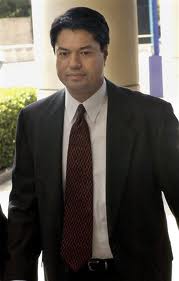
Three Houston businessmen arraigned in the Premiere Holdings criminal case

losing money.jpgIn a case that has been swirling around Houston legal and business circles for the past five years, the three former owners of Houston-based Premiere Holdings of Texas — which promoted itself as a high-yield investment fund to prominent Houstonian investors but spiraled into bankuptcy in late 2001 amid allegations of Ponzi scheme-type activity — pled not guilty yesterday in connection with their arraignment in federal court in Houston on securities fraud and money laundering charges in a 24-count indictment (you can download a pdf of the indictment here).
Attorney Ted Murray, securities broker David Lapin, and securities broker Jeffrey Wigginton are charged in the indictment for their roles in the promotion and sale of unregistered security interests to investors through Premiere Holdings between 1999 and late 2001. Although the case has been preliminarity scheduled for trial trial on October 30, 2006, my sense is that a case of this nature will not go to trial that quickly after indictment.
Premiere Holdings has been an item of local interest for quite some time for a couple of reasons. First, the company promoted itself as a high-yield investment fund to mainly wealthy and conservative Houstonians, and often advertised itself through several of the talk show hosts on the Houston conservative radio station KSEV. Moreover, Premiere’s business unraveled soon after the September 11, 2001 attacks on New York and Washington, but that story flew somewhat under the radar screen of the local business media that was preoccupied with the demise of Enron, which was taking place at the same time. Finally, one of the defendants — David Lapin — is related to prominent Houston attorneys Jack Lapin (father) and Bobby Lapin (brother).
The Justice Department’s press release on the indictment is here and a previous press release on an SEC action against the three owners is here. A couple of Houston Business Journal articles on the Premiere Holdings case from late 2001 are here and here.

Former Enron Assistant Treasurer gets four years probation

enronlogo32.gifIn the first of many sentencing hearings that will take place this fall n connection with various Enron-related criminal cases, Timothy DeSpain, a 41-year old former assistant treasurer of Enron from 1999 to 2002, was sentenced this morning by U.S. District Judge Ewing Werlein to four years probation in connection with a 2004 plea agreement in which he pled guilty to a single count of securities fraud. Here is an earlier blog post with background on DeSpain’s role at Enron and his plea deal. The Chronicle’s Tom Fowler files a report on the sentencing here.

Milton Friedman on limited government

milton-friedman-3.jpgRussell Roberts over at Cafe Hayek points us to a remarkable Open Mind video from over 30 years ago of Milton Friedman discussing principles of economics and limited government. The entire video is about a half hour, but if you watch nothing else, take a moment to marvel at Professor Friedman brilliantly responding to an inflammatory opening question that suggests he lacks compassion for his fellow man. Professor Friedman calmly refuses to take the bait and turns the issue around to question the motives of those who advocate the cure-all of government intervention:

INTERVIEWER: Professor Friedman, I wonder if I might begin the program by saying that you’re a kind gentleman, yet you’re identified by many with those who seem — to those who make that identification to want us not to do kind and gentle things — perhaps not provide for the poor, perhaps not provide for the aged — and I wonder how you’d reconcile these phenomena and whether you feel it’s fair to characterize you as a conservative economist.
FRIEDMAN: Well, let me start at the end of that first. I never characterize myself as a conservative economist. As I understand the English language, conservative means conserving, keeping things as they are. I don’t want to keep things as they are. The true conservatives today are the people who are in favor of ever bigger government. The people who call themselves liberals today — the New Dealers — they are the true conservatives, because they want to keep going on the same path we’re going on. I would like to dismantle that. I call myself a liberal in the true sense of liberal, in the sense in which it means (inaudible) and pertaining to freedom.
Now, that brings me to your second point. One of the great mistakes is to judge policies and programs by their intentions rather than their results. We all know a famous road that is paved with good intentions. The people who go around talking about their soft heart — I share their — I admire them for the softness of their heart, but unfortunately, it very often extends to their head as well, because the fact is that the programs that are labeled as being for the poor, for the needy, almost always have effects exactly the opposite of those which their well-intentioned sponsors intend them to have.

Continue reading

More gripping for the Ryder Cup matches

Rydercup06logo3.jpgAs noted here earlier, there is something about the upcoming Ryder Cup matches next week in Ireland (perhaps that the American squad has lost four of the last five matches?) that provokes some entertaining reactions.
In this IdahoStatesman.com article, NBC golf color man and former PGA Tour player Johnny Miller rips the American Ryder Cup team:

“This is probably on paper the worst Ryder Cup team we’ve ever fielded,” Miller said during [a] press conference . . .
Miller also expressed reservations about captain Tom Lehman, who will decide how to use his 12 players. He will create four two-man teams for each of the first four rounds.
Miller says it’s imperative that Lehman pair Tiger Woods with Jim Furyk, and Phil Mickelson with Chris DiMarco, because those pairings have worked in the past.
That could leave the team’s inexperienced players, including four Ryder Cup rookies, paired together.
“I believe if he divides those up we’re going to get creamed,” Miller said of the Woods-Furyk and Mickelson-DiMarco teams. “I’m really concerned that Lehman uses the theory that we’ve got to use a good player with a not-so-experienced player.” [. . .]
Miller, a former Ryder Cup player, will call the action for NBC.
“It’s going to be tough to win with the team (Europe has) got,” he said.

I don’t think Miller will be the one pursuing interviews from the American squad members for NBC during the matches. Meanwhile, this blog post of senior GolfWorld writer John Hawkins, an excellent golfer himself, provides a more balanced analysis of the American squad’s prospects.

Continue reading

More rumblings in the Nigerian Barge appeal

merrill-bull.jpgIn a move that may backfire, the Enron Task Force filed this petition requesting that the entire Fifth Circuit Court of Appeals consider and reject the decision of a Fifth Circuit three-judge panel from last month (previous posts here and here) that struck down the wire fraud and conspiracy convictions of four Merrill Lynch executives involved in the controversial Enron-related Nigerian Barge case. The Chronicle’s Kristen Hays reports on the Task Force’s motion here and this post from a year ago provides an extensive thread of posts discussing the case.
The Task Force’s petition — which is focused on the “honest services” issue in the appeal — is somewhat odd, which may reflect the Task Force’s reservations about filing it at all given the considerable risk that a majority of the Fifth Circuit could adopt Judge Harold DeMoss’ dissent in the panel decision. On a threshold basis, the motion does not even mention that the Fifth Circuit panel’s decision reversed and rendered the convictions of Merrill Lynch executive William Fuhs on all counts and then makes the ludicrous suggestion in a footnote that former Enron CEO Jeff Skilling’s anticipated appeal of his conviction and former Enron executive Chris Calger’s recent motion to withdraw his plea agreement are somehow valid reasons for reconsidering the panel’s decision (“we can’t allow those evil former Enron executives be protected by the law!”). Beyond that, the Task Force’s short pleading mischaracterizes the panel’s decision and fails to address the Task Force’s seminal problem with the entire Nigerian Barge prosecution — that the Task Force prosecuted the Merrill Lynch executives for doing their jobs in connection with Enron’s sale of an asset to Merrill for which Enron, not Merrill, may have improperly accounted, although even that issue was never proven by the Task Force during the trial.
Meanwhile, in another interesting development, two of the former Merrill executives involved in the Nigerian Barge appeal, Dan Bayly and Robert Furst, who face the possibility of a retrial as a result of the Fifth Circuit panel’s decision — filed this motion for rehearing in which they request the Fifth Circuit panel to address a key evidentiary issue — the trial court’s decision to allow the Task Force to introduce an email of Brown that was prepared over a year after the barge transaction took place — that the panel did not address in its original decision because of its reversal of the convictions on other grounds. Bayly and Furst argue in the motion that the panel’s ruling on that evidentiary issue will resolve the issue in any re-trial of the case and should be known to the entire Fifth Circuit before it decides whether to grant en banc review of the panel’s decision (if Bayly and Furst are right that the trial court erred in admitting the Brown email, then even an en banc reversal of the panel’s decision on the honest services issue would not alter the reversal of the convictions).

Stros 2006 Review, Part Nine

biggiomissing.jpgAs I’ve noted before, it’s funny how our expectations for the Stros color the way in which we view the team at a particular stage of the season.
After essentially playing themselves out of the National League playoff race in the eighth 1/10th segment of the season, the Stros (71-74) have actually played quite well over their ninth segment of the season, going 10-6 and completing a segment with a winning record for just the third time this season. However, as the Stros enter their final 17 games of the season, the general consensus in the local media is that the Stros have not been playing well and certainly not as well as last season at this time when they were also contending for the NL wildcard playoff spot.
Indeed, taking a look at where the Stros stood last season at this time is instructive as to where the Stros find themselves this season. After 145 games last season, the Stros were 77-71, which means that the team had won only six more games than the current club at the same stage of the season. That 2005 team was plagued by the same chronic hitting woes that the current Stros team is experiencing — that club’s team runs created against average (“RCAA,” explained here) after 145 games was within a run or two of being the same as this season’s club (-38).
Meanwhile, the 2005 club’s pitching staff — led by the extraordinary starting trio of Clemens, Pettitte and Oswalt — had an outstanding 97 runs saved against average (“RSAA,” explained here) after 145 games. This year’s staff currently has a very respectable 54 RSAA (third in the NL), but that performance is only about half as good as last season’s pitching staff’s incredible performance after 145 games.
Thus, expectations aside, the reality is that this season’s club has not improved in hitting from last season’s club and thus, the roughly 43 fewer runs saved by the 2006 pitching staff in comparison to the 2005 staff is the difference between the 2005 club winning six more games than the 2006 club at the same stage of the season. That difference — as well as a couple of nagging injuries to Pettitte and Clemens down the stretch of this season — is more than enough to prevent this fragile Stros club from making the push necessary to contend seriously for a playoff spot.
Despite the disappointment of missing the playoffs after the past two magical seasons and flirting with a sub-.500 season for only the second time in the past 14 seasons, the Stros did have a couple of good things happen since the review of the club’s 8th segment of the season:

The Stros locked up Roy Oswalt (3.06 ERA/33 RSAA (tied for 4th in RSAA in Major League Baseball); and
Lance Berkman (57 RCAA (tied for 4th in Major League Baseball)/.414 OBA/.616 SLG/1.030 OPS) officially became the 2nd best hitter in Stros history and, with his tater in yesterday’s win against the Cardinals, became the first Major League Baseball switch-hitter since the late Mickey Mantle to hit 40 or more home runs in multiple seasons (Mantle’s stats for his 18-year career were 1099 RCAA/.421 OBA/.557 SLG/.977 OPS).

The club’s hitting and pitching statistics to date are set forth below, and pdf’s of the current hitting stats are here and the current pitching stats are here, courtesy of Lee Sinins‘ sabermetric Complete Baseball Encyclopedia. The abbreviations for the hitting stats are defined here and the same for the pitching stats are here:

Continue reading

Houston’s nature trail

buffalo bayou.jpgOne of the things about Houston that has surprised many guests of mine over the years are the beautiful nature areas that have been preserved in city’s core. One of the best of such areas is the Memorial Park area, which includes the Houston Arboretum & Nature Center, the 155-acre nature sanctuary on the banks of Buffalo Bayou literally within the shadows of the West Loop skyscrapers. Chronicle columnist Doug Pike, who is one of the local newspaper’s fine contingent of writers on hunting, fishing and other outdoor activities, provides this column today in which he reviews the types of wildlife that visitors can see while hiking through the arboretum. If you have never visited th arboretum (and even many longtime Houstonians have not), I highly recommend it. Just watch out for the snakes and the feral hogs!

Olis Resentencing Hearing Concludes

After a hearing in state court yesterday concluded, I was able to attend the conclusion of the resentencing hearing for Jamie Olis in U.S. District Judge Sim Lake’s court (Tom Fowler’s Chronicle article on the hearing is here). My sense is that the hearing went reasonably well for Olis.

Judge Lake allowed Olis to make a personal statement to him during the hearing, and Olis’ statement was equally heartfelt and heart-wrenching.

Olis, who was not allowed even to look at his delightful and dedicated family in the courtroom during the two-day hearing, choked back tears as he told Judge Lake that he was sorry that he did not — as a young, mid-level executive at a big, publicly-owned company — question the judgment of proceeding with a transaction (Project Alpha) for which he was convicted, and that he was hugely frustrated that he could not do anything about it now. Although Judge Lake is notoriously hard to read, he was clearly moved by Olis’ statement.

In questioning the attorneys during final argument, Judge Lake was primarily interested in the general deterrent effect of the sentence.

Olis defense attorney David Gerger contended that the prison time that Olis has already served and the other ramifications from his conviction (fines, enjoined from serving as an officer of a public company, public humilation, etc) are more than a sufficient general deterrent for other mid-level executives at publicly-owned companies from engaging in wrongdoing, and that the lengthy sentence being proposed by the prosecution is really just a thinly-veiled deterrent for business executives from exercising their right to assert their innocence at trial.

Unfortunately, not mentioned during the hearing was the hugely detrimental effect that the Olis sentence could have on beneficial risk-taking that creates jobs for communities and wealth for shareholders.

Meanwhile, Judge Lake — who clearly has a sound understanding of the sentencing issues — zeroed in on the prosecution by asking why the government was asking for a sentence of a mid-level company executive who did not personally profit from the transaction for which he was convicted that is equal to or harsher than the recent sentences levied on several more senior executives who actually looted their companies while committing wrongdoing.

In what I thought was the defining moment of the portion of the hearing that I attended, the lead prosecutor could not answer Judge Lake’s pointed question and blathered on about how it was important to make Olis a poster boy for what can happen to a business executive who engages in corporate crime. There is no question that Judge Lake noticed the evasiveness of the prosecution on that key point.

So, what will Judge Lake do?

Given that he originally levied the 24+ year sentence on Olis and generally has a reputation of levying stiff sentences, a couple of fellow courtroom spectators predicted afterward that Judge Lake would come back with a 10-12 year sentence.

However, I know that Judge Lake is a man of compassion and grace, and the circumstances of Olis’ case simply do not call for a sentence of that length.

Thus, I’m betting that the sentence lands in the 4-7 year range, with the hope that it will fall into the lower part of that range and that Judge Lake will allow a portion of the sentence to be served in home detention or at least near Olis’ wife and young daughter. Judge Lake stated at the end of the hearing that he will likely issue his ruling late next week, so stay tuned.

Would you want to march at a Texans game?

reliant_stadium.jpgAlthough not as bad a public relations blunder as last year’s decision to roast their fans during their first home game, the Texans were not particularly hospitable to the high school band that performed at this past Sunday’s opening game of the 2006 season. In addition to being subjected to NFL-mandated pat downs before entering the stadium, Houston-based public relations expert John Wagner reports that the band members were not even allowed to watch one play of the game!
Of course, based on the way the game went after the Texans’ first drive, the kids didn’t miss much as a result of the Texans’ lack of hospitality.

The Olis Market Loss Hearing

The hearing phase of the re-sentencing of former Dynegy executive Jamie Olis involving the key market loss issue is taking place yesterday and today before U.S. District Judge Sim Lake, and the Chronicle’s Tom Fowler files this report on yesterday’s proceedings.

The hearing is expected to conclude today and Judge Lake — who is usually quite prompt in rendering rulings — is expected to issue his decision on the market loss issue shortly.

By the way, according to the Chronicle article, the prosecutor in the Olis case used the same “deep” line of questioning in attempting to impeach the testimony of Olis expert Joseph Grundfest that the Enron Task Force prosecutors used during the Lay-Skilling trial:

During cross examination, Assistant U.S. Attorney Jimmy Sledge challenged Grundfest’s motive for getting involved in the case, noting a number of news articles that mentioned he is doing this pro bono.

“Does it warm your heart to read nice things about yourself?” Sledge asked.

That a prosecutor stoops to that level of questioning (in front of a sophisticated judge rather than a jury, no less!) in an attempt to impeach the testimony of a noted expert who is donating his time to address a gross injustice is an appalling reminder of the lack of adult supervision that presently plagues the Department of Justice.