Probably not the best spokesman for home schooling
3

 The National Collegiate Athletic Association’s dubious regulation of intercollegiate athletics has been a frequent topic on this blog, but I must admit that this absurd example of overwrought regulatory control from last weekend’s NCAA Super-Regional baseball series surprised even me:
Everybody can watch a game on TV and put their musings online. But don’t try blogging from a press box at an NCAA championship.
After the NCAA tossed Louisville Courier-Journal reporter Brian Bennett for doing just that at an NCAA baseball tournament game Sunday ó actually revoking his media credential during a Louisville-Oklahoma State super regional game ó it said Monday that it was just protecting its rights.
Like rights to live game radio or TV coverage, suggests NCAA spokesman Erik Christianson, live coverage online is a longstanding “protected right” that is bought and sold. Blogging reporters can report about things such as game “atmosphere,” he says in an e-mail, but “any reference to game action” could cost them their credentials.
Christianson says those online “rights” were packaged into media deals with CBS and ESPN ó which aired the game. Monday, ESPN spokesman Dave Nagle said “our rights are the live TV rights. We didn’t ask them (to take the reporter’s credential.) And they didn’t ask us.”
A similar incident occurred at the Rice-Texas A&M Super-Regional in Houston.
Howard Wasserman analyzes the speech restriction issues, while Rich Karcher reviews it from an intellectual property standpoint. And the NY Times is reporting today that the Courier-Journal is weighing whether to mount a legal challenge to the NCAA’s action on First Amendment grounds.
What on earth are these NCAA-types thinking?
By the way, not everyone is pleased with the way in which Rice won the Houston Super-Regional.
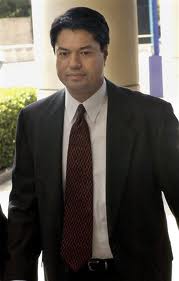 Following up on a post on this blog from a couple of weeks ago, the WSJ’s ($) Paul Davies and David Reilly report on how the shadow of former Dynegy executive Jamie Olis is hovering over the pending criminal proceedings against 16 former KPMG LLP executives in New York. Larry Ribstein and Peter Lattman comment on the issues confronting the former executives in attempting to obtain a fair trial after the prosecution browbeat KPMG to stop paying for their defense.
As I’ve noted before, we are still too close in time to the barbaric treatment of Olis to be able to comprehend the full implications of that case. How many innocent business executives pled guilty to crimes that they did not commit out of fear of an Olis-like sentence? I suspect more than a few.

 In driving back to the office today, I was listening to Charlie Pallilo — who, like me, analyzes baseball using mostly objective criteria — and reminded me of a point that I meant to make in my most recent periodic review of the Stros season — that is, subjective perceptions about baseball are usually quite inaccurate (a point noted in this post from the midway point of the 2006 season).
A case in point this season is Stros LF Carlos Lee. The consensus among most of the media that covers the Stros is that Lee is having a great season and that 1B Lance Berkman is having a lousy season. Well, that latter part of that statement is certainly correct — Berkman, by his lofty standards (career 357 RCAA/.414 OBA/.556 SLG/.971 OPS), is having a bad season (2007 stats: 4 RCAA/.383/.381/.765).
However, the reality is that Lee has not been any more productive than Berkman. Going into last night’s game with the A’s, Lee has generated exactly the same number of runs as Berkman (i.e., 4) over what an average National League hitter would have created for the Stros using the same number of outs as Lee has used. Lee’s key stat line (4/.340/.496/.836) is a bit better than Berkman’s this season, but not all that great by league leader standards. Moreover, Lee’s high number of RBI’s (52) is largely the result of where he hits in the order, not any great hitting performance. Lee’s hitting is largely undermined by the fact that he leads the league in grounding into double plays (14) and his low walk rate (18, compared with Berkman’s 46).
As noted earlier here, Lee’s career numbers (82/.344/515/.859) are nowhere near as good as Berkman’s and really not all that much better than 3B Morgan Ensberg, who is mostly riding the bench these days. Even Luke Scott, who has a 3 RCAA for the season, is about as productive as Lee, while Mark Loretta — who most folks believe has been much more productive than Scott this seaon — has actually been slightly less productive (2 RCAA) than Scott. Meanwhile, Biggio — who has been one of the least productive hitters in the National League from June 12, 2006 through June 12, 2007 (-31 RCAA!) continues to leadoff regularly.
The point of all this is that baseball is not rocket science, but many folks still make it more complicated than it is. Over a long season, a club’s best hitters based on career performance are generally going to produce the most runs for the team. The Stros need to play Berkman, Lee, Ensberg, Scott, and Hunter Pence regularly, fill in the other spots with the most productive players available and and then let the chips fall where they may. It’s highly improbable that the Stros will score more runs taking any other approach.
 It’s T-minus 24 hours or so until the the 2007 U.S. Open at Oakmont Country Club in the Pittsburgh area gets underway, so it’s time to check out the Golf Digest.com flyover of the golf course and Ran Morrissett’s Oakmont course profile at GolfClubAtlas.com. Hat tip to Geoff Shackelford.
 Senator Joe Lieberman’s hawkish comments from over the weekend regarding Iran received much media attention, but Gregory Scoblete in this TCS op-ed makes the case that Pakistan is actually the more toubling foreign policy problem:
While the 2008 presidential candidates are busy fielding questions about how they would confront Iran’s nuclear ambitions, few seem interested in addressing a much more pressing issue: Pakistan. [. . .]
The truth is Pakistan represents a far greater danger to the U.S. than Iran, at least for the foreseeable future. Let us count the ways. Pakistan is a nuclear power. Iran is not. Pakistan has a proven track record of proliferation, including a dalliance with al Qaeda. It was Pakistani nuclear scientists, after all, who met with bin Laden. Indeed, it was a Pakistani scientist, A. Q. Khan, whose black-market network significantly expanded the reach of nuclear equipment and know-how. Meanwhile, Iranian scientists are still laboring to master the basic elements of the nuclear fuel cycle (though progress continues).
Pakistan was one of three countries prior to 9/11 to recognize and provide significant material support to the Taliban – the one regime whose accommodation made 9/11 possible. Iran opposed the Taliban. Elements within the Pakistani military continue to support rump Taliban elements as they battle NATO and U.S. forces in Afghanistan. The New York Times reported that Pakistani army elements have gone so far as to directly fire on Afghan forces (though Pakistan denies it).
Ideologically, Pakistan is vastly more sympathetic to al Qaeda than Iran. Its religious schools preach the extremist variety of Sunni Islam that animates bin Laden’s jihad. While Iran’s Shiite theocrats preach “death to America,” few Iranians have actually embraced the mantra. There are, for instance, 65 Pakistanis in Guantanamo Bay; there are zero Iranians. Unlike al Qaeda, Iran’s Shiite proxy Hezbollah has not embraced mass-causality suicide terrorism against American civilian targets. Indeed, Hezbollah’s most significant anti-American strike was against a military target 24 years ago: a Marine barracks in Lebanon.
The single most important element, however, is the presence of a reconstituted al Qaeda leadership network in Pakistan. The country plays host (whether willingly or not) to the architects of the largest massacre on U.S. soil in history: Osama bin Laden and Ayman al-Zawahiri. In contrast, Iran reportedly harbors a small number of lesser al Qaeda figures.
In Senate testimony earlier this year, intelligence chief John Negroponte described Pakistan as a “secure hide-out” within which al Qaeda plots further carnage. In February, the New York Times reported that al Qaeda “had been steadily building an operations hub in the mountainous Pakistani tribal area of North Waziristan” including full-fledged terror training camps. In Waziristan, al Qaeda inhabits a failed state within a functioning, nuclear-armed one.
In sum, the danger to Americans in America is emanating principally from Pakistan, not Iran. . .
Read the entire article. Scoblete makes a compelling case.
 This Wall Street Journal Online provides this nifty graphic overview of the approval ratings of all U.S. presidents since Truman. Take a few minutes to check it out and enjoy the surprises of a quick history refresher. For example, I had forgotten about the length of the bounce in President Carter’s approval ratings after the Iranian hostage crisis began in late 1979. Of course, that bounce didn’t last as the hostage crisis dragged on for over a year, contributing substantially to Carter’s loss to Ronald Reagan in the 1980 election.
 Clear Thinkers favorite — USC Urban Economics Professor Peter Gordon — is one of the participants in this Wall Street Journal Econoblog from earlier this year, in which the subject is one near and dear to most Houstonians — that is, the cost of traffic congestion, the problems that such congestion poses for urban areas and the policy options that are effective in dealing with the problems. The discussion is a very good overview of the policies and the problems involved in implementing them.
 The U.S. Open begins this week at historic Oakmont Country Club near Pittsburgh. As noted in this Matthew Rudy/Golf Digest article after last year’s Open, the tricked-up nature of the famed Winged Foot course undermined much of the enjoyment of that event for both the competitors and viewers. According to this E.M. Swift/Golf Digest article, we can expect more of the same this year at Oakmont.
When is the United States Golf Association going to realize that setting up a course so that shooting a good score is a crapshoot is neither a good way to determine the nation’s golf champion for the year nor particularly interesting to watch?
 It’s hurricane season in the Gulf Coast region, which always generates some interesting issues involving insurance markets and liability (see also here). Along those lines, this Tim Haab post discusses an interesting case arising from the floods of Hurricane Katrina regarding the difference between an Act of God and an act of man under a homeowner’s insurance policy. A good reminder to pull out your homeowner’s policy and review what type of damage is covered and what’s not in the event of a hurricane.