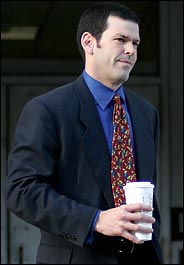
In this WSJ Law Blog post, Paul Davies of the WSJ Law Blog passes along this Chronicle article about Beaumont plaintiff’s attorney Brent Coon issuing a subpoena to the editor and a reporter of a new weekly paper called the Southeast Texas Record, which is bankrolled by the U.S. Chamber of Commerce Institute for Legal Reform in Washington to promote an tort reform agenda (the Chronicle’s Mary Flood has more). Coon’s purpose in issuing the subpoena is that he believes that the editor and the reporter of the newspaper were attempting to taint jurors in one of his pending asbestos cases with regard to the newspaper’s April 2 inaugural issue. “This shameful propaganda machine is deceptive and demonstrates a willingness to misrepresent fact,” Coon complained as he was charging that the editor and reporter might have committed a “criminal act.”
Sounds as if Mr. Coon is better at pursuing plaintiff’s cases than Constitutional Law. The editor and the reporter’s writings are clearly protected free speech under the First Amendment. Not even a close call. Even in Beaumont.
Monthly Archives: April 2007
Making sense of the subprime markets
In this WSJ ($) op-ed, American Enterprise Institute fellow Ted Frank provides a particularly lucid explanation of the many benefits of the markets relating to subprime mortgages and the absurd nature of the attempt by some plaintiffs’ firms to extract some ransom from some institutional investors in those markets. While reviewing how certain members of Congress refuse to allow their ignorance to stop them from attempting to make matters worse, Ted asks:
“Shouldn’t at least one of the two political parties have someone heading up the House Financial Services Committee who understands financial services?”
Meanwhile, Michael Lewis asks three common sense questions in regard to the allegations of wrongdoing in regard to subprime mortgages:
1) If the subprime home-loan market was a cynical conspiracy, why did so many of the putative conspirators wind up taking so much of the risk? [. . .]
2) Why does the most financially obsessed and presumably well-informed character on earth, the American Investor, insist on playing the fool? [. . .]
3) Why in this new drama is it so easy to imagine borrowers in a different role, other than the one in which they are currently cast: The Victim? [. . .]
Messrs. Frank and Lewis both hit on an important characteristic of American markets in general and the subprime markets, in particular. The U.S. mortgage market is the most efficient in the world largely because it is the most securitized. Banks don’t need to take the risk that doomed many of them back in 1980’s when they commonly held on to home mortgages that they originated. Now, banks sell them into the bond market to institutional investors who disperse the risk to those who can afford to take it.
Interestingly, a strong case can be made that the mortgage-backed securities markets is a descendant of the liquidity crunch in home mortgage lending that resulted from the savings and loan crisis of the 1980’s, Just as Congress had a big hand in causing the S&L debacle, the current Congressional crusaders are threatening the markets that corrected the 1980’s downturn in home mortgage lending.
Go Barney Go!
Barney Frank, that conflicted anti-business Congressional crusader (see here and here) who is nevertheless challenging the federal government’s ludicrous prohibition of internet gambling, has decided to introduce legislation to overturn the prohibition, and he thinks it has a chance of passing.
Good for Barney. But how sad is it that Rep. Frank — who is essentially a socialist with regard to economics, business and big government issues — is one of the only national politicians who is willing to advocate reasonable and common sense restraints on the federal government’s prosecutorial power against business interests?
This is not going to look good on TV
I buzzed up to Ft. Worth for a hearing yesterday and the golfers in the crowd were all talking about the EDS Byron Nelson Golf Tournament, which already has a less than inspiring field. Now, it turns out that several greens at the Tournament Players Course at Los Colinas are not going to be particularly picturesque on television:
One after another, competitors at the EDS Byron Nelson Championship struggled Monday to describe the patchwork greens that greeted them at the TPC Las Colinas course.
Riddled with bare patches and marked by evidence of multiple grasses growing on selected greens, the bumpy surfaces triggered a mea culpa from officials at the Four Seasons Resort, who own and oversee maintenance on both courses used at the Nelson tournament. [. . .]
Players who competed in Monday’s pro-am at the Cottonwood Valley course reported thin fairways on selected holes but praised the greens. Competitors at TPC, on the other hand, wondered if PGA Tour officials could find three viable pin placements during tournament week at selected holes.
Tax simplification made simple
One of the more distressing aspects of the Bush Administration’s distractions is the abandonment of the movement toward income tax simplification. In this lucid EconTalk session, Alvin Rabushka of Stanford University’s Hoover Institution lays out the case for the flat tax, which he has been advocating with colleague Robert Hall since 1981. Rabuska’s plan would reform the current system that is based on the 66,000 page U.S. Tax Code with a single rate and no deductions other than personal exemptions, and each individual tax return would be the size of a postcard. This is a common sense reform that is long overdue for many reasons, including one that Russ Roberts makes: “Wouldn’t it be wonderful if all the talented people who currently help rich people avoid taxes were instead encouraged to something productive?” Check out Rabushka’s talk.
More love for Zach
Clear Thinkers favorite Dan Jenkins is not having any part of the notion that Zach Johnson‘s victory in The Masters Golf Tournament was boring due to a tricked-up Augusta National:
I, for one, loved it. The Augusta National, with an assist from nature, finally reined in technology. That alone was worth a roar, wasn’t it?
They took the winning 72-hole score back to 289, the highest it had been since 1954 and 1956, when the basic culprits were strong, gusty winds and the hard old Bermuda/rye greens that wouldn’t hold a pitchfork if Tiger Woods was swinging it.
If there was anything I liked better than seeing the tour pros have to face a tough course for a change, it was learning that Zach Johnson, the new Masters champion, is an unapologetic God-fearing lad who has a Yorkshire terrier like I do.
Only his is named Hogan.
Read the entire article.
Criminalizing business in Kazahkstan
This New York Times article reports on the troubles of American businessman Mark Seidenfeld, the telecommunications entreprenuer who made a fortune during the dizzying days of Kazahkstan’s conversion from a communist to a market economy. The case against Seidenfeld is controversial and is being watched closely, largely because Kazakhstan is perceived to be one of the least repressive countries in the region for foreigners to do business. However, what is most chilling about the account is how many similarities exist between the way in which the Kazahkstan criminal justice system is handling this case and the way in which many recent criminal prosecutions against U.S. businesspersons have been handled in the American criminal justice system (a point made earlier here). Interestingly, several human rights organizations are weighing in with the Kazahkstan government about the handling of the Seidenfeld case, something that is unheard of in regard to similar prosecutorial tactics that are taking place in the U.S.
MLB team values
Forbes just published its annual valuation of Major League Baseball clubs, with the Stros rating a solid 11th among the 30 clubs at an estimated $442 million, or a bit more than a 1/3rd of the value of the top-ranked Yankees and about 60% of the value of the second-ranked Mets and Red Sox. The Texas Rangers are valued at about $80 million less than the Stros. Craig Depken provides some heavy duty analysis of the numbers and comes to the following conclusion:
In the business of baseball, especially in an era of free-agent salaries and the luxury tax, the more the team wins, the lower the profits. What’s going on? The source of this conundrum is the diminishing returns to quality on the revenue side: marginal improvements in team quality do not increase revenue as much. On the cost side, marginal improvements in team quality become ever more expensive.
The Glisan Interview
Tongues were wagging all over Houston this weekend as a result of Wall Street Journal reporter John Emshwiller’s exclusive interview ($) with former Enron treasurer and Andy Fastow confidant, Ben Glisan (excerpts of the interview are here).
The theme of the interview is that Glisan initially deluded himself into thinking that he hadn’t done anything wrong while at Enron, but that he discovered his true self during his 4+ year prison term and came to terms with his criminality.
Emshwiller — whose coverage of the Enron case has been subject to serious conflict of interest issues before — laps up the morality play. Next thing you know, Glisan will be joining Sherron Watkins as a speaker on the “corporate governance reform” rubber chicken circuit.
However, as with almost everything pertaining to Enron, the true story about Glisan is more nuanced than meets the eye.
Glisan was a golden boy at Enron, a rising star in the management circles who Fastow plucked as his hand-picked replacement after running off Enron treasurer Jeff McMahon in early 2000. Contrary to the unsupported statements contained in the interview with Emshwiller, there are real questions as to whether Glisan did much of anything wrong in his duties as Enron’s treasurer.
However, it does appear that he used poor judgment in getting drawn into one of Fastow’s partnership deals in which he made a quick $1 million in mid-2001 on a nominal investment, although it remains unclear as to whether Glisan actually knew that he was engaged in any criminal wrongdoing in taking that return on his investment.
Nonetheless, later in 2001, a month or so before Enron filed its chapter 11 case, Glisan was ultimately canned as Enron’s treasurer because of his failure to disclose that investment in connection Enron’s failed merger negotiations with Dynegy, and so he quickly came under the scrutiny of federal investigators who were suspicious that Glisan’s $1 million return violated the “too good to be true rule” that prosecutors often rely upon to prosecute wealthy businesspeople.
For over a year and a half after being fired by Enron, Glisan continued to maintain to investigators that he had not engaged in any criminal conduct while at Enron. But soon after being indicted in 2003, Glisan — who had not made big money at Enron and was not financially capable of mounting a formidable defense to the criminal charges — copped his deal with the Enron Task Force and began serving his prison sentence.
The rest of the story is not particularly surprising. Glisan was treated roughly during his early days in prison and he quickly began negotiating with the Task Force prosecutors for better accommodations in return for testimony in other Enron-related criminal cases.
He ended up being one of the key witnesses in the Nigerian Barge trial, even though he was not directly involved in the transaction. Most of his testimony in that trial was hearsay of alleged statements made by other “co-conspirators” that was admitted as evidence under an exception to the hearsay rule that would have otherwise excluded such testimony. That testimony helped lead to the improper convictions of four former Merrill Lynch executives that were later overturned on appeal.
Glisan then parleyed his Nigerian Barge work into a transfer to a better prison, where he offered his testimony against former Enron executives Jeff Skilling and Ken Lay in return for liberal furloughs from prison to Houston, where he lived at home while working with prosecutors.
Although the Lay-Skilling jurors viewed him as an effective prosecution witness, there remain substantial questions whether Glisan was truthful during much of his testimony.
So, what to make of all this?
Simple morality plays are easier to write and understand, and certainly easier (and legally safer) to spin on the rubber chicken circuit. The truth in such matters is often far less certain and more difficult to understand, but it’s far more likely to prevent the injustices that have been heaped upon the four former Merrill Lynch executives, Jeff Skilling, Ken Lay, Kevin Howard and Chris Calger, just to name a few. As Ellen Podgor comments:
Although not the focus of [the Glisan interview], it is interesting to note that the risk and cost of trial weigh heavily in the decision to plea. Glisan, like Martha Stewart realized the value of “getting it over with,” and “moving on.” But is that the way the justice system is supposed to work?

The next troubled Texas PGA Tour event
The Shell Houston Open recently finished a rather uninspiring 2007 edition of the event. Now, the EDS Byron Nelson Championship in Dallas — which has also had (earlier post problems brewing) over the past several years — is looking as if it will have its weakest field in years, although it still appears to be better than the SHO’s field. Another PGA Tour event entering the Tiger chasm? The Star-Telegram’s Gil LeBreton thinks so:
The message this time, though, seems unmistakable. If the tributes planned for Byron werenít enough to lure Woods back this year, what makes anyone think that heíll come back next April? Or the year after?
Or that Tiger Woods will ever play tournament golf again in Texas?
His first and last appearance at Colonial came in 1997. A disappointing final round left Woods steamed and tied for fourth place, and he has never returned.
He played in the Texas Open, a fall tour event in San Antonio, in 1996 and came in third. He has never returned.
Woods has never played in the Shell Houston Open.
The Nelson, however, was supposed to be Woodsí tournament. The tournament where Fergie, the Duchess of York, once came to see Tiger play. From 1997 to 2004, Woods played in the Nelson Championship seven times, shooting a combined 77 under par.