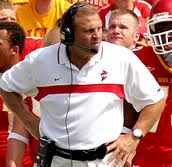
 Dan McCarney, the “dean” of the Big 12 Conference football coaches, resigned under pressure on Wednesday as head football coach at Iowa State University after 12 seasons.
The announcement barely made a blip in the local Houston media, but Coach Mac’s resignation highlighted many aspects of the troubling direction of major college football.
I am biased about Coach McCarney, who is called Coach Mac by most everyone. As regular readers of this blog know, Coach Mac and I have been friends since growing up together in Iowa City, Iowa, where we played together on City High School’s championship football team in 1970.
I moved to Houston with my family shortly after finishing high school and Mac went on to play football at the University of Iowa in Iowa City, but we remained in contact over the years as I went to law school and began a legal career in Houston and Mac went on to the Iowa coaching staff after graduating from undergraduate school.
When Hayden Fry was hired to revive the downtrodden Iowa program in 1979, Coach Mac was one of the only coaches who Coach Fry retained from the previous coaching staff.
As with most of Coach Fry’s personnel decisions, retaining Coach Mac was a good one.
For the following decade, Coach Mac was a part of an extraordinary Iowa coaching staff that not only revived Iowa’s football fortunes, but also produced such outstanding head coaches as Wisconsin’s Barry Alvarez, Oklahoma’s Bob Stoops, Kansas State’s Bill Snyder, Iowa’s Kirk Ferentz and South Florida’s Jim Leavitt.
In 1990, Coach Mac followed Alvarez to Wisconsin, where they took over a 2-9 Badger program and, by 1993, had the team winning the Big Ten Conference championship with a 10-1-1 record, which included a Rose Bowl victory over UCLA.
The next year, Iowa State came calling for Coach Mac and the native Iowan was off to Ames for his first head coaching job.
Over the years, Mac and I have laughed many times about the fact that neither of us really had a clue of what he was getting into at Iowa State. We both knew that the university had long been a coaching graveyard and had eeked out a barely-winning record only a couple of times in the previous 15 years.
Ames is nice little college town, but it is in north central Iowa, pretty much in the middle of nowhere in the opinion of most good college football players. As a result, the football program has always struggled to attract good football prospects, who usually have sexier alternatives to living in central Iowa for four years.
The physical facilities of Iowa State’s football program were poor and the entire football budget at the time was just over $3 million, which was by far the smallest of any public school in the then newly-constituted Big 12 Conference that included such far better-funded programs as Texas, Texas A&M, Oklahoma, and Nebraska, just to name a few.
To make matters worse, Iowa State was a clear second fiddle in the state of Iowa to the University of Iowa, which has a far superior football tradition and an athletic budget more than twice as large as Iowa State’s.
Most folks assume that Kansas State was the toughest head coaching job in the United States before Bill Snyder resurrected it in the 1990’s, but I think a good case can be made that the Iowa State job was even more difficult before Coach Mac took over.
To Mac and Iowa State’s credit, they agreed at the outset that turning Iowa State’s program around was going to be a long-term project. As he did at Iowa and Wisconsin, Mac literally threw himself into the job of rebuilding the Cyclone football program, taking on any speaking engagement and going anywhere to promote Iowa State and its athletic teams.
An outstanding recruiter, Mac and his coaching staff began to expand Iowa State’s traditional Midwestern recruiting base to such football hotbeds as Texas, Florida and California. Mac began to challenge Iowa’s traditional toehold on the best recruits in the state of Iowa.
The progress was slow, though — Mac’s teams lost 42 or their 57 games during his first five seasons.
However, by the 2000 season, Mac and his staff had built a solid foundation for the program. Behind QB Sage Rosenfels (yes, the Texans’ backup QB), Iowa State went 9-3 during that season and won the university’s first post-season bowl game in the university’s 108-year football history (over Pitt in the Insight.com Bowl in Tucson).
That started a 40 game run where Mac’s teams were 25-15, a remarkable feat considering that Iowa State was competing in the brutally-tough Big 12 Conference and playing cross-state rival Iowa each season (Mac’s teams won six of their last nine games against their in-state rival).
By the 2004 and 2005 seasons, Coach Mac had his teams on the cusp of the Big 12 North Division title both seasons only to lose them in an agonizingly close final games in each season.
Nevertheless, after Iowa State had gone to only four bowl games in its history before Coach Mac’s tenure, Mac took the Cyclones to five bowl games in six years, winning two of them. Coming into the 2006 season, optimism was high that the Cyclones would again contend for the Big 12 North Division championship and go to yet another bowl game.
Alas, the 2006 season did not turn out as planned.
First, the Cyclones faced one of the toughest schedules in the country, including an initial stretch of Big 12 games at Texas, at home against Nebraska, at Oklahoma and at home against Texas Tech. Iowa State lost all four and were battered in the process, losing six senior starters to season-ending injury.
Lack of depth is a chronic problem at a place such as Iowa State, so a thin and deflated Cyclone team was smoked over the past two weeks by mediocre Kansas State and Kansas teams. That brought out the “what have you done for me lately” crowd in full force, many of whom were calling on Iowa State to fire Coach Mac despite the fact that few of them have any idea how difficult it is to win consistently at the top levels of major college football.
Suddenly, a little over a year after one of Mac’s best wins as a coach, Mac concluded it was not right for him to become a divisive issue for the university. Understanding Spike Dykes‘ advice that “you lose 10% of your support each season” as a college football coach, Mac understood that he was 20% in the hole at Iowa State based on that formula.
So, Coach Mac elected to resign as head football coach at Iowa State, a difficult job that he would have gladly continued to perform for the rest of his coaching days.
Take a moment to watch his performance during the press conference (click the video camera icon on the left side of the page) to announce his resignation — Mac exudes the class and passion with which he handled all of his duties at Iowa State. In this age of cold-hearted and businesslike coaches who are constantly posturing for the “better” job, it is refreshing to watch someone such as Mac, who wears his big heart and humanity on his sleeve.
Thus, 12 years after arriving at Iowa State, Mac leaves the football program in far better shape than he found it.
The football budget has quadrupled in size under Mac, but it remains the smallest of any public institution in the Big 12 Conference (Texas and A&M’s football budgets are at least 4 to 5 times larger than Iowa State’s). Mac worked behind the scenes continually to improve Iowa State’s facilities and they have improved substantially during his time there.
However, Cyclone athletic department officials are now attempting to raise another $135 million for facilities upgrades in an effort to keep up with the seemingly endless arms race of major college football. In one of the more bizarre aspects of Mac’s resignation, that imminent capital funds campaign was one of the key pressure points that prompted the resignation of the best fundraiser in the history of the Cyclone football program. So it goes in trying to keep up with the Joneses in the wacky world of college football.
After coaching the Iowa State team in its final two games this season, Mac will kick back for a few days, but then I suspect that he will back out looking for another opportunity. His motor is always running and he has a passionate love for coaching. Inasmuch as Mac is widely popular among his fellow coaches, I am confident that he will land on his feet.
However, I am not so sure about Iowa State. The institution is caught in the proverbial rat race of attempting to compete with far-better funded programs and the gap between Iowa State’s resources and those of programs such as Texas and A&M are likely to get even larger. The pressure of that competition has now prompted Iowa State’s administration to take what appears to be a huge risk that the program will decline from the solid foundation that Mac painstakingly built over the past 12 years.
Does Iowa State think that it is going to hire someone who will magically recruit better athletes to Ames than Mac? That’s highly doubtful as Mac is one of the best recruiters in the business and Ames is always going to be a difficult sell to all but a few of the best football prospects.
Does the institution think that it is going to hire someone who will coach better than Mac? Maybe, but Mac is a pretty darn good coach and how many more wins does Iowa State really believe it can achieve through slightly better coaching methods? And even Iowa State officials readily concede that it is highly unlikely that they will ever be able to find someone who can match Mac’s tireless enthusiasm for promoting the institution and the football program.
The bottom line is that seasons such as the one that the Cyclones and Mac are enduring this season are inevitable at a program such as Iowa State’s. That is one of the costs of attempting to compete with limited resources at the highest level of major college football.
That’s not a particularly pleasant reality, but it’s dubious decision-making to take big risks based on an emotional reaction to a disappointing result that is inevitable. That appears to be precisely what Iowa State is doing in letting Mac get away. Wouldn’t embracing a good coach who understands the institution’s limitations and has competed effectively in spite of them be far less risky and much more likely to result in continued success?
Ironically, the Cyclone family now finds itself looking for a new head coach who has the depth and characteristics of . . . well, Dan McCarney. Iowa State will be extremely fortunate if they find one.

 The NY Times’ Alexei Barrionuevo provides this entertaining article on former Enron CFO Andrew Fastow’s deposition in connection with the various civil lawsuits involving the demise of Enron.