Milton Friedman, R.I.P.

milton-friedman-5.jpgI cannot improve on the brilliant simplicity of the lead sentence in the Wall Street Journal’s article on the death earlier today of Milton Friedman:

Nobel prize winner Milton Friedman, one of the most influential economists of the last century, died today.

OpinionJournal chimes in with this fine tribute to Professor Friedman and the NY Times articles on Professor Friedman’s death are here and here, the latter of which is by Austan Goolsbee, a University of Chicago economics professor. The Cato Institute also has posted this excellent online tribute to Professor Friedman from his 90th birthday, and the Hoover Institution’s news release on his death is here. The Financial Times’ excellent obituary is here, and Professor Friedman’s student, Thomas Sowell, has a heartfelt tribute here.
Professor Friedman’s writings are one of the primary reasons that I studied economics in undergraduate school and his wisdom and wit frequently blessed this blog over the past three years. Here are a few examples of Professor Friedman’s remarkable ability to communicate complex principles with engaging simplicity:

Continue reading

Fred Weary’s adventure

Weary_Fred.jpgH’mm, now let me get this one straight.
As Stephanie Stradley reports in detail (John McClain’s comments are here), Texans offensive guard Fred Weary left work at Reliant Park a little after noon on Tuesday. Weary, who is 6’4″, 308 lbs., was followed by a couple of Houston policemen in a squad car as he drove through the Reliant Park area to get on the South Loop and head home.
The officers followed Weary for about six miles and determined that he was “acting suspiciously” and “looking at (them) on several occasions.” After seeing him commit the heinous offense of making a bad lane change, the crack team of officers swooped into action and pulled Weary over on the shoulder of the West Loop, which just happens to be the busiest freeway in Houston. After stopping Weary, the officers ramped up their investigation and determined that the front license plate on Weary’s car was missing.
Weary was understandably irritated that the officiers had pulled him over in one of the most dangerous locations in Houston for doing something that occurs probably a million times in Houston each day. One thing led to another and, before you know it, the officers had Tasered Weary, arrested him and hauled him down to city jail. Verifying once again that it is virtually impossible to get someone processed out of jail in Houston in less than seven hours regardless of the offense, Weary was finally bailed out and able to head home at around 9:30 p.m. Quite a day off, eh?
As usual, HPD is contending that the officers acted reasonably in Tasering and arresting Weary. Count me as highly skeptical about that.
Update: The criminal case against Weary was dismissed in short order. Stay tuned.

Re-thinking angioplasty in certain situations

balloon_angioplasty.JPGFollowing on a trend noted in previous posts here and here, this NY Times article (see also here) reports that findings from a major new study suggest that noninvasive treatment with beta-blockers and other heart drugs turns out to be at least as good as angioplasty for patients whose arteries remain blocked at least three days after a heart attack. The findings — which were presented earlier this week at the annual scientific meeting of the American Heart Association and published simultaneously online by the New England Journal of Medicine — supplement an increasing body of research that is indicating that heart-attack patients whose disease is stable and whose symptoms are under control should be wary of taking the risk of invasive treatment, which can result in infection and bleeding.
Over the past 20 years or so, treatment of heart attacks has been transformed by the ability of doctors to break up blood clots that cause the heart attacks with clot-busting drugs and angioplasty procedures. By quickly restoring blood flow to the heart muscle following an attack, doctors have been able to save lives and minimize damage that can lead to total heart failure. However, a nagging problem has been that about a third of the million or so Amerians who suffer a heart attack each year do not arrive at a hospital within the 12-hour window after the attack during which the patients are most likely to benefit from these techniques. In those patients who stabilize on their own after an attack and then are not diagnosed with blocked arteries until days after the attack, the conventional wisdom has been to go ahead and perform the angioplasty, anyway.

Continue reading

Handicapping the competition for the Texas Fifth Circuit Judgeships

Fifth Circuit.jpgDavid Lat of AbovetheLaw.com does a good job here of analyzing the various candidates for the two “Texas” Fifth Circuit Court of Appeals judgeships that will be opening soon with Judges Patrick Higginbotham and Harold DeMoss taking senior status. Houston judges George C. Hanks, Jr. (First Court of Appeals), Jennifer W. Elrod (190th District Court), Jane Bland (First Court of Appeals) and U.S. District Judge Lee Rosenthal are on the short list, as is former Houstonian, Texas Supreme Court Chief Justice Wallace Jefferson. This should be quite a competition, so stay tuned.

It’s all Flutie’s fault?

Longhorn.jpgGeez, and I thought Texas Aggie fans were taking their team’s losses hard. But Aggie angst is nothing compared to what boiled over in Longhorn land after Texas’ upset loss to Kansas State last Saturday night that doomed the Horns’ BCS championship hopes:

An unhinged Texas Longhorn fan who blames Doug Flutieís televised analysis for the teamís upset Saturday threatened the former football star and his family in an electronic mail message, police said.
The threat, which was not detailed by police, was sent to the Doug Flutie Jr. Foundation for Autism early Sunday, police Lt. Paul Shastany said.
ìWe have intentions of finding this person and speaking to this person,î said Shastany. ìAs threats go, itís a pretty serious incident.î

Continue reading

A Sonic boom fizzles in Seattle

SeattleSonics2.jpgI read this NY Times article over the weekend and found it rather refreshing:

Empowered by a wave of venture capital, a hiring boom and pride in its homegrown billionaires, this city has decided it no longer needs a mediocre professional basketball team to feel good about itself.
On Election Day, residents rebuffed their once-beloved Seattle SuperSonics, voting overwhelmingly for a ballot measure ending public subsidies for professional sports teams. [. . .]
The vote last week guarantees that the Sonics will leave their current home, KeyArena, in 2010, he said. The team may move to the Seattle suburbs and plans to talk to the State Legislature about that in coming weeks, but most people here think [the Sonics’ owners] will move the team to Oklahoma City.

In short, the cost of subsidizing an NBA team has finally exceeded the benefits that most Seattle residents believe they derive from having an NBA team. The same thing has already occurred in Los Angeles with regard to the NFL. As professional sports franchises test the upper limit of what consumers are willing to pay for their product, several other cities will likely follow LA and Seattle’s lead. That’s not a bad development. Warren Meyer agrees.

The super-heated free agent market

drew.jpgDodgers rightfielder J.D. Drew opted out of the final three years of his $11 million per year contract last week, passing up the remaining three years and $33 million on his deal to test what he could draw on the free agent market. The conventional wisdom is that Drew made a mistake.
However, based on the first week or so of free agent transactions this off-season, not only did Drew not make a mistake, it looks to me as if his decision to opt-out was a no-brainer. Drew (28 RCAA/.393 OBA/.498 SLG/.891 OPS for 2006; 146/.393/.512/.904 career) is probably the best outfielder in this year’s free agent pool and maybe even the position player overall. With the upper end of of this year’s market looking like 5 years and $80 million or so for a player of his caliber, the 31 year-old Drew will probably earn an additional $20-30 million of guaranteed money and almost certainly do much better than $33 million over 3 years. Yeah, he’s not the most popular guy in the clubhouse and he has had injury problems, but he’s coming off a solid season in which he played a career-high 146 games. Some team needing solid production from the left side of the plate (which team doesn’t) will probably pay him the premium over his prior contract that prompted the opt-out.
Drew’s opt-out reflects the reason why the Stros probably won’t be much of a factor on the free agent market this off-season. Drew is good, but he’s not as good as the Stros’ Lance Berkman, who is entering the third season of his six year deal that pays him about $14 million a year. There is no way the Stros are going to pay someone like Drew more than Berkman, even though Drew probably will end up making more than Berkman from some other team.
That’s why retooling a Major League Baseball club on the free agent market is really not a practical approach except for a few big-market clubs — it’s prohibitively expensive. Better to maintain the farm (and fiscal sanity) with good prospects and then tap the free agent market only when it is likely to produce a player who will propel the club into playoff contention.

Causey Exposes Another Dirty Secret of the Enron Task Force

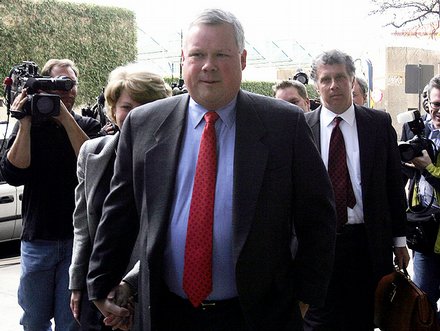
Former Enron chief accountant Richard Causey will be sentenced tomorrow by U.S. District Judge Sim Lake, and Causey’s sentencing hearing highlights another of the Enron Task Force’s dirty secrets that the mainstream media has largely ignored in favor of demonizing former Enron executives.

When Causey entered into his plea deal on the eve of the Lay-Skilling trial, most folks figured that the Task Force would use him as a key witness against his former co-defendant Skilling. The Task Force needed Causey to corroborate former Enron CFO Andrew Fastow’s testimony regarding the Global Galactic agreement, the alleged secret handwritten agreement between Fastow and Causey under which Causey supposedly provided Enron’s assurance — allegedly with Skilling’s blessing — that Fastow’s various special purpose entities would receive a guaranteed rate of return for investing in Enron assets.

Inasmuch as those SPE transactions removed a substantial amount of debt and underperforming assets from Enron’s balance sheet, a key contention in the Task Force’s charges against Skilling and Lay was that Global Galactic proved that Enron’s SPE transactions were shams that helped Skilling and Lay illegally disguise the company’s deteriorating financial condition. So, Global Galactic was a pretty important element in the Task Force’s case against Skilling and Lay.

During his Lay-Skilling testimony, Fastow sang like a canary about the Global Galactic agreement, although the existence of the agreement became more suspect the more Fastow talked about it.

Meanwhile, the Task Force never called Causey to testify during the Lay-Skilling trial, probably because Causey would not corroborate Fastow’s likely false testimony regarding Global Galactic.

Thus, Fastow — who stole millions and then lied to help convict Skilling and Lay — is doing a six-year sentence and will be out in about five.

On the other hand, Causey — who didn’t steal a dime and refused to corroborate Fastow’s lies — will probably serve more time in prison than Fastow.

Is this how we want to go about learning the truth about what really happened at Enron? Ellen Podgor has more here.

Update: Judge Lake sentenced Causey to five and a half years in prison.

The indiscriminate Hammer

DeLay-765296.jpgBen Witherington is a noted New Testament scholar at Asbury Theological Institute in Wilmore, Kentucky near Lexington, which is not the typical place that former House Majority Leader Tom DeLay would normally have been trolling for money during his heyday in Congress. In this post explaining the danger for Evangelical Christians in aligning themselves with either major political party, Dr. Witherington passes along the following anecdote about DeLay:

Several years ago I was contacted by Tom DeLay. He figured since I was a well known white Evangelical I must be on his side on a host of things. I was invited to the White House, and I was named Kentucky Business Man of the Year. I have the plaque sitting in my office framed to prove it. Now, I am no businessman. Just ask my wife. For five years I ran a little coffee shop in Wilmore for our Christian students as a ministry to them– its called Solomon’s Porch, and its still up and running, employing and feeding students and helping them work their way through college and seminary. Its a good ministry, but its not a business that made money. In fact I lost $40,000 helping those students during that time. I was definitely not a Kentucky Businessman of the Year! There were many who did better than I, and I could talk at length about the plight of small businesses which are taxed right out of existence. Several previous restaurants in that spot had not lasted more than about six months. Wilmore is only a town of some 5,000 souls.

Continue reading

It’s lonely being a Texans fan in Austin

downtown-austin.jpegThe Houston Texans recent improved play is not being noticed yet in Austin, at least according to this letter from a local Austin television programing director to Texans fan Brian over at Longhorn Law:

The last Texans game we aired (last Sunday) was tuned-in by just 21,000 households in Austin (a city with 589,000 households). By comparison, the Titans game we aired on Oct 8th (after Vince Young became quarterback) was watched by over 53,000 households (152% more football fanís homes). At one point during that game there were as many as 68,000 households tuned in. It was the most-watched ìearlyî game weíve aired all season. Actually, that game was watched by more Austin fans than any Texans game weíve aired going all the way back to October of last season – with two notable exceptions. The first is when the Texans played the Cowboys on October 15th (which you could expect to be highly watched) and the other, honestly, was when the Texans played the Titans on October 29th. [. . .]

Continue reading