This earlier post reviewed the problems that continue to plague the Shell Houston Open Golf Tournament on the PGA Tour schedule. However, to the north of Houston, the EDS Byron Nelson Open — which begins Thursday in Dallas — is facing many of the same problems that the Shell Houston Open is experiencing.
Due to its current spot on the PGA Tour schedule a month or so after The Masters, “the Nelson” has generally enjoyed one of the stronger “non-major” tournament fields — including Tiger Woods — because most players view it as a timely tune-up for The Memorial Tournament later in the month and then the U.S. Open in June. However, Woods is not participating this year because of the death of his father last week and my sense is that Dallas — as with Houston — may not see Woods again for a very long time.
Not only did Woods’ consecutive-cut streak on the PGA Tour end at last year’s Nelson, but the Nelson is played on two mediocre courses, Cottonwood Valley (for only the first two rounds) and the TPC Four Seasons, neither of which are particularly favored tracts among PGA Tour players. Moreover, next year, when the Players Championship moves to the second week of May, the Nelson will be moved up to the final week of April, just three weeks after the Masters. Thus, the Nelson will be followed by the Wachovia Championship in Charlotte and then the Players Championship the following week.
Notwithstanding Byron Nelson’s drawing power, it’s not likely that Woods, Phil Mickelson, Ernie Els and other top Tour players will cut their post-Masters layoff to two weeks to play in the Nelson when many of them will be playing the pre-Players tuneup the next week at Wachovia and all of them the following week at the Players. In short, the Nelson is about to begin experiencing the type of fields that the Shell Houston Open has endured over the past several years.
With San Antonio’s Texas Open already relegated to an afterthought during football season in the fall, and Ft. Worth’s Colonial Invitational gradually losing the best players because of the tight layout that is not conducive to the floggers, the PGA Tour better sit up and take notice — its four tournaments in the one of nation’s premier golfing states are suffering from serious neglect. How much longer will the thousands of Texans who volunteer their time to run those tournaments — and the tens of thousands who fund them — continue to do so in the face the subpar fields that the PGA Tour is serving up in Texas?
Monthly Archives: May 2006
Self-help dentistry
This NY Sunday Times article explores Britain’s state-financed dental system and finds that the lines for treatment are so long that some citizens simply opt to treating themselves:
Britain has too few public dentists for too many people. At the beginning of the year, just 49 percent of the adults and 63 percent of the children in England and Wales were registered with public dentists.
And now, discouraged by what they say is the assembly-line nature of the job and by a new contract that pays them to perform a set number of “units of dental activity” per year, even more dentists are abandoning the health service and going into private practice ó some 2,000 in April alone, the British Dental Association says.
How does this affect the teeth of the nation? [ . . .]
“I snapped it out myself,” said William Kelly, 43, describing his most recent dental procedure, the autoextraction of one of his upper teeth.
Now it is a jagged black stump, and the pain gnawing at Mr. Kelly’s mouth has transferred itself to a different tooth, mottled and rickety, on the other side of his mouth. “I’m in the middle of pulling that one out, too,” he said. [ . . .]
A recent Guardian newspaper article about the company titled “D.I.Y. Dentistry” (meaning Do It Yourself) said that the previous week British drugstores had sold 6,000 jars of the filling replacement, and 6,000 of the crown-and-cap replacement.
Keep this article handy to show to the next person who advocates a state-funded health care finance system for the U.S.
Darwin trumps Buffett at the WSJ
The Wall Street Journal ($) online edition has a section entitled “At a Glance,” which contains several groupings of articles from the WSJ online edition. One of the grouping categories is called “Most Popular,” which lists the articles that are receiving the most hits from WSJ readers.
On this weekend of Berkshire Hathaway’s always popular shareholders meeting, the No. 1 article receiving the most hits in today’s WSJ online edition is science columnist Susan Begley’s column entitled Darwin Revisited: Females Don’t Always Go for Hottest Mate.
Heh.
A Texas Hill Country Legend
Don’t miss this Susan Dominus/NY Sunday Times profile of actor Rip Torn, who was born and raised in the Texas Hill Country and studied acting in the mid-1950’s at the University of Texas under the noted Shakespearean professor B. Iden Payne.
Although Torn is better known these days for his character roles in such mainstream comedy films as Men in Black and Dodgeball, I maintain that his defining role was as the despicable country-western singing star, Maury Dann, in the 1972 cult classic, Payday. In that film — which is not carried by Netflix and is somewhat difficult to find — Torn’s character plumbs the depths of human depravity while being indulged every step of the way by the people who are dependent on him for their livelihood. Marlon Brando won the Academy Award that year for his memorable performance as Don Corleone in The Godfather, but in my view, Torn’s performance as Maury Dann in Payday was even better.
Promoting John Daly
Any excuse to run the outstanding picture on the left of PGA Tour golfer John Daly, eh?
Although a winner of two majors (1991 PGA and 1995 British Open) over a decade ago, Daly has won only golf tournament in the past 11 years. Nevertheless, he remains one of the most popular and colorful members of the PGA Tour. Married four times with periodic alcohol problems, a big heart and a reality television show to his credit, Daly is one of those larger-than-life characters who seem to attract many of the same folks who watch auto races in anticipation of the crashes.
This week, Daly raised more than a few eyebrows around the rather staid PGA Tour as a result of being the subject of a rather odd promotional campaign for his new autobiography, My Life In and Out of the Rough (HarperCollins 2006), which hits the stores on Monday. The promotional campaign is highlighting Daly’s wild days and nights on the PGA Tour and, according to this Mike Bianchi/Orlando Sentinel review, the book is not for the fainthearted. After reading Daly’s description of various sexual exploits, Bianchi notes:
It’s always amazed me why Daly is so beloved among sports fans when he is 10 times more corrupt than Terrell Owens, Barry Bonds and Ricky Williams combined. I guess it pays to be a good ol’ boy white golfer.
Meanwhile, most of the media coverage focused on the gambling habit that Daly claims in the book has cost him between $50 million and $60 million. Daly’s gambling revelations garnered so much publicity during the week that former NBA basketball star Charles Barkley was prompted to remind folks that he, too, is a character in that he had lost $10 million or so at the gaming tables. To top it all off, Daly will be the subject of the seemingly obligatory segment during this Sunday’s 60 Minutes show on CBS.
It’s Derby time!
The 132nd running of the Kentucky Derby takes place Saturday afternoon and this year’s race has a definite Houston flavor. Bob and John — owned by Texans owner Bob McNair and his wife, Janice — goes off as one of three horses in the race with 12-1 odds, behind only Brother Derek (3-1) and Barbaro (4-1) and Lawyer Ron (4-1). The Chronicle’s John Lopez has more on the McNairs and Bob and John.
Bob and John is the most recent product of the McNairs’ quest to to breed a Derby winner, which they coordinate out of their magnificent 1,500 acre Stonerside Stables in the heart of Bourbon County, Kentucky. Under the careful direction of their advisor John Adger, the McNairs have populated Stonerside with a band of almost 100 broodmares and built the racing stable to its current level of about 70 horses in training. Stonerside is currently the sixth leading breeder in North America and the tenth leading racing stable.
Bob and John is following the lead of another Stonerside homebred, Congaree, who ran the second fastest mile in Derby history before finishing third in the 2001 race. The Cliff’s Edge, bred and sold as a yearling at Stonerside, came in fifth after losing a shoe in the slop of 2004’s rain-drenched Derby.
Meanwhile, Wall Street Journal ($) sports columnist Allen St. John explores the bloodlines of every Kentucky Derby winner from 1940 through last year and concludes that, despite horse owners’ dependence on breeding, there is little direct correlation between a horse that wins on the track and one that produces champion offspring.
Lay-Skilling, Week Fourteen
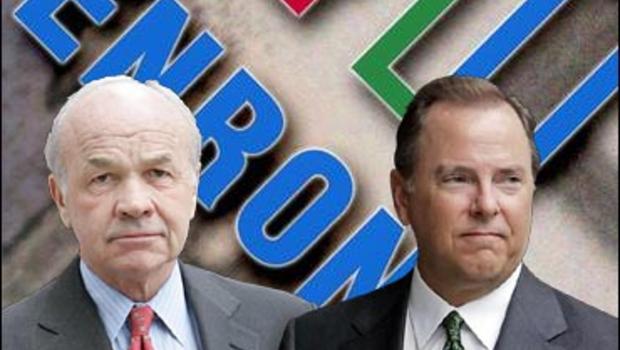
Week 14 of the corporate criminal case of the decade is in the books and the biggest news is that U.S. District Judge Sim Lake has issued an edict that he does not want the case to go beyond Week 16.
So, it presently looks as if the Lay-Skilling defense will wrap up its case-in-chief next early next week, the Enron Task Force will present a short rebuttal case, and then the reading of the jury charge and the closing arguments will begin on Monday, May 15th with the jury to get the case on Wednesday, May 17th.
So, yes, it does appear that this long slog is really coming come to an end.
The first part of Week 14 was the last chapter of the Ken Lay phase of the trial, and the cross-examination of Lay this week was not much different from last week’s.
Prosecutor John Hueston wasted little time addressing the actual business fraud charges against Lay, choosing again to spend far more time attempting to equate humiliation with guilt in hammering Lay over his personal financial affairs.
Although not particularly persuasive substantively, Hueston’s approach was at least consistent with the Task Force’s strategy of masking a fundamentally weak case through reliance on the real presumption that underlies the Task Force’s theory of the case — i.e., that Enron went bust and Lay and Skilling are rich, so Lay and Skilling must be guilty of some crime.
No corporate criminal trial in recent memory (perhaps ever) has had the extensive media coverage of the Lay-Skilling trial. Multiple blogs and major newspapers cover the trial daily, and the coverage is generally helpful in attempting to keep up with whatís going on in the trial.
However, just as the media coverage generally of Enron from the beginning has been overwhelmingly slanted against the company and its executives, the media coverage of the Lay-Skilling trial has not been particularly insightful in the depth of its analysis of the substance of the Task Forceís business fraud case against the two former executives.
Interestingly, a good dose of the vacuity that passes for analysis of the Lay-Skilling trial comes from the media’s various legal “experts,” some of whom have little or no experience in complex business cases and who appear to be competing with each other to have the most colorful comment of each day.
One such expert even pulled out the Watergate card this week by comparing Lay to the late former president, Richard Nixon.
Really penetrating analysis, eh?
Meanwhile, the media reported breathlessly this week on Hueston’s questioning of Lay regarding his relatively lavish lifestyle and use of Enron stock to pay his company line of credit while attempting to reassure employees and the market that Enron was still a fundamentally strong company.
During and after that testimony, the media covering the trial reached a virtually unanimous consensus that Lay and his defense team had performed poorly.
However, none of the media reports or legal experts raised a key fact relating to the Task Force’s focus on Lay’s personal finances — i.e., that the Task Force has not charged Lay with any crime relating to either his use of Enron stock to pay his company line of credit or his lavish lifestyle.
Sort of an important point, don’t you think?
In reality, the entire line of credit issue smacks of a red herring.
Lay traditionally took a substantial part of his compensation from Enron in stock, which was a good thing for both the company and him. As an accommodation to Lay, Enron’s board approved a line of credit — eventually reaching $7.5 million — that allowed Lay to monetize the stock efficiently by borrowing on the line and then repaying it with his Enron stock.
Each year, Lay and Enron complied with the requirement under S.E.C. rules and regulations to disclose Lay’s use of stock to pay the line.
That arrangement probably wouldn’t have made any difference in this trial except that Lay made what turned out to be a bad financial decision in regard to his personal financial affairs well before the time that the Task Force contends he was involved in wrongdoing at Enron.
Because his $300 million-plus net worth was almost entirely invested in Enron stock, Lay and his financial advisers decided that he should diversify his portfolio.
However, Lay continued to believe that Enron stock was the best value in his portfolio, so rather than selling the stock and using the proceeds to buy other securities, Lay borrowed $100 million from third party financial institutions, pledged his Enron stock as collateral and began buying other assets with the loan proceeds.
In so doing, Lay was exhibiting an optimism and confidence in the underlying value of Enron, a fact that the Task Force conveniently ignores in blithely alleging that Lay knew that Enron was a sinking ship.
Unfortunately for Lay, the steady decline in Enron stock price during 2001 undermined the value of the Enron stock collateral for the $100 million in personal loans that he had used to diversify his portfolio.
Thus, as the collateral value fell and margin calls resulted, Lay used the most efficient facility at his disposal to repay about $70 million of debt in 2001 — i.e., the proceeds from draws on his company line of credit, which he repaid with his Enron stock.
Despite the straightforward nature of the Lay’s line of credit arrangement, the Task Force spent more time on Lay’s handling of it than any other subject during his cross-examination.
Hueston hammered Lay relentlessly over the fact that Lay did not disclose to Enron employees in late October, 2001 that he was using Enron stock to repay the line of credit, on one hand, while advising the employees at the same time that he was purchasing Enron stock and that the stock remained a good value, on the other.
Similarly, Hueston skewered Lay for his draw of a final $1 million on the line of credit roughly five days before Enron filed its bankruptcy case and Lay’s application of those proceeds to pay the remaining balance on the mortgage on his multi-million dollar homestead at the tony Huntington condominiums near River Oaks.
Although the Task Force has not charged Lay with any crime regarding his handling of the line of credit, Hueston repeatedly asserted that Lay’s conduct in regard to it reflects that he is a hypocrite who lacks credibility on other issues.
Lay’s eve-of-bankruptcy draw on the line of credit was clearly ill-advised, but the Task Force is simply wrong in its contention that Lay was largely dumping Enron stock at a time when he was advising employees and the market that it was a good value.
For example, in September, 2001, Lay accepted $10 million in cash and another $10 million in Enron stock when he agreed to step back into the CEO role after Skilling resigned, and Lay used the $10 million in cash to repay a portion of his margin loans.
In so doing, Lay effectively bought $10 million in Enron stock, meaning that Lay acquired over $20 million in Enron stock roughly a month before he made the statements to Enron employees of which the Task Force complains.
Consequently, even though Lay was also paying his line of credit with Enron stock at the same time, his acquisition of another $20 million in Enron stock is consistent with the optimistic view about Enron that Lay was communicating to employees and the public.
In its quest to demonize Lay, the Task Force simply ignores that salient fact.
In view of the Task Forceís emphasis on Lay’s handling of his line of credit, I suspect that the prosecution may attempt to morph Lay’s non-disclosure regarding his use of Enron stock to pay the line of credit into an alleged basis for either a wire fraud or securities fraud charge against Lay.
As noted above, there is nothing in the indictment about any of this being the basis of criminal charges against Lay, so it will be interesting to see how Judge Lake deals with that issue if the Task Force indeed seeks to make such a case to the jury.
However, the underlying weakness of the Task Force’s business fraud case against Lay and Skilling is perhaps best reflected by comparing the number of questions that the Task Force prosecutors asked Lay and Skilling over such titillating issues as PhotoFete and Lay’s handling of his personal finances (literally hundreds) versus the number of questions that the prosecution asked on such core business fraud issues as the alleged Global Galactic agreement and the alleged huge conspiracy at Enron (zero).
Just to underscore the weakness of the prosecution’s case on those points, the Task Force announced on Thursday that it was not going to call former Enron chief accountant and Lay-Skilling co-defendant Richard Causey as a rebuttal witness. So much for the Global Galactic and conspiracy issues.
Accordingly, at the Week 14 pole, the corporate criminal case of the decade appears to be boiling down to PhotoFete and whether Lay should have disclosed that he was using Enron stock to pay his company line of credit while he was touting Enron.
Despite the media’s fixation on Hueston’s hammering Lay regarding his personal finances, Lay actually acquitted himself reasonably well on cross-examination regarding the issues relating to the Task Force’s core business fraud charges.
Moreover, as most of the media fled the courtroom as Lay’s testimony on the lives of the rich and famous ended, a series of expert witnesses continued to poke holes in the foundation of the Task Force’s business fraud charges over the latter part of the week.
For example, I was able to sit in for a couple of hours during Wednesday afternoonís testimony as Skilling accounting expert Walter K. Rush schooled Task Force chief Sean Berkowitz — who does not let a disadvantage in specialized knowledge deter him from lengthy cross-examination — on the validity of Enron’s accounting for its reserves and the resegmentation of the EES retail unit.
Rush was clear and convincing, and explained application of relevant accounting principles to the jury in a clearer manner than any witness to date. Berkowitz was no match for him.
How all of this is going over with the jury is anyone’s guess.
Could a jury convict either or both of the defendants based on such a weak case? Sure, it happens all the time.
However, Skilling and Lay have presented — under extraordinarily adverse circumstances — a compelling defense that they were not involved in any criminal wrongdoing at Enron and that the company’s failure was, at worst, the result of business misjudgments, such as maintaining too low a credit rating and too much leverage for a company with a huge trading operation to endure the post-bubble and post-9/11 market’s reaction to the negative Fastow/Kopper-fraud disclosures during the fall of 2001.
Can a jury immersed in anti-Enron publicity for the past five years see through beguiling theories of massive frauds, conspiracies and high lifestyles to grasp that simple truth?
That’s the key question still to be answered in Houston as the corporate criminal case of the decade enters its final two weeks.

60 Minutes on Colbert
I realize that he may have bombed at the recent White House Correspondents’ Association awards dinner, but I’m still a big fan of Comedy Central’s Stephen Colbert. Here is the recent 60 Minutes segment on Colbert (segment 2 and segment 3), which includes a good dose of Colbert’s hilarious interviewing techniques.
By the way, one thing that I’ve always wondered about Colbert — but that Morley Safer did not ask him in the 60 Minutes piece — is whether the pronunciation of Colbert’s name (prounouced “Cole-bear”) on his show is a play on the wonderful Hyacinth Bucket character (pronounced “bouquet” by Hyacinth and “bucket” by everyone else) in the equally hilarious BBC comedy show, “Keeping Up With Appearances“? Anyone know the answer?
Update: In the small world department, turns out that Jeff Skilling’s law firm — O’Melveny & Myers — has a Colbert connection. One of Colbert’s older brothers is Jim Colbert (who pronounced his name with a good, hard “ert”), who was a litigation partner at O’Melveny for approximatey 30 years in Los Angeles. The elder Colbert was known at O’Melveny as a brilliant litigator with — you guessed it — a sharp wit.
Gingrich on Texas medical malpractice reform
This Opinion Journal op-ed by former House Speaker Newt Gingrich and Dallas orthopedic surgeon John Gill urges Congress to view Texas’ 2003 medical malpractice litigation reform legislation as a model for such legislation:
[P]hysicians are returning to the [Texas], particularly in underserved specialties and counties. Insurance premiums to protect against frivolous lawsuits have declined dramatically, with the stateís largest carrier reporting declines up to 22% and other carriers reducing premiums by an average of 13%. The number of lawsuits filed against doctors has been cut almost in half.
But Gingrich and Gill caution to get ready for a rumble over the Congressional debate on medical malpractice reform:
In the coming days, our senators in Washington will have a chance to stand up with America’s doctors and patients against the personal injury lawyers. Expect a brawl. On one side will be the lawyers, frantically attempting to protect and pad their wallets, while driving up costs for the American people and limiting our access to health-care providers. On the other will be the positive, pro-patient, pro-health-care story from Texas, a state which has taken an important first step toward creating a 21st-century health justice system that meets the needs of doctors and patients alike.
Read the entire piece.
The Bagwell disability claim lawsuit
As noted earlier here, the Stros have initiated a lawsuit against Connecticut General Life Insurance Co. over the insurer’s denial of the Stros’ claim under the disability insurance policy on the best player in Stros franchise history, Jeff Bagwell. Previous posts on the Bagwell disability claim are here.
Connecticut General has removed the Stros lawsuit from state district court to federal district court, and the case has been assigned to U.S. District Judge Keith Ellison, who has set the initial scheduling conference in the case for August 4th. You can download a copy of the the Stros’ original petition in the lawsuit here.
According to the Stros’ petition, the policy defines disability as “any physical illness or condition . . . that renders [Bagwell] totally disabled from performing as a professional baseball player.” Thus, the issue in the lawsuit is whether not being able to throw a baseball, while at the same time still being able to hit one, renders Bagwell totally disabled under the terms of the policy. Connecticut General probably wishes that it could remove the lawsuit to the American League, where the existence of the designated hitter rule would mitigate in favor of the insurer’s position.
As noted earlier, the Stros are represented in the lawsuit by well-known Houston plaintiff’s lawyer Wayne Fisher, who is a longtime friend of Stros owner Drayton McLane. Tynan Buthod of Baker & Botts is lead counsel in the case for Connecticut General.