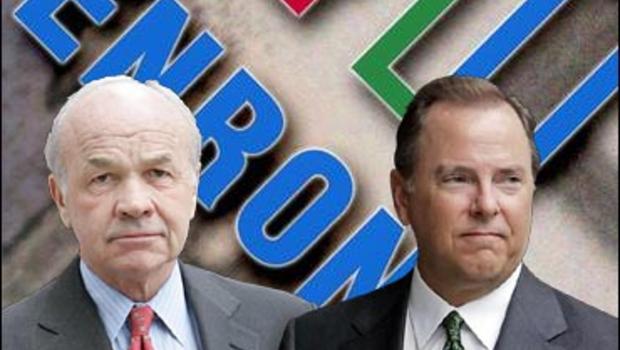
 After only one week of the defense’s case and the tenth week of trial, it has become clearer than ever that the Enron Task Force’s prosecution of former key Enron executives Ken Lay and Jeff Skilling has become the purest attempt to criminalize corporate agency costs of any prosecution since the bursting of the stock-market bubble of the late 1990’s.
After a friend of prosecution witness and former Enron investor relations chief Mark Koenig kicked off the defense case by testifying that Koenig had told her that he lied about wrongdoing at Enron in order to cop a plea deal with the Enron Task Force, the Lay-Skilling defense presented a series of former Enron executives who disputed the testimony of prosecution witnesses on a number of key prosecution allegations, including the following:
That Skilling authorized former Enron CFO Andy Fastow to operate Enron’s special purpose entities as parking lots for Enron’s underperforming assets while running roughshod over other Enron executives in negotiations;
That Enron had no internal controls regarding Fastow’s conflict of interest in managing certain of Enron’s SPE’s while acting as Enron’s chief financial officer;
That there was any wide-ranging criminal conspiracy within Enron;
That Skilling had misrespresented to the marketplace layoffs in Enron’s broadband unit as redeployments;
That Skilling had misrepresented to the marketplace the true purpose of a restructuring of Enron’s EES business unit and the nature of problems within that unit;
That former finance executives Fastow and Ben Glisan had ever informed Lay that the Dhabol Power Plant in India was highly overvalued; and
That Vinson & Elkins’ investigation into the allegations contained in Sherron Watkins’ memo was a sham by Lay to cover-up Enron’s shaky finances
Business decisions necessarily involve judgments over various possible alternatives, and the nature of business risk means that a number of those decisions will ultimately turn out badly, as certainly occurred at Enron.
But rather than allowing the civil justice system to sort out responsibility for such a loss, the Enron Task Force’s mindset is to criminalize the loss by appealing to the jurors’ hindsight bias and urging them to convict Lay and Skilling of making “the choice of seemingly riskier alternatives.”
As corporate law experts Stephen Bainbridge and Larry Ribstein have long maintained, shareholders deserve protection from theft, but not from risk taking, and it’s not clear that government prosecutors know — or even care about — the difference.
Thus, while the Task Force has properly obtained guilty pleas from Fastow, Glisan and the relative few of their cohorts who truly committed crimes by effectively embezzling money from Enron, the Task Force continues to spend an enormous amount of resources criminalizing business judgments that Lay, Skilling and others made in regard to Enron that simply do not involve the black-and-white circumstances of theft or embezzlement.
As a result, the Task Force has been forced to engage in a number of highly questionable tactics in order to attempt to pull off a win in such cases. The Task Force’s record in the three previous Enron-related prosecutions that have actually gone to trial — the Andersen case, the Enron Broadband case, and the unraveling Nigerian Barge case — reflects that even those dubious tactics cannot pull the wool over the specious nature of such prosecutions.
The cross-examination of former Enron general counsel James Derrick Thursday afternoon was a case in point.
Derrick — who is a quietly forceful, competent and genuinely nice man — made the following insight Thursday afternoon when Task Force prosecutor John Hueston accused him of trying to shield himself from civil liability by denying wrongdoing in connection with his involvement in retaining Vinson & Elkins to conduct the investigation into allegations contained in the Watkins’ memo:
A. I think it is fair for people to question [Derrick’s involvement in the decision to retain V&E], but the reason I haven’t admitted to [wrongdoing] is because I am personally confident that I have discharged, and did discharge, my obligation in good faith to the company. It’s perfectly proper to challenge my judgment, but in terms of whether I exercised it in good faith in a way that I thought was in the best interest of the company, I have no doubt that I did that. [. . .]
Q. Sir, it certainly helps you claim that you did everything proper by denying ever receiving a memo in that same time from your own internal legal counsel which would corroborate those Watkins allegations; right?
A. I think it serves my interest to tell the truth.
Derrick’s analysis is spot on. Sure, his and Lay’s decision to retain V&E to handle the investigation over the Watkins’ memo is subject to legitimate question. But there is little doubt that the decision was a reasonable business judgment that these two men made after careful consideration of the difficult circumstances and issues that their company faced at the time of the decision.
Whether management makes such judgments correctly is a fundamental risk of business ownership, and criminalizing that risk — through the prism of hindsight bias — will simply make executives in the future less likely to take the risks necessary to build wealth and create jobs while not deterring in the slightest the Fastows of the world from embezzling money.
How all of this is affecting the Lay-Skilling jury remains decidedly unclear. As Professor Bainbridge pointed out earlier in the week, the betting markets are lining up in favor of conviction, which mirrors public opinion that is conditioned by the mainstream media’s presumption in such cases — i.e., that Enron melted down and, thus, Lay and Skilling must be guilty of something as a result.
Although most of the reporters attending the trial each day are providing reasonably objective analysis, that hardly makes a dent in the societal bias against anything having to do with Enron. Heck, the business columnist for Lay and Skilling’s hometown newspaper has rarely missed a day during the trial in which he does not call for the conviction of the two men.
Nevertheless, my sense remains that the dynamics in play in the Lay-Skilling courtroom indicate that the outcome is not as certain as conventional wisdom suggests.
This week, the defense witnesses have presented an interesting contrast to the prosecution witnesses of the previous nine weeks. Inasmuch as virtually all of the key prosecution witnesses had cut plea deals with the Task Force in return for their testimony against Lay and Skilling, their testimony came after many hours of preparation with prosecutors. In contrast, almost all of the defense witnesses this week had either met only briefly or not at all with the Lay-Skilling team before testifying.
The result was testimony that was not as prepared as that of the prosecution witnesses, but maybe just more credible to the jury than the heavily-scripted testimony of the prosecution’s plea-bargaining witnesses.
Similarly, the Task Force’s cross-examination of the defense witnesses has seemed mostly off-target.
For example, during cross-examination of Max Hendrick, a Vinson & Elkins partner involved in the investigation of the allegations in the Watkins memo, a Task Force prosecutor attempted to impeach the testimony of Hendrick with the hearsay statement of an unindicted co-conspirator, even though the statement was exculpatory with regard to the unindicted co-conspirator being involved at all in the alleged conspiracy at Enron.
That not-so-subtle point went unreported in the mainstream media accounts of the trial, but it nevertheless highlighted perhaps the biggest injustice of all of the Enron-related prosecutions — the Task Force tactic of effectively precluding key witnesses with exculpatory testimony from testifying for the Lay-Skilling defense.
Likewise, the Task Force’s cross-examination of Derrick on Thursday afternoon was questionable, at best. During direct examination earlier in the day, Derrick had recounted conversations with Skilling on how they both valued the importance of family and how burdensome Enron executive jobs were on their them.
Derrick — who did not prepare his testimony with the Lay-Skilling team before taking the stand — then expressed appreciation to Skilling and Enron for allowing him to take an extended 1991 vacation trip rafting down the Colorado River with his only son, who died unexpectedly several years ago. “I’ll be forever grateful,” stated Derrick from the stand regarding Skilling’s kindness. An observer of the morning session told me later that the jury’s attention was riveted on Derrick during that part of his testimony.
Then, in the afternoon session (which I was able to attend), Task Force prosecutor Hueston attacked — with an accusatory tone in his voice — Derrick’s credibility and integrity.
Never changing his quiet and patient demeanor in the face of Hueston’s misguided tone of cross-examination, Derrick politely but firmly refused to give Hueston an inch and, by the end of the day, appeared to have Hueston flustered.
After the morning’s testimony about Derrick and his son, my sense in the courtroom was that the jury — which is predominantly female — was not appreciating the style of Hueston’s cross-examination toward Derrick one bit. Sometimes such seemingly small incidents in long trials end up making a big difference in the way jurors ultimately frame the issues.
Derrick returns to testify on Monday for a short time before Skilling takes the stand, probably around mid-morning.
Thus, Week Eleven of the corporate criminal case of the decade will be the Jeff Skilling Week, as the former Enron CEO will probably be on the stand for the entire week and probably a portion of the following week.
Unlike many white collar business defendants, Skilling is anxious to tell his side of the story, and I expect his testimony will be a fascinating look into the conflicting considerations and pressures that surrounded the process of making tough business judgments for a huge company that was often involved in taking cutting-edge risks.
From a business law standpoint, it doesn’t get much more interesting than that, so stay tuned.

 On the heels of her cameo at the Lay-Skilling trial, the ubiquitous one — Houston Congresswoman Sheila Jackson Lee — gets more camera time standing next to colleague Cynthia McKinney apologizing about waylaying a Capital Hill police officer. Slampo will be pleased.