
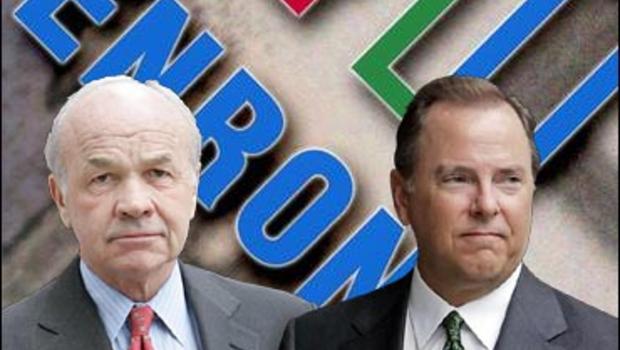
Lay-Skilling, Week Five

The pace of the Enron Task Force’s legacy case against former key Enron executives Ken Lay and Jeff Skilling continued to pick up pace during its fifth week, but that quicker pace is highlighting an unusual aspect of the trial — that is, the Task Force’s case appears to be shrinking dramatically before our very eyes.

After years of a highly-publicized propaganda campaign against anything having to do with Enron, after bludgeoning plea bargains from over a dozen former Enron executives, after alleging the biggest criminal conspiracy in the history of federal prosecutions, and after issuing a 66-page indictment against Lay and Skilling that is so far afield from what is going on in court that the prosecutors don’t want the jury to see it, the Task Force’s case is coming down to a complex jumble that relies heavily on innuendo and requires the jury to connect the dots of amorphous points that the Task Force is hoping will be enough to convict Lay and Skilling.

This week’s testimony was a case in point. The Task Force’s main theme was that Enron was so successful in making money in its trading operations that it allowed Lay and Skilling to soft-pedal to the investing public the losses that Enron was incurring in a couple parts of its business.

Mind you, the Task Force is not suggesting that Lay or Skilling was involved in approving fraudulent accounting; rather, the Task Force alleges that Skilling engineered a reorganization of an Enron business unit in a manner that hid losses of the poorly-operating unit underneath the blanket of high profits of Enron’s trading unit.

According to the Task Force, the hiding of these losses, along with over-reserving to hide excess profits of the trading unit, allowed Skilling — and presumably Lay, although he was almost an afterthought this week — to misrepresent Enron as a stable logistics company than a more volatile trading company, which the Task Force contends would not have been as highly valued in the marketplace.

Thus, the prosecution of Lay and Skilling is shaping up as the purest prosecution of corporate agency costs in the post-Enron era.

The underlying message of this prosecution is that an executive of any publicly-owned corporation better disclose every bit of bad news about their company or risk prosecution — under the sharp lens of hindsight bias — for misleading the investing public about the true health of the company. If the Task Force’s approach is successful against Lay and Skilling, one would wonder why any executive of a publicly-owned corporation would risk saying anything to analysts and the investing public other than “go read the financial statements in our regulatory filings. It’s all there.”

Amidst this muddle, the Task Force continues to show clear signs of desperation.

One such sign is that the Task Force continues to fumble about in regard to the order of its witnesses, a problem that drew the rare ire of the remarkably patient Judge Lake early this week.

Moreover, the Task Force continues to rely heavily on testimony from witnesses who are testifying under cooperation agreements with the Task Force under which the witnesses hedged the risk of a long prison term and the loss of millions in return for their testimony.

Is the jury really going to believe that the biggest corporate conspiracy in history was hidden from everyone except the relative few Enron executives who have copped pleas or entered into non-prosecution agreements?

An even bigger problem for the Task Force is that the testimony of the cooperating witnesses has been all over the map in regard to their conduct.

Mark Koenig testified that he lied a few times while touting Enron. Paula Rieker testified that others lied, but she did not — she only “overstretched” a few times. This week’s star prosecution witness, former Enron Energy Services executive David Delainey, testified that he lied all the time. Wes Colwell, a former Enron trading unit accountant, incredibly testified that he was involved at Enron in defrauding Tom Bauer, a former Andersen accountant with whom Colwell is now in business!

Meanwhile, there is no documentary evidence that any of these cooperating witnesses thought they were lying at the time of the alleged crimes and no meaningful evidence that they even told anyone that they thought they were lying.

Meanwhile, the defense has introduced on cross-examination large amounts of documentary and video evidence that the cooperating witnesses appeared to be working hard under difficult conditions to help Enron’s cause.

Is the jury going to believe that all of these witnesses were such good liars? And, if so, will the jury believe that they were lying then or lying now on the stand?

Seemingly sensing this dynamic, the Task Force elicited testimony at the end of the week from its latest cooperating witness — former Enron Broadband executive Kevin Hannon — that Hannon had actually participated in a meeting with Skilling, Lay and others in May 2001 in which Skilling supposedly admitted that an analyst’s report at the time had finally figured out his elaborate fraud on the market.

Testimony for the week closed with Hannon still under direct examination from the prosecution, so no cross-examination has occurred. But just how likely is it that such a significant meeting took place and Skilling made such incriminating statements, and yet none of the half-dozen previous former Enron executives who have testified during the trial were told about it by either Hannon or any other participant in such meeting? Stay tuned on that issue.

Consistent with the shrinking nature of the prosecution’s case, the Task Force announced this week that it is over halfway through with putting on its case in chief and expects to be through presenting its case by the end of this month. Inasmuch as the Task Force originally estimated that it would take 36 days (i.e., nine weeks) to put on its case, assuming an equal amount of time on cross-examination to that spend on direct.

Even though the Task Force took more time than was necessary or advisable with its initial witness Koenig and cross-examination has been taking far longer than direct, the Task Force is now over halfway through presenting its case. That’s another indication that the Task Force is literally adjusting its theory of the case “on the fly” during the trial, and that it has concluded that it cannot prove the vast majority of what it alleged in its charging documents against Lay and Skilling.

Next week should be particularly interesting as demonized former Enron CFO Andy Fastow — the architect of Enron’s special purpose entities or “SPE’s” — takes the stand after Hannon.

Fastow was a notoriously volatile fellow — at least to subordinates — while at Enron, and it will be interesting to see whether his demeanor has changed since he copped a plea deal with prosecutors back in early 2004.

On the other hand, the Task Force’s case to date has wandered away from the SPE’s, so there is a decent chance that a difficult-to-control Fastow could end up being a not-so-important witness in the ever-changing big scheme of this corporate criminal case of the decade.

Graceless

nancy grace-thumb.jpgLooks as if Bill O’Reilly is not the only prominent television pundit who is a tad wacky.
This NY Observor article (hat tip to Walter Olson) reveals that CNN personality Nancy Grace is playing fast and loose with background facts that bear on the motivation for her crime-busting agenda.
Beward of the demagogues.

The Sea Sponge brief

spell check.gifThe Latin phrase sua sponte is often used in legal pleadings to refer to actions that the court takes in a case on its accord or motion. But this Law.com article ($) indicates that Santa Cruz, CA lawyer Arthur Dudley’s use of that phrase will never quite be the same:
In an opening brief to San Francisco’s 1st District Court of Appeal, a search-and-replace command by Dudley inexplicably inserted the words “sea sponge” instead of the legal term “sua sponte,” . . .

“Spell check did not have sua sponte in it,” said Dudley, who, not noticing the error, shipped the brief to court.

That left the justices reading — and probably laughing at — such classic statements as: “An appropriate instruction limiting the judge’s criminal liability in such a prosecution must be given sea sponge explaining that certain acts or omissions by themselves are not sufficient to support a conviction.”
And: “It is well settled that a trial court must instruct sea sponge on any defense, including a mistake of fact defense.”
The sneaky “sea sponge” popped up at least five times.

At least grizzled courthouse veterans are honoring Dudley with a new characterization of the legal duty involved in his case:

The faux pas has made Dudley the butt of some mild ribbing around Santa Cruz. Local attorneys, he said, have started calling his unique defense the “sea sponge duty to instruct.”

Criminalizing the business reporters

short selling4.jpgThe increasing criminalization of business took an interesting turn earlier this week when the Securities and Exchange Commission’s San Francisco office subpoenaed email and other documents from several journalists, including one who works at Dow Jones Newswires, another at MarketWatch.com, and even TheStreet.com and its co-founder, “Mad Money”‘s James Cramer, who, ironically, is a buddy of that subpoena-issuing machine, New York AG Eliot Spitzer. My younger son — a big fan of Cramer’s off-the-wall show — got a big kick out of Cramer rebelliously throwing the subpoena on the floor during his television show.
The subpoenas started flying after the online retailer Overstock.com accused a hedge fund and a stock-research firm of manipulating the media to drive down the price of its stock for the purpose of profiting through shorting Overstock.com stock (this tactic is described earlier here and here). It apparently meant little to the SEC Enforcement Division that the reporters were simply doing their job of tapping sources for information and then reporting that information to investors who make informed judgments in buying and selling stocks. Some of those sources may have even profited from shorting Overstock.com stock. Who knows and, frankly, who cares? So long as reporters are reporting what they learn and are not bribed to do so, they are simply doing their jobs and fulfilling their role in the complicated workings of efficient financial markets.
Then, in an extraordinary development, SEC Chairman Christopher Cox called off the SEC Enforcement Division dogs and issued a public rebuke of the division for failing to obtain his approval for issuing the subpoenas in the first place. Although I am occasionally critical of the media’s reporting on the increasing criminalization of business by various governmental entites, I viewed Cox’s action as a good thing and an indication that he was intent upon implementing responsible oversight of dubious regulatory initiatives that has been sadly lacking in the SEC and the Department of Justice in the post-Enron era.

Continue reading

A big UT-A&M game in March?

A&M v UT.jpegThe University of Texas – Texas A&M game that most folks in these parts normally care about occurs on the day after Thanksgiving, but a capacity crowd will be whooping it up this evening in College Station (televised on ESPN2) as the A&M basketball team attempts to derail league-leading UT’s attempt to add a Big 12 Conference basketball title to its Big 12 Football Championship.
Basketball — which is normally a diversion in College Station between football season and spring football practice — is generating more interest in Aggieland this season because A&M has a legitimate shot at making the NCAA Tournament for the first time since, well, this year’s freshman class of A&M students was waiting to be born. The Ags really need a win to keep their NCAA Tournament hopes alive because, despite winning their last five and sporting an 18-7 record (8-6 in the Big 12), the Aggies have only a 1-4 record against top 50 RPI teams and padded its overall record by playing an absurdly weak non-conference schedule.
Nevertheless, a win over the sixth-ranked Horns (24-4 overall record, 12-2 in Big 12) would be a feather in A&M’s hat and, coupled with a couple of Aggie wins to close out the season, might be enough to push the Ags into the tournament. Forward P.J. Tucker (16.4 ppg, 9.2 rpg) and center LaMarcus Aldridge (16.0/9.3) are UT’s top players, while the Ags are led by guard A.C. Law (16.5 ppg, 3.8 apg) and center Joseph Jones (15.8 ppg, 6.7 rpg).
Update: Aggies win on a buzzer-beater, 46-43!

Anna Nicole a winner?

Anna Nicole2.jpgBased on yesterday’s oral argument in Anna Nicole Smith’s appeal to the Supreme Court in regard to her claims against the estate of former Houston oilman J. Howard Marshall, the early speculation from the experts in such matters is that Anna Nicole is likely to win. Steve Jakubowski has a nice wrap-up of the argument here.
Despite all the hoopla of Anna Nicole barreling into the normally stuffy Supreme Court courtroom, the legal issue in the case is decidedly unsexy — Did the bankruptcy court have jurisdiction over a tort claim that Anna Nicole’s bankruptcy estate owned and asserted against against J. Howard’s son, who is the executor of J. Howard’s estate? My sense is that it’s not particularly surprising that the experts believe that Anna Nicole has a winner on that issue.
Anna Nicole’s appeal is based on what is called a ìrelated toî claim to a bankruptcy case, which simply means that it is a claim that could have some impact on the bankruptcy estate. Inasmuch as successful assertion of Anna Nicole’s claim against the younger Marshall could generate money for her estate, the claim is clearly a “related to” claim. Although a bankruptcy court has broad discretion to abstain from adjudicating such a claim, it is clear that such abstention is not mandatory, and the Anna Nicole bankruptcy court elected not to abstain from adjudicating her claim.
The younger Marshallís legal team asserts that there is a non-statutory ìprobate exceptionî to federal jurisdiction that applies in federal diversity cases and bankruptcy cases. But their legal authority for that proposition in the context of Anna Nicole’s case is pretty skimpy and distinguishable. As such, I too will be surprised if Anna Nicole doesn’t win.
In discussing my view that Anna Nicole is a winner with one of my teenage daughters, she asked: “Does that mean that she will get her television show back?” ;^)

Guilty plea in another gas trader reporting case

traders8.jpgDonald Burwell, a former El Paso Corp. energy trader, pled guilty under a cooperation agreement with the Justice Department to federal charges Tuesday that he falsely reported natural gas trading data to a natural gas industry publication. Burwell faces a possible five-year prison sentence and a fine of $500,000, and his plea deal comes just two weeks after another of the dozen or so traders ensnared in the Justice Department’s prosecutions of natural gas traders filed a motion to withdraw his guilty plea. Earlier posts on Burwell’s case are here and here. The DOJ’s press release on the plea deal is here.
Given that he is unemployed and broke financially, Burwell’s plea deal is not surprising. The Justice Department has been alleging some astronomical market effect figures in these cases in order to threaten defendants with draconian prison sentences and, as we have seen in the sad case of Jamie Olis, the DOJ will follow through on the threat regardless of the law or the facts. At least one of the other trader cases similar to Burwell’s is scheduled for trial later this year.