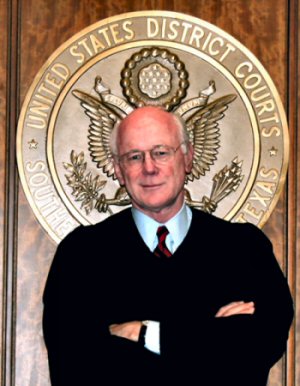
Doesn’t the Fifth Circuit know about Gallery Furniture?

5th Cir logo9.gifThe Fifth Circuit Court of Appeals plan to re-open for business this week in Houston ran into a logistics problem — furniture for the Court’s personnel could not be delivered until this weekend. Accordingly, the Court has pushed back its re-opening date to September 21 and the new deadline for filing non-emergency pleadings is October 10. Here is the Court’s announcement and related Order.
Meanwhile, this Chronicle article on the Fifth Circuit’s operations notes that none of the Court’s files in its New Orleans offices appear to have been damaged by the flood.

In the wake of KPMG

deutscheb3.gifFollowing on this post from last month, this New York Times article reports that, on the heels of KPMG’s deferred prosecution agreement with the Justice Department and the subsequent indictment of eight former KPMG partners, federal prosecutors are apparently focusing on other firms involved in the creation and promotion of allegedly illegal tax shelters, including Deutsche Bank and possibly Ernst & Young, the law firm of Sidley, Austin, Brown & Wood, and Texas-based law firms Jenkens & Gilchrist and Scheef & Stone. Here are the previous posts on the KPMG tax shelter saga.

The myopia of the Times

Jamie Olis.jpgIt should be considered progress whenever the New York Times runs an article questioning the draconian prison sentences that are being handed down to business executives in connection with the government’s criminalization of business during the post-Enron era. However, one question is prompted by the Times article:
How on earth does one write such an article without noting the sad case of Jamie Olis?
For much more complete analysis of white collar criminal sentences, check out this post over at Doug Berman’s blawg, Sentencing Law and Policy.

Spitzer goes after former Marsh execs

spitzernew2.jpgEven news relating to natural disasters cannot push the Lord of Regulation out of the public eye for long.
In a widely-anticipated move, Mr. Spitzer’s office indicted eight former Marsh Inc. insurance brokers and executives yesterday on criminal-fraud charges in connection with Mr. Spitzer’s long-running investigation of alleged bid-rigging in the insurance industry. Earlier posts on Mr. Spitzer’s forays against the Marsh employess are here and here.

Continue reading

A new home

houston skyline2.jpgThis Washington Post article reports that a survey by The Washington Post, the Henry J. Kaiser Family Foundation and the Harvard School of Public Health has found that less than half of all New Orleans evacuees living in emergency shelters in Houston said they will return to the Crescent City and that about two-thirds of those who plan to relocate are probably going to settle permanently in the Houston area.
The findings in the survey are consistent with my anecdotal experience in talking with evacuees while volunteering over the past couple of weeks at the George R. Brown Convention Center and at my family’s church here in The Woodlands. Few of the evacuees who I have spoken with plan to return to New Orleans, primarily because they have lost everything and they do not believe that they will have any employment opportunities for a long time if they were to return. Those who have relatives in larger cities in the region tend to gravitate toward those family members, but few of the evacuees have any desire to move away from the region. I helped cook breakfast for some evacuees this past Tuesday morning, and one nice man put it to me in this way with a wry smile: “If we were to leave [the region], where would I fish?”
Finally, every evacuee with whom I have spoken has expressed heartfelt gratitude for the kindness and hospitality that Houstonians have shown them. One of my sons and I are looking forward to working the morning shift (4 a.m. to 10 a.m.) tomorrow at the Brown Convention Center, and it appears that we will be helping the last group of evacuees at the Brown prepare to move on to smaller shelters or apartments. Houston officials are projecting that the Brown Convention Center shelter may be able to be closed by as soon as the end of this weekend. The Astrodome and Reliant Convention Center shelters at Reliant Park are currently scheduled to be closed by early next week, although the Reliant Arena shelter at Reliant Park will probably continue to be City’s center for processing evacuees to smaller shelters and permanent housing for several more weeks.
Finally, the NY Times carried this nice piece about Houston‘s civic efforts to assist the evacuees from the Gulf Coast.
Update: Just got word that the Brown Convention Center will close as a shelter after dinner next Tuesday, September 20.

Markets at work

gasoline pump.jpgA funny thing happened in response to the recent run-up in gasoline prices resulting from Hurricane Katrina — demand for gasoline dropped dramatically.
Clear Thinkers favorite James Hamilton puts it all into perspective.

Tom DeLay said what?

Delay pic.jpgThis Washington Times article refers to House Majority Leager Tom DeLay‘s recent comments regarding the Bush Administration’s record on government spending:

House Majority Leader Tom DeLay said yesterday that Republicans have done so well in cutting spending that he declared an “ongoing victory,” and said there is simply no fat left to cut in the federal budget.
Mr. DeLay was defending Republicans’ choice to borrow money and add to this year’s expected $331 billion deficit to pay for Hurricane Katrina relief. Some Republicans have said Congress should make cuts in other areas, but Mr. DeLay said that doesn’t seem possible.

On the contrary, the Bush Administration compares poorly with past administrations in terms of cutting non-defense governmental spending, approved outrageous and poorly-administered pork barrel spending, ushered in a huge unfunded increase in the government’s future liabilities through the Medicare prescription drug benefit package, and has arguably presided over the biggest and most reckless deterioration of America’s finances in history.
In what parallel universe is Mr. DeLay operating?
Hat tip to Arnold Kling for the link to the Washington Times article.

Incredibly bad judgment

john-dean.jpgSometimes I am left to scratch my head and ponder whether there is any adult supervision left in Washington, D.C. these days. The latest incident giving me pause is the disclosure that Senate Democrats have designated John W. Dean III as a potential witness today during Judge John Roberts‘ confirmation hearing before the Senate Judiciary Committee.
Now, most of us older bloggers know all about John Dean, but younger folks might not. Mr. Dean is the convicted felon who somehow crafted his legacy of breaching the attorney-client privilege and testifying to Congress against his client (former President Richard M. Nixon) during the Watergate Scandal in the early 1970’s into a job as an “expert” legal commentator for FindLaw.com. An example of his “scholarship” is this article in which he took the dubious position that Senator John Kerry would have a pretty good defamation claim against Swift Boat veteran John O’Neill, who is a longtime and well-regarded Houston attorney.
Recently, Mr. Dean has been writing articles on FindLaw.com opposing the confirmation of Judge Roberts and contending that the White House should release Mr. Roberts’ documents from his time in the Solicitor General’s office during the 1980’s. Unfortunately for Mr. Dean, every Soliciter General in recent memory has taken the position publicly that such documents are covered by the attorney-client privilege and should remain confidential.
So, rather than rely on the advice of previous Solicitor Generals, the Democrats on the Judiciary Committee tap a convicted felon who violated the attorney-client privilege during the Watergate hearings to testify that the privilege should be violated again with regard to Judge Roberts’ work on behalf of the Solicitor General.
What on earth are these people thinking?

Delta and Northwest tank

delta.gifNorthwest.gifAs anticipated here earlier this week, Delta Air Lines commenced its inevitable chapter 11 reorganization case yesterday and was joined by fellow legacy carrier Northwest Airlines. Both chapter 11 cases were filed in New York City, which has become the preferred venue for big reorganization cases (or at least the preferred venue for the debtors’ attorneys).
With the filing of these cases, four of the U.S.’s seven largest airlines (by passenger traffic) are wallowing in Chapter 11 and more than half the capacity of the nation’s top dozen airlines are now under the jurisdiction of the Bankruptcy Courts. Although the liquidation of one or more of these debtor-carriers would likely improve the overall financial health of the airline industry, it’s difficult to put a big airline out of its misery.

Continue reading

A Judge challenges the Enron Task Force’s bludgeoning of a plea bargain

A frequent topic on this blog has been the unjust nature of the government’s questionable tactic of bludgeoning business executives into plea bargains by playing on the executive’s fear of a draconian prison sentence (often an effective life sentence) if the executive has the temerity to assert his or her Constitutional right to a fair trial by jury.

Although prosecutors justify such tactics as a reasonable tool in seeking the truth about criminal acts of others, plea bargainers often undermine that goal by testifying falsely in order to obtain the favorable terms of the deal.

Moreover, the Enron Task Force’s bludgeoning of plea bargains has been particularly egregious because the Task Force is not using the tactic to promote the truth. Rather, as reflected by the strong evidence of witness tampering in all of the Enron-related criminal cases, the Task Force has been intimidating huge numbers of witnesses (114 in the Lay-Skilling-Causey case alone!) who would testify favorably for the defendants in those cases. That tactic has already resulted in the jury in the Nigerian Barge case not hearing the full story in that case, contributing to the imprisonment of four innocent former Merrill Lynch executives.

Although one judge is currently grappling with how to deal with the Enron Task Force’s witness tampering tactics, another judge — U.S. District Judge Lynn Hughes — recently made clear during a hearing in another Enron-related criminal case that he is highly skeptical of the Enron Task Force’s bludgeoning of a plea bargain from a former Enron executive who is likely going to be a key witness in the upcoming trial against former Enron executives Ken Lay, Jeff Skilling and Richard Causey. You may recall from this previous post that Judge Hughes is not reluctant to criticize the government when it abuses its overwhelming power against individual citizens.

The particular Enron-related criminal case in which Judge Hughes weighed in is that of Christopher Calger, a former Enron North America executive, whose plea bargain was the subject of this previous post. As noted in that post, the case against Mr. Calger involved a somewhat convoluted 2000 transaction known as Coyote Springs II in which Enron North America sold some energy assets to a third party and arranged a hedge of the third party’s risk that Enron North America would not complete the sale of all of the assets.

Although it’s not at all clear that there is anything even questionable — much less criminal — with that transaction, Mr. Calger elected to enter into a plea bargain with the Enron Task Force rather than risk the financial drain and long prison sentence that could result from defending his innocence at trial.

At any rate, when the Task Force decided to announce Mr. Calger’s plea bargain — which just happened to be on the same day that the jury in the Enron Broadband case began jury deliberations (are you still doubting that the Enron Task Force plays fair?) — the judge assigned to the criminal case against Mr. Calger was out of town and unavailable to take the plea.

Rather than postpone the hearing and lose the opportunity to taint the Enron Broadband jury with publicity about another admission of guilt in connection with an Enron-related case, the Task Force elected to proceed with the hearing on Mr. Calger’s plea bargain in front of Judge Hughes, who has not been assigned to any Enron-related criminal cases.

Although mainstream media accounts of the hearing on Mr. Calger’s plea bargain reported nothing about what actually occurred during the hearing, the transcript of the hearing (download here) reveals that the Task Force’s decision to proceed with the hearing in front of Judge Hughes nearly backfired.

Beginning on page 9 of the 23 page transcript (p. 11 of the pdf), Judge Hughes begins questioning both Mr. Calger and then the Enron Task Force prosecutor regarding the nature of the alleged offense. Very quickly, it becomes clear from the transcript that the Task Force prosecutor neither understood the underlying transaction involved in the indictment of Mr. Calger nor could articulate precisely what crime Mr. Calger had committed.

At the end of the pointed questioning, Judge Hughes gave Mr. Calger an opportunity to reject the plea bargain, which he declined to do. As a result, Judge Hughes accepted the plea bargain, although it is clear from the transcript that he was not comfortable in doing so.

So, what really is the bigger problem to American society and the rule of law — criminal business executives or out-of-control prosecutors?
