The Power of Pork

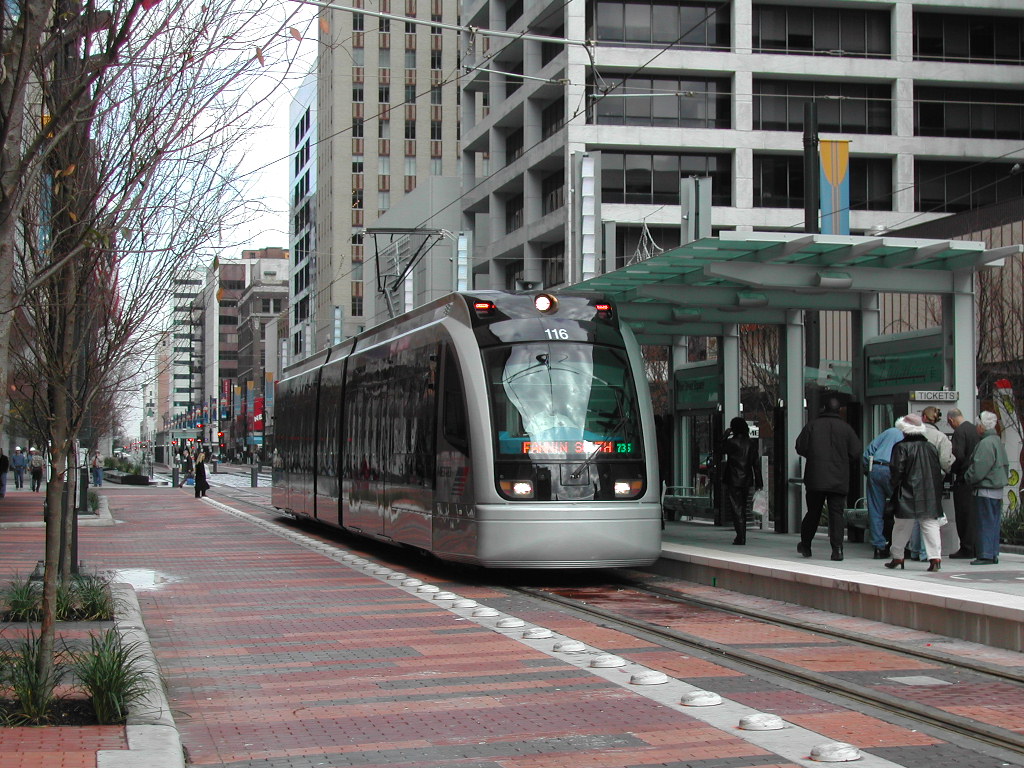
metrocar8.jpgTory Gattis and I recently generated some interesting discussion regarding mass transit generally and light rail in particular in a series of posts (here, here and here). Part of the psychology in favor of the light rail projects discussed in that blog thread is that the federal government — regardless of economic merit — is going to throw some political pork barrel funds at light rail projects, so light rail proponents reason that we might as well claim our fair share.
Although that line of reasoning is understandable, it doesn’t really make me feel any better about the pork being distributed in the first place. This Washington Post article provides a good analysis of the politics of the new transportation bill:

Continue reading

The Psychology of Light Rail

Tory Gattis (Houston Strategies) recently authored this insightful post that explores the vexing question of why many people passionately support light rail in the face of the overwhelming economic arguments against it?

Tory concludes that it has something to do with an unexpressed human psychological need to be liked — sort of like, “Here, check out and play with my light rail toy, and you will probably think better of me.”

Tory is clearly on to something in that there appears to be an element of a civic inferiority complex underlying some folks’ support for light rail. However, Tory’s point still does not explain why people who need mass transit the most — i.e., folks who cannot afford the cost of buying and maintaining a car — support light rail, which certainly does not improve their mobility and, by drawing resources away from mobility projects that would, probably harms it.

My sense is that that question lies somewhere between the human demand for entitlement and lack of viable choices.

As previously noted on this blog, the true economic benefit of light rail is highly concentrated in only a few interest groups — political representatives of minority communities who tout the political accomplishment of shiny toy rail lines while ignoring their constituents need for more effective mass transit, environmental groups that are striving for political influence, construction-related firms that feed at the trough of light rail projects, and private real estate developers who enrich themselves through the increase in their property values along the rail line.

Inasmuch as none of these reasons for mass transit appeal to the part of the electorate who actually need mass transit, this amalgamation of interest groups continues to disguise their true interests behind amorphus claims that the uneconomic rail lines reduce traffic congestion (they do not), curb air pollution (they do not), or improve the quality of life (at least debatable). The literature on all this is public and volumnious — check out demographia.com, cascadepolicy.org, and americandreamcoalition.org.

So, how do these interest groups get away with this? The costs of such systems are widely dispersed among the local population of an area such as Houston, so the many who stand to lose will lose only a little while the few who stand to gain will gain a lot.

As a result, these small interest groups recognize that it is usually not worth the relatively small cost per taxpayer for most citizens who do not use mass transit to spend any substantial amount of time or money lobbying or simply taking the time to vote against an uneconomic rail system.

Meanwhile, the light rail interest groups garner support for light rail from the part of the electorate that actually needs mass transit by simultaneously limiting the mass transit choices and threatening that part of the electorate with loss of the governmental funds for mass transit if they fail to support light rail.

Thus, a referendum on mass transit issues is never promoted with choices between alternatives such as a light rail system, one one hand, and a cheaper and more effective bus-based system system, on the other. It’s simply an “all or nothing” choice, and folks who need mass transit will understandably vote in favor of getting their share of public transportation funds even if it does not improve their mobility one iota.

Indeed, given the cost of light rail systems, one wonders how those citizens who actually need mass transit would vote if the alternative were a light rail system, on one hand, and a new Toyota Prius for each such citizen, on the other? Frankly, the cost of the latter alternative would likely be cheaper than most any light rail plan.

So, at the end of the day, where does that leave us? Is it wrong that people who need mass transit vote in favor of something that does not really address their needs? No, it does not, but it troubles me when they are misled in doing so.

As Anne Linehan and Kevin Whited (blogHouston.net) have repeatedly pointed out, a part of Metro’s pitch for its light rail plan was that light rail would enhance Metro’s bus system and service. Inasmuch as that representation has turned out to be patently false, it seems reasonable that our public officials should at least be required to point out publicly that Metro’s most utilized and efficient mass transit system — i.e., the bus system — will likely continue to erode as Metro continues to invest heavily in light rail.

In the meantime, it would also be nice if public officials would admit publicly that the usual economic justifications for light rail are also dubious. If mass transit users and other citizens want to allow Houston’s public officials to continue to throw money at a light rail system in the face of the economic truth about such a system, then I can live with that result despite my compassion for those citizens who are not being provided the mass transit that they need.

But at least let’s require truth in advertising in connection with having citizens vote on such matters.

A similar sentiment is shared in this interesting Owen Courreges post (Lone Star Times) in which he takes the Chronicle to task for suggesting that Metro’s political opposition — rather than Metro itself — is misleading the public about Metro’s expanded light rail plan.

Finally, Tory points out that we should take some comfort in the fact that Houston’s light rail plan is at least not as big an economic boondoggle as similar plans proposed for Seattle and Denver. Similarly, a couple of commentators to Tony’s post chime in that the marginal cost of the light rail system to Houston area citizens is relatively small for a civic asset that will impress citizens and visitors alike for many years to come. That latter point may have some validity, but let’s make sure that we are talking about the correct marginal cost.

A big difference between the light rail system and the publicly-funded stadiums that Houston has built over the past several years are that the stadiums have tenants who pay the vast majority of the cost of maintaining the facilities.

In comparison, Metro’s light rail system does not come close to generating enough revenue to pay its ongoing costs, as was brought home by Metro’s recent announcement of desultory operating results coupled with the expenditure of $104 million more on the three-year-old rail line to fix problems caused by construction errors and add more rail cars.

In that regard, even the $1.5 million that Harris County spends annually to mothball the Astrodome pales in comparison to underwriting the ongoing cost of the light rail system.

The bottom line is that light rail systems eat voraciously, and any analysis of the true marginal cost of such a system to citizens has to take into consideration the high cost of feeding that appetite.

Watch out!

metrocar4.jpgThe Chronicle’s Rad Sallee reports on one category in which Houston’s Metropolitan Transit Authority is surely leading among the country’s transit systems:

MetroRail logged its third collision in four days Friday, making 29 this year and 96 since fall 2003, when testing of the rail line began.
Before that, the last collision was July 5. The last string of three accidents in four days was March 13-16. Metro recorded three light rail collisions in two days Jan. 26-27 and five in eight days March 22-29, 2004.

Who boy, Kevin Whited and Anne Linehan at blogHouston.net are going to have fun with this one. BlogHouston.net’s Houston Transit category and Kevin’s PubliusTX.net Danger Train category are the two best sources for information on the seemingly unending foibles of Houston Metro.
By the way, is it just me or does Mr. Sallee’s analysis of MetroRail’s many crashes seems eerily similar to the way in which one would evaluate a Major League Baseball player’s career statistics?

Light rail where? In New Mexico?!

metrocar2.jpgThe economic pox of light rail is even filtering down to New Mexico, which enjoys one of the least densely populated areas in the nation. Despite the absurdity of this economic boondoggle, this common sense analysis keeps a straight face while evaluating the light rail proposal.

More on the black hole that is Metro

metroraillogo4.gifIn the “could-it-possibly-be-any-worse” department, this Rad Sadlee/Chronicle article reports on the just-released external audit of Houston’s Metropolitan Transit Authority. It’s not a pretty picture:

Comparing Metro’s numbers for fiscal years 2001 and 2004, the audit shows a 29 percent rise in operating costs, to $304 million, and a 36 percent increase per passenger boarding. On the income side, Metro’s annual report shows fare revenue has hovered around $46 million a year since 1995.
The report says ridership slipped 5 percent in the three years, from 100 million yearly boardings to 95 million, despite a one-year bump in 2004 when 5 million boardings on the new MetroRail line offset the loss of 3 million on buses. Most of the loss was on local and express routes, with Park & Ride numbers holding steady.

This less-than-inspiring performance is after Metro plunked down $325 million to construct the underutilized 7.5 mile Red Rail Line from downtown to Reliant Park and Metro’s announcement from a little over a month ago that the agency plans to spend another $104 million on the Red Line — less than three years after completion of the project — to double the number of trains and fix problems caused by construction errors. Then, as if to jolt into perspective the economic absurdity of all of this, Metro and public officials recently announced a modified public transit plan in which Metro puts up $676 million (in addition to the $325 million already spent on the Red Line) in return for an additional $1 billion in federal matching funds. Given how poorly Metro has invested public money to date makes the details of how Metro intends to spend that additional money almost an afterthought, but Anne Linehan over at blogHouston.net and Tory Gattis at Houston Strategies have done a good job of analyzing that issue. By the way, blogHouston.net’s compendium of Metro posts that Ms. Linehan and Kevin Whited have prepared is the flat-out best resource on the web to track what Metro is doing.

Continue reading

A picture of Metro, 30 years from now?

metrocar.jpgThis post from last year addressed the economic failure of the urban rail system in Washington, D.C. Now, the Washington Post is running a series of articles (first one here) that is examining the dubious economics and management of D.C.’s subway system. Here are other posts on various urban rail boondoggles.
Tory Gattis over at Houston Strategies picks up on the same WaPo article and observes the following regarding the failed economics of most urban rail systems:

Quite the depressing and scary litany. It’s really hard to have good management at a public agency, and transit is a seriously complicated and expensive business with billions of dollars at stake, especially rail transit. Amtrak’s a mess. DC’s a mess. NY, Chicago, SF/San Jose, and LA all have serious problems with their transit agencies. What makes us think Houston Metro can buck this trend?

The black hole that is Metro

metroraillogo.gifThe economic lunacy of light rail has been an occasional topic on this blog (here, here, here, and here). However, blogHouston.net has a much more impressive archive of insightful posts over the past year on the foibles of the Houston Metropolitan Transit Authority, which has completely redesigned Houston’s public transit system over the past decade from a flexible one based primarily on bus transit to an inflexible one based primarily on light rail.
Well, as this Anne Linehan post from today points out, that inflexible light rail system is turning out to be a rather expensive one, too. This Chronicle story reports the shocking news:

Metro wants to spend an additional $104 million on its Main Street light rail line to almost double the number of trains and fix costly problems it blames on construction errors.
Metropolitan Transit Authority president and CEO Frank Wilson laid out his wish list to the agency’s board Thursday, shortly after releasing statistics that show surging rail ridership but decreased numbers of bus riders and overall customers.
The cost Metro estimates for the improvements would raise the bill for what Metro calls its Red Line ? the 7.5-mile route from downtown to Reliant Park ? by about a third.
At the same time, the agency is seeking federal money to help build four light rail extensions with a combined price tag of $1.7 billion.

The Chronicle goes on to report that, although light rail ridership has increased, the total number of people using Metro mass transit (i.e., light rail and buses) has declined by 3% over the past year.
Not exactly the return on investment that one would wish for after plunking down $325 million to build the 7.5 mile light rail system.
At any rate, Ms. Linehan uses her skill in translating Metro-speak to explain why Metro officials believe that spending another cool $104 mil on the existing light rail line is a good idea:

“We cut corners building the 7.5 miles of downtown light rail; we have dismantled bus and trolley service in order to feed the light rail; we don’t have a consistent method for collecting fares so we can’t talk about ‘paid ridership;’ we are bleeding passengers systemwide even though Houston’s population has increased; and now we’d like an extra $100 million to help fix our mess.”

Thus, the scam of this publicly-financed rail system continues to eat money voraciously with no end in sight. The economic benefit of light rail is actually highly concentrated in only a few interest groups, such as elected officials who enjoy touting their political “accomplishment,” environmental groups who seek to gain political influence, construction-related firms who can soak the public till, and real estate developers who enjoy the increase in the value of their property along the rail line. Inasmuch as none of these reasons for mass transit are particularly appealing to the vast majority of the electorate, the interest groups disguise their goals behind disingenuous claims that rail lines will reduce traffic congestion, curb air pollution, or — the one I like best — make a city “world class.” In reality, rail transit has never been an efficient means to reduce either congestion or air pollution, and a rail line has certainly never made a city “world class.”
On the other hand, the costs of such systems are widely dispersed among the local population. Thus, the many who stand to lose will lose only a little while the few who stand to gain will gain a lot. As a result, it is usually not worth the relatively small cost per taxpayer for most citizens to spend any substantial amount of time or money lobbying against even an uneconomic rail system. With political leadership more interested in shiny toys than pro forma operating statements, the publicly-financed rail systems continue to infect metro areas like a bad virus, and the cost of treating this civic virus grows larger each month.
Finally, the foregoing analysis does not even count the cost associated with this carnage.
Where is the Lord of Regulation when you really need him? ;^)

Would you like to buy a note on a Houston downtown hotel?

There is an old saying among investors and insolvency lawyers that a hotel is such a bad investment that no owner makes any money on it until at least three prior owners have gone bust.
Well, it appears that the City of Houston is about ready to experience the truth of that observation. Following on the news from last week that the downtown Hyatt Regency Hotel has been posted for a foreclosure sale, the Chronicle reports that two other hotels — The Magnolia downtown and the Crowne Plaza Hotel in the Medical Center — have defaulted on a total of $15 million in redevelopment loans that the City provided in connection with the recent rehabilitation of the hotels.
It occurs to me that if I were a downtown or Medical Center hotel owner, and the City of Houston had subsidized two competitors of mine with a tax on my business, I’d be rather angry right now.

Continue reading

The Las Vegas Monofail

Houston’s light rail boondoggle has been the subject of several previous posts here. Given that misery loves company, this Washington Post article provides Houstonians with some comfort that Las Vegas may have managed to generate an even bigger rail boondoggle than Houston’s:

When it debuted in mid-July, this city’s sleek $650 million monorail was supposed to be the envy of the nation, a high-tech public transit system paid for without taxpayer money that would be so popular it could even turn a profit.
But during a busy convention season, bits and pieces of the trains started falling off, potentially endangering anything below, and the system was shut down indefinitely for major repairs. By Thanksgiving, newspaper cartoonists and tourists alike were dubbing it “monofail” and deriding the futuristic cars sitting idle on the costly tracks.
After being closed for 3 1/2 months, at a cost of more than $9 million in fare revenue, the system reopened over Christmas weekend, just in time for Las Vegas’s busiest tourist week of the year. It was a Christmas gift from Clark County officials to monorail operators who hope to erase the memory of one of the city’s most humiliating and expensive debacles.

However, the Las Vegas monorail has an interesting characteristic that is not shared by most rail systems — it was not built with government funds and is not designed for commuters:

Unlike any of the nation’s other transit systems, the Las Vegas Monorail is not designed to aid local commuters or even to alleviate roadway congestion. The traffic reduced by this train is in the casino corridor, making visitors its chief beneficiary.

The Las Vegas Monorail deal is unique . . . Transit Systems Management is a private entity that reports to the Las Vegas Monorail LLC, a board appointed by the governor. . . it is largely a privately operated venture funded by construction bonds sold to investors using the state’s bond rating but with debt insurance so Nevada taxpayers are not liable in a default.

Nevertheless, the ubiquitous governmental subsidy of the system appears to be on the horizon:

[F]ederal and county funds will be used for future legs of the monorail — including a $450 million, 2.9-mile stretch to the downtown casino center northeast of the Strip, planned to open in 2008 but now pushed back by the closure. The monorail also is slated to be extended to McCarran International Airport to the south by 2012, using taxpayer money.

Thus, as with publicly-financed stadiums, the scam of these publicly-financed rail systems lives on because the benefits of light rail are highly concentrated in a few interest groups such as elected officials, environmental groups, labor organizations, engineering and architectural firms, developers and regional businesses. On the other hand, the costs of such systems are widely dispersed among the general population. Consequently, the many who stand to lose will lose only a little while the few who stand to gain will gain a lot.
This is why a politically savvy minority can con a large group of taxpayers facing relatively small costs into voting for an uneconomic rail system based on perceived benefits such as helping the poor, reducing congestion and pollution, and fostering development. Even though these benefits are exaggerated, it is usually not worth the relatively small cost per taxpayer for most taxpayers to spend any substantial amount of time lobbying against the cost-ineffectiveness of the rail system. With political leadership usually more interested in reading tea leaves than balance sheets and pro forma operating statements, these uneconomic rail systems just continue to perpetuate like a bad virus.
Of course, if other public projects are proposed where the overall costs outweigh benefits, then the small cost to the taxpayer per project could add up to quite a hefty boondoggler?s bill after awhile. Las Vegans should think about that as they consider publicly financing both the extensions of the monorail and a stadium to attract a Major League Baseball team.

What to do with the Astrodome?

Following on this earlier post on the dilemma posed by the obsolescent Astrodome, this Richard Connelly Houston Press article does a good job of reviewing the Astrodome hotel project and the other options that are being considered.
Given the constraints posed by regular events at Reliant Stadium and the use of Reliant Park by the Houston Livestock Show and Rodeo and other conventions, retrofitting the Dome into a commercial development is not feasible. The Dome is an important part of Houston’s history, but its time is passed and the nostalgia is the only productive aspect of it that remains. It’s time to recognize that the only viable option is to demolish the Dome and use the valuable land for better and more productive purposes at Reliant Park.
Update: Charles Kuffner has an interesting thought on the Dome dilemma.