City Hall, San Diego style

San Diego logo.gifA couple of former City of Houston aides have had a rough spot lately, but frankly our corruption is blase’ compared to what’s going on at City Hall in San Diego recently.
First, the San Diego mayor resigned a couple of weeks ago amidst a pension fund scandal. Then, after about 60 hours on the job, the mayor’s interim successor — along with another member of the San Diego City Council — was convicted of conspiracy, extortion, and fraud in connection with a scheme to receive money for changing a city law to benefit strip club owners. With a new interim mayor and another mayor to be elected in a special election, that makes four mayors by my count in the space of just a few months. All of which prompted economist and San Diego resident James Hamilton to observe:

Forgive me if this sounds paranoid, but isn’t this the same crowd to whom the Supreme Court gave the power to kick me out of my home in order to hand it to some developer? Not that any City Council members would ever let how much money they got from that developer influence their decision on something like that.

Judge Roberts in action

John_G._roberts.jpgOrin Kerr over at the Volokh Conspiracy refers us to this recent D.C. Circuit decision in which U.S. Supreme Court nominee John G. Roberts, Jr. wrote a lively dissent and, in so doing, provides a glimpse of why he was one of my favorites for nomination to the Supreme Court.
The decision involves a search and seizure case. The defendant was driving a car with the license plate light out. After police stopped him, it turned out that he did not have a driver’s license on him, that his license had been suspended, and that the car had stolen tags. During the stop, the police could find not find anything that indicated that the car was properly registered. Thus, the police arrested the defendant and then they searched the car’s trunk, where they found a gun. Wallah! The defendant was charged with a gun possession crime and we now have a search and seizure case.

Continue reading

The changing Houston golf scene

golfer2.jpgThis Sunday Chronicle article reviews the status of Houston’s municipal golf course system, which has run a deficit for the past five years, including a cool $620,000 for the most recent fiscal year. Although rounds are down at all muni courses other than the City’s crown jewel at Memorial Park, Brock Park was responsible for over 75% of the losses in the most recent fiscal year.
Frankly, the City of Houston needs to phase out of the golf business entirely. Although providing golf courses for citizens made sense a generation ago, the proliferation of a wide-variety of private daily fee courses in the Houston area have made most of the muni courses not only unattractive by comparison, but also unnecessary. Such a marketplace of private golf courses did not exist when the City of Houston developed its municipal golf system, but given the development of that private marketplace over the past 30 years, there is simply no longer any reason for the City of Houston to subsidize golf operations for a relatively small number of its citizens.
Here is a “thinking outside the box” suggestion for the Houston City Council on the golf course operation. Other than Memorial Park and Hermann Park golf courses, sell the remainder of the golf courses, including a sale or donation of the Gus Wortham Course to the University of Houston, which could then invest the funds necessary to renovate that tract into a potentially fine university course close to the University’s Central Campus. With a portion of the funds generated from the sale of the courses, the City could then fund an endowment to be administered by the Houston Golf Association to promote golf to underprivileged children and citizens of Houston.
The foregoing would be a “win-win” situation for the City of Houston and its citizens. Not only would the City shed the cost of its unprofitable golf operation and provide the city’s main public University with a convenient home for its storied golf program, the City would maintain two very good, profitable and well-located municipal golf courses, and provide its citizens who need it the recreational opportunity to enjoy the game of golf.

Chronicle follows up on Harris County Jail story

jail2.jpgThe Chronicle’s Steve McVicker and Bill Murphy follow up their earlier story on the chronically abysmal condition of the Harris County Jail facilities with this story that reports that Harris County officials have ignored repeated warnings regarding the unsanitary and over-crowded condition of the jails.
To make matters even more egregious (if that were possible), a Sam Houston State University report warned Harris County officials almost two years ago of a looming explosion in the county jail population. Despite that report, the Harris County Criminal Justice Committee — which was created in 1995 in response to a jail-overcrowding lawsuit that resulted in the jail being under a federal judge’s oversight for 23 years — has not met to review the report or the conditions at the jail.
By strange coincidence, the Criminal Justice Committee is now scheduled to meet this Friday. I’m sure the previous Chronicle article has nothing to do with that.

Continue reading

Stros 2005 Review: Checking in on the Stros

Bruntlett.jpgWhen journeyman Eric Bruntlett (-5 RCAA/.262 OBP/.333 SLG./.595 OPS) jacks a three run yak in the 14th inning to pull out a Sunday afternoon win and finish off a 7-4 roadie, you know it’s time to check in on the Stros (51-47).
Somehow, the Stros find themselves only three and a half games behind the Nationals (55-44) for the lead for the NL Wild Card Playoff spot, but my sense is that the Nationals are sinking and will not be in contention any longer by Labor Day. Accordingly, it’s looking as if the Stros’ competition for the Wild Card spot is going to be the NL East teams other than the Nationals — the Braves (55-44), Phillies (52-47), Mets (51-47) and Marlins (49-47) — and the Cubs (49-48) in the NL Central.

Continue reading

The Chron Interviews Outgoing Enron Task Force Director

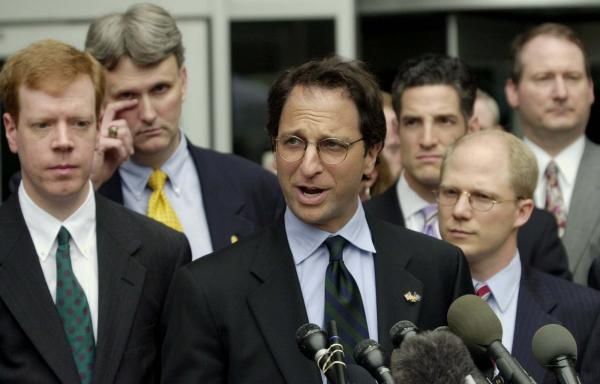
Andrew Weissman.jpgThe Chronicle’s Mary Flood, who has done a fine job of covering the Enron case for the local newspaper, interviews Andrew Weissmann, the former Enron Task Force director who resigned as director of the Task Force this past week amidst widespread allegations of prosecutorial misconduct.

Overall, the interview is a disappointing fluff piece. Ms. Flood — who, as the Chronicle’s lead reporter on Enron, is not the best person to be ruffling feathers with the Task Force — asks Mr. Weissman only a general question about prosecutorial misconduct and fails to follow that up with questions about specific instances of misconduct, such as the following:

The Task Force’s questionable public relations campaign demonizing anything having to do with Enron;

The Task Force’s poor trial record involving former Enron executives (one conviction of a mid-level manager out of seven Enron executives tried to date) compared with the Task Force’s bludgeoning former Enron executives into plea bargains;

The Task Force’s dubious policy of fingering potential defense witnesses as either unindicted co-conspirators or targets of the Enron criminal investigation to deter such witnesses from testifying for defendants in the Enron criminal trials;

The Task Force’s disingenuous market loss arguments in connection with the sentencings of the five convicted Nigerian Barge defendants, which argument contradicted the Justice Department’s position before the U.S. Supreme Court;

The questionable nature of the Task Force’s prosecution of the Merrill Lynch executives in the Nigerian Barge case, particularly Daniel Bayly (note posts here and here) and William Fuhs.

The overreaching nature of the Task Force’s prosecution of Arthur Andersen which the Supreme Court noted in its unanimous reversal of that conviction;

The Task Force’s elicitation of false testimony from Ken Rice, its key witness in the Task Force’s miserably failed Enron Broadband prosecution;

The Task Force threats toward two witnesses in the Broadband trial — Beth Stier and Lawrence Ciscon — who testified favorably for the defense in that trial;

A Task Force prosecutor’s violation of the judge’s instruction not to question witnesses on certain subjects during the Broadband trial; and

The strong evidence that the Task Force has been chilling witnesses favorable for the defense in the upcoming trial of former Enron key executives, Ken Lay, Jeff Skilling, and Richard Causey.

Given the extent of the foregoing instances of misconduct, if I would have been allowed one question of Mr. Weissman, it would have been the following:

“Do you believe that the end of convicting former Enron executives of crimes justifies the means by which you obtain such convictions?”

My sense is that most Chronicle readers would have been far more interested in Mr. Weissmann’s answer to that question than his answer to the question of how has he enjoyed his time in Houston.

Watch out!

metrocar4.jpgThe Chronicle’s Rad Sallee reports on one category in which Houston’s Metropolitan Transit Authority is surely leading among the country’s transit systems:

MetroRail logged its third collision in four days Friday, making 29 this year and 96 since fall 2003, when testing of the rail line began.
Before that, the last collision was July 5. The last string of three accidents in four days was March 13-16. Metro recorded three light rail collisions in two days Jan. 26-27 and five in eight days March 22-29, 2004.

Who boy, Kevin Whited and Anne Linehan at blogHouston.net are going to have fun with this one. BlogHouston.net’s Houston Transit category and Kevin’s PubliusTX.net Danger Train category are the two best sources for information on the seemingly unending foibles of Houston Metro.
By the way, is it just me or does Mr. Sallee’s analysis of MetroRail’s many crashes seems eerily similar to the way in which one would evaluate a Major League Baseball player’s career statistics?

Spitzer fights payola with a little payola

Spitzer32.jpgMy two teenage daughters and their friends just laugh at me whenever I observe to them that most of the noise that they listen to on the radio is so bad that the only way the “music” could ever make the airwaves is through bribery.
Well, my view was vindicated today as this NY Times article reports that New York Aspiring Governor Eliot Spitzer will announce a settlement that will involve at least a $10 million fine with Sony BMG Music Entertainment as part of an 11-month investigation into how music companies get radio stations to play songs. As is typical in such investigations these days, the big four global music companies — Sony BMG, Vivendi Universal SA’s Universal Music Group, EMI Group PLC, and Warner Music Group Corp. — have apparently been cooperating with Mr. Spitzer’s investigation out of fear of a criminal indictment that would be potentially devastating to the companies’ U.S. business.
The investigation apparently relates to the companies’ use of so-called “independent promoters,” who are brokers who are paid to plug new songs to radio stations. The practice is similar to payola — direct payment in exchange for airplay of specific songs — which has been illegal under federal law since the payola scandals of the 1950s. Inasmuch as the line is often a tad fuzzy between merely persuading a radio station executive to play noise and offering the executive a quid pro quo for doing so, representatives of Mr. Spitzer and Sony BMG have apparently been haggling over mutually acceptable guidelines for future conduct between the music company and radio stations.
Although I am usually wary of government attempts to criminalize these types of business transactions, I could make an exception in this case if the settlement contains a prohibition against playing the noise of this “artist.” Despite such social benefits, Larry Ribstein notes that there are strong economic arguments in favor of payola and that the governmental prohibition against it only made the market less transparent.

The sad case of Daniel Bayly

Daniel Bayly has had an impeccable professional career.

A 30-year veteran of the executive ranks of Merrill Lynch, Mr. Bayly joined Merrill in 1972 as an associate in New York and rose through the ranks to become a managing director of Merrill while working in Chicago.

After returning to New York, Mr. Bayly was named head of Merrill’s U.S. corporate banking group in 1993, and eventually was named head of Merrill’s global investment banking division.

During his three decades with Merrill, Mr. Bayly was one of the firm’s most popular and respected executives.

Despite this stellar career, Mr. Bayly has just finished serving the first week of a two and a half prison sentence handed down this past May in connection with the Enron-related Nigerian Barge case. Although Mr. Bayly has a strong case for having his conviction overturned, the Fifth Circuit Court of Appeals denied without so much as an explanation of its basis for doing so his motion to remain free pending disposition of his appeal.

As with the sad case of Jamie Olis, most of the mainstream media is ignoring Mr. Bayly’s plight, treating it as a bad dream that has now gone away. However, Mr. Bayly’s family and many friends are not going to allow this injustice to recede quietly from public view.

In that regard, two friends of the Bayly family — Susan Scherbel and Steven Jackson — prepared the following piece that makes as compelling a case as any legal brief that Mr. Bayly is a victim of the government’s misguided criminalization of ordinary business transactions in the post-Enron era and that, but for God’s grace, this nightmare could be happening to any of us:

Last week, Daniel Bayly left his home and family in Connecticut to report to a prison in Hopewell, Virginia. There, he will begin a two and a half year prison sentence for his role in the Nigerian Barge transaction – a legitimate and successful deal between Enron and Mr. Bayly’s former employer, Merrill Lynch. From the evidence presented at his trial, his only offense appears to be that he was at Merrill Lynch when the deal was done. This is a tragic time for the Bayly family as well as for us, the hundreds of friends, colleagues and well-wishers who know Mr. Bayly to be a good, decent and honorable man.

At Mr. Bayly’s sentencing in April, Judge Ewing Werlein, Jr. said: ” . . . it may be that I’ve never had a defendant stand before me, probably in my years as a judge and having sentenced hundreds of people, that has had a more glowing and extraordinary record of being a good citizen . . .”

However, when Mr. Bayly appealed his conviction, his motion to be released pending appeal was denied. It was irrelevant that he had no history of prior wrongdoing. It was similarly irrelevant that over one hundred of his close friends and supporters sent letters to the court pledging bonds of $10,000, guaranteeing Mr. Bayly’s bail. Neither the strength of his appeal, his stellar record nor the trust of his friends has prevented the worst: Mr. Bayly is in jail while his appeal proceeds – this is the way a hardened, serial offender is treated. And, yet, nothing about the case or this man merits this indignity.

At the time Merrill Lynch purchased an interest in unfinished energy-producing barges from Enron, Mr. Bayly was the head of global investment banking at Merrill Lynch. But, contrary to what has been described in press accounts, Mr. Bayly did not structure, champion, approve or benefit from the transaction. The job of analyzing the transaction was delegated to the Merrill Lynch Commitment Committee composed of eight lawyers, CPA’s and financial experts from outside of Mr. Bayly’s division, who unanimously blessed the deal and recommended approval. Mr. Bayly’s boss, one of the top five officials at Merrill Lynch, was responsible for approving the transaction.

Mr. Bayly’s sole involvement in the Nigerian Barge transaction consisted of determining that the investment banking division could afford the $7 million investment in the deal (this was not difficult – his division had revenues of $4 billion that year). Then, at the request of the Committee, Mr. Bayly’s boss directed him to participate in a conference call with Enron’s Chief Financial Officer, Andrew Fastow.

During Merrill’s review process, Enron had repeatedly promised that the barges would be completed and ready for resale within six months, but the Committee wanted Mr. Fastow’s personal assurance on this point.

Despite these benign facts, a Houston jury convicted Mr. Bayly of criminal conspiracy. Anyone with more than passing familiarity with the case was not surprised — Houston was devastated by the Enron bankruptcy and, unfortunately, the Nigerian Barge trial was the first Enron-related criminal trial to be held there. By this time, many of the key people involved in Enron’s fall had already entered plea bargains — they would never see a courtroom or experience a trial. With none of the “major players” in sight, Mr. Bayly and a few other innocent bystanders were poised to bear the public’s wrath.

To make matters worse, Justice Department prosecutors made it practically impossible for Mr. Bayly’s lawyers to mount an effective defense. Although there were over fifty other Merrill Lynch and former Enron employees with knowledge about the Nigerian Barge deal (including numerous lawyers and other experts), all of those witnesses declined to testify during the trial because the prosecutors had named them as “unindicted co-conspirators.”

Inasmuch as the only difference between an indicted and non-indicted co-conspirator is government favor, the prosecutors used this tactic to scare these Merrill Lynch and Enron employees from coming forward and providing valuable, corroborative testimony for Mr. Bayly about the way banking deals operate, the limited role played by Mr. Bayly and the other defendants, and the deal itself.

As a result, the true story of Mr. Bayly’s involvement in the transaction was never told during the trial. Testimony about the transaction came from prosecution witnesses with second-hand information who had cut deals with the government.

In the end, perhaps the most troubling aspect of this case is that it is about a successful deal common in investment banking circles. Not suited to conventional financing, the barge deal was precisely the kind of transaction companies regularly bring to their investment banks. Merrill’s decision to purchase the barges was completely legitimate.

Similarly, Merrill’s subsequent sale of the completed barges six months to a partnership (set up by Enron for an entirely different set of investors) was appropriate. This sale, too, was thoroughly reviewed by numerous attorneys (including those who had blessed the original sale) prior to being approved (again, not by Mr. Bayly). It is noteworthy that the barges were then combined with other barges held by Enron and sold to a third party buyer, global power company AES Corp., that actually paid more than Merrill had received (proving that the barges were valuable).

In short, Mr. Bayly is in prison because of a highly profitable transaction that occasioned no loss to Enron or to its shareholders. Enron made money, its shareholders made money, the people of Nigeria obtained low price energy and, according to its financial reports, AES is making money (the barges are currently producing roughly $50mm/year).

In fact, the sole issue of the case turns on when Enron and its auditors reported the gain (the Justice Department contends that the gain should have been reported at the time of the sale to AES rather than six months earlier at the time of the Merrill purchase). Not even the prosecutors alleged that Mr. Bayly and his co-defendants controlled or even knew of Enron’s accounting choice.

What kind of justice is this?

Those of us who know Mr. Bayly have tried to help him. However, we are reluctant. We are warned that a single voice raised in his defense could provoke the Department of Justice lawyers to mete out more cruelty. When will their bloodlust be satiated?

Isn’t it enough that this wonderful man who had a 30-year flawless record at Merrill Lynch was forced out of his job and had his reputation sullied? Isn’t it enough that he endured a Kafkaesque trial, when all who could help him were silenced by fear and intimidation? Isn’t it enough that he was subject to electronic monitoring and his assets frozen? Isn’t it enough that he and the others were plucked from their homes, families and children sent to prison despite their appeals (something virtually unthinkable for first time offenders in American jurisprudence)?

These men did nothing more than assist a respected client. They followed every conceivable rule and procedure. Furthermore, they pose no threat to anyone — why could not they be free pending their appeals? As we onlookers cower, afraid to help these people, lest our efforts unleash new waves of wanton harassment against them, it’s damned hard to refer to their tormentors as “justice.”

Update: The Fifth Circuit Court of Appeals overturned the conviction of Mr. Bayly after Mr. Bayly had spend a year in prison.

Dan Jenkins on America’s contributions to golf

dan jenkins2.jpgIn summertime, thoughts turn to golf, and the August issue of Golf Digest is called it’s All-American edition. That theme gives columnist Dan Jenkins an opportunity to provide his wit and wisdom on America’s contributions to golf in this hilarious article entitled What America gave Golf — We might have burned the edges, but the good outweighs the bad (previous posts on Mr. Jenkins’ work are here, here, here, and here). The entire article is a must read, but here are a few Jenkins pearls to peak your interest:

It’s easy enough to blame America for the six-hour round, . . . but ask yourself this: What would the game be like without the gimme, the mulligan, the shapely cart girl and a chili dog at the turn?

Continue reading