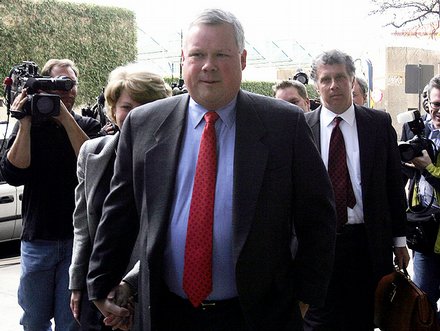
Causey Not on Task Force’s Witness List for Lay-Skilling Trial

The Chronicle’s Mary Flood reports that former Enron chief accountant Richard Causey, who pled guilty to a single count of securities fraud last week under an plea deal in which he agreed to serve seven years in prison, is still not listed on the most recent witness list that the Enron Task Force was required to provide yesterday to the defense teams of Causey’s co-defendants, former key Enron executives Ken Lay and Jeff Skilling.

Ms. Flood reports that the Task Force also dropped several witnesses on three topics — Enron Broadband, the Coyote Springs deal and the valuation of an Enron asset dubbed “Mariner.”

The Task Force’s indecision on whether to use Causey as a witness is really not surprising despite much of the mainstream media’s expectation that he would transform into a key witness against his former co-defendants simply because he agreed to a plea deal.

Unlike discredited former Enron Broadband CEO Ken Rice, Mr. Causey’s plea deal with the Task Force is not a cooperation agreement, so he is under no obligation to assist the Task Force in its prosecution of Messrs. Lay and Skilling.

Moreover, as Ms. Flood notes, the Task Force may still elect to revise its witness list closer to trial to add Causey as a witness and may gain a small tactical advantage in doing so by delaying the delivery of his witness statements to the Lay-Skilling defense team.

However, the Task Force better not wait too long if they want to use Causey because U.S. District Judge Sim Lake probably would not look kindly upon such gamesmanship.

The lastest revelation is just more confirmation that the Task Force is dispensing with a substantial number of its allegations in its indictment against Lay and Skilling regarding alleged accounting fraud and focusing on developing a case that is based on alleged false or non-disclosure of material information to the investing public.

Given the Task Force’s experience in the Enron Broadband case, simplification of its case against Lay and Skilling is probably a prudent move, although it sure opens up legitimate questions that the defense can raise with the jury on why the Task Force alleged in the indictment dozens of other inflammatory allegations — particularly against Skilling — and then didn’t pursue them.

Finally, the Chronicle’s business columnist Loren Steffy wrote this interesting column in which he speculates that Causey’s plea deal was the result of a good man coming to terms with his wrongdoing.

Maybe so, but the circumstantial evidence indicates that my explanation is closer to the truth.

Remember those high prices for natural gas?

natural gas rainbow-well4.jpgWasn’t it just a few weeks ago that we were enduring demagogues’ calls for governmental intervention in regard to increasing oil and gas prices?
Well, continuing a trend noted in this post from a week ago, the natural-gas contract for February delivery on the New York Mercantile Exchange settled at $9.499 per million British thermal units during intraday trading on the New York Mercantile Exchange, the first time that such contacts have settled below $10 since Hurricane Katrina wreaked havoc on Gulf Coast production facilities last summer. This represents almost a 40% decline from the Dec. 13 record. The market was undercut yesterday by an Energy Information Agency report that natural-gas volumes in U.S. storage actually rose last week, which is unprecedented during the last week of December.
Meanwhile, Clear Thinkers favorite James Hamilton is wondering whether the U.S. economy has faded the 2005 oil price shock and notes that there are some reasons to worry about energy prices in 2006.

The High Price of Asserting Innocence

Last week, former Enron chief accountant Richard Causey pled guilty to a single count of securities fraud and agreed to a seven-year prison term after vigorously defending himself from multiple charges of business crimes for over two years. Had he elected to defend himself at trial against the charges and lost, he would have faced an effective life sentence.

A friend of Causey’s commented that, despite the plea, Causey does not think he committed crimes at Enron and that he pled guilty to spare his family the emotional trauma of the trial and a possibly longer prison sentence.

Earlier this year, former Enron Broadband CEO Ken Rice testified falsely in the Enron Broadband trial after cutting a plea bargain with prosecutors in the face of an almost certain conviction on insider-trading charges (Rice had sold Enron stock in August, 2001 immediately after a meeting with Jeff Skilling in which Skilling informed Rice that he was resigning as Enron’s CEO).

The Enron Broadband trial ended in a mess of acquittals and a mistrial, and all five defendants in that case face re-trials later this year. Rice remains free on bond and has not yet been sentenced.

Meanwhile, throughout the over four-year criminal investigation relating to the demise of Enron, the Enron Task Force has engaged in widespread intimidation of potential witnesses in Enron criminal cases by threatening those witnesses with indictment if they provide exculpatory testimony on behalf of any defendant in an Enron-related criminal trial.

Lawrence Ciscon and Beth Stier testified dramatically about those prosecution threats during the Enron Broadband trial, and dozens of key witnesses with exculpatory testimony declined to testify on behalf of four Merrill Lynch executives in the Nigerian Barge trial after the prosecution had fingered the witnesses as unindicted co-conspirators. The Merrill Lynch executives were all convicted in that trial and are now serving jail sentences.

Amidst that backdrop, U.S. District Judge Sim Lake yesterday sentenced the plea-bargaining defendants in the sad case of Jamie Olis (Chronicle article here) — former Dynegy executive and Olis boss Gene Foster, and Dynegy employee Helen Sharkey — to 15-month and one-month sentences respectively for their involvement in the Project Alpha transaction that ensnared Olis (Doug Berman comments on the sentences here as does Peter Henning here).

The government previously obtained a gruesome 24 year sentence against Olis for having the temerity of asserting his innocence in regard to the Project Alpha-related charges at trial. The Fifth Circuit later overturned that sentence and Olis is awaiting re-sentencing.

Yale Law Professor John Langbien, who has written extensively on prosecutorial abuse in the American criminal justice system, observes as follows:

Plea bargaining concentrates effective control of criminal procedure in the hands of a single officer. Our formal law of trial envisages a division of responsibility. We expect the prosecutor to make the charging decision, the judge and especially the jury to adjudicate, and the judge to set the sentence. Plea bargaining merges these accusatory, determinative, and sanctional phases of procedure in the hands of the prosecutor.

Students of the history of the law of torture are reminded that the great psychological fallacy of the European inquisitorial procedure of that time was that it concentrated in the investigating magistrate the powers of accusation, investigation, torture and condemnation. The single inquisitor who wielded those powers needed to have what one recent historian has called ‘superhuman capabilities [in order to] . . . keep himself in his decisional function free from the predisposing influences of his own instigating and investigating activity.'”

I cannot emphasize too strongly how dangerous this concentration of prosecutorial power can be. The modern prosecutor commands the vast resources of the state for gathering and generating accusing evidence. We allowed him this power in large part because the criminal trial interpose the safeguard of adjudication against the danger that he might bring those resources to bear against an innocent citizen — whether on account of honest error, arbitrariness, or worse.

So, what really is the bigger problem for American society and the rule of law? Criminal business executives or out-of-control prosecutors who bludgeon defendants into plea bargains and use the threat of indictment to prevent juries from hearing exculpatory testimony about defendants charged with crimes?

The disparity in sentences between Olis, on one hand, and Foster and Sharkey, on the other, is a stark reminder of the high price that a business executive must pay these days for asserting innocence in the American criminal justice system. Similarly, the difference between Causey’s seven year sentence and whatever Rice eventually gets is largely attributable to Causey’s assertion of his innocence until the eve of his trial. Ellen Podgor previously commented on the troubling implications of this trend in connection with the sentences emanating from the WorldCom prosecutions.

In a scene set just after World War II from the movie The Aviator (hat tip to Larry Ribstein), Howard Hughes asks Senator Brewster if he really wants to go to war with him. Brewster responds:

“It’s not me, Howard. It’s the United States government. We just beat Germany and Japan. Who the hell are you?”

What the government is doing in punishing Jamie Olis for asserting his innocence is wrong. Likewise, regardless of what one thinks about the propriety of the government’s Lay-Skilling and Nigerian Barge prosecutions, the government is wrong in preventing the defendants in those cases from presenting to their juries exculpatory testimony from dozens of relevent witnesses.

It’s easy to delude ourselves that the cost of doing nothing in response to such wrongs is “merely” the lives of a few unpopular businessmen. But in reality, erosion of justice and respect for the rule of law is the far higher price that we pay for turning our collective cheeks in the face of such abusive tactics. For, as Sir Thomas More reminds us, if that abusive state power is not controlled and is then turned on us, “do you really think you could stand upright in the winds [of abusive state power] that would blow then?”

Belly to Hip Ratio more important than BMI?

beerbelly.jpgThis Washington Post article reports on a new study published in The Lancet that indicates the relationship between belly size and hip size is more useful measure of health risk than the commonly-used body mass index (BMI):

According to a study published in The Lancet, a calculation comparing waist circumference to hip circumference is a better predictor of heart attack risk than . . . [b]ody mass index, [which] is often used to screen for obesity and to assess risk for a variety of diseases and conditions, including diabetes, metabolic syndrome and heart attack.
[T]he Lancet study, described by the authors as the largest and most conclusive to date, found that “BMI is a very weak predictor of the risk of a heart attack,” said Salim Yusuf, lead author and director of the Population Health Research Institute at McMaster University in Hamilton, Ontario. “Measuring the girth of the waist and [the] girth of the hip is far more powerful.”
The authors suggested people forgo calculating BMI. “I’d say just do the waist-to-hip ratio,” Yusuf said. “There really is no additional value [in] doing the BMI.”

The study indicates that even relatively lean people with a BMI that is quite low still have increased risk for heart attack based on the presence of abdominal fat. It remains unclear why location of fat in the abdominal area poses a greater health risk than fat carried around the hips, but recent studies have also linked waist-to-hip ratio to increased risk of diabetes and hypertension. The findings reported in Lancet study indicate that men with waist-to-hip ratios greater than 0.95 are at heightened risk for a heart attack and that females with ratios above 0.8 are at increased risk, and that the the risk “rose progressively with increasing values for waist-to-hip ratio, with no evidence of a threshold.”
Speaking of health-related matters, the Chronicle has added a health-related blog by medical reporter Leigh Hopper to its growing list of weblogs. Chronicle technology reporter Dwight Silverman spearheaded the Chronicle’s blog initiative last year, and now other prominent newspapers are emulating the Chronicle’s blog idea. Kudos to Dwight and the Chronicle for contributing greatly to this productive trend of enhancing communication between media and its customers.

Just an expense of doing business at KPMG

kpmg logo38.jpgAs KPMG’s settlement of the class action lawsuit against the firm over its promotion of tax shelters lurches toward final approval, this NY Times article reports that the number of class members opting-out of the proposed settlement is unusually high (almost 30% of all class members) and speculates that KPMG may elect to exercise its right under the settlement agreement to opt-out of the settlement itself if too many class members opt-out.
Although it was nice of the Times to deliver that message by KPMG to class members, there is little chance that the firm will terminate the settlement. Even if 30% of the class members opt out, that means that KPMG has still liquidated its liability to over 190 former tax shelter clients at an aggregate amount of the $180 million or so that KPMG will contribute to the $225 million settlement. That’s under a million per individual claim, which is the equivalent of a payout on a “slip and fall ” case for KPMG these days. No way KPMG rolls the dice that it can do better than that by defending the class action and even more opt-out individual claims at trial.

Jamie Olis resentencing hearing postponed

Jamie Olis8.jpgThe long-awaited resentencing hearing in the sad case of Jamie Olis that was scheduled to take place today has been postponed indefinitely to give U.S. District Judge Sim Lake time to review recently-filed materials in the case relating to the key issue of market loss causation and to conduct another hearing on the market loss issue. You can download a copy of Olis’ lengthy memorandum on the market loss and related sentencing issues — which includes copies of letters from Olis and his wife to Judge Lake — here.
Although the delay in the resentencing is unfortunate, it is understandable. There is no harder working judge in the country right now than Judge Lake, who is literally snowed under with both the prodigious materials relating to the Olis resentencing and dozens of pre-trial motions in the run-up to the complex trial of former key Enron executives Ken Lay and Jeff Skilling that is scheduled to begin on January 30 in Houston. Given Judge Lake’s nature, I suspect that he will attempt to schedule the market loss hearing in the Olis case before the commencement of the Lay-Skilling trial.
Meanwhile, Doug Berman — who has provided the flat-out best analysis in the blogosphere of the Olis case from a sentencing perspective — added this informative post earlier in the week and this post today on the key issues to be addressed in the Olis resentencing hearing. As this earlier post notes, the prosecution misled Judge Lake in the previous sentencing hearing on the key market-loss issue, and I’m optimistic that Judge Lake will come to understand this time around the folly of attributing any meaningful market loss to Olis’ participation in the ill-fated Project Alpha, a point that is amply buttressed in Olis’ memorandum on resentencing by the expert reports of Rice University business professor Bala Dharan, former SEC economist Craig McCann, and well-known Houston energy securities analyst John Olson. In contrast, the Justice Department’s strikingly superficial response to the Olis memorandum and expert reports comes across as mean-spirited and baseless. If Judge Lake properly concludes that the reasons for market loss are simply too diffuse to attribute to Olis’ actions, then my sense is that he will reduce Olis’ sentence to considerably less than the 5-7 years that Professor Berman is predicting.
Update: Professor Berman comments on the postponement, as well as the resentencing hearing of Olis’ co-defendants (both copped pleas), which will proceed as scheduled today.

Texas Longhorns 41 USC Trojans 38

texas longhorn logo.jpg
vince_1.jpg
The University of Texas Longhorns, National Champions!
It’s taken me until 9 a.m. the morning after the game just to recover enough to pass along my thoughts.
In short, the game was hugely entertaining, if not particularly well-played in all respects. The first quarter was just kind of an all-around mess, Texas owned the second quarter, the third quarter turned into a fist fight between two heavyweights who could not defend themselves, and then Vince Young simply picked up his Texas team in the last six minutes of the fourth quarter and refused to let them lose.
It was truly a game for the ages and a perfect example of the reason that I prefer college football to the NFL.
By the way, don’t miss the Austin American-Statesman’s photo gallery containing a measly 143 photos from the Rose Bowl game.

First things first for Clarett

Clarett.jpgYou may have heard that former star Ohio State running back Maurice Clarett was wanted by Ohio police earlier this week for his alleged participation in a robbery.
Well, according to this NY Times article, Clarett had a particularly compelling reason to delay turning himself in to police for a couple of days:

Clarett declined to answer most questions from reporters, but he did reveal that he watched Ohio State beat Notre Dame on Monday night before turning himself in to the police. Clarett, who had been wanted for almost two days, apparently wanted to see his former teammates play in the Fiesta Bowl, the same game in which he achieved stardom and helped capture the 2002 national championship for the Buckeyes. Asked about Ohio State’s 34-20 victory over the Irish, Clarett cracked a half-smile and said:

“Glad we won.”

Remember that follow up question

witness chair.jpgThis San Diego Union-Tribune story reminded me that, in asking questions about the credentials of an expert witness, it’s usually a good idea to ask a few follow-up questions before moving on to other areas:

The Medical Board of California is investigating whether a surgeon it used as an expert witness lied about his qualifications when testifying against other doctors in disciplinary hearings.
According to a transcript of the hearing, [Dr. Don J.] Schiller implied he currently was certified by the American Board of Surgery when questioned by Deputy Attorney General Mary Agnes Matyszewski. But Schiller . . . has not been a board certified surgeon for 18 years, though his resume indicates he is certified and he has sworn under oath to being certified.
In an interview, Schiller said that when he testifies as an expert witness, he says he was certified by the American Board of Surgery in 1977. But he doesn’t volunteer that he has not renewed the certification.

“If I am ever asked if I was re-certified I say ‘no,'” Schiller said.

And that’s how he testified Sept. 23 in the San Diego case:

“Are you board certified, sir?” deputy attorney general Matyszewski asked, according to a transcript of the hearing.
“I was certified by the American Board of Surgery in 1977,” Schiller responded before Matyszewski moved on to other questions about his professional background.

Is the Task Force gripping in preparation for the Lay-Skilling trial?

skilling and lay4.jpgAn unusually high number of the prospective jury pool for the upcoming trial of former key Enron executives Ken Lay and Jeff Skilling already have concluded that the two men are guilty of various business crimes merely because of their connection with the social pariah, Enron. Although such widespread bias against the two defendants would seem to be great source of comfort for Enron Task Force prosecutors, there are increasing signs that the Task Force is not sanguine about its case against Messrs. Lay and Skilling. As Larry Ribstein points out, that’s part of the conunbrum of the lottery-style system of criminalizing agency costs in the first place.
The Wall Street Journal’s John Emshwiller, who has as good an information pipeline into the Task Force as any reporter covering the Enron case, has a couple of W$J articles today (here and here) in which he reports that the Task Force — less than a month before trial — has made a new allegation of wrongdoing against Skilling relating to the former Enron CEO’s December 6, 2001 SEC deposition testimony. The gist of the new allegations are that the Task Force contends that Skilling lied when he testified that he sold over $15 million of Enron stock on September 17, 2001 because of concerns over the impact of the 9/11 attacks on the stock market (Skilling resigned from Enron in August, 2001). The Task Force contends that Skilling lied about the reason for that September 17 stock sale and that evidence of the lie is that he failed to inform the SEC during the deposition that he had inquired with a broker on September 6th about selling less than half as much Enron stock as he sold on September 17th.
H’mm, cranking up a new allegation of wrongdoing less than a month before trial based on those dubious facts? Sure looks like a bunny trail to me.
Meanwhile, as I speculated in this earlier post, this Emshwiller article confirms that, even though Richard Causey’s plea bargain last week simplifies the Task Force’s case against Lay and Skilling, the Task Force’s post-plea bargain debriefing of Causey has apparently left prosecutors undecided on whether even to use the former Enron chief accountant as a witness against Lay and Skilling.
Last minute preparations for a big trial are usually somewhat chaotic and often involve minor alterations in strategy. However, adding new allegations of misconduct and wondering whether even to use a key witness involved in the allegations are not the type of strategy decisions that one normally wants to be making less than a month before trial. As with the Task Force’s schizophrenic approach to Arthur Andersen, the latest revelations about the Task Force’s preparations for the Lay-Skilling trial do not reflect that the Task Force is particularly confident about its case. Although the Task Force has already won the public relations battle regarding the Enron scandal, winning its legacy case in the courtroom may prove to be far more difficult.