
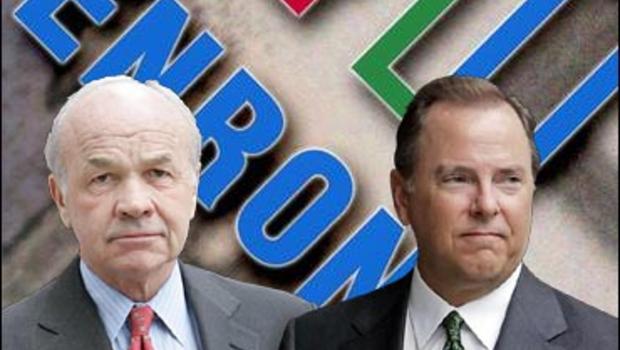
Lay-Skilling, Week Two

At the outset of the criminal trial of former key Enron executives Ken Lay and Jeff Skilling, the Enron Task Force prosecutors estimated that it would take nine weeks to put on its case-in-chief against the defendants.

Inasmuch as that prediction assumed four days of trial time each week and that the defense would use the same amount of time on cross-examination of each witness as the prosecution used on direct, the prosecution’s prediction effectively meant that the Task Force believed that it could put on its entire case against Lay and Skilling in eighteen days of testimony.

Well, the Task Force’s prediction has pretty well gone by the wayside with its first witness, former Enron investor relations chief, Mark Koenig.

After the Task Force took two-and-a-half days on Koenig’s direct examination, the defense has used the past three-and-a-half days for cross-examination, and it now looks as if Koenig’s testimony will continue for at least another day-and-a-half, which means that the prosecution will not be in a position to present its second witness — former Enron Broadband co-CEO Ken Rice — until next Tuesday afternoon at the earliest.

Next Tuesday marks the beginning of the third week of the trial.

Moreover, when Koenig is finally through testifying, the prosecution will have used over three days of its original 36-day prediction (over 16% of its case-in-chief) on examination of Koenig.

There is no way that the testimony of Koenig — who is primarily a background witness who was not involved in the mechanics of how Enron’s earnings and finances were evaluated — represents over 16% of the prosecution’s case-in-chief.

This is shaping up to be one very long slog.

Mark Cuban’s bucket boy

PhilJackson.jpgcuban.jpgDon’t you love it when wealthy, grown men get upset with each other over basketball?
In this corner, Dallas Mavericks owner Mark Cuban. And in the other corner, L.A. Lakers’ coach, Phil Jackson.
I think Jackson needs to start his own blog. ;^)

Omnicon’s nuclear waste dump

omnicominc.gifIn addition to maintaining the Wall Street Journal’s essential Law Blog, Peter Lattman continues to contribute interesting news articles for the WSJ, including this one from yesterday that he co-authored with Jesse Eisinger about something that is close to the heart of the Enron scandal — a company’s alleged use of special purpose entities to dump low-performing assets that would otherwise depress earnings if the company were to hold on to them (thus, the characterization of an SPE as a “nuclear waste dump”).
Public revelations of former Enron CFO Andy Fastow’s shenanigans with certain of Enron’s SPE’s in October, 2001 triggered the collapse of Enron into bankruptcy, and the same thing almost happened to Omnicon — the world’s largest ad holding company — back in June 2002. At that time, the WSJ reported that an Omnicon SPE called Seneca Investments appeared to have been used by Omnicom to avoid an earnings charge of about $90 million in connection with its reporting of $246 million of earnings for the first half of 2001. Given the nearness of similar disclosures relating to Enron and Enron’s subsequent December, 2001 bankruptcy, Omnicom’s stock price dropped like a rock before stabilizing at about half of its pre-SPE disclosure price. Nevertheless, the company was able to stem an Enronesque collapse into bankruptcy.

Continue reading

Investigation ordered into the David Boies Copy Club

David Boies3.jpgDavid Boies — who champions himself as an advocate of honest corporate governance and disclosure — was the Tyco board’s outside counsel in connection with investigating corporate fraud. Consequently, during the trial of former Tyco executives Dennis Kozlowski and Mark Swartz last year, Boies was one of the prosecution’s main witnesses in contending that the Tyco executives had failed to disclose their compensation adequately to the Tyco board.
Meanwhile, however, Boies resigned last year as special chapter 11 counsel at the request of his client, Adelphia Communications, for failing to disclose to the Adelphia Bankruptcy Court and creditors that members of the Boies family indirectly own a substantial interest in a document management services company that did between $5 and $10 million of business with Adelphia. Apparently, other clients of Mr. Boies’ firm also have paid substantial sums to the document management company without knowing of the company’s affiliation with the Boies law firm.
Now, after a hearing earlier this week, this Wall Street Journal ($) article reports that the Bankruptcy Judge in the Adelphia case has ordered an ethics investigation into whether Boies and his firm should have disclosed the firm’s partners’ ties to the company that Adelphia used for document management.
In the meantime, final Bankruptcy Court approval of the Boies firm’s almost $30 million fee (most of which has already been paid) for doing legal work for Adelphia hangs in the balance. If any significant portion of that fee is disallowed, then that could prove to be one expensive non-disclosure for the champion of good corporate governance and disclosure.

The second Lay-Skilling prosecution witness

ken rice9.jpgThe NY Times Alexei Barrionuevo, who is writing some of the best background pieces in connection with the criminal trial of former key Enron executives Ken Lay and Jeff Skilling, profiles former Enron Broadband CEO Ken Rice today, who is expected to be the prosecution’s second witness in the trial if the parties ever get done with the first witness, former Enron investor relations chief, Mark Koenig.
In addition to noting Rice’s disastrous testimony in the Enron Broadband trial last year, Barrionuevo’s piece points out the little-reported fact (mentioned earlier here) that Rice copped his plea deal after prosecutors discovered circumstantial evidence that strongly indicated that Rice engaged in insider trading shortly before Skilling’s resignation in August, 2001:

More than $9 million of [Rice’s $40.3 million in profits from Enron stock trades] came from three trades on July 13, 2001, about a month before Mr. Skilling officially resigned from Enron, according to records from the Securities and Exchange Commission, and around the same time that Mr. Skilling privately told Mr. Lay of his intention to resign, according to earlier testimony by Mark E. Koenig, Enron’s former investor relations chief.

Meanwhile, the prosecution’s decision to spend an inordinate amount of time on direct examination with Koenig appears to be backfiring. The prosecution spent almost two and a half days on direct examination of Koenig, who has now admitted on cross-examination that he really does not have much knowledge of the underlying evaluation process upon which Lay and Skilling based their public statements regarding Enron’s finances. Thus, Koenig is a quintessential witness whose knowledge is a mile wide and an inch deep, and the defense is now hammering his basis for asserting on direct that Lay and Skilling intentionally misled investors. To make matters worse for the Enron Task Force, the prosecution took so much time with Koenig on direct that it is really not in a position to object to the length of time that the defense is spending with Koenig on cross-examination.
Moreover, my old friend, Joel Androphy, blogging the Lay-Skilling trial over at KTRK-TV, observes the following about another prosecution mistake in dealing with Koenig:

The government allowed Koenig to keep $5 million to fight the civil cases and provide for his family, not the families of the victims. The plea bargain could have required Koenig to pay the maximum fine, and full restitution to the victims even if he provided influential testimony. That would have supported his credibility. Although the judge has the final say on restitution and fines, the government could have required mandatory surrender of funds. Now it looks like he could get reduced jail time and a large pension unlike most former employees. Koenig’s attorney did a commendable job.

It now appears that Rice’s testimony will not begin until Thursday of this week at the earliest, and may not even begin this week at all. Therefore, unless the prosecution pares down its case-in-chief dramatically on the fly, the prosecution’s pre-trial prediction of completing its case-in-chief in nine weeks is looking more and more like a pipe dream.

Directors and the business judgment rule

bainbridge.jpgribstein4.jpgStephen Bainbridge and Larry Ribstein are two of the blawgosphere’s most insightful thinkers on corporate governance issues, and their their blawgs have contributed more to the understanding and appreciation of those and many related business law issues over the past couple of years than virtually any other resources on the Web of which I am aware. These two academics continued their generous contributions over the past week with a couple of timely pieces in regard to director liability and the business judgment rule that should be required reading for any director of a public company or any advisor of a director.
First, Professor Bainbridge used the oral argument in the Delaware Supreme Court in the Disney-Ovitz case to provide this timely refresher (blog post here) on the business judgment rule and its importance to good corporate governance. He plainly states the rule as it relates to directors:

Continue reading

Harvey Miller and high fees go together

Harvey Miller.jpegThis Wall Street Journal ($) article reports that Harvey Miller — the New York attorney who built Weil, Gotshal & Manges‘ bankruptcy and corporate reorganization practice into a national dynamo before leaving the firm in 2002 to join Greenhill & Co. — is being accused of overbilling his client Loral Space & Communications Ltd. of as much as $3.6 million in the company’s recently concluded corporate reorganization case.
To add intrigue to the matter, Miller’s chief accuser is the creditors’ committee counsel in the Loral case, Akin, Gump, which incurred the wrath of Miller’s opinion last year in the Vermont bankruptcy case of FiberMark Inc., in which Miller concluded that the firm should forfeit a “significant portion” of its fees in that case because Akin, Gump gave allegedly biased advice to the FiberMark creditors’ committee. Akin, Gump is reportedly prepared to waive $1.5 million of its total remaining unpaid fee of $4.0 million in that case.
The challenge to Miller’s fee-charging is particularly interesting in that Miller was at the forefront of the movement to attract top-notch legal talent to the U.S. bankruptcy and reorganization legal field over the past 30 years. One of the ways that was accomplished was through the incorporation into the U.S. Bankruptcy Code of provisions that provide for attorneys to be compensated at the market rate for providing professional services to debtors in bankruptcy cases. For many years while at Weil, Miller’s hourly billing rate was among the highest of any attorney practicing bankruptcy law in the United States, and Weil’s fees for representing corporate debtors in a number of reorganization cases have been among the highest ever approved and paid. Those high fees are the genesis of the nickname for Weil, Gotshal & Manges among some envious members of the bankruptcy bar — “We’ll, Getcha & Mangle Ya.”
Update: The prescient Peter Lattman provides even more interesting background.

“You didn’t think we really meant that, did you?”

Enron Task Force.jpgDuring opening arguments last week in the criminal trial of former key Enron executives Ken Lay and Jeff Skilling, Lay defense attorney Mike Ramsey made the following observation to the jury about the Enron Task Force’s indictment against the two men:

“This is the indictment . . .[It] is 66 pages long. Someday you may be called upon — God save you — to have to read it. If you do, you’ll find it is enormously complex. I don’t blame the [prosecutors] at the table here; I think their predecessors wrote it. But with all the power and precision of the English language, it is a babbling kind of indictment [that makes it] very hard to pin down, very hard to determine what you are actually charged with. . .”

Well, it turns out that that the Task Force pretty much agrees with Ramsey’s characterization of the indictment. In this motion that showed up on the docket of the case yesterday, the Task Force requests that U.S. District Judge Sim Lake not allow the Lay-Skilling defense to use the Task Force’s indictment during cross-examination of the Task Force’s witnesses in the trial because, among other things, to do so would risk “unfair prejudice, confusion of the issues [and] misleading the jury. . . ”
Not exactly a sterling self-endorsement of the Task Force’s writing skills, would you say? ;^)
Meanwhile, after the Task Force took almost all of Monday morning to complete direct examination of its first (and relatively minor) witness, Mark Koenig, cross-examination of Koenig continues today (Chronicle/Flood – Fowler; NY Times/Barrionuevo – Evans; WaPo/Carrie Johnson).

In case you missed it . . .

Holmes.jpgWith the Super Bowl and all, it was easy to miss, but the PGA Tour’s newest millionaire is J.B. Holmes, a 23-year-old Tour rookie who makes long John Daly look short in comparison. Playing in just his fourth tournament since winning the PGA Tour School tournament last fall, Holmes won the FBR Open in Scottsdale by seven strokes on Sunday.
Through the first four Tour tournaments this season, Holmes leads the Tour with 72% (128 out of 168) of his drives finishing over 300 yards. On the par five 15th on Sunday afternoon, Holmes reached the green easily in two with a 263-yard 4-iron shot over water, then sank a 15-foot putt for an eagle to go to 20 under.
A 263-yard 4-iron over water? On the back nine of the final day of a tournament while trying to win for the first time on the Tour?
Keep an eye on this guy.

What? A business scandal in The Woodlands?

cbi.gifThe Woodlands is a dynamic suburban community on Houston’s far northside, but it’s not the type of place that one normally associates with business scandals.
However, late last week, it appears that The Woodlands had its own real business scandal. The revelations began unfolding on Thursday when Chicago Bridge & Iron — the Netherlands-based engineering company that maintains its worldwide administrative office in The Woodlands — filed an 8-K (i.e., the regulatory filing that advices the investing public of significant corporate events) that contained this agreement, under which CBI controller Tommy C. Rhodes will be paid a $1.8 million ìstay bonusî so long as he remains with the company until the end of June. However, the more interesting part of the deal is that Rhodes must ìwithdraw and dismiss or close any and all complaints he previously has filed against the company.î This follows an earlier 8-K from the company on October 31, 2005 that disclosed that a senior member of CB&Iís accounting department had alleged accounting improprieties and that, as a result, third quarter 2005 numbers would be delayed.
All of that was followed on Friday with this announcement in which the company disclosed the termination of Gerald M. Glenn as Chairman, President and Chief Executive Officer, and Robert B. Jordan as Executive Vice President and Chief Operating Officer. Then, on Saturday, the Chronicle reported that Messrs. Glenn and Jordan’s attorney was already taking the approach that a good offense is the best defense, asserting that the executives “are being targeted by a results-oriented process where the reputations of honest men have been unfairly called into question. These men are not going to hand over their good names for the sake of a misguided, biased and incomplete review.”
Meanwhile, the company announced that “all previous earnings guidance issued by the company for 2005 is no longer operative. When given, the guidance will be subject to closing the books of the company for 2005 and completion of the audit committee’s previously announced ongoing investigation.”
Not exactly Enronesque, but pretty juicy nonetheless for The Woodlands.