
 I’ve already said my piece on the proposed Treasury Bailout of Wall Street, so I won’t belabor that view.
In the meantime, there are much better places to keep up with the minute-by-minute political developments on the proposed bailout — for example, check out Clusterstock, DealBreaker and Felix Salmon for astute and up-to-the-minute analysis.
However, one point from my previous post deserves further review — that is, circumstances such as this provide us with a revealing view of our political leaders.
Do they inspire positive and collaborative action in difficult times for the better good of society?
Or do they attempt to generate support for their political position through fear-mongering and demagoguery?
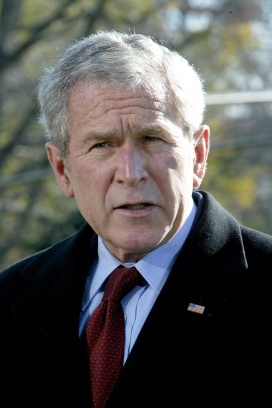
In my view, President Bush’s handling of the negotiations over the proposed bailout has been abysmal. As Jeff Matthews points out:
The President’s unfortunate choice of words—”this sucker could go down”—carry the same deer-in-headlights quality as his televised speech to the American people last week, in which he used the word “panic,” as we recall.
At a minimum, it makes you nervous; at a maximum, it makes you want to throw up first and sell everything second.What happened to the heroic, forward-looking rhetoric great leaders are supposed to provide in times of crisis?
FDR gave us “We have nothing to fear but fear itself.” Churchill gave us “We shall fight on the beaches.” George Bush cruises in with “This sucker could go down.”
We wonder: has a more irresponsible sentence been uttered, by anyone, during this entire crisis?
John Carney reports that President Bush wasn’t any better today in responding to the House’s rejection of the proposed bailout:
“We put forth a plan that was big because we got a big problem,” Bush just said, sitting in a chair placed before a fireplace in the White House. He’s meeting with advisers, he said. “I’m disappointed with the vote in Congress,” the president said.
Was that his version of FDR’s famous fireside chats? Bush looked annoyed he was being bothered with this stuff.
This from a President who failed to persuade more than a third of his own party members in the House for his position in response to a financial emergency?