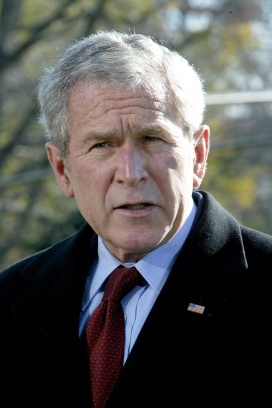
This is Leadership?

I’ve already said my piece on the proposed Treasury Bailout of Wall Street, so I won’t belabor that view.

In the meantime, there are much better places to keep up with the minute-by-minute political developments on the proposed bailout — for example, check out Clusterstock, DealBreaker and Felix Salmon for astute and up-to-the-minute analysis.

However, one point from my previous post deserves further review — that is, circumstances such as this provide us with a revealing view of our political leaders.

Do they inspire positive and collaborative action in difficult times for the better good of society?

Or do they attempt to generate support for their political position through fear-mongering and demagoguery?

In my view, President Bush’s handling of the negotiations over the proposed bailout has been abysmal. As Jeff Matthews points out:

The President’s unfortunate choice of words—”this sucker could go down”—carry the same deer-in-headlights quality as his televised speech to the American people last week, in which he used the word “panic,” as we recall.

At a minimum, it makes you nervous; at a maximum, it makes you want to throw up first and sell everything second.What happened to the heroic, forward-looking rhetoric great leaders are supposed to provide in times of crisis?

FDR gave us “We have nothing to fear but fear itself.” Churchill gave us “We shall fight on the beaches.” George Bush cruises in with “This sucker could go down.”

We wonder: has a more irresponsible sentence been uttered, by anyone, during this entire crisis?

John Carney reports that President Bush wasn’t any better today in responding to the House’s rejection of the proposed bailout:

“We put forth a plan that was big because we got a big problem,” Bush just said, sitting in a chair placed before a fireplace in the White House. He’s meeting with advisers, he said. “I’m disappointed with the vote in Congress,” the president said.

Was that his version of FDR’s famous fireside chats? Bush looked annoyed he was being bothered with this stuff.

This from a President who failed to persuade more than a third of his own party members in the House for his position in response to a financial emergency?

2008 Weekly local football review

Kubiak yelling (AP Photo/Phil Coale; previous weekly reviews are here).

Jaguars 30 Texans 27 (OT)

If it isn’t one thing, it’s another for the Texans (0-3).

After pretty much stinking it up in the Texans’ first two games, QB Matt Schaub was outstanding in this one, leading the Texans to scores on their five consecutive possessions (three TD’s and two FG’s, including Kris Brown’s 51 yarder with a second left that sent the game into overtime). Schaub was 29-40 for 307 yds with 3 TD’s and no INT’s. WR Kevin Walter had two TD’s reception and rookie RB Steve Slaton caught 8 passes for 83 yds and a TD. Can’t ask for much more than that.

On the other hand, after playing a decent first half, the Texans’ defense was horrible in the second half and overtime. For the first three quarters of the game, the Texans’ defense inexplicably allowed the Jags to complete slant passes at will. Then, when the Texans’ defense finally took away the slant pass in the fourth quarter, they forgot to maintain containment on Jags’ QB David Garrard, who proceeded to make three key runs out of the pocket on the final TD drive in regulation. The poor defensive performance was punctuated by poor tackling in OT, which allowed the Jags to set up a chip shot field goal to win the game.

About the only good thing that can be said about the defense is that it may have been better than the Texans’ coverage teams, which were absolutely awful. They provided the Jags with good field position throughout the game.

Finally, how is it that the Texans’ coaching staff and players were the only ones watching the game who did not realize that the Jags had kept their offense on the field in their initial punting situation of the game? The gift-wrapped TD that the Texans’ punt-return team gave the Jags might have made a difference in the final score, don’t you think?

The Texans finally return to Houston for their first home game of the season next week against the well-rested Colts (1-2) and QB Peyton Manning, who carved the Texans’ defense up like a holiday turkey the last time the teams played. Ay, yi, yi.

Continue reading

Paul Newman, R.I.P.

The NY Times’ Manohla Dargis reviews Newman’s film career.

The Rothko Chapel

rothko It was the 105th anniversary of Mark Rothko’s birth earlier this week, so it’s a good time to learn a bit more about the artist whose paintings hang in one of Houston’s most remarkable places, the Rothko Chapel on the campus of the University of St. Thomas (earlier post here).

Tough day at the office

Clear Thinkers reader Charles Satterfield passes along these pictures of a trading office on the sixth floor of JP Morgan Chase Center, looking out toward the blown-out windows on the east side of JP Morgan Chase Tower (the tallest building in downtown Houston), taken shortly after Hurricane Ike blew out dozens of windows on the building’s east side during the early morning of Saturday, Sept 13th. Going on two weeks after the storm, over half a million Houston area residents remain without power and about 250,000 have no running water.

601 Travis Pic 7

601 Travis Pic 6 Trading Desk

The Treasury Bailout is Not Rocket Science

The debate over the proposed Treasury bailout of Wall Street firms is coming at a fortuitous time — the election season.

Be wary of any candidates who, after looking appropriately concerned about the dire predictions of the plan’s promoters, throw up their hands and vote in favor of the bailout because “we just have to do something” even if they don’t understand what they are doing.

The fear mongering that the promoters are using to sell the bailout is laughable. This is not rocket science.

For example, when Enron tanked in late 2001, it was the seventh largest public company in the U.S. Enron traded derivatives and other financial instruments with counterparties that were among Wall Street’s biggest commercial and investment banks, which were heavily exposed to its losses. To make matters worse, these investments were concentrated in the energy sector, which is at least as important to the nation’s economy as the housing sector that is at the center of the current crisis.

In short, at the time of its bankruptcy, Enron was one of the nation’s largest publicly-owned companies, a vitally-important market-maker in the natural gas trading industry and a leader in hedging corporate risk through structured finance transactions.

Despite the huge wealth destruction that would result from Enron’s insolvency, not one government or Wall Street leader proposed a bailout of Enron in order to preserve the huge value to the public of the natural gas trading industry and the market for structured finance transactions. And they were right not to do so.

Enron’s bankruptcy proceeded to cause enormous tremors through various industries — particularly the energy industry — because valuable resources for hedging risk of loss had evaporated seemingly overnight. The natural gas trading industry nearly fell apart completely, costing companies and their customers untold billions of dollars that they otherwise could have saved through hedging risk of loss. Similarly, the market for many structured finance transactions dried up, also costing companies another valuable avenue for hedging risk.

However, the nation’s financial system did not break down. Companies adjusted to the changed circumstances and endured their additional costs as best they could. Markets also adjusted. Slowly but surely, both the natural gas trading industry and the market for structured finance transactions rebounded so that both are again providing companies with valuable alternatives for hedging risk and saving money.

Now, the tables are turned on Wall Street. Rather than facing the consequences of their risk-taking decisions in chapter 11, Wall Street’s politically well-connected leaders are weaving their tales of doom for the overall economy to compliant governmental leaders who are only too willing to do their bidding.

In reality, each of these Wall Street firms should be required to endure the same thing that Enron and its creditors did — a chapter 11 reorganization where equity gets wiped out and creditors either take a haircut on payment of their debts or convert their debt to equity in a reorganized firm that emerges from bankruptcy with a cleaned-up balance sheet.

That process ensures that investors and creditors who undertook the risk of investing or dealing with the bankrupt firms share the losses of their risk-taking. Moreover, it allows the firms that really are worth saving (as opposed to simply liquidating) to emerge from bankruptcy with an improved financial condition that should provide the firm with an enhanced opportunity to create wealth again.

What the bailout plan proposes to do is insulate investors and creditors from risk of loss by having the government — funded by taxpayers such as you and me — undertake that risk. There is simply no moral justification for foisting that risk on taxpayers and the only possible practical justification is that sorting all of these firms’ problems out in chapter 11 might take awhile.

But even if the government saw fit to accelerate the Wall Street reorganizations to hedge the risk of a prolonged economic downturn, there is simply no reason for the government to overpay for assets from financially-troubled firms. Rather, the government should simply propose a plan that implements the going-concern liquidation and debt-for-equity reorganization features of chapter 11 on an accelerated basis in return for some reasonable financial contribution to the process. And you can bet that contribution doesn’t need to be close to $700 billion.

Luigi Zingales, the Robert C. Mc Cormack Professor of Entrepreneurship and Finance at the University of Chicago, has written the most cogent piece I’ve seen to date on why the bailout is a bad idea.

Even though it was wrong for the government to contribute to the massive amounts of wealth destruction that resulted from the demonization of Enron, the government was right not to bail out Enron. The circumstances are different now, so perhaps a different approach is more prudent than simply allowing all of these Wall Street companies to be sorted out in chapter 11.

But throwing $700 billion at investors and creditors who should be sharing the losses of their risk-taking is not even close to the best way of doing it.

Update: I couldn’t help but laugh out loud this morning as Warren Buffett and the promoters of the Treasury bailout plan point to Buffett’s sweet $5 billion investment in Goldman Sachs as an endorsement of the plan.

I prefer to look at what Buffett is doing rather than what he is saying.

What he is not doing is what Paulson and Bernanke want the U.S. Treasury to do — buy investment banks’ toxic assets.

Rather, Buffett is buying preferred shares in Goldman with a big yield and warrants to buy Goldman stock at $115 (its trading at over $130) so that he can recover the profit his investment helps foster while Goldman transitions from an investment bank to a bank holding company over the next couple of years.

Meanwhile, Paulson and Bernanke keep promoting their plan to throw $700 billion at whatever trashy assets that Wall Street serves up to them.

It does not engender much confidence that Buffett can cut a far better deal with Wall Street’s best-run investment bank than Paulson and Bernanke propose to cut with the worst-run ones.

The "Rookies and Rednecks" come through

82781331TL459_2008_Ryder_Cu What with a hurricane hitting the upper Texas coast and a financial hurricane hammering Wall Street, the U.S. team’s improbably stirring victory over the European team in last weekend’s Ryder Cup matches has been somewhat overlooked.

As usual, Geoff Shackelford has chronicled all the reviews of the U.S. team’s victory, including this interesting Mike Adamson article in which he notes the esprit de corps of the "Tigerless" U.S. team:

Woods’s below-par record for the US team – combining the Ryder Cup and Presidents Cup, he has lost more of his 50 matches than he has won – remains something of a mystery. He has won the WGC Match Play on three occasions, including this year, his competitive streak thriving in mano-a-mano combat. But pair him with another and he cannot stop losing.

Woods has had a remarkable 11 partners in the Ryder Cup, three of whom were in this US team. All three, Jim Furyk, Justin Leonard and particularly Phil Mickelson, have played with spirit, unburdened by the great man’s presence. Likewise it is hard, albeit not impossible, to imagine the debutants Anthony Kim and Boo Weekley playing with such uninhibited personality were they in Woods’s shadow. Although Azinger lost the world’s best player, it is not too much of a stretch to suggest that his uplifting captaincy has also benefited from the absence of such an intimidating figure in the team room.

Also, don’t miss this fine Doug Ferguson article on the tense third day match between the cocky U.S. rookie, Anthony Kim, and Euro Ryder Cup stalwart, Sergio Garcia. Kim stared Garcia down on the first green and then proceeded to whip him, 5 and 4.

The Ryder Cup is finally competitive again!

2008 Weekly local football review

Kubiak and Schaub (AP Photo/John Russell)

After a week off in deference to Hurricane Ike, the weekly local football review is back (previous weekly reviews are here).

Titans 31 Texans 12

OK, it wasn’t as bad as the Week One loss to the Steelers, but that’s faint praise. The Texans (0-2) defense was actually better against the Titans (3-0), but the offense continues to hit on far fewer than all cylinders. Rookie RB Steve Slaton looked promising(18 car/115 yds/1 TD), but QB Matt Schaub (17-37/ 188 yds/ 3 INT’s) and Pro Bowl WR Andre Johnson (2 receptions for 29 yds and two dropped passes in the end zone) looked awful. The road to a first 2008 victory doesn’t get any easier for the Texans next week as they travel to Jacksonville to play the Jaguars (1-2), who handed the Colts (1-2) their second loss in three 2008 games on Sunday. And guess who the Texans get after the Jags? The Colts at Reliant Stadium. The Chron’s Lance Zerlein sums up the state of the Texans after two games here.

Miami 41 Texas Aggies 23 

Aggie RB Michael Goodson started the game off with an electrifying 62 yard TD catch and run, but then Miami tied the game four plays later and never looked back. The score was 41-10 by late in the third quarter, so this game was a blowout well before the Aggies scored two meaningless scores late. The Aggies (1-2) better get a win next Saturday at College Station against Army (0-3) because their next legitimate chance for a victory after that game is a month later against Big 12 doormat, Iowa State (2-2), and that’s by no means a sure thing. My, how low can it go in Aggieland?

Texas 52 Rice 10

As the Owls (2-2) served up their annual sacrificial lamb offering to the Longhorns (3-0), does anyone else think the Horns’ soft schedule may make them prime meat for an upset at Boulder by Colorado (3-0) two weeks from now? The Horns play a bad Arkansas (2-1) team next Saturday in Austin, while the Owls will have a scoreboard-burning free-for-all against North Texas (0-3) at Rice Stadium.

Colorado State 28 Houston Cougars 25

Given that UH players and coaches were inexplicably forced to play last week while many of their families were enduring peril from Hurricane Ike, and then spent most of last week trying to get back to a largely power-deprived city in the aftermath of the hurricane, I am almost inclined to give the Cougars (1-3) a pass on this loss. That is until I discovered that Colorado State (2-1) struggled to beat Sacramento State (!) two weeks ago. The Coogs better get their mojo back quickly because they travel next Saturday to Greenville, North Carolina to play East Carolina (3-1), which was the 15th-ranked team in the country before they were upset in overtime by North Carolina State on Saturday. A 1-4 start is not what new Cougar coach Kevin Sumlin had in mind as his introduction to the Houston sports community.