Have you had a symptom of an illness or an injury that has bothering you for awhile? Medgle allows you to click on the body part that’s bothering you and select the specific symptom from a list of possible options. Then, Medgle asks how long the symptom has been apparent, as well as th inquirer’s sex and age. Medgle then returns a listing of possible matches for the symptoms.
Moreover, you can then take the result that Medgle generates and, on the following page, provides you with a brief summary of the condition and a Google search relating to treatment, prevention, drugs, tests, research, diet, alternative medicine, and fitness. You can even refine the search by changing the age or gender.
This is never going to replace a visit to your doctor, but it sure provides a handy way to increase the patient’s knowledge and understanding regarding diagnosis and treatment. Check it out.
Monthly Archives: August 2007
Another wonderful thing about the blogosphere
Is that you can find far better previews of college football teams than are served up in the mainstream media. A case in point — TAMABINPO’s 2007 Aggie Football Preview. Check it out to find out everything you need to know about the 2007 Aggie football team.
In Dr. Pou’s words
Dr. Anna Pou (previous posts here), the former faculty member of the University of Texas Medical Branch in Galveston, performed heroically in the horrific aftermath of Hurricane Katrina. For her heroism, she became the main subject of one of the most egregious examples of prosecutorial misconduct in recent memory. In this extensive Newsweek article, Dr. Pou finally tells her side of the story and it magnifies the enormity of the injustice that a few irresponsible Louisiana state officials have put her through. The following are a few tidbits:
What was it like after the levees broke?
Monday after the storm passed, we figured, ëOK, minimal damage; we began organizing how we were going to evacuate the hospital.í We didnít have full power so we needed to move patients. Tuesday morning we were planning our day and one of the nurses called me to the window and said youíve got to come see this. Water was gushing from the street. So we all kind of looked in disbelief. What is this? We could tell the city was flooding, you could see water down Claiborne Street. It was rising about a foot an hour. Then the whole mood at the hospital changed and what we were doing changed. We were in hurricane mode and we had to go into survival mode because we knew we had to be there for some time.
How did things change on Wednesday?
Tuesday night, we lost generator power, and that changed things a lot. ëTil then we were on generator power so we did have some lights, and we did have some water. Water wasnít clean, but it was running. But then we didnít have water, we didnít have any electricity, commodes were backing up everywhere. Conditions in the hospital started to deteriorate Tuesday night and early Wednesday. When that happens it makes care a lot more difficult. I was called to help suction a patient who had a tracheotomy but we had no suction running. We were going down to very, very basic care. You try every old-time method you can Ö [P]eople in charge were trying to get helicopters to come, [but] at that time we were told we were low priority. There were people on rooftops [who were going to get rescued first]. They said Ö thereís not going to be a lot of help coming, [so] what we decided [was] if helicopters were going to show up sporadically, we have to have patients ready and waiting to go. [. . .]
The conditions were unbearable. Inside the hospital it was pitch black, with odors, smell, human waste everywhere. It was very rancid. You would take a breath in and it would burn the back of your throat. The patients were very sick. Thatís when we had to go from triage to reverse triage because we came to realize if patients arenít being evacuated, [we had to deal with what we had]. Basically it was a general consensus that weíre not going to be able to save everybody. We hope that we can, but we realize everybody may not make it out. [. . .]
By the time Wednesday evening came around, if you can imagine in our mind, there is a central area that is a sea of people. A lot of very sick patients in that central triage area. Itís grossly backed up. Few patients had been evacuated. So there was just enough space to walk between the stretchers. It is extremely dark. Weíre having to care for patients by flashlight. There were patients that were moaning, patients that are crying. Weíre trying to cool them off. We had some dirty water we could use, some ice. We were sponging them down, giving them sips of bottled water, those who could drink. The heat wasóthere is no way to describe that heat. I was in it and I canít believe how hot it was. There are people fanning patients with cardboard, nurses everywhere, a few doctors and wall-to-wall patients. Patients are so frightened and weíre saying prayers with them. We kind of looked around at each other and said, ìYou know thereís not a whole lot we can really do for those people.î Weíre waiting [for help]. The people in that area could have [been evacuated] by boat but no boats were coming. I would do what I could with the nurses: changing diapers, cooling patients down with fanning. It wasnít like, ìIím a doctor, youíre a nurse.î We were all human beings trying to help another human being, whatever it took.
What happened Thursday?
On Thursday morning we were told nobody was coming and we had to fend for ourselves. Everybody was kind of like at a loss here. What is plan B? Or plan C?
Not your typical highway robbery
Carrying too much cash is now probable cause of a crime?:
Anastasio Prieto of El Paso gave a state police officer at the weigh station permission to search the truck to see if it contained “needles or cash in excess of $10,000,” according to the American Civil Liberties Union, which filed the federal lawsuit Thursday.
Prieto told the officer he didn’t have any needles but did have $23,700.
Officers took the money and turned it over to the DEA. DEA agents photographed and fingerprinted Prieto over his objections, then released him without charging him with anything.
Border Patrol agents searched his truck with drug-sniffing dogs, but found no evidence of illegal substances, the ACLU said. […]
DEA agents told Prieto he would receive a notice of federal proceedings to permanently forfeit the money within 30 days and that to get it back, he’d have to prove it was his and did not come from illegal drug sales.
They told him the process probably would take a year, the ACLU said.
H’mm. I didn’t realize that one of the dangers of carrying a large amount of cash is now the federal government.
Big downtown building deal
The Bank of America Center in downtown Houston — the distinctive Phillip Johnson and John Burgee-designed building that graces this blog’s heading — is changing hands in a record-setting deal:
Bank of America Center has just sold for about $370 million, a record-setting price for a Houston office building.
Novati Group, a new Dallas-based real estate player, and the General Electric Pension Trust, which was advised by Stamford, Conn.-based GE Asset Management, paid about $295 a square foot for the building at 700 Louisiana, according to sources familiar with the deal. The seller was Houston-based Hines, which developed the 56-story, 1.3 million-square-foot skyscraper in 1983.
. . . the reported total price is record-breaking, as well as the price per square foot. The deal edges out the $286 per square foot record set in December 2005 when the 581,000-square-foot 5 Houston Center was purchased by Wells Real Estate Investment Trust II Inc. for $166 million.
This building, which is at 700 Louisiana in downtown Houston, has always been special to me. My old firm was one of the original tenants in the building and we occupied the 51st and 48th floors for 18 years. Known for its unique architecture, the building has three major setbacks tha tmke it appear to be three adjoining buildings. The exterior is made from deep russet-colored granite, known as Napolean Red, which was quarried in Sweden and finished in Italy. Since it was built, the building has always had the highest occupancy of any building in downtown Houston and is currently 93% leased.
Are you ready for some college football?
The college football season kicks off this week, so take a look at this clever table containing the schedules of most major college teams utilizing the logos of each team and opponent. And here is an interesting pre-season analysis of the major conferences.
The charm of capitalism
Scott Adams figures out the essential charm of capitalism:
I understand the math of capitalism, and how the few successes are so large they pay for all the failures and then some. But at any given moment, the majority of resources in a capitalist system are being pushed over a cliff by morons. This fascinates me. And itís clearly the reason that humans rule the earth. We found a system to harness the power of stupid.
Read the entire post.
Copland on Stoneridge v. Scientific-Atlanta
Jim Copland, the director of the Center for Legal Policy at the Manhattan Institute, provides this particularly lucid analysis of the important legal and public policy issues involved in the pending Supreme Court case of Stoneridge Investment v. Scientific-Atlanta, which could seriously erode the longstanding Central Bank rule against holding financial institutions secondarily liable for damages in providing financing for a company that defrauds its investors:
Nothing in the securities laws as written enables private investors to file lawsuits over alleged frauds. Courts have inferred such ìprivate rights of actionî stemming from section 10(b)(5) of the Securities Exchange Act of 1934, but the Supreme Court limited such private suits to ìprimaryî violators in 1994 in a case called Central Bank of Denver v. First Interstate Bank of Denver. The court expressly declined to embrace liability for companies ìaiding and abettingî frauds that injured shareholders.
After Central Bank, Congress quickly jumped in to clarify that the Securities and Exchange Commission itself had authority over an entity that ìknowingly provides substantial assistance to anotherî in securities-related frauds. But Congress wisely decided not to extend such authority to private lawsuits.
If the Supreme Court decides to endorse such suits notwithstanding congressional inaction, the implications for U.S. competitiveness could be profound. Anyone doing business with a publicly listed American company would be subject to a potential lawsuit should that companyís stock price tank ó and would thus have to hire extra auditors and take out insurance policies to protect against such lawsuits. The disadvantages for listing on American stock market, already significant, would be that much more substantial.
And if you want an example of the absurdity of what would happen if the Central Bank rule is overturned or eroded, read this.
The Slade trial begins
The criminal trial of former Texas Southern University President Priscilla Slade on charges of misappropirating TSU property begins today at the county criminal courthouse in downtown Houston (previous posts here). Harris County prosecutors and Mike DeGeurin, Ms. Slade’s defense counsel, spent the last several days picking the jury.
Meanwhile, life goes on as usual over at TSU:
Texas Southern University’s accrediting agency is taking a deeper ó and unscheduled ó look into financial accountability and leadership at the state’s largest historically black university.
In an extraordinary move, the Southern Association of Colleges and Schools, the regional accrediting body for 780 colleges and universities in 11 Southern states, has ordered TSU to provide audits, rehabilitation plans and other documents by Oct. 1. [. . .]
The worst-case scenario for TSU is the loss of its accreditation. Without it, the federal government would stop providing financial aid to students.
Nearly two-thirds of TSU’s 11,000 students receive Pell Grants, which are awarded to low-income students.
There are many sad aspects to this entire affair, but one of the saddest is that Ms. Slade’s trial will almost certainly garner far more of the public’s attention than the continuing failure of local and state officials to take any meaningful steps to begin solving the chronic problems at TSU.
Cheerleading the Cowboys?
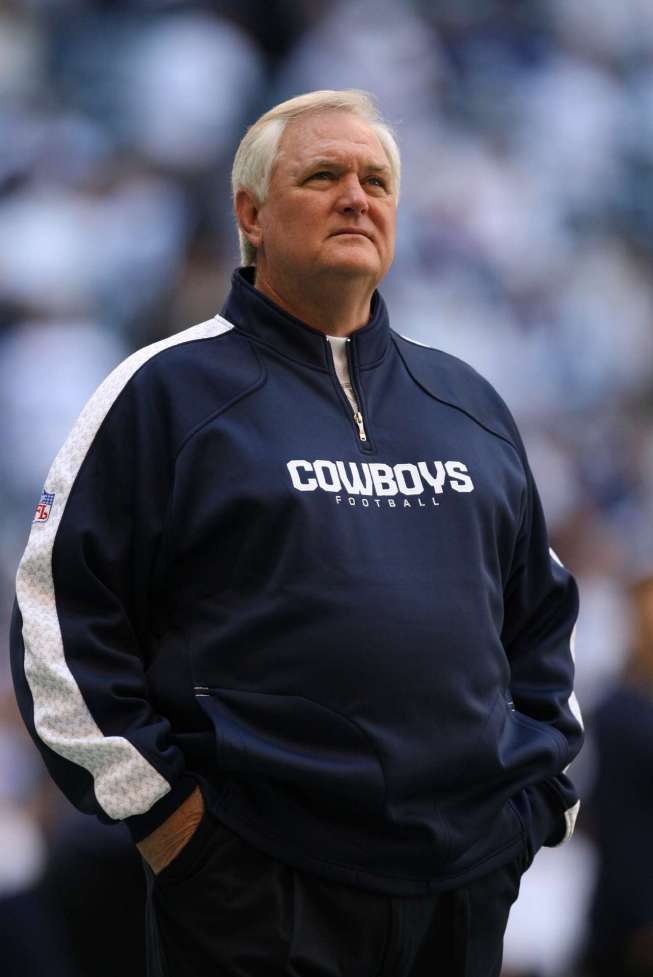
We already know that the Chronicle sportswriters lead the nation in pre-season puff pieces about local professional football team. But now the Chron sportswriters are expanding the reach of their incessant cheerleading to Dallas with this soft toss about new Cowboys head coach, Wade Phillips, who happens to be the son of the still hugely popular former Houston Oilers head coach, Bum Phillips:
So after all these years, Wade is who he is, something of a rumpled, unprepossessing presence on the sideline and not the most silver-tongued of news conference orators. The only thing overtly sexy about him is his latest job title: head coach of the Dallas Cowboys, one of sport’s most lustrous brands. [. . .]
Funny thing. If you ask the Cowboys about their new coach, they’re wont to speak about how Wade also sees stuff. For that reason, quarterback Tony Romo calls him the smartest coach he has ever been around.
Let’s just say that there is a slight difference of opinion about Wade’s head coaching abilities at one of his previous stops, Buffalo, New York. The Buffalo News’ Jerry Sullivan laid out the case against Phillips as a head coach in a column (not available online) at the time the Cowboys hired Phillips last February:
When I heard that Jerry Jones had hired Wade Phillips to be the Dallas Cowboys’ new head coach, I had the same reaction as when Jones signed Drew Bledsoe two years ago:
Good luck, fella.
Is this what it’s come to for the once-great Dallas franchise? When times get tough, go out and grab a castoff from the Buffalo Bills’ recent, sorry past? Maybe Jones’ next move will be luring Rob Johnson out of retirement to compete with Tony Romo for the quarterback job.
Ralph Wilson has to be smiling. Maybe he can’t get Jones and the other rich NFL owners to give him a bigger share of the revenue pie. But at least Wilson gets the satisfaction of seeing the Cowboys picking through his table scraps — you know, the way the Bills did with Patriots discards during the Donahoe era.
Jones can spin it any way he likes. But it’s clear that the Cowboys owner, who has the title of general manager, decided it was time to meddle again and wanted a puppet as coach. Jones gave Bill Parcells control for four years and didn’t get a single playoff win for his trouble. That makes 10 years without a playoff win for the storied Cowboys — nearly as long as Buffalo’s playoff drought.
Phillips was the ideal candidate, a retread who is close to 60 and was desperate for one last shot at a top job. Phillips is a nice, self-deprecating guy, a native Texan who wore ostrich-skin boots to his introductory news conference.
“Wade wanted it so bad,” Jones said when he announced Phillips’ hiring.
Phillips wanted it badly enough to accept Jason Garrett as Jones’ hand-picked offensive coordinator. He didn’t get to pick his offensive staff. I suppose he’d have taken the Cowboys cheerleaders as coaches if Jones had required it.
Jones favors the 3-4 defense. Phillips is a 3-4 guy, a good defensive coach. Some would say great, but it’s funny how his defenses have failed to rise to the ultimate test over the years. The Chargers’ playoff collapse against the Pats last month was the most recent example.
Of course, the Cowboys aren’t hiring Phillips to run a defense. They’re hiring him to be the head coach. As Bills fans have discovered to their horror (Gregg Williams, Mike Mularkey), it’s a huge step from coordinator to head man. All too often, owners elevate men beyond their intellect and abilities.
Why would Jones expect great things from Phillips in his third go-round? Phillips is a proven mediocrity as a head coach. His supporters point to his 29-21 record with the Bills. I’m sorry, those teams were loaded. It didn’t take a Vince Lombardi to produce a winning record.
Phillips isn’t big on detail. A former assistant told me Phillips didn’t account for a short practice week before the Music City Miracle, which was played on a Saturday. He wasn’t a stickler for conditioning. He was not a commanding presence on the sideline.
Phillips didn’t win a playoff game in Buffalo and made some classic blunders along the way. He made Johnson his starting QB before a playoff game, after Doug Flutie got the team to 10-5. He made Bruce DeHaven the scapegoat for the playoff loss. Then he brought in Ronnie Jones, an unqualified crony, to coach the special teams. It was a disaster.
Before a Monday night game late in the 2000 season, Phillips went on national TV and said the Bills and Colts (who were tied at the time) were essentially out of playoff contention. The Colts won and found a way into the playoffs.
My mind throbs at the memory of Phillips fumbling his way through the Flutie-Johnson flap. He was in over his head as the spokesman for a franchise. If he thought he had it tough here, wait until the Texas media gets hold of him.
They’ll chew the guy up and spit him out, ostrich skin boots and all.
Funny how none of the foregoing made it into the Chron article. Everything remains peaches and cream at the Chron during the pre-season.
