As noted in this earlier post and several previous posts, football is synonomous with autumn in Texas and, each year, there always seems to be one play that stands out among all the rest from the season.
This season, there really is no question about the play of the year, but it’s not for the faint of stomach. During a key part of the 4th quarter in the state 5A D-1 championship game between Southlake Carroll and Austin Westlake, Southlake Carroll QB Riley Dodge barks out the signals, vomits immediately before taking the snap, proceeds to throw a perfect TD pass to put Southlake ahead for good in the game, and then is helped off the field by a couple of his teammates as he vomits again on his way to the sideline.
Through the genius of YouTube, you can now enjoy — or at least admire — QB Dodge’s effort.
Monthly Archives: January 2007
The Todd Graham Affair
My, the risk of managing a minor league professional football team certainly is not pleasant at times, is it?
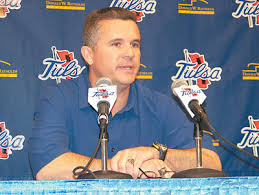
As this John Lopez column relates, Conference USA Coach of the Year Todd Graham — who in his first season at Rice University led the Owls to their first bowl game since the early 1960’s — stunned the Rice community last week by announcing that he was leaving after only one season to replace his former boss, Steve Kragthorpe, as head coach at the University of Tulsa.
Hightailing it after only one season, switching jobs between conference members and leaving Rice without a head coach and most of its football coaching staff during the middle of recruiting season — Graham pretty well handled this job change about as shabbily as possible (Whew! Just wait until the Marching Owl Band gets ahold of that material for its halftime show at the next Rice-Tulsa game). And as Lopez’s column and Rice alum Charles Kuffner report, supporters of the Rice football program are certainly not happy with Coach Graham.
Of course, many of those disgruntled Rice supporters overlook the fact that they ran off Ken Hatfield, a loyal and good football coach who had served the Rice program honorably and effectively for many years in order to hire Coach Graham in the first place. Oh well, chalk it up to the dysfunctional marriage of university management and minor league professional football.
By the way, Coach Graham better hope that his career choices are better than the last Rice football coach who elected to take another job after just one season on South Main.
Also a golf pioneer
On this eve of Martin Luther King Day, GolfObservor.com’s Frank Hannigan reflects in this piece on a little-known pioneering effort of another important black man of Dr. King’s era — Willie Mays.
Although Jackie Robinson broke the color barrier in Major League Baseball in 1947, Mays and Hank Aaron were the first true black superstars in baseball. To give you a snapshot of Mays’ greatness, he began his career as a 20 year-old in 1951 and played until he was a 42 year-old. During that span, he only had one season (as a 42 year old in 1973) in which he generated fewer runs for his team than an average National League hitter would have created using the same number of outs as Mays (“RCAA,” explained here). For his career, Mays generated an RCAA of 1008, which is 11th all-time among Major League ballplayers and second only to Mickey Mantle (who had an RCAA of 1099) among centerfielders in Major League Baseball history. A true five-tool player, Mays was also an extraordinary defensive player and a fine baserunner for most of his career. In short, anyone who knew anything about professional sports in that era knew about Willie Mays.
Mays was also an avid amateur golfer and, along with dozens of other baseball players, he had played in an off-season golf tournament in which the promoter had provided some prize money to entice the ballplayers. Under the rules of the United States Golf Association at the time, the USGA ruled that all the participants in the tournament had lost their amateur status, regardless, as Hannigan puts it, as to “whether or not they could break 100.”
Mays enjoyed playing in the annual Bing Crosby Pro-Am at Pebble Beach during the off-season, so losing his amateur status would have prevented him from playing in that tournament. As a result, shortly after the close of the 1972 baseball season, Mays showed up at the USGA’s offices in New York to arrange to reclaim his amateur status and Hannigan was the USGA Assistant Director who helped Mays do so. In reflecting on his short meeting with Mays, Hannigan concludes by observing that even Mays probably did not realize just how much of a pioneer that he was:
Mays was soon to join the Los Altos Country Club in the San Francisco Bay area, known to be a club that was favored by professional athletes including John Brodie and Bob Rosburg.
Although there are no precise records for such matters, it was my impression at that time that no other black person in America belonged to a member-owned club. This was more than an impression since we at the USGA knew the front office managers of every golf organization in the United States. It’s hard to imagine we would not have known of a black member of a private, member owned course.
So, until somebody tells me otherwise, I regard Mays as having been a pioneer. My guess is that he may not have known that.

The NFL Network gambit
These previous posts have questioned the judgment of the National Football League owners in restricting viewership of NFL games through the new NFL Network. In this American.com op-ed, Will Wilson — who shares my lack of ability to win football pools — wonders the same thing:
For casual fans, as opposed to the diehards, spectator sports are a cultural artifact with unique rhythms and socialization rituals: we clean in the spring, we shop the day after Thanksgiving, and we watch football on Sundays. For casual fans, interest in the culture of football on Sunday afternoonsóand, crucially, around the water cooler on Monday morningsódepended on a rhythm that was broken once games began taking place midweek. Casual office pool participants didnít want to structure their weeks like hardcore fans. For them, the choice wasnít between football and no football, as the NFL would like to believe, but between football and reading, or sewing, or learning Mandarin, or watching sitcoms, or whatever it is that people do on Thursday evenings in December. These casual fans werenít interested in the game for the gameís sake. They were involved because the game opened up a social interaction without much time commitment. Many people in my office only watched on Sunday in order to participate in the pool, and participated in the pool because it only involved Sunday (with a Monday bonus if they were still in the running). For them, the NFL vanished between Tuesday and Saturday. When Thursdays became mandatory, the NFL ceased to exist for them altogether. [. . .]
All of this raises one question: why are professional sports leagues threatening to stamp out the cultural ties that keep casual fans interested in sports? Surely they are shrewd enough to recognize the riskóattempts to capture all possible present profits drive potential and future users to other hobbies. Fantasy sports are a billion dollar a year business, but much of that would erode quickly if initial entry costs were raised.
Both leagues have a ìlast period problemîóa phrase not from the language of sports, but of economics. Todayís ballplayers and owners donít care if tomorrowís ballplayers and owners make a dime, so theyíre willing to discourage potential fans of the future in order to capitalize on the diehards right now.
It is already absurdly expensive to attend an NFL football game in person. When the flap between the NFL owners and the cable companies over the NFL Network is eventually resolved, it will be more expensive to watch television because of NFL football. Maybe this is the way for NFL owners to maximize profits, but there are many other things to do in life than watch NFL football games. Just ask folks in L.A.
Rabinowitz on the mob in the Duke lacrosse team case
I’ve written frequently about how a mob mentality took hold in a case familiar to Houstonians and led to a grave injustice for a large number of businesspersons, particularly two men and their families (examples here, here and here). The Wall Street Journal’s Dorothy Rabinowitz examines in this OpinionJournal op-ed how a similar dynamic resulted in the demonization of several young men in what will now forever be known as the Duke lacrosse team case. Rabinowitz analogizes the Duke students’ case to that of the phony child-abuse cases that she has previously exposed, but the dynamic is the same in many high-profile cases in which certain elements of the government, media and the public jump to a conclusion about guilt when a reasoned, objective and deliberate examination of the facts of the case would result in a far different and more nuanced conclusion. Larry Ribstein and the WSJ’s ($) Holman Jenkins have masterfully presented how the same dynamic has led to the unnecessary destruction of careers and lives in connection with the media-inspired scandal regarding the widespread policy of backdating options as a means of compensating corporate personnel (Larry analyzes today’s news of the newly-reported criminal investigation of Apple here). In the Duke lacrosse team case, it is particularly ironic that many in the media and on Duke’s faculty were enablers of abusive, dishonest law enforcement and prosecution tactics that are far more often used in cases against minorities that those enablers would decry. They now share responsibility for the continued use of such tactics long after the spotlight on the Duke lacrosse team case has moved on to the next fixation of the mob.
The myth of healthy marathoners
The Chevron Houston Marathon takes place Sunday morning, and this Dale Robertson/Chronicle article tells the story of Dolph Tillotson, the Galveston Daily News publisher who almost died of a heart attack while training at Memorial Park in preparation for the 2004 marathon. Tillotson has now recovered to the extent that he is going to try and complete the marathon on Sunday, which is certainly a remarkable comeback.
But is Tillotson’s long-distance running making him healthier? Art DeVany argues that it does not and, in this recent post, notes a study from the Annals of New York Academy of Sciences that indicates that long-distance running is more dangerous to one’s health than conventional wisdom suggests:
Ann N Y Acad Sci. 1977;301:593-619.
Related Articles, Links
Coronary heart disease in marathon runners.
Noakes T, Opie L, Beck W, McKechnie J, Benchimol A, Desser K.
Six highly trained marathon runners developed myocardial infarction. One of the two cases of clinically diagnosed myocardial infarction was fatal, and there were four cases of angiographically-proven infarction. Two athletes had significant arterial disease of two major coronary arteries, a third had stenosis of the anterior descending and the fourth of the right coronary artery. All these athletes had warning symptoms. Three of them completed marathon races despite symptoms, one athlete running more than 20 miles after the onset of exertional discomfort to complete the 56 mile Comrades Marathon. In spite of developing chest pain, another athlete who died had continued training for three weeks, including a 40 mile run. Two other athletes also continued to train with chest pain. We conclude that the marathon runners studied were not immune to coronary heart disease, nor to coronary atherosclerosis and that high levels of physical fitness did not guarantee the absence of significant cardiovascular disease. In addition, the relationship of exercise and myocardial infarction was complex because two athletes developed myocardial infarction during marathon running in the absence of complete coronary artery occlusion. We stress that marathon runners, like other sportsmen, should be warned of the serious significance of the development of exertional symptoms. Our conclusions do not reflect on the possible value of exercise in the prevention of coronary heart disease. Rather we refute exaggerated claims that marathon running provides complete immunity from coronary heart disease.
DeVany — who has been studying physiology and exercise protocols for years — has accumulated a series of posts regarding the unhealthy nature and outright dangers of endurance training. The reality is that many endurance runners are not particularly healthy people, suffering from lack of muscle mass, overuse injuries, dangerous inflammation and dubious nutrition.
Tillotson obviously has great desire and discipline to be able to return to marathon running after almost dying of a heart attack. But his judgment in doing so is open to serious question.
Rocket docket
Awhile back, this post noted a Harris County criminal district judge who contributes to the chronically over-crowded Harris County jail by requiring jail time for any defendant convicted of a drug offense, no matter how inconsequential.
Now, another Harris County criminal judge is being called on carpet for his rather odd manner of administering justice. This Chronicle article reports that Harris County Criminal Court at Law No. 3 Judge Donald Jackson ordered more than a dozen criminal defendants who were late to court earlier this week to enter a guilty plea or spend the night in jail:
Jackson, who presides over County Criminal Court No. 3, ordered 16 people accused of misdemeanor crimes to sit in the jury box, told them that they were in custody and that their bonds were being revoked and raised, according to several Houston attorneys.
Jackson also told the defendants they would have to stay in jail overnight unless they agreed to plea bargain ó essentially to enter guilty pleas, the attorneys said. [. . .]
Houston attorney Kyle Vance, whose client was about 20 minutes late to court, said the man was “trying to get out of jail” Wednesday afternoon.
Vance said his client is facing a first-time charge of driving while intoxicated and had posted a $500 bond. Jackson raised his client’s bail to $2,500, Vance said.
“I was out of the courtroom for just a minute, and I asked the clerk, ‘Is their bond being revoked?’ And she said, ‘Both. It has been revoked and raised, unless you plea bargain.’ ”
Right after that, Vance said, another defendant entered a plea bargain. “And the judge said the revocation has been withdrawn since he pled.”
To make matters worse, the Harris County Criminal Justice building is a tough slog most mornings, with long lines at the x-ray machines slowing down traffic. The ACLU and the Harris County Criminal Defense Lawyers Association are looking into Judge Jackson’s behavior. Sounds as if it’s about time that the State Board of Judicial Conduct and Harris County voters did, too.
Did Drew outsmart himself?
Early in this past season for baseball free agents, I noted that J.D. Drew appeared to make a savvy move by opting out of a player option with the Dodgers that would have guaranteed him $33 million over the next three seasons. It appeared that I was right about a month ago when uber-agent, Scott Boras, engineered a $70 million deal for Drew with the Red Sox over five years. Nothing like picking up a cool $37 million by simply opting out of an option.
However, it’s been over 40 days since the announcement of the Drew-Red Sox deal and Drew still has not signed a contract. As this Murray Chass/NY Times article notes, there are rumors that Drew’s recent shoulder injury may have been more serious than the Red Sox thought before examining Drew physically. If so, then it’s highly doubtful that the BoSox will commit anything close to $70 million smackeroos to Drew over five years.
If Drew’s deal with the Red Sox goes awry, I wonder whether Boras will pick up the difference between the $33 million that Drew left on the table from the Dodgers and the possibly lesser amount that a tarnished Drew can draw on the rebound in even a superheated free agent market?
Acrobatic lawyers
In my practice, I am continually amazed at how most lawyers underuse Adobe Acrobat’s features despite the fact that pdf files have become the standard file form for legal briefs and pleadings. Such basic and simple-to-use Adobe features as bookmarking and linking greatly facilitate the review of large documents, but rarely do lawyers include these features in their papers. I bookmark and link all my large briefs and pleadings, and many judges — most of whom review briefs and pleadings on a computer these days — have commented to me on how much they enjoy using those features in reviewing voluminous documents.
Ed Poll realizes the same thing that I do. So, he interviews Rick Borstein, Business Development Manager for the Legal Community for Abobe Systems, Inc. in this podcast in which Borstein discusses the new features in the latest version of Adobe Acrobat that are of special interest to lawyers. It’s 20 minutes of listening that will be well worth your time.
Big money golf
Don’t miss this fascinating Ron Sirak/Golf Digest article on the top 50 money-generating golfers. Julius Boros ushered in play-for-logo deals for professional golfers back in the early 1960’s when he donned an Amana hat for $50 a week. I think it’s safe to say that no one in their wildest dreams imagined at that time that a 17-year old female golfer (Michelle Wie) would be pulling in almost $20 million in off-course income in a single year. Imagine what she could pull down if she actually won a tournament or two.
Several other interesting tidbits:
Wie made $2 million more in off-course income than Jack Nicklaus.
Someone still paid David Duval over $4 million in off-course income?
Chad Campbell is the highest-ranking Texan at 19 with over $6.6 million in total income, but The Woodlands’ K.J. Choi is gaining on him (25th at $5.7 million).
A caddie for a mid-range player in the top-50 money-earning list, who won at least once on the PGA Tour in 2006, had gross earnings of around $260,000.
This year, everyone on the PGA Tour will get a courtesy car at every tournament.