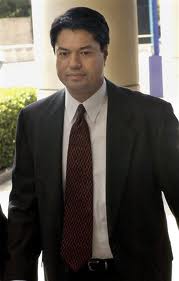
Longtime Houston independent oil and gas entreprenuer, real estate developer and philanthropist George Mitchell announced jointly with Texas A&M University yesterday that he and his wife Cynthia are donating $35 million to A&M to help build two physics facilities at the university. Jennifer Radcliffe of the Chronicle reports on the donation, which is one of the largest in A&M history. Earlier posts on philanthropic donations of the Mitchells are here and here.
A&M is certainly appreciative of the Mitchells’ generous gift, but what most Aggies want is for Mr. Mitchell to do something about the reeling Aggie football program, which Chronicle sportswriter and former Aggie John Lopez sizes up here and here. Similarly, this caustic San Antonio Express article on the A&M football situation pretty well reflects the Aggie sentiment around the Lone Star State at this particular moment.
The Aggies are currently 16.5 point underdogs in their game at Texas Tech on Saturday. Taking Tech and laying the points may be the lock bet of the year.
Monthly Archives: November 2005
Ron Perelman continues to torture Morgan Stanley
You would think that hammering Morgan Stanley for $1.57 billion in damages would be enough for Ronald Perelman.
No way. This Wall Street Journal ($) article reports that Mr. Perelman has requested the same Florida state district judge who eviscerated Morgan Stanley’s defense in his lawsuit to hold the investment banking firm in criminal contempt of court for allegedly lying to the court in connection with testimony over when company executives found out that certain electronic tapes at issue in the trial might have contained potentially relevant email.
Under normal circumstances, Morgan Stanley should not worry too much about Mr. Perelman’s motion. Unless the contemptuous behavior takes place in the judge’s presence, all the judge should be able to do is refer the matter to the local district attorney for prosecution if she concludes that Mr. Perelman has made a prima facie case of criminal contempt. Moreover, the judge should recuse herself from overseeing the criminal case because she would likely be a witness in that case.
Having said all that, the way this case has gone for Morgan Stanley, the firm would be well-advised to have bail money immediately available for use after the hearing.
The federal government’s increasing equity stake in public companies
This Wall Street Journal ($) article picks up on a subject that I have previously addressed in regard to the legacy airline bankruptcies — that is, the federal government’s increasing equity stake in public companies resulting from the conversion of the Pension Benefit Guaranty Corp.’s debt to equity in the reorganized companies under their chapter 11 reorganization plans:
The U.S. government is on its way to becoming a big shareholder in the nation’s airline industry and possibly in the auto industry.
The Pension Benefit Guarantee Corp., the federal agency that partially guarantees traditional pensions, recently was awarded 7% of US Airways Group Inc. by a federal bankruptcy court handling the company’s Chapter 11 reorganization, according to the PBGC’s recent filing with the Securities and Exchange Commission. The agency got the shares as compensation for the underfunded pension plans it assumed when the company filed for bankruptcy.
The agency is likely to get an even larger stake — between 15% and 35% of new shares — of UAL Corp.’s United Airlines when it emerges from Chapter 11 in February, after 38 months in court protection, according to a PBGC official. And it’s likely to get sizable chunks of Northwest Airlines, Delta Air Lines and Delphi Corp. — if, as expected, the companies ask the bankruptcy courts to dump their pension plans on the insurer.
Thinking about the Enron legacy case
It is currently the calm before the storm that will be the trial of the legacy case of the Enron Task Force — that is, the criminal trial of former Enron executives Ken Lay, Jeff Skilling, and Richard Causey that is scheduled to begin in mid-January, 2006.
In that connection, this Washington Post article discusses the extensive questionnaire that was recently sent to prospective jurors in the Lay-Skilling-Causey trial, which has taken on added importance because of the extensive evidence of jury pool bias against all things related to Enron that the Lay-Skilling-Causey defense team has submitted to U.S. District Judge Sim Lake. Judge Lake declined to grant the defense’s motion to change the venue of the trial out of Houston, but he has supported the defense’s desire to have a more extensive questionnaire than the Task Force desired.
Meanwhile, in this the Conglomerate blog post, David Zaring addresses the important question of how does one make a case as complex as the one against Messrs. Lay, Skilling and Causey understandable to a jury? The Task Force already stumbled badly on that score in the trial of Enron Broadband case, and recent indications are that the Task Force is having similar problems in the preparation of its case against Messrs. Lay, Skilling and Causey. A reflection of that is the recent change that the Task Force has taken in regard to Arthur Andersen. Not only did the Task Force previously demonize Andersen in connection with prosecuting the firm out of business, the Task Force named Andersen as a co-conspirator in connection with various Enron criminal cases. However, the Task Force is changing its tune toward Andersen in regard to the Lay-Skilling-Causey prosecution, as prosecutors now recognize that relying on the testimony of admitted criminals such as Andy Fastow and Ben Glisan may not be particularly persuasive to a jury. So, the Task Force is currently listing several former Andersen partners as prosecution witnesses and, in so doing, contending that Andersen was duped by Enron and not really a co-conspirator with Enron, after all. It remains to be seen whether the Task Force can explain to a jury why it prosecuted Andersen out of business at an earlier stage of the Enron case when it is now contending that the firm was simply duped by Enron like everyone else.
More on former Stros General Managers

Blogging is a big light today as I make some blog site upgrades, but I wanted to pass along a couple of interesting items on former Stros general managers.
In this remarkably frank article, Chronicle Stros beat reporter Jose de Jesus Ortiz uses the occasion of former Stros general manager Gerry Hunsicker losing out on the Phillies’ GM job to take a serious whack at Mr. Hunsicker’s credibility. Entitled “Hunsicker Must Prove That He’s Trustworthy,” the article relates how Stros owner Drayton McLane and current Stros GM Tim Purpura became disenchanted with Mr. Hunsicker’s alleged manipulation of media accounts of various Stros transactions, including the following:
Finally, Some Justice for Jamie Olis
The sad case of Jamie Olis has been a frequent topic on this blog as an egregious example of the injustice that has resulted from the government’s increasing criminalization of business in American society.
Last night, after many months of waiting, Mr. Olis finally received some relief from his ordeal.
Although the Fifth Circuit declined to overturn his conviction, the Court did in this long-awaited opinion vacated Mr. Olis’ 24 year sentence and ordered U.S. District Judge Sim Lake to resentence Mr. Olis in accordance with Booker’s overall standard of reasonableness, including a recalculation of the amount of loss for which Mr. Olis should truly be held responsible.
Sentencing expert Doug Berman has more analysis of the Fifth Circuit’s opinion here and business law expert Larry Ribstein comments here.
Writing for the Fifth Circuit panel, Judge Edith H. Jones — who is one of the top appellate judges in the country on business issues — zeroed in on the main flaw in Judge Lake’s acceptance of the prosecution’s dubious theory relating to Mr. Olis’ sentencing.
As noted in this previous post relating to the Enron-related Nigerian Barge trial, the prosecution in Mr. Olis’ case misled Judge Lake regarding the proper method for calculating the market loss for purposes of Mr. Olis’ sentencing.
Indeed, at the time of Mr. Olis’ sentencing, the Justice Department had already taken the position before the Supreme Court in Dura Pharmaceuticals v. Broudo that the market loss calculation method that it was using in Mr. Olis’ case was not the proper method for calculating market loss.
Without noting that egregious contradiction, Judge Jones in the Olis opinion nonetheless criticizes Judge Lake’s acceptance of the government’s method of market loss calculation:
In this case, the district court, faced with a “cook the books” fraud, overemphasized his discretion as factfinder at the expense of economic analysis. Thus, the court elected to rely solely on the Heil testimony concerning the purchase and sale of UCRS stock as a measure of the loss caused by Olis’s offense. When Heil’s testimony was offered at trial to prove guilt, Olis’s counsel was not placed on notice that the same evidence might later pertain to the guidelines loss calculation. For that reason, other significant extrinsic causes of the UCRS loss were not explored, much less quantified, at trial. UCRS bought most of its Dynegy holdings at the top of the market. As Olis pointed out at sentencing, however, two-thirds of the drop in Dynegy’s price occurred either before the revelation of Project Alpha’s problems or more than a week after the announcement of the restatement of earnings caused by Project Alpha. Taken on the court’s own terms, a substantial portion of the entire loss on the UCRS investment in Dynegy, over $100 million, could not have been caused by Olis’s work on Project Alpha.
During sentencing, moreover, Olis offered the expert report of a Rice University expert, Professor Bala Dharan, which explored numerous forces at work on the Dynegy stock price during the relevant periods. The court refused to consider the report, criticizing the expert’s analysis of whether Olis could have “reasonably foreseen” the impact of his conduct on the stock market. As the court observed, the economist was arguably stretching his expertise into an improper legal conclusion, but his statements on this matter are separate from his economic analysis of price and market movements. Professor Dharan’s report demonstrates that Dynegy stock declined during the period covering Project Alpha in tandem with the stocks of other publicly traded companies in the energy marketing and trading business.
Further, Dynegy’s stock was negatively affected, even before the restatement of Project Alpha’s cash flow impact, by the company’s failed bid to acquire the faltering Enron. These factors and others cited in the report suggested that attributing to Olis the entire stock market decline suffered by one large or multiple small shareholders of Dynegy would greatly overstate his personal criminal culpability.
Because the district court’s approach to the loss calculation did not take into account the impact of extrinsic factors on Dynegy’s stock price decline, Olis is entitled to resentencing on this factor, subject to the principles just discussed.
If there has ever been a case in which the sentence should be reduced to time already served, this is the one.
Stay tuned for further developments.

Criminalizing everything
George Melloan, the deputy editor, international, of The Wall Street Journal, has recently written two columns (here and here) in which he has addressed a common topic on this blog — i.e., the increasing criminalization in American society of ordinary business practices. Following on those columns, Mr. Melloan notes in this WSJ ($) column that the equally dubious criminalization of politics that is evident in the Scooter Libby indictment is a likely precursor of an even greater threat to freedom in American society:
The prosecutorial tsunami that has swept through a land teeming with lawyers and litigants has now come lapping up on the shores of the First Amendment. Now that politics has been criminalized, can reporting on politics be far behind?
If that sounds far-fetched, think how far prosecutors and state attorneys general have managed to stretch the reach of the law, tolerated by judges and a gullible press. A huge accounting firm, Arthur Andersen, was wiped out by an indictment because it failed to uncover the Enron fraud, something accountants are ill-equipped to do. Sarbanes-Oxley makes it hazardous to manage a company or sit on a corporate board because of the new liabilities it imposes. . . And then there’s Eliot Spitzer, an AG who specializes in extracting confessions to non-crimes.
The next big story will be the debate over Mr. Bush’s new nominee for the Supreme Court, Appeals Court Judge Samuel Alito. Advance word is that he, like sitting Justice Antonin Scalia, is concerned about abuses of constitutional law. That won’t save Scooter Libby from the ordeal he faces, but the high court is very much in need of such views.
Finally, as noted earlier here, having encouraged abuse of state power against unpopular business executives, the Bush Administration and Republican-controlled Congress are now in no position to rein in similar abuses toward the unpopular politician of the moment.
What a mess!
KPMG class action tax shelter settlement moves toward final approval
Following on this earlier post regarding the proposed settlement, U.S. District Judge Dennis Cavanaugh preliminarily approved a proposed $225 million class-action settlement by KPMG LLP and the Sidley Austin Brown & Wood LLP law firm over questionable tax shelters that KPMG promoted and sold to hundreds of wealthy clients. Here are posts over the past year or so that chronicle KPMG’s multiple problems arising from its tax shelter venture.
Under the settlement, KPMG will pay about 80% of the settlement while Sidley Austin — which had written legal opinions supporting many of the shelters — will pick up the balance of the settlement amount. The settlement covers about 275 former KPMG tax-shelter clients. The preliminary settlement comes a couple of months after KPMG reached a $456 million settlement with the Justice Department over the same tax shelters under which KPMG avoided a criminal indictment but admitted criminal wrongdoing.