Cowboy business

Cowboys Stadium-Night-Shot_0 The Texans are the toast of their local cheerleading team, but the unquestioned NFL team of Texas remains the Dallas Cowboys. This Glenn Hunter/D Magazine interview of Cowboys owner Jerry Jones confirms that the Cowboys business model is performing very, very well:

With the Cowboys, you’re said to lead the league in corporate sponsorships. Can you give me an idea how much those relationships are worth each year?

We’ve got significant, long-term relationships with Dr Pepper, Miller Lite, Pepsi, Bank of America. If you would aggregate those key, basic long-term sponsorships, that would exceed $50 million annually. We have smaller relationships through our broadcasting, radio and television.

And for merchandising, would $50 million be a good number?

The wholesale-merchandising area is a very, very proprietary number that has a lot involved with it. Let’s see, how to say this? Our wholesaling and retailing combined, as far as financial viability is concerned, is on par with what we do with sponsorships. They are equal in their contribution to the Cowboys.

Continue reading

The fall of a demagogue

Hunter-Edwards- I wasn’t going to blog anything about John Edwards’ recent public admission to an affair with Rielle Hunter. As has been noted many times previously on this blog, Edwards is a demagogue who represents the worst in American national politics. I would have much preferred that Edwards’ demagoguery be the reason for the demise of his political career rather than a tawdry affair that is hurtful to Edwards’ innocent family members, even if it was "oncologically correct," as Maureen Dowd put it.

But turning to Ms. Hunter, check out this Jonathan Darman/Newsweek article. What a piece of work. Once Hunter decided to pounce, Edwards never had a chance. It almost makes one feel sorry for him. Almost.

By the way, while considering matters political, don’t miss Josh Green’s Atlantic piece on the demise of the Hillary Clinton campaign (previous posts here).

Here we go again?

Ryder Cup 2008 With the completion of the PGA Championship this past weekend, the eight automatic qualifiers for the 12-man 2008 U.S. Ryder Cup team were named for next month’s matches at Valhalla Golf Club in Louisville (Sept. 16-21).  U.S. team captain Paul Azinger will complete the 12-member roster by announcing his four Captain’s selections Tuesday, Sept. 2, at 10 a.m. at the Hotel Martinique on Broadway in New York City.

The automatic qualifiers are the following:

Player                 Points

Phil Mickelson    5,342.500

Stewart Cink      4,952.665

Kenny Perry       4,480.700

Jim Furyk           4,423.892

Anthony Kim     4,035.296

Justin Leonard  3,379.274

Ben Curtis         3,120.061

Boo Weekley     2,785.095

My sense is that this group isn’t sending shivers up the spine of the European team, which has recently dominated the U.S. team, winning four of the past five matches. The U.S. team is younger than prior teams with three of the eight (Ben Curtis, Anthony Kim and Boo Weekley) participating in their first Ryder Cup. Phil Mickelson is the veteran of the U.S. team by virtue of making his seventh consecutive appearance in the matches, but he is coming off a pathetic 1-7-1 record in the past two matches.

At least Mickelson played reasonably well over the past two weeks, contending for both titles and tying for seventh at the PGA Championship. Likewise, Furyk (29th) and Weekley (20th) played decently at the PGA even though they were not in contention for the title, while Curtis played very well in tying for second place.

However, Kim and Justin Leonard disappeared during the weekend rounds, Stewart Cink didn’t even make the cut and Kenny Perry withdrew after the first round after scratching his cornea with a wayward contact lense. Leonard and Perry have never won a Ryder Cup match, and Mickelson, Furyk and Cink have an aggregate Ryder Cup record of 18-29-10.

Meanwhile, Euro team members Padraig Harrington (first place), Sergio Garcia (second place tie with Curtis), Henrik Stenson (tied for fourth) and Justin Rose (tied for ninth) were stellar during the PGA Championship.

Is anyone else getting a bad feeling about this year’s matches? At least the U.S. team won’t have to deal with being the favorite going into the matches.

Barackroll

As political satire, the video below probably doesn’t top this one, but it’s close.

Elegant Elk

Steve Elkington Clear Thinkers favorite and longtime Houstonian Steve Elkington (PGA Tour page here) is now 45 years old and past his prime on the PGA Tour, where he has won a major (the 1995 PGA at Riviera), is a ten time winner (the most recent was in 1999 at Doral). Nevertheless, Elk continues to have one of most elegant golf swings on the Tour and remains quite competitive, reflected by his tie for eighth place through two rounds of this week’s PGA Championship at Oakland Hills outside Detroit.

Mirroring his swing, Elk has also established himself as one of the most fashionable dressers on the Tour. During this first round of the PGA Championship, Elk was resplendent in a white shirt with pink dots and a hard collar, high-rise brown trousers with a windowpane check and long pleats, and green, white and red patent-leather Foot Joy shoes. Elk is continuing the tradition of fellow Houstonians Doug Sanders and the late Jimmy Demaret, both of whom were the fashion plates on the Tour during their respective eras.

As he winds down his PGA Tour career and prepares for the Champions Tour, Elk has established his own website — elksworld.com — where he is displaying and selling the shirts and caps he wears and designs. Elk also provides this slick deck that summarizes the marketing opportunities that businesses can derive by associating with Elk. Rather than selling advertising space on himself or his golf bag, Elk is using his artistic talent and entrepreneurial spirit to start an interesting business. Here’s hoping that he is as successful in that endeavor as he has been during his PGA Tour career.

Criminal Justice?

The always-insightful Larry Ribstein points out that Jamie Olis would have been better off providing material support for Osama Bin Laden than working on the beneficial structured finance transaction that ultimately led to his criminal conviction.

The sad case of Jamie Olis remains one of the most egregious abuses of the government’s prosecutorial power during the post-Enron criminalization of business. The relative lack of outrage over it reflects poorly on all freedom-loving Americans.

Is the problem really risk aversion?

Risk Steve Waldman (H/T Felix Salmon) makes a spot-on observation regarding the conventional wisdom that the current downturn in the financial sector of the global economy is the result of too much risk:

One of the more depressing bits of emerging conventional wisdom is the notion that the financial system took on "too much risk" in recent years. I think it is equally accurate to suggest that the financial system took on too little risk. [.   .   .]

The big central banks, whose investment largely drove the credit boom, were (and still are) seeking safety, not risk. The banks and SIVs that bought up "super-senior AAA" tranches of CDOs were looking for safe assets, not risky assets. We had a housing boom, rather than a Pez dispenser bubble, because housing collateral is (well, was) the preferred raw material for fabricating safe paper. Investors were never enthusiastic about cul-de-sacs and McMansions. They wanted safe assets, never mind what backed ’em, and mortgages are what Wall Street knew how to lipstick into safe assets. The housing boom was born less from inordinate risk-taking than from the unwillingness of investors to take and bear considered risks. Agencies, asset-backed securities, it was all just AAA paper. It was "safe", so who cared what it was funding? [.  .  .]

.   .   . We’ve trained a generation of professionals to forget that investing is precisely the art of taking economic risks, then delivering the goods or eating the losses. The exotica of modern finance is fascinating, and I’ve nothing against any acronym that you care to name. But until owners of capital stop hiding behind cleverness and diversification and take responsibility for the resources they steward, finance will remain a shell game, a tournament in evading responsibility for poor outcomes.

Investors’ childlike demand for safety has made the financial world terribly risky. As we rebuild our broken financial system, we must not pretend that risk can be regulated or innovated away. We must demand that investors choose risks and bear consequences. We need more, and more creative, risk-taking, not false promises of safety that taxpayers will inevitably be called upon to keep.

Read the entire piece here. As noted many times on this blog (most recently here), many powerful forces in our society — the government and the mainstream media to name just two — continue to embrace myths that distract from a mature understanding of the nature of risk.

A bad idea that just won’t die

astrodome 080708 Isn’t it amazing how long bad ideas will remain festering so long as local governmental officials have something to do with it?

After four years of dithering, this Bill Murphy/Chronicle article breathlessly reports that there may be hope for the Astrodome hotel project after all:

Despite their previous staunch opposition to the project, the Houston Livestock Show and Rodeo and the Texans signaled that they may be able to coexist with a convention hotel that would be built in the Astrodome.

Their more conciliatory attitude toward the 1,300-room project was evident in recently submitted reviews of the proposed convention hotel lease.  .  . 

And since the promoters of the project already have a financing commitment lined up, this deal is about ready to take off, right? Uh, well, maybe not:

Even if the Texans and the rodeo drop opposition to the project, Astrodome Redevelopment Co. still needs to obtain financing for the ambitious, $450 million effort to transform the building once known as the Eighth Wonder of the World into a convention hotel.

Astrodome Redevelopment president Scott Hanson said the company’s efforts to obtain financing have been hampered by an inability to strike a lease with the sports corporation, which oversees Reliant Park operations, including the Astrodome.

"The (commercial lending) market is much tougher now. Quite frankly, we have been waiting on getting an approved lease before we go back out into the marketplace," he said.

So, what happened to that financing commitment for the project about which the Chronicle previously reported? What the heck, even in a tough lending market, half-a-billion or so in financing shouldn’t be all that difficult to line up for a project that almost certainly will be a financial success, now could it? Well maybe, except that the parent company that owns the model for the Astrodome hotel project — The Gaylord Texan — is not exactly doing all that well:

The Star-Telegram has a story today about the Gaylord Texan’s parent company, Gaylord Entertainment, reporting a second quarter revenue increase of 36 percent over last year—but a net income drop of 91 percent. The company reported a net income of $106.8 million in Q2 ‘07; for Q2 ‘08, they’re looking at a net income of $8.78 million. That’s right, eight. They blame it on decreased attendance at conventions. Does this bode well for the convention center hotel business?

So, let’s get this straight. After not being able to arrange financing for this boondoggle during the robust equity and credit markets that existed up to 2007, the promoters think they are going to be able to line up financing in the current tight financing market for a business that is not even doing particularly well?

Give it up folks.

Update: Kevin Whited suggests that the promoters’ PF staff should retain the Chron’s Murphy.

Cutting the Pai

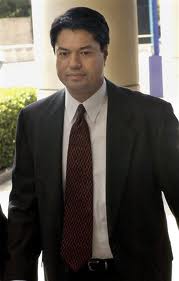
Former Enron Bldg Former Enron executive Lou Pai’s recent settlement with the Securities and Exchange Commission confirmed that the Greed Narrative is still embraced by much of mainstream American society. Take, for example, Charles Kuffner’s reaction:

Reading this story reminds me why I was bothered less than folks like Tom were about the criminal cases that were brought against the likes of Ken Lay, Jeff Skilling, and so on. Pai was (eventually) punished through the civil process, but the punishment he received doesn’t come close to balancing the scales, in my view. He’s still a millionaire many times over – assuming he hasn’t blown it all, of course – while so many other people, employees and shareholders, got wiped out. I think the only way the civil justice system could really make these guys pay for their wrongdoings is if it left them in the same shape as the people who were affected by their actions – namely, in a situation where they’d have to work for the rest of their lives because they no longer had any accumulated wealth. Here’s a bit I wrote from my review of "The Smartest Guys In The Room":

There’s a really poignant scene in which Portland General Electric lineman Al Kaseweter matter-of-factly states that he sold his entire retirement portfolio, which was worth $348,000 at its peak, for $1200.

PGE had been bought by Enron before the crash; like most Enron employees were encouraged to do, Kaseweter put the bulk of his retirement funds into Enron stock. Put Lou Pai in Al Kaseweter’s shoes, and I’d agree that justice had been served. Same with Skilling and the rest of that crowd. But that’s not how it works, so despite the problems associated with the Enron prosecutions, I think they were necessary.

Stated simply, Charles’ view is that "Pai got rich at Enron and a bunch of people lost money when Enron went down in flames, so he must have done something criminal and must be punished." Chron business reporter Loren Steffy, who really ought to know better, spews a similar view.

Frankly, given the societal bias against nearly everything related to Enron, such reactions are not particularly surprising. But it remains disappointing — and, frankly, a reflection of our human instinct to demonize those in regard to whom we feel morally superior — that reasonably intelligent people dismiss as a virtual white-collar criminal a man of considerable talent without even passing mention of what he supposedly did wrong.

Continue reading

Enunciate!

Come to think of it, I had a difficult time understanding Batman at times, too.