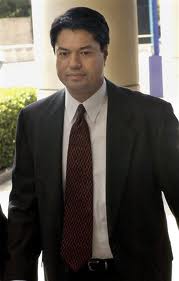
And in this corner . . .

prosecutors.jpgAlthough not as well-known as John Emshwiller of the Wall Street Journal and Kurt Eichenwald of the NY Times when it comes to covering the Enron scandal, Carrie Johnson of the Washington Post has been doing some of the best and most balanced reporting on Enron, and she scores again today with this interesting article profiling the Enron Task Force prosecution team that will be handling the upcoming trial of the Task Force’s legacy case against former key Enron executives, Ken Lay and Jeff Skilling.
Ms. Johnson notes that the stakes are high for the prosecution team, which has had a decidedly better record in cutting plea deals than in actually obtaining convictions in court:

For all its success in dealmaking, the task force’s record when it takes cases to a jury has been mixed.
The trial last year of former executives in Enron’s broadband Internet unit dragged on for three months under the weight of testimony about the division’s technological capabilities. The case ended in a hung jury in July. Weeks earlier, the U.S. Supreme Court unanimously tossed out the government’s groundbreaking conviction of audit firm Arthur Andersen LLP because of faulty jury instructions. Both cases were prosecuted by the task force, but lawyers involved in the coming Lay trial had little involvement in investigating those defendants.

The prosecution team is led by 38-year-old Chicago lawyer Sean Berkowitz, who replaced the controversial Andrew Weissmann as Task Force director at the conclusion of the Enron Broadband trial in July of last year. Interestingly, it appears that the prosecutors on the Task Force trial team in the Lay-Skilling case did not have much to do in preparing the sweeping indictment against Lay and Skilling, which may explain why the prosecution is narrowing its case against the defendants as the commencement of the trial approaches.
Even with such narrowing, however, the Chronicle’s Mary Flood reports that the Task Force is currently predicting that it will take over two months for the prosecution to present its case in chief in the Lay-Skilling trial. Such predictions are notoriously speculative, but two months is a long time to present a case and poses a substantial risk of juror rebellion.


Now, that’s serious!

2006-01-15-bettis.jpgAnd I thought that Texans took football seriously:

Bettis Fumble Coincides With Fan’s Heart Attack (WTAE-TV)
The excitement of the Steelers taking on the Indianapolis Colts proved too much for one fan on Sunday.
With about 1 minute remaining in the game, Colts linebacker Gary Brackett hit Steelers running back Jerome Bettis on the Indianapolis goal line and forced a fumble — one that caused a man to go into cardiac arrest at Cupka’s bar, in the South Side, Sheldon Ingram said.
The firemen performed CPR on [the victim] and the called the paramedics, . . .
[The victim] was later revived with a defibrillator and taken to UMPC Presbyterian Hospital.

Missing the Point

Chronicle business columnist Loren Steffy has been a harsh critic of Enron and its former key executives, Ken Lay and Jeff Skilling.

In their motion to transfer venue of their upcoming criminal trial, Lay and Skilling have used Steffy’s past columns as examples of the biased and negative reporting in Houston that makes it far less likely that an unbiased jury can be found here than in, say, Denver, Phoenix or Atlanta.

In his column today, Steffy responds by conceding that he has been critical and mocking of Lay and Skilling, but arguing that jurors can put aside inflamed passions and biased reporting to render a verdict based solely on the evidence presented in court.

Besides, Steffy snipes, that Lay and Skilling are entitled to a fair trial does not mean that he shouldn’t be allowed to express his outrage in his columns over what happened at Enron.

Well, it’s pretty clear that Steffy has missed the point of Lay and Skilling’s use of his columns, which is not uncommon for someone who is promoting a certain view toward a case rather than a more balanced one.

Lay and Skilling’s pleadings never question Steffy’s right to express whatever viewpoint he wants in regard to Enron or their case.

Rather, Lay and Skilling’s point is that the Chronicle and local media’s almost total failure to provide a counterbalance to the one-sided views of those expressed by Steffy and others has greatly contributed to the overwhelmingly negative views toward Lay and Skilling that are expressed in the responses to the juror questionnaire that was transmitted to prospective jurors several months ago.

As noted many times on this blog, there does exist a different view toward what happened at Enron than that which Steffy shares with the vast majority of the mainstream media.

The problem is not with Steffy’s viewpoint. Rather, the problem is with the effect on potential jurors of the promotion of that viewpoint to the almost total excluson of the contrary view.

On a related note, Larry Ribstein and Thom Lambert (of the terrific new blog, Truth on the Market) comment on the effect of bloggers expressing balancing views to those of the mainstream business media.

More Prosecutorial Misconduct in the Sad Case of Jamie Olis

One can only wonder when the mainstream media will pick up on the outrageous conduct of the Justice Department in the sad case of former mid-level Dynegy executive Jamie Olis?

First, in a prosecution that probably should never have been pursued in the first place, the Justice Department dramatically misrepresented the market loss attributable to the transaction over which Olis was prosecuted, prompting U.S. District Judge Sim Lake to sentence Olis in March 2004 to an absurd 24 years in prison.

Then, after the Fifth Circuit Court of Appeals threw out Olis’ sentence on this past October 31, the Justice Department had over two months to prepare for the hearing on Olis’ resentencing. Despite that time to prepare, the prosecution simply asserted that Olis should be sentenced to an almost as absurd 15 years in prison and failed to prepare any meaningful evidence of market loss to support that position.

On the other hand, Olis’ defense team produced impressive expert reports that establish the impossibility of establishing with any degree of meaningful certainty the market loss attributable to the transaction over which Olis was prosecuted.

Now, in yet another outrage, the Justice Department has requested six additional weeks to prepare market loss evidence for Olis’ resentencing hearing despite the fact that it has been clear since the Fifth Circuit’s decision of October 31 that such evidence would be necessary for Olis’ resentencing. Inasmuch as Judge Lake is about ready to commence the trial of former key Enron executives Ken Lay and Jeff Skilling, it now appears that Olis resentencing will be postponed for at least four months.

Meanwhile, justice, respect for the rule of law, the principle of prosecutorial discretion, common sense and human decency continue to be the casualties of the sad case of Jamie Olis and other dubious prosecutions of corporate agency costs in the post-Enron era.

Update: Doug Berman continues to place the over/under on the Olis resentencing at 5-7 years. I’ve been taking the under on that bet, but the latest news reflects that my bet is based more on a generally optimistic nature than savvy betting skills in such matters.

WSJ profiles David Adickes

sam_houston_01.jpgThis Wall Street Journal ($) article profiles Houston sculptor David Adickes, who specializes in huge works such as the sculpture of Sam Houston on I-45 just outside of Huntsville about 60 miles north of downtown Houston. In recent months, Adickes has been working on erecting a 60-foot-tall statue of Stephen F. Austin in Brazoria County, a project that Banjo Jones has been following closely (scroll down to 10.26.05 pictures), but the WSJ reports that Adickes is contemplating an even more ambitious project — a 280-foot-tall cowboy (equivalent to a 23 story building) that Adickes envisions standing next to one of the Texas’ busiest freeways.
Alas, the Journal reports that Adickes’ creations have not brought him much critical acclaim:

Mr. Adickes’s statues don’t bring him much approval in the world of serious art. The sculptor’s skillful, Titan-sized likenesses of historical figures may have a big “gee-whiz” factor, but they’re of “minimal aesthetic interest,” says University of Kansas professor of art history David Cateforis. He likens Mr. Adickes’s statues to such artifacts of roadside Americana as the 80-foot-high Uniroyal tire outside Detroit.

Nevertheless, that noted Houston art critic — heart surgeon Denton Cooley — defends Adickes’ creations:

Famed Houston heart surgeon Denton Cooley, who is the subject of one of Mr. Adickes’s more life-size (8-foot) statues in Houston’s Texas Medical Center, sees genius in Mr. Adickes’s enormous scale.

“Some of the great wonders of the world are big things like that,” he notes.

Boston Scientific won’t take no for an answer

boston scientific_logo2.jpgguidant_logo_web8.jpgGosh, just a little over two months ago, Johnson & Johnson was threatening to walk on its proposed $25.4 billion ($76 per share) merger with Guidant. J&J eventually agreed to stay in the deal after Guidant agreed that J&J could knock $4 billion off the purchase price.
But then, Boston Scientific got in the game for Guidant. Before you know it, J&J was making nice with Guidant and had increased its bid for Guidant back up to $24.2 billion ( $40.52 in cash and .493 shares of J&J stock for each Guidant share) with a quick closing date. Guidant’s board accepted that revised offer and J&J heaved a sigh of relief until . . .
Boston Scientific announced this morning that it had increased its bid for Guidant to an eye-popping $80 a share or more than $27 billion. With that offer, it now appears that J&J may have to raise its offer to above the $25.4 billion, $76 per share offer that J&J originally agreed to pay for Guidant.
Does anyone else get the sense that J&J wished it had never heard of such things as “material adverse effects” and Eliot Spitzer?
Update: And Guidant has switched allegiances and now supports Boston Scientific’s new bid.

How many Texans have been on the Supreme Court?

Tom clark.jpgWith the confirmation hearing for U.S. Supreme Court nominee Samuel A. Alito, Jr. coming to a close this week, it’s time to dust off a good Supreme Court trivia question that you can use to stump your colleagues: How many U.S. Supreme Court Justices have hailed from Texas?
The answer is one — Tom Clark, who President Truman appointed in 1949. Justice Clark served until 1967 when fellow Texan Lyndon Johnson engineered Clark’s resignation so that Johnson could appoint the first black Justice — Thurgood Marshall — to the Supreme Court. How did President Johnson induce Justice Clark to resign? By appointing Clark’s son Ramsey as Attorney General of the United States. Johnson really could get things done, eh?
With the Supreme Court in the news, the University of Texas’ fine Utopia site has made Justice Clark’s personal papers available on the Web. The materials “contain a comprehensive record of Justice Clark’s activities as a U.S. Supreme Court Justice, public servant, and advocate for improved judicial administration. . . [f]rom . . . 1949 until his death in 1977.” The site focuses on court documents relating to Judge Clark’s work in the areas of desegregation, school prayer, voting rights, civil rights, and much more.
Hat tip to the Librarians Internet Index via ZiefBrief for the link to Justice Clark’s papers.

The Tulia nightmare

Tulia.jpgMuriel Dobbin’s Washington Times review of Nate Blakeslee’s new book on the Tulia scandal — Tulia: Race, Cocaine, and Corruption in a Small Texas Town (PublicAffairs 2005) — says it all about the enduring legacy of racism in American society:

It was only six years ago that it happened, but it could have been 60. Decades after the gains of the civil rights movement in the battle against discrimination, this book warns that it isn’t over. This is the disturbing chronicle of what happened in the bleak little west Texas town of Tulia when a rogue cop ran amok and organized a drug sweep that put a substantial number of the black population in jail for allegedly dealing powdered cocaine. . .
This book is dark evidence of the kind of racism that still lingers in America, from corrupt cops and judges to an indifference to justice most commonly associated with the deep south of the 1930s. . . .
Almost as difficult to believe as the Tulia sting operation are the dimensions of the legal battle it took to reverse the conviction of the Tulia defendants and disclose that [rogue police officer Tom] Coleman had a record of leaving jobs with unpaid debts and had a reputation as a racist and pathological liar obsessed with guns. Mr. Blakeslee’s meticulous account of court proceedings and legal actions underscores the racist roots as well as the inadequacies of justice on the Texas panhandle.

Read the entire review. Tulia reminds us that the stubborn prejudice noted earlier here remains woven tightly within the fabric of American life. When the dark passions of racism are combined with the power of the state, the damage to lives, justice and the rule of law is truly foreboding.

Jobs Tweaks Dell

Back in 1997, shortly after Steven Jobs had returned to be Apple Computer’s CEO in what at the time appeared to be a last-ditch attempt to revive the flagging company, Dell, Inc. founder and chairman Michael Dell was asked at a technology conference in front of thousands of techies what might be done to fix Apple:

“What would I do?’ Dell replied. “I’d shut it down and give the money back to the shareholders.”

Well, times change and iPods became popular, so a 12% surge in Apple’s stock price last week pushed the company’s market capitalization to $72.13 billion, which made it greater than Dell’s $71.97 billion market cap. Given that milestone, how much do you think Jobs enjoyed sending the following email to Apple’s employees at the end of last week as reported in this NY Times article?:

“Team, it turned out that Michael Dell wasn’t perfect at predicting the future. Based on today’s stock market close, Apple is worth more than Dell. Stocks go up and down, and things may be different tomorrow, but I thought it was worth a moment of reflection today. Steve.”

Nevertheless, Dell’s personal net worth estimated to be in excess of $14 billion still dwarfs that of Jobs, who is “only” worth five billion or two. Several years ago, when Apple wasn’t doing as well as it is now, Jobs traded options on Apple stock that would now be worth $3.3 billion for a more conservative package. So, based on Apple’s current $80 per share value, Jobs gave up about $2.5 billion in that deal. Jobs’ main wealth now is in his stake in the animation company Pixar. That stake is valued at around $3.5 billion.

Spinning the new date for the Shell Houston Open

shologo3.gifLast week, the PGA Tour announced its new schedule of Tour tournaments to begin during the 2007 season, and it remains to be seen how a new date for the increasingly-troubled Shell Houston Open (“the SHO”) will play out.
As noted in this previous post, the SHO has suffered over the past several years for a variety of reasons, including the fact that its recent date has been the relatively unattractive week just two weeks after The Masters Tournament. At the current time of the SHO, most of the best Tour players are taking a break from the Tour before gearing up for the U.S. Open in June.
However, under the revised Tour schedule beginning in 2007, the SHO will be moved to the weekend before The Masters. The Houston Golf Association — which runs the SHO — had been hoping for a date on the new schedule that would have been the weekend before the new spot for the Players Championship, which will be played after The Masters in mid-May under the new schedule rather than in mid-March before The Masters as it is currently scheduled.
As you might expect, the HGA is putting the best spin on the new date as possible. “Clearly our new date will generate additional excitement in the marketplace because we may attract even more marquee players to the Shell Houston Open,î said HGA president Steve Timms in a statement on the SHO website.
Count me as not so sure. Although the current date two weeks after The Masters is certainly not ideal, moving to the week before The Masters might be even worse. Under the new schedule, the Tour players will be finishing up a month-long swing through Florida, which will include a new World Golf event at Doral during the week before the SHO. After playing at Doral, the top Tour players may find it easy to skip the long jaunt to Texas and simply opt to take a week off to prepare for The Masters.
For the organizers of a tournament that attracted only two of the top ten Tour players during last year’s event, that new schedule has to raise more than a few concerns that efforts to elevate the Shell Houston Open to the first tier of the non-major Tour tournaments simply may not be feasible under the Tour’s present setup.