How not to treat friends

BetonSports.gifFirst, federal prosecutors heavy-handed tactics generated a political firestorm with one of America’s closest allies over the NatWest Three case. Now this:

In a sharp escalation of their crackdown on Internet gambling, United States prosecutors said yesterday that they were pressing charges against the chief executive of BetOnSports, a prominent Internet gambling company that is publicly traded in Britain, and against several other current and former company officers.
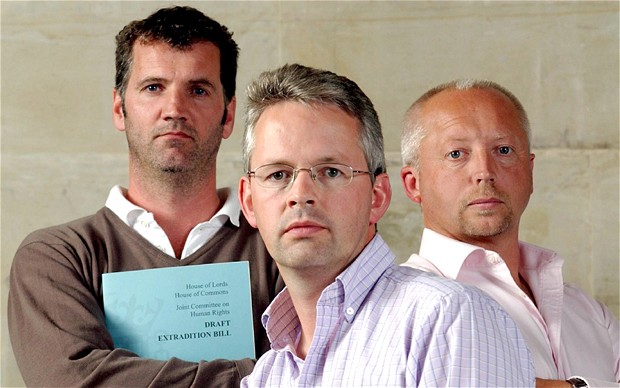
Federal authorities arrested the chief executive, David Carruthers, late Sunday as he was on layover at Dallas-Fort Worth International Airport on his way from Britain to Costa Rica. In a hearing yesterday in Federal District Court in Fort Worth, he was charged with racketeering conspiracy for participating in an illegal gambling enterprise.

Let me get this straight. Carruthers is a UK citizen, legally runs a UK-based company with a UK-based website, and he gets arrested in the US because US citizens are gambling on his website?
Here’s hoping that the UK raises hell with the Bush Administration over this latest incident as well as the handling of the NatWest Three case (which, by the way, has not generated even a civil case in the UK, much less a criminal one). As Larry Ribstein has pointed out on many occasions, the remedy of granting federal prosecutors broad latitude to criminalize business interests is generating a wave of prosecutorial abuse that is far more troubling than the original “problem” that the remedy is supposed to address. Christine Hurt has more.

“A peep show of utter horror”

death penalty2.jpgOn of my favorite books of 2003 was Erik Larson’s Devil in the White City (Crown 2003) (website here), the engaging tale of Chicago and the 1893 World’s Fair, which has just finished an astounding 124th straight week on the NY Times Bestseller List. A movie is currently being planned for the book, so the Chicago Sun-Times interviewed Larson and several other experts on the “White City” to determine the source of the fascination over the 1893 Fair:

On the one hand, Larson says, the White City was designed and built by the Gilded Age elite “as a way of demonstrating that America could come up with this level of sophistication. They went for drama at a time when architecture had very little relevance for most of the country, paving the way for things to come by inserting into the American psyche an appreciation for architecture. The sheer beauty in that array of buildings in the Court of Honor, ingeniously using the backdrop of the lake to stage the whole thing, was enough to knock anybody flat.”
But if the White City was a dream made real, much of the rest of Chicago was a nightmare.
“The fair gripped people,” [Chicago Architecture Foundation lecturer Christopher] Multhauf says, “partly because it was a vision of beauty in a place that was so squalid.” The streets were a quagmire of mud and manure, the air laced with soot and the rank aroma of stockyards and slaughterhouses. Poverty was widespread; labor unrest simmered and sometimes boiled. Prostitution flourished. Not far from the baronial mansions of Prairie Avenue, there were 31 brothels on Clark Street between Congress and Harrison, all of which were open at the time of the fair. The German writer Paul Lindau called Chicago “a peep show of utter horror, but extraordinarily to the point.”

Read the entire article and, if you have not already done so, pick up this fine book.

Innocence as a distraction

death penalty.jpgDavid Dow, a University Distinguished Professor of Law at the University of Houston, is one of nation’s leading experts on the death penalty and the author of Executed on a Technicality: Lethal Injustice on America’s Death Row (Beacon 2006) (previous death penalty posts here). Rick Garnett passes along this NY Times op-ed from several weeks ago in which Professor Dow makes the interesting point that “innocence is a distraction” in the political and legal debate over capital punishment:

For too many years now, though, death penalty opponents have seized on the nightmare of executing an innocent man as a tactic to erode support for capital punishment in America.
Innocence is a distraction. . . [M]ost people on death row did what the state said they did. But that does not mean they should be executed.
Focusing on innocence forces abolitionists into silence when a cause cÈlËbre turns out to be guilty. When the DNA testing [proved that such a defendant] was a murderer, and a good liar besides, abolitionists wrung their hands about how to respond. They seemed sorry that he had been guilty after all.
I, too, am a death penalty opponent, but I was happy to learn that [the defendant] was a murderer. I was happy that the prosecutors would not have to live with the guilt of knowing that they sent an innocent man to death row. . . .
As Justice Scalia has said elsewhere, of course we are going to execute innocent people if we have the death penalty. The criminal justice system is made up of human beings, and fallible beings make mistakes.
But perhaps that is a price society is willing to pay. If the death penalty is worth having, it might still be worth having, despite the occasional loss of innocent life. . .
[We] ought to focus on the far more pervasive problem: that the machinery of death in America is lawless, and in carrying out death sentences, we violate our legal principles nearly all of the time.

Professor Dow nails the key issue in the death penalty debate. Proponents of the death penalty reason that it is not wrong for the state to kill a person as punishment for murder where that person was lawfully convicted in a fair and accurate criminal justice process. However, reasonable proponents of the death penalty must confront the reality that errors will occur in carrying out the death penalty in even a morally-justified criminal justice system. By making the above-stated moral justification the central issue in the debate, proponents of the death penalty are overlooking the glaring defects in the process that undermine the moral justification.

Dome redevelopment plan lurches forward

Reliant Astrodome Hotel.jpgHas it really been almost two years since we began talking about what to do with the Astrodome? (previous posts here, here, here and here).
After floating a Gaylord Texan-type concept for the past year or so, Astrodome Redevelopment Corp. and Harris County are ready to enter into a letter of intent regarding ARC’s $450 million plan to reinvent the Astrodome as a luxury convention hotel with a parking garage and new exit from Loop 610 South to keep the facility from interfering with Houston Texans games and the Houston Livestock Show and Rodeo. ARC is a consortium comprised of Oceaneering International Inc., a publicly traded firm working in engineering, science and technology; URS, an architectural and design firm; NBGS International, a theme park developer; and Falcon’s Treehouse, a Florida-based design firm.
Although touted “as a major milestone,” the letter of intent is not such a big deal. ARC needs it to be able to negotiate deals with the array of entities (Texans, Rodeo, Harris County, financiers, investors, etc.) that it will have to cut deals with in order to make a deal of this magnitude come together. The letter of intent requires ARC to have its financing arranged in six months and to have its final deal cut with the county in a year.
Although I’m surprised that this proposal has gotten this far, I give the chances of the Astrodome hotel actually coming together without public financing as roughly the same as the Texans making the Super Bowl this upcoming season.

Houston’s most influential churches

megachurch.jpgThe Church Report has released its annual list of America’s 50 Most Influential (Protestant) Churches and, as with last year’s list, several Houston megachurches made the list.
Lakewood Church and the ubiquitous Joel Osteen come in again as the highest-rated local church at fifth, while Kerry Shook’s Fellowship of The Woodlands dropped from no. 17 last year to 41 this year, and KirbyJohn Caldwell’s Windsor Village United Methodist dropped from no. 43 to 49. Surprisingly, Ed Young’s Second Baptist Church — one of Houston’s original megachurches and arguably its most influential — dropped out of the top 50 list altogether after being listed at no. 33 last year.
The list is interesting in that it includes churches from both ends of the current political debate that is raging among Protestants regarding the core nature of megachurches. Osteen, Shook and a number of others on the list preach what traditionalists criticize as a feel-good gospel that views God as sort of a cosmic bellhop who exists to meet desires of humans and to make them feel comfortable with material wealth. Dallas’ T.D. Jakes (Potter’s House – 8) even denies the orthodox doctrine of the Holy Trinity, although the rest of his message has a harder edge than that of either Osteen or Shook. On the other hand, the list also includes a number of church leaders — including notably John MacArthur (Grace Community – 31), John Piper (Bethlehem Baptist – 42) and Dallas’ Tony Evans (Oak Cliff – 44) — who advocate the more traditional Christian theology that emphasizes Christ’s divinity, justification by faith, sacrifice and stewardship.
Meanwhile, the Catholics just shake their heads and go off to Mass. ;^)

Is KPMG’s tough stance helping its former partners in the tax shelter case?

kpmg logo50.jpgIn connection with negotiations over its non-prosecution agreement with the Justice Department in the KPMG tax shelter case, KPMG decided to give in to a DOJ “suggestion” and revoke in the tax shelter case its longstanding policy of paying defense costs of the firm’s partners who were accused of wrongdoing in the course of firm’s business. U.S. District Judge Lewis Kaplan issued a blistering decision condemning the DOJ’s tactic, but stopped short of dismissing the case. Rather, he directed the former KPMG partners to sue KPMG to reimburse them for the defense costs.
As noted in this earlier post, I’m skeptical that attempting to force KPMG to pay the defense costs through another legal action is a sufficient remedy for the prosecutorial misconduct and, according to this Lynne Browning/NY Times article, it’s looking as if my skepticism is warranted — KPMG is contesting any obligation to pay its former partners’ defense costs in the tax shelter case.
Frankly, despite Judge Kaplan’s belief that KPMG should pay the defense costs, KPMG’s position is a smart one. If the firm voluntarily paid the costs, then it faces the risk that the DOJ would view that action as a lack of cooperation, which could damage KPMG’s prospects of avoiding a criminal prosecution in a future case. On the other hand, if the firm continues to stiff its former partners, then it does not run the risk of being perceived as being uncooperative by the DOJ and besides — even if it loses the former partners’ civil action for reimbursement of the defense costs — the firm will only have to pay about the same amount that it would if it paid the defense costs voluntarily.
However, the more interesting question is whether KPMG’s continued refusal to pay the defense costs will ultimately persuade Judge Kaplan that dismissal of the criminal case is the only effective remedy to the Justice Department’s improper interference with the financing of the defendants’ legal defense. Judge Kaplan is already perturbed with the prosecution’s foot-dragging on other issues in the case, and the financial plight faced by the defendants as a result of KPMG’s refusal to pay their defense costs may be enough to push Judge Kaplan toward dismissal of the charges against the former KPMG partners. If so, then KPMG’s tough stance on refusing to pay its former partners’ defense costs could turn out to be better for its former partners than if the firm had simply paid the defense costs after issuance of Judge Kaplan’s earlier decision.

Can the NatWest Three receive a fair trial in Houston?

Barry Turner, lecturer in criminal law and criminal evidence at Leeds Law School, makes the following declaration in this Times Online blog post regarding the NatWest Three, who are presently awaiting a bond hearing in Houston in regard to the Enron-related criminal case against them:

“It is . . . absurd to suggest that the men will not get a fair trial in a country that uses exactly the same legal system as we do.”

H’mm. Better check the facts, Mr. Turner. Kevin Howard and Ken Lay are stark reminders that the suggestion is not absurd at all.

By the way, a friend who is prominent in the media business was vacationing in England when Ken Lay died. He passes along the following observation regarding the British media coverage of Mr. Lay’s death:

“The coverage [of Mr. Lay’s death] on the domestic BBC service was interesting.

Close to the top of the report, the journalist noted that Ken Lay continued to maintain that he had done nothing wrong. The report then went on to entertain the idea that this might actually be true.

The extensive coverage of the Natwest Three added to the sense that, in Britain at least, there is now as much questioning of the Department of Justice as there is of ex-Enron officers.”

“On Teaching” by Ross M. Lence

This has been a weekend of reflection for me as I contemplate the life of one of Houston’s finest teachers — Professor Ross M. Lence (previous post here) of the University of Houston — who died this past week.

Over a hundred former students, colleagues and friends gathered this past Thursday evening to laugh, cry and reminisce about Ross at the visitation, and then those friends and hundreds more gathered on Friday morning for the Requiem Mass for Ross at St. Anne Catholic Church. The mass was profoundly moving, with St. Anne’s soloist Kay Kahl providing beautiful singing and UH Honors College Dean Ted Estess — one of Ross’ best friends and closest colleagues — absolutely hitting the ball out of the park with a poignant eulogy that conveyed perfectly Ross’ extraordinary combination of teaching brilliance, humor and humanity.

A particularly nice touch of the services for Ross was his family’s decision to provide a copy of one of Ross’ essays to everyone who attended. The essay — entitled “On Teaching” — was written by Ross a decade or so ago while collecting his thoughts on teaching in connection with the effort of his former students and friends to raise the funds that eventually endowed the Ross M. Lence Distinguished Teaching Chair at the University of Houston.

Ross never published “On Teaching,” but by passing it along below, I hope that each teacher who happens upon this special essay will take a moment to read and reflect on it, and then use it as inspiration to provide the type of warm, thoughtful and rich mentoring to their students that is Ross Lence’s legacy to his:

I shall not shock anyone, but merely subject myself to good-natured ridicule, if I profess myself inclined to the old way of thinking that the primary concern of teaching and teachers is the student.

While such an observation may seem elementary, it should be noted that for those who define the function of a university as the discovery, preservation, and transmission of knowledge,î the role of teaching (presumably the transmission of knowledge) is formulated in such a way as to avoid mentioning either the teacher or the student. Indeed, when confined to the transmission and preservation of knowledge alone, teaching would seem to be little more than the transmission of decaying sense, entombed in that graveyard of knowledge, the notes of the teacher’s students.

Teaching necessarily involves the highest forms of discovery, the awakening of the students’ minds and souls to the world of creativity and imagination. A good teacher challenges students to join in the continuous, meticulous, and solitary questions of the mind. I myself prefer important questions partially answered to unimportant questions fully answered.

Who could doubt that those students were blessed who witnessed the phenomenal mind of Enrico Fermi as he unleashed the power of the universe on that cold, winter day under the bleachers of Stagg Field at the University of Chicago? There, with only the assistance of a slide rule and his hands, Fermi managed to do what it now takes two computers to replicate: to produce man’s first nuclear reaction.

There, a great teacher, who in the tongue of his native Italy and understood by hardly anyone present, managed to convey to his peers the desperate need to insert the carbon rods into the nuclear mass, thereby saving not only themselves, but the city of Chicago.

No doubt everyone remembers the teacher who most influenced his or her thoughts, person, and soul. No one is perhaps more aware of the best teachers than teachers themselves. That person who most influenced my own thinking was the Sage of Goose Creek, Charles S. Hyneman, Indiana University’s Distinguished Service Professor and President of the American Political Science Association.

That man did for me something that few teachers have ever done for a student. In a desperate effort to teach this kid from the wilds of Montana about the American Regime, Charles Hyneman took me on a 15,000 mile, 5-year trip across America, where he introduced me to every site where an Indian had died, every sausage factory in American and even Alvin, Texas, home of Nolan Ryan.

Today I attempt to lead my students on such a journey of the mind. Some days are good; some days are not so good. But every day I remind myself that teaching is like missionary work, and that I am the messenger, not the message. I constantly strive to bring others to see the excitement, as well as the limits, offered by the life of the mind. I encourage all students to be bold in their thoughts, moderate in their actions, and courageous in their pursuit of truth, wherever it is and however it can be known.

As I now come to my own golden age, I often think of my teacher. Of his incredible kindness, his depth of soul, and the power of his imagination. My real hope is that I, too, will be remembered by those who come after me with the same fondness.

This, then, is my philosophy of teaching: teachers love their own teachers, and they are loved in turn.

Ross M. Lence
Houston, Texas

Update: Ted Estess eulogized Ross and the Abbeville Institute provides a touching tribute.

Agency costs of big-time college football

auburn.tigers.jpgCollege football is a big and competitive business, so it’s no surprise that the issue of agency costs has reared its head with frequency over the past century of the sport. This NY Times article reports on the latest incident of apparent academic fraud — an Auburn University sociology professor arranged to have 18 members of the 2004 Auburn football team, which went undefeated and finished No. 2 in the nation, take a combined 97 hours of the “directed-reading courses” which required no classroom instruction whatsoever. More than a quarter of the students in the professor’s directed-reading courses were Auburn University athletes. The usual NCAA investigation is to follow while serious academics at Auburn must be shaking their heads over it all.
As noted in this previous post, big-time college football and basketball are caught in a vicious cycle of uneven growth, feckless leadership from many university presidents and obsolescent business models. As the previous post notes, it’s an unfortunate situation because big-time college football and basketball would likely not suffer a bit from reform that required universities to compete with true student-athletes, as opposed to minor league professional players. Given the hyprocrisy of many state universities subsidizing minor league football and basketball at the same time as grappling with funding issues for core academic programs, one would think that expensive and mostly unprofitable system of big-time college football and basketball would be ripe for reform. However, powerful and wealthy special interests continue to support the current system despite the implications to the universities’ academic responsibilities.
Is there any hope for true reform of intercollegiate athletics as well as minor league football and basketball? Or is the current system so entrenched in concentrated wealth and regulation that it is impervious to reform?

Not so fast, Mr. Eisenstat

yukos-houston2.jpgAs noted in a number of these previous posts, the Russian government’s dismemberment and effective nationalization of the assets of OAO Yukos last year has dire implications generally for Western business interests hoping to engage in reasonably free commercial investment in Russia, the recent Rosneft IPO notwithstanding.
In this WSJ ($) op-ed, former Carter and Clinton admnistration official Stuart Eizenstat observes that the Yukos affair has had broad and negative implications to the world economy, and contends that the Bush Administration and other free-market governments’ failure to call Russian Prime Minister Putin to task for his trashing of free-market business interests has contributed substantially to that negative impact. Eisenstat makes a number of good points, including the following:

Mr. Putin should also be put on notice that . . . the continued incarceration of Messrs. [former Yukos CEO Michael] Khodorkovsky and [Russian financier Platon] Lebedev, who is ill and suffering unnecessarily in a prison north of the Artic Circle, limits Russia’s prospects of being viewed as a member in good standing of the world’s group of leading nations.

Unfortunately, based on this and this, Mr. Putin could quite appropriately respond “say what?” to such a notice.