Comparing boondoggles

metro light rail routes Warren Meyer has some fun commenting on the latest Phoenix-area urban boondoggle — a three-quarter of a billion dollar state subsidy for an amusement park in the Arizona desert!

Of course, that subsidy is peanuts in comparison to the subsidy that Houston is gearing up to pay in connection with this local boondoggle (see also here and here). Why invest billions in an inflexible light rail system in a region that is not densely-populated, contains numerous and dispersed employment centers and possesses an excellent freeway system that would facilitate a far cheaper and more effective bus system?

In this recent post about the Miami transit system, Randal O’Toole sums up the common characteristics of light rail systems in areas without the density of population to generate the ridership necessary to make them economically viable:

1. Transit agencies might run excellent bus systems. But when they start building rail, they quickly get in over their heads by optimistic forecasts, unforeseen costs, and the sheer humongous expense of building dedicated transit lines.

2. Though all rail systems require periodic expensive maintenance, few transit agencies set aside any money for this because it is easier to spend the money now and let future managers worry about the future.

3. Though the rail systems are usually built to serve downtown white-collar workers, in the end it is the transit-dependent people who rely on buses who pay the cost.

4. There is only one thing rails can do that buses can’t do better, faster, and more flexibly, and that is spend a lot of your money.

The enormous cost relative to usage and inflexibility of most light rail systems reminds me of something that USC urban economist Peter Gordon observed a couple of years ago about the political forces that support these boondoggles. Some are disingenuous promoters seeking to profit from the rail lines, others pose as high-minded environmentalists and many are simply ignorant of the inefficiency and inflexibility of such systems. Professor Gordon wryly points out:

"It adds up to a winning coalition."

Professor Gordon provides more recent perspective here.

The Obligation to Throw in the Towel

So, the shoe finally dropped on the two Bear Stearns executives who managed the two Bear hedge funds that imploded in mid-2007. A copy of the indictment is here.

As I read the indictment, the government is contending that Messrs. Cioffi and Tannin were required to disclose to investors immediately in February and March, 2007 that the two of them feared that the two funds might be “toast” even as Cioffi and other Bear executives were fighting market pessimism toward the funds and urging investors to maintain trust in their ultimate financial merit.

So, with their careers riding on whether the funds would survive, Cioffi and Tannin were supposed to throw in the towel and light a match to the funds by disclosing to the market their concerns about the heightened risk of a meltdown.

Stated simply, according to the Feds, about the time you think your trust-based business might be toast, it’s already too late. Inasmuch as you are required to disclose to the markets that you think the business might be toast, that disclosure will understandably prompt the market to lose trust in your business, which means that your company is kaput.

Thus, the smart thing to do is never to voice (and sure as heck don’t write any emails!) your concern to anyone regarding the downside risk of your business. That lack of communication might dampen internal company analysis regarding risk of loss, but what the hell — at least you won’t get indicted for misleading investors when your company fails.

Just another chapter in the twisted policy implications that result from regulating business through criminalizing businesspeople’s risk-taking. Larry Ribstein has typically insightful observations along the same lines, while Bess Levin muses over the Feds’ suggestion that investors didn’t know exactly what they were buying when investing in Bear’s funds.

Tiger’s Bittersweet Victory

Just off one of the most remarkable performances of his amazing career, Tiger Woods is going on the shelf for the rest of this golf season and probably for a good chunk of next season rehabilitating from surgery to repair a torn anterior cruciate ligament in his left knee. This will be Woods’ second surgery on his left knee in two months and his fourth since 1994.

But first, a few comments on last week’s U.S. Open.

Frankly, it’s been difficult this close to the thrilling tournament to provide any decent perspective of the event.

Unquestionably, the tournament will go down as one of the most entertaining U.S. Opens of the modern era. Torrey Pines is a great muny golf course, but it’s not considered an architectural gem on the level of many other U.S. Open venues, so there really was not much anticipation going into the tournament that the course would produce a particularly memorable event.

Nevertheless, to the surprise of most golf fans, the USGA wisely moved away from its draconian past course set-ups and arranged Torrey Pines in a first-class manner that facilitated the competition rather than restricting it.

That set the stage for 45-year-old journeyman Rocco Mediate — ranked 158th in the World Rankings coming into the tournament and without a win on the Tour since 2002 — to somehow find a rhythm over the week that allowed him to take the best player in the history of the game to the brink of a crushing loss on two different occasions.

One of the friendliest players on the Tour, Mediate looked all weekend as if he was just as surprised as everyone else that he was battling Woods toe-to-toe. Amazingly, had he been able to hit a decent wedge shot on either Sunday or Monday to set up a birdie on the relatively easy par-5 18th hole, Rocco Mediate — not Tiger Woods — would be the 2008 U.S. Open champion.

Meanwhile, playing on what we now know is a torn ACL a couple of stress fractures in his left tibia (an injury apparently suffered during rehab from his recent knee surgery), Woods was certainly not at his best during the tournament, perhaps best reflected by the fact that he double-bogeyed the par-4 first hole three times in the first four rounds.

But those missteps were offset by Woods’ extraordinary play at other times, such as his three eagles on the par-5’s and holing more clutch putts than any player in the field.

Stated simply, Woods and Mediate put on a great show that will rank as one of the best U.S. Opens ever.

Sadly, however, Woods’ once-in-a-lifetime talent will not be on display for a good while now. What is perhaps most baffling about Woods’ injury is that it is largely self-inflicted.

He has unwisely for years included a frequent long-distance running regimen in his intense exercise protocol, which has at least contributed to the injury in his left knee. Woods’ running program reflects a common and destructive misconception within America society that “more is better” when it comes to exercise.

In fact, allowing the body to recover adequately after intensive periods of exercise is at least as important to good health as the exercise itself.

Although we will almost certainly read stories over the coming days on how Woods will come back even stronger and better after the surgery, my sense is that he is facing almost certain chronic arthritis in his left knee and total knee replacement surgery within 10 years or so.

I sincerely hope that Woods’ stubborn adherence to a physically-damaging exercise regimen does not end up taking from us the enjoyment of watching one of the most gifted athletes of our time compete at the highest level of his ability.

Futures trading 101

futures graph As noted many times over the years on this blog (recently here and here), the instinct of most politicians and much of the mainstream media is to embrace simple "villain and victim" morality plays when attempting to explain investment loss. The more nuanced story about the financial decisions that underlie the failed investment strategy doesn’t garner enough votes or sell enough newspapers to generate much interest from the pols or muckrakers. That’s why we are currently enduring demagoguery regarding speculators and why it’s so important that citizens who are not familiar with the function of speculation in markets take a moment to read  Mark Perry’s primer on the economics of future trading:

In fact, speculators don’t determine market forces, they respond to market forces of supply and demand.

Therefore, speculators can’t be blamed for high oil prices, because high oil prices are ultimately caused by factors beyond the control of any speculator: rising global demand in places like India and China, and global supply in places like Saudi Arabia, Nigeria and Venezuela. No individual speculator, or any group of speculators has an iota of influence over the demand for gas or oil in Brazil, nor do they have one iota of influence over the amount of oil in Canada or ANWR, or any control over OPEC quotas. Think about it – Exxon Mobil, one of the largest oil producers and private oil companies in the world, has NO control over the world spot price of oil, so how could a small group of speculators?

Read the entire post. Part II is here and an additional post on the same topic is here.

Criminalizing Failure

play_risk As Larry Ribstein reports, the Enron prosecutorial veterans are already picking up the usual suspects in regard to the Bear Stearns meltdown.

Meanwhile, John Carney wonders whether any investors really feel safer as a result of these criminal probes?

And although Bear struck out, do we really want to deter potentially beneficial risk-taking by criminalizing it when it fails?

Finally, wouldn’t it make more sense to allocate the resources spent on criminalizing such risk-taking toward educating investors in trust-based businesses on how to hedge their risk of loss?

Bill King’s Story

As Republican presidential nominee John McCain is doing his best to stoke public prejudice against job-creators and wealth builders, longtime Houston lawyer and businessman Bill King is promoting his new book, Saving Face (Somerset 2008), which is King’s personal history of the savings & loan crisis of the late 1980’s and early 1990’s.

Ironically, McCain knows quite a bit about the back story to King’s book.

McCain was one of the Keating Five, the Congressional supporters of former Lincoln Savings & Loan chairman and CEO Charles Keating, who was convicted of various corporate fraud crimes and served four years in prison as a result of highly-stoked but substantively-thin prosecutions that were ultimately overturned on appeal.

Keating eventually pled guilty to a single count of bankruptcy fraud to limit further prison time and insulate a family member from prosecution. For a thorough review of the mendacity of the Keating prosecutions, pick up a copy of Dan Fischel‘s book, Payback: The Conspiracy to Destroy Michael Milken and his Financial Revolution (HarperCollins 1995).

King’s story is the Houston version of Keating’s and a precursor of the prosecutorial abuse that the post-Enron criminal prosecutions in Houston generated a decade later.

Not only does King do an excellent job of explaining the financial, economic, regulatory and political underpinnings of the S&L crisis, he explores how the government wielded its prosecutorial power indiscriminately to serve up scapegoats to a salivating mainstream media and an ill-informed public.

King is thinking about running for Houston mayor in 2009 and, based on the depth and perspective that he exhibits in Saving Face, King would probably be a fine mayor. The following is King’s overview of Saving Face, which I recommend highly:

These days I find myself cringing when I hear media accounts that fraudulent and greedy mortgage brokers are responsible for all of the woes of the current housing bubble and the sub-prime defaults. I do so because the recriminations are an all too familiar echo of an earlier debacle. One to which I had a ring-side seat.

Many of you who have known me for some years know that shortly after law school I made the somewhat less-than-fortuitous career decision of joining a law firm that specialized in representing savings and loans.

At the time it did not seem like a bad decision. The Houston real estate market was enjoying an unprecedented boom and the savings and loan industry had just been deregulated. Investors were clamoring to get into the business.Within a few years of joining the law firm, I began investing in savings and loans and related businesses.

By 1986, notwithstanding that I had started with barely two nickels to rub together after working my way through law school, I had built a small, but respectable, business empire consisting of savings and loan holdings, title companies, and real estate investments.

However, within a couple of years, everything I had built evaporated into thin air.The Houston market collapsed when the price of oil fell from over $34 per barrel in 1984 to $9 the next year. It did not recover to above $20 until 2002.

Manufacturing jobs in the region fell by nearly 50% and for the first time in history Texans’ personal income declined. Bankruptcies in Houston tripled between 1983 and 1987. All but one of Texas’ major banking holding companies failed. Harris County’s population actually declined from 1985 to 1989. It was the first and only time in Houston’s history that it has lost population.

If you did not live through these times, the magnitude of melt down is hard to imagine.It is certainly difficult to lose everything that you have worked for, but the environment that existed in the late 1980s and early 1990s had an even more ominous aspect.

As the public became increasingly aware that the savings and loan crisis was going to take a major taxpayer bailout, there were ever more strident cries to hold someone responsible.

The complexity of confluence of interest rates, regulatory policy, oil prices, the Tax Reform Act of 1986, and the collapse of large portions of the real estate market that actually explained the collapse was too great to be reduced to sound bites. Politicians and bureaucrats began pointing the finger at those in the industry, and soon, the “S&L crook” was born.

And there were enough egregious cases for the politicians and bureaucrats to hold up as “proof” of their argument that the “S&L crooks” caused the crisis. The proposition that fraud and insider abuse had sunk the savings and loan industry was eventually discredited.

In 1993, a National Commission concluded that fraud had caused less than 15% of the total problem. But in the heat of the moment, there was little interest in cool, scholarly reflection on the problems of the industry.

As the 1980s came to a close I watched as many friends, associates and former clients in the S&L industry were swept up in a maelstrom of civil and criminal litigation. Naively, it never occurred to me that I might be caught up in such a dispute as well. But I was.

Eventually, I prevailed in my battle with the regulators, but as you might imagine, it was an experience that left an indelible mark and from which it took me many years to recover.

For some time I have been jotting down notes for a book about these experiences. For a couple of reasons, I recently decided to finalize such a book.

First, as many of you know, I am considering a candidacy for mayor of Houston in 2009. We all know too well that “negative campaigning” has become the standard today. Certainly going bankrupt in the savings and loan business will provide potential opponents ready ammunition. So first and foremost, I want to put the issue squarely on the table.

If I decide to become a candidate, there will undoubtedly be some voters who will be troubled by these experiences. Some will believe difficult times such as the ones I went through are a crucible that better prepares a person for leadership. Most, I expect, will simply want to be advised of the facts so that they can be weighed with other issues bearing on their decision.

But beyond the potential political implications, the troubling similarities between what I saw in the S&L collapse of the 1980s and the sub-prime crisis playing out before us now demands some consideration.

It is a well worn adage, but nonetheless true, that if we do not learn from our history, we are doomed to repeat our mistakes. Perhaps relating what I saw during the saving and loan industry collapse will provide some perspective on the current financial crises.

So for these reasons I have written Saving Face: An Alternative and Personal Account of the Savings and Loan Debacle. I have attempted in the book to tell the story of what I experienced during these times, but at the same time, to place my experiences in a larger, national context. I believe my story has some relevance to anyone experiencing trying times generally, and certainly to those in the Houston real estate industry, many of whom lived through these times as I did.

The Refco Question

refco 061508Ellen Podgor has the sentencing memos in regard to former Refco CEO Phil Bennett’s plea deal. They are interesting reading, but what they do not answer is the most intriguing question that remains unanswered from the entire Refco affair:

Why did Bennett risk taking Refco public in the first place?

Cool Graph Friday

New Picture (1)

H/T Craig Depken


New Picture (2)

H/T W$J/Josee Valcourt


  Life Expectancy chart

H/T Russell Roberts


Gas Price Map June 08H/T James Hamilton

An Odd Advocate for Limiting Corporate Criminal Liability

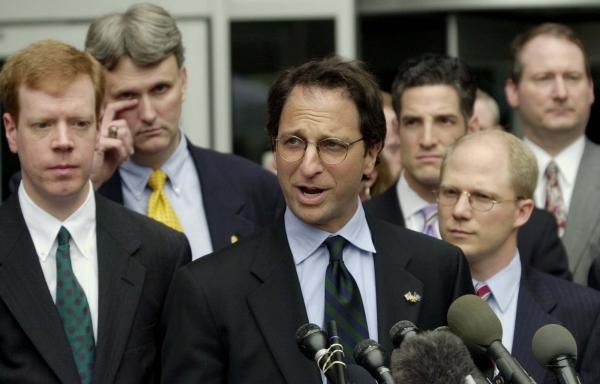
The always-alert Ellen Podgor notes that former Enron Task Force chief Andrew Weissmann (see also here and here) recently wrote an amicus brief on behalf of various business and defense-oriented organizations in the United States v. Ionia Management, S.A. case currently pending at the Second Circuit.

In the brief, Weissmann advocates that the appellate court “adopt a standard for vicarious corporate criminal liability” . . . that limits “the application of respondeat superior.”

As you may recall, Weissmann promoted precisely the opposite standard while engineering the destruction of enormous wealth and tens of thousands of jobs in prosecuting Arthur Andersen out of business.

It’s better late than never that Weissmann apparently now understands the error of his prior ways. I wonder whether he will admit that to the Second Circuit panel?