The shame!

lehman BrothersYou know things are really getting bad in the financial markets when FT.com’s always-lively Dear Lucy column (previous post here) receives the following letter from an investment banker:

"At a dinner party last Saturday I was asked by a fellow guest what I did and I said I was an investment banker. I might as well have said I was a paedophile. Suddenly the whole table – all friends of my wife from the art world – turned on me with such venom I was really taken aback. I tried to defend myself by saying that I had nothing to be ashamed of in the work that I do in M&A, but the more I argued the more hostile the other guests became."

"Next time this happens – and I fear there will be a next time – should I accept guilt for what isn’t my fault, or should I lie and say I’m a librarian?"

Investment banker, male, 42

Among the many entertaining reader comments to the letter were the following:

"Bit surprised you were invited to dinner in the first place."

"Confess and beg for another glass of wine."

"A sensitive investment banker……….. whatever next?"

Refracting Enron Myopia

One of the more entertaining aspects of the current Wall Street financial crisis has been reading how some of the business columnists have been interpreting it.

Take, for example, Houston Chronicle business columnist, Loren Steffy.

You may remember him from his acerbic coverage of the trial of former Enron executives, Jeff Skilling and the late Ken Lay, or his perpetuation of the Enron Myth regardless of the circumstances.

Dismissing me as an Enron apologist, Steffy regularly disputed my long-held theory that the run-on-the-bank that felled Enron could well happen to any trust-based business.

Apparently confused by the fact that what happened to Enron has now happened to Bear Stearns, Freddie and Fannie, Merrill Lynch, Lehman Brothers, AIG and any number of other trust-based businesses impacted by the current credit crunch, Steffy reaches for insight from one of the fellows who set the stage for this mess:

Investigators are poring over the failed firms, looking for signs that executives misled shareholders. Some evidence may be found, but Sam Buell, the former prosecutor who led the effort to indict Enron’s Jeff Skilling, doesn’t think we’ll see widespread prosecutions.

“It’s not a conspiracy if everybody’s in on it,” said Buell, who’s now a law professor at Washington University in St. Louis. “In order to have a fraud conspiracy, you’ve got to have some effort by one group to deceive another group.”

In this case, individual investors may not have understood what Wall Street bankers were doing with complex debt securities, but those charged with safeguarding the marketplace were certainly aware. Regulators knew and approved. So did credit rating agencies. And auditors, both internal and external.

With a mouse click, investors could find public documents that described the debt instruments with hundreds of pages of detail. [.   .   .]

“If everybody’s in a bubble mentality, if they’re betting the price of real estate will keep going up, disclosure doesn’t address the problem of what happens when all those assumptions turn out to be wrong,” Buell said. “Everybody knows what they’re doing. They’re just making bad decisions.”

Yes, you read that correctly. Buell implies that Skilling was guilty of criminal conspiracy because not “everybody” was “in on it” at the time Enron was making its supposedly opaque disclosures. However, since “everybody’s in on it” now, Buell doesn’t think there will be widespread prosecutions because “[i]t’s not a conspiracy if everybody’s in on it.”

With such reasoning, is there any doubt now why this outfit generated this record?

For the record, I actually hope Buell is right this time that few businesspeople are prosecuted for misjudging business risk. But for a more rational explanation of how financial regulation fits into the current crisis, check out these Larry Ribstein posts here, here and here and this masterful one by Arnold Kling.

Stone and the capitalist roaders

Don’t miss Larry Ribstein’s post on Oliver Stone’s financing philosophy in regard to his new movie about George W. Bush — W — the trailer of which is below:

230 years?

So, the Justice Department is seeking a sentence of 230 years for former General Re senior counsel Robert Graham, a 60-year old man who has never been involved in any wrongdoing in his life.

Mercifully, the pre-sentencing report recommends a sentence of “only” 12-17 years.

Graham was convicted earlier this year of securities fraud in connection with his involvement in a finite risk transaction between General Re and AIG that was one of the transactions that led to the downfall of former AIG CEO, Hank Greenberg.

Ironically, AIG is now fighting for its life — even after receiving loans from the Fed in amounts approaching $150 billion — as a result of thousands of transaction decisions that were far more questionable than the one Graham made.

230 years. For involvement in a transaction that was not even clearly improper, much less criminal in nature.

230 years. As a result of a prosecution that required application of the Buffett rule.

230 years. What does that portend for the AIG executives who engaged in this bit of bad judgment? Or those who were involved in this? Did they commit a crime because they breached an obligation to throw in the towel?

This is our government doing such things, folks. It is a reflection of us. And that reflection is not particularly attractive these days.

Say what?

As noted earlier here and here, the lack of leadership involved in the current credit crisis and related Treasury bailout really has been appalling. You don’t think so? Check this out:

Following up on my concierge health care experience

DrWilliamLentMDThis post from about a year ago explored the reasons why my friend and personal physician — internist Bill Lent, MD — decided to convert his internal medicine practice to a concierge practice in which he limited his practice to 600 patients who pay $1,500 per year to retain his services. Inasmuch as I am blessed with good health, the only time I see Bill in most years is for my annual physical, which was this past week. As always, it was good to catch up with him and hear his thoughts about the first year of a concierge practice.

In short, Bill’s experience has been overwhelmingly positive. The funds generated through his patients’ retainer payments have relieved Bill of the financial pressure that had been mounting over the past decade to increase patient visits as Medicare and private medical insurers systematically reduced the amount paid to doctors for such visits. Released from that pressure, Bill is now able to spend more time with each patient, which Bill believes provides the patient with better quality service. The response from Bill’s patients has been uniformly positive.

Although Bill’s workload has been reduced from the standpoint that he no longer feels compelled to see more and more patients to maintain revenue levels in the face of reduced insurance payments, Bill has had to spend quite a bit of time over the past year in the process of computerizing his patients records. Part of the deal for patients in signing up for the concierge service is that their records are digitized so that the patient, Bill or any other doctor who the patient retains can review the records from anywhere via the Web. That perk has required a considerable expenditure of effort over the past year in digitizing those records, but now that the process is largely complete, Bill will spend far less time in future years as he simply amends a patient’s computerized record with each visit.

There have been a number of pleasant surprises in Bill’s first year of the concierge practice. For example, Bill was initially concerned that a number of his less affluent patients would opt not to participate because of the retainer payment. Surprisingly, however, his patient base has remained quite diverse from a socioeconomic standpoint — even a large number of his elderly patients on Medicare elected to participate despite the fact that Medicare doesn’t cover any of the retainer payment.

One of those is a long-time patient who is a retired bus driver with a host of medical problems that Bill has helped control for years. Rather than taking the risk of moving on to another physician, the retired bus driver’s five children decided to split payment of the retainer between themselves so that their father could remain one of Bill’s patients.

But the most pleasant aspect of the concierge practice is that Bill is back to doing what he loves to do — taking the requisite amount of time to visit with patients about their symptoms and then diagnosing the nature of the problem. He no longer feels rushed to complete a patient visit so that he can move on to the next patient in an effort to fill his quota for the day.

Bill did have one foreboding experience in the transition to a concierge practice. Being the kind of fellow that he is, Bill offered at no cost to his former patients who opted out of the concierge practice to help them find another internist to replace him as their personal physician. Many of Bill’s former patients took him up on his offer and he accommodated each of them. However, in so doing, Bill discovered that a growing number of internists and family practitioners in the Houston area are no longer accepting patients on Medicare because of the economic constraints of taking on such patients. As the number of primary care physicians continues to decline across the country, where are patients on Medicare going to find a primary care physician if this trend continues?

So, one of Houston’s best internists was successful in saving his practice from the perverse impact of America’s Byzantine health care finance system. As I noted in the previous post, if such entrepreneurial spirit can succeed in reviving a doctor’s practice in the current highly-regulated health care finance system, then imagine what might happen if we unleashed the power of the marketplace to reform the health care finance system and the delivery of health care, as well?

Another cost of the bailout

The Doctor is Out As reconsideration of the proposed Treasury Bailout of Wall Street takes center stage in Washington, other pressing and arguably more important problems continue to be ignored.

Take the chronically dysfunctional American health care finance system. This Boston Globe article reports that Massachusetts’ supposedly innovative 2006 health insurance mandate has caused such a shortage of primary care physicians in the state that the wait to see such a doctor has grown to as long as 100 days. In addition, almost half a million citizens are having a difficult time finding a doctor at all:

"There were so many people waiting to get in, it was like opening the floodgates," [Dr. Kate] Atkinson said. "Most of these patients hadn’t seen the doctor in a long time so they had a lot of complicated problems." She closed her practice to new patients again six weeks later. "We literally have 10 calls a day from patients crying and begging," she said.

On the other hand, maybe its better that Congress is distracted from such problems. As a friend of Don Broudreaux observes:

"The one good thing that came out of this whole credit debacle, I now have the perfect pithy response to all the lefties who tell me that the government should take over health care and make it affordable to everyone.  You mean the way they made home ownership affordable to all through Fannie and Freddie?  How did that work out for you?"

Awkward Loan Interview

The proposed Treasury bailout leads to an awkward loan interview:

This is Leadership?

I’ve already said my piece on the proposed Treasury Bailout of Wall Street, so I won’t belabor that view.

In the meantime, there are much better places to keep up with the minute-by-minute political developments on the proposed bailout — for example, check out Clusterstock, DealBreaker and Felix Salmon for astute and up-to-the-minute analysis.

However, one point from my previous post deserves further review — that is, circumstances such as this provide us with a revealing view of our political leaders.

Do they inspire positive and collaborative action in difficult times for the better good of society?

Or do they attempt to generate support for their political position through fear-mongering and demagoguery?

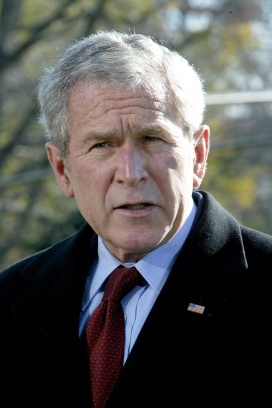
In my view, President Bush’s handling of the negotiations over the proposed bailout has been abysmal. As Jeff Matthews points out:

The President’s unfortunate choice of words—”this sucker could go down”—carry the same deer-in-headlights quality as his televised speech to the American people last week, in which he used the word “panic,” as we recall.

At a minimum, it makes you nervous; at a maximum, it makes you want to throw up first and sell everything second.What happened to the heroic, forward-looking rhetoric great leaders are supposed to provide in times of crisis?

FDR gave us “We have nothing to fear but fear itself.” Churchill gave us “We shall fight on the beaches.” George Bush cruises in with “This sucker could go down.”

We wonder: has a more irresponsible sentence been uttered, by anyone, during this entire crisis?

John Carney reports that President Bush wasn’t any better today in responding to the House’s rejection of the proposed bailout:

“We put forth a plan that was big because we got a big problem,” Bush just said, sitting in a chair placed before a fireplace in the White House. He’s meeting with advisers, he said. “I’m disappointed with the vote in Congress,” the president said.

Was that his version of FDR’s famous fireside chats? Bush looked annoyed he was being bothered with this stuff.

This from a President who failed to persuade more than a third of his own party members in the House for his position in response to a financial emergency?

The Treasury Bailout is Not Rocket Science

The debate over the proposed Treasury bailout of Wall Street firms is coming at a fortuitous time — the election season.

Be wary of any candidates who, after looking appropriately concerned about the dire predictions of the plan’s promoters, throw up their hands and vote in favor of the bailout because “we just have to do something” even if they don’t understand what they are doing.

The fear mongering that the promoters are using to sell the bailout is laughable. This is not rocket science.

For example, when Enron tanked in late 2001, it was the seventh largest public company in the U.S. Enron traded derivatives and other financial instruments with counterparties that were among Wall Street’s biggest commercial and investment banks, which were heavily exposed to its losses. To make matters worse, these investments were concentrated in the energy sector, which is at least as important to the nation’s economy as the housing sector that is at the center of the current crisis.

In short, at the time of its bankruptcy, Enron was one of the nation’s largest publicly-owned companies, a vitally-important market-maker in the natural gas trading industry and a leader in hedging corporate risk through structured finance transactions.

Despite the huge wealth destruction that would result from Enron’s insolvency, not one government or Wall Street leader proposed a bailout of Enron in order to preserve the huge value to the public of the natural gas trading industry and the market for structured finance transactions. And they were right not to do so.

Enron’s bankruptcy proceeded to cause enormous tremors through various industries — particularly the energy industry — because valuable resources for hedging risk of loss had evaporated seemingly overnight. The natural gas trading industry nearly fell apart completely, costing companies and their customers untold billions of dollars that they otherwise could have saved through hedging risk of loss. Similarly, the market for many structured finance transactions dried up, also costing companies another valuable avenue for hedging risk.

However, the nation’s financial system did not break down. Companies adjusted to the changed circumstances and endured their additional costs as best they could. Markets also adjusted. Slowly but surely, both the natural gas trading industry and the market for structured finance transactions rebounded so that both are again providing companies with valuable alternatives for hedging risk and saving money.

Now, the tables are turned on Wall Street. Rather than facing the consequences of their risk-taking decisions in chapter 11, Wall Street’s politically well-connected leaders are weaving their tales of doom for the overall economy to compliant governmental leaders who are only too willing to do their bidding.

In reality, each of these Wall Street firms should be required to endure the same thing that Enron and its creditors did — a chapter 11 reorganization where equity gets wiped out and creditors either take a haircut on payment of their debts or convert their debt to equity in a reorganized firm that emerges from bankruptcy with a cleaned-up balance sheet.

That process ensures that investors and creditors who undertook the risk of investing or dealing with the bankrupt firms share the losses of their risk-taking. Moreover, it allows the firms that really are worth saving (as opposed to simply liquidating) to emerge from bankruptcy with an improved financial condition that should provide the firm with an enhanced opportunity to create wealth again.

What the bailout plan proposes to do is insulate investors and creditors from risk of loss by having the government — funded by taxpayers such as you and me — undertake that risk. There is simply no moral justification for foisting that risk on taxpayers and the only possible practical justification is that sorting all of these firms’ problems out in chapter 11 might take awhile.

But even if the government saw fit to accelerate the Wall Street reorganizations to hedge the risk of a prolonged economic downturn, there is simply no reason for the government to overpay for assets from financially-troubled firms. Rather, the government should simply propose a plan that implements the going-concern liquidation and debt-for-equity reorganization features of chapter 11 on an accelerated basis in return for some reasonable financial contribution to the process. And you can bet that contribution doesn’t need to be close to $700 billion.

Luigi Zingales, the Robert C. Mc Cormack Professor of Entrepreneurship and Finance at the University of Chicago, has written the most cogent piece I’ve seen to date on why the bailout is a bad idea.

Even though it was wrong for the government to contribute to the massive amounts of wealth destruction that resulted from the demonization of Enron, the government was right not to bail out Enron. The circumstances are different now, so perhaps a different approach is more prudent than simply allowing all of these Wall Street companies to be sorted out in chapter 11.

But throwing $700 billion at investors and creditors who should be sharing the losses of their risk-taking is not even close to the best way of doing it.

Update: I couldn’t help but laugh out loud this morning as Warren Buffett and the promoters of the Treasury bailout plan point to Buffett’s sweet $5 billion investment in Goldman Sachs as an endorsement of the plan.

I prefer to look at what Buffett is doing rather than what he is saying.

What he is not doing is what Paulson and Bernanke want the U.S. Treasury to do — buy investment banks’ toxic assets.

Rather, Buffett is buying preferred shares in Goldman with a big yield and warrants to buy Goldman stock at $115 (its trading at over $130) so that he can recover the profit his investment helps foster while Goldman transitions from an investment bank to a bank holding company over the next couple of years.

Meanwhile, Paulson and Bernanke keep promoting their plan to throw $700 billion at whatever trashy assets that Wall Street serves up to them.

It does not engender much confidence that Buffett can cut a far better deal with Wall Street’s best-run investment bank than Paulson and Bernanke propose to cut with the worst-run ones.