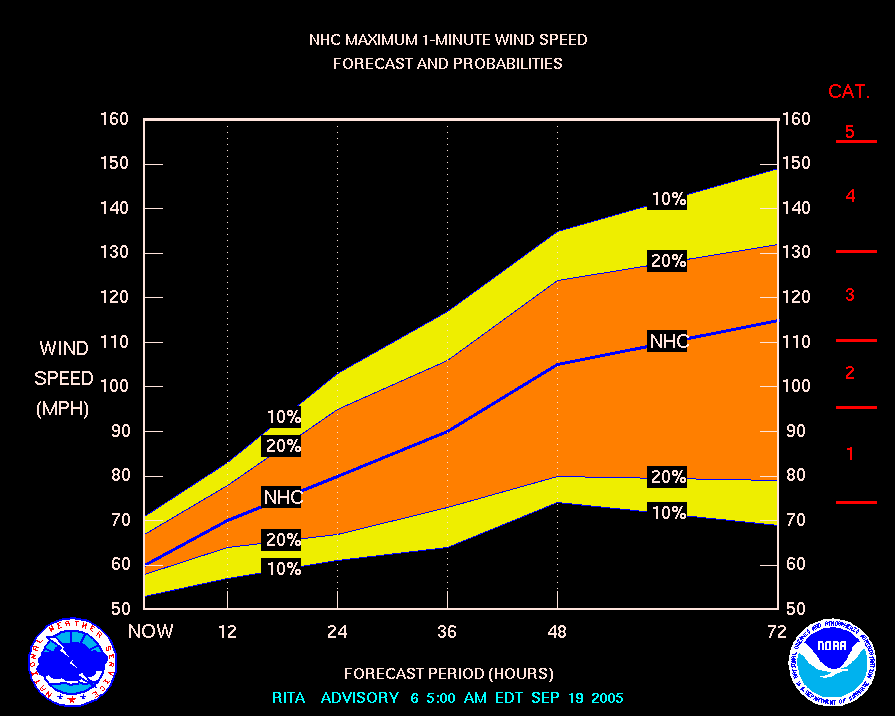
Houston awakens this morning to the news that the two most likely locations for landfall are Port Arthur and Galveston. The cone of uncertainty extends from southwestern Louisiana on the east to the entire Houston metro area on the west. The National Hurricane Center is currently predicting landfall to occur in Jefferson County near Port Arthur, while local experts are predicting landfall slightly west in Chambers County nearer Galveston Bay (county map here). As Rita continues to move slowly with its eye about 260 miles southeast of Galveston, a consensus has developed that the storm will move into northeast Texas after landfall and then stall on Sunday and Monday, potentially causing huge amounts of rainfall of the type that flooded the Houston area during Tropical Storm Allison in 2001. Landfall is expected at this point sometime in the early morning hours of Saturday, probably between 5 a.m. to 8 a.m., although heavy rainfall and strong winds throughout the Houston area will be experienced well before then.
Houston, get ready to rumble.
Category Archives: News – Hurricanes
“Houston to Coach Briles, are you with us?”
For the sake of the University of Houston football program, I am hoping that head football coach Art Briles had his tongue placed squarely in his cheek during his weekly radio show Wednesday described by Chronicle sportswriter Richard Justice:
“OK, there’s no requirement that your local college football coach has to read the New York Times Book Review.
But shouldn’t he know something.
UH’s Art Briles went on the radio Wednesday and just about made a fool out of himself.
When he was asked if this week’s game with Southern Miss would be cancelled, he said he hadn’t heard anything about it. He also said he hadn’t heard anything about a hurricane.
If I’m the president or athletics director at UH, I’m wondering if this guy might have a little too much tunnel vision.”
A cautionary observation
After the jolting early morning news that Hurricane Rita was heading directly toward Galveston Bay, the track models have been trending further eastward for most of the day. The current most likely projection is that the storm will make landfall east of Galveston Bay closer to Port Arthur and Beaumont and, if that happens, most of the Houston metro area would at least be spared a direct hit by the most damaging winds around the storm’s eyewall.
However, the key words here are “most likely,” which means that there is a very small percentage difference between the storm making landfall at one spot over another. Stated another way, the chance that the storm could come onshore directly on Galveston Bay is still very likely. The storm is reacting to the movement of three weather systems to its north, and it’s simply impossible at this point to determine with any reasonable degree of certainty where the storm will make landfall between Freeport, Tx to Lafayette, La. My sense is that it will not be until early Friday morning before the experts will really have a good handle on how the storm is finally going to react to the weather systems to its north and thus, where landfall will occur. Moreover, even that very good prediction can be as much as 30-50 miles off if the storm wobbles even slightly while coming onshore. Remember, Katrina wobbled east at almost the last minute and spared New Orleans a direct hit.
Thus, the bottom line is to remain vigilant in following this storm. It looks like the storm will be at least a strong category 3 when the it somes onshore, and a storm of that magnitude — even if it comes onshore well east of Galveston Bay — will cause very dangerous wind and rainfall in the entire Houston metro area.
Economic waves of Rita
With the eastern shift of the projected path of Hurricane Rita directly into the part of the Houston metro area that contains a huge number of some of the nation’s largest oil refineries and petrochemical facilities, Rita’s economic ripples have now turned into waves with the distinct possibility that they could turn into an economic tsunami.
It now appears almost certain that Rita will substantially disrupt operations at a significant number of the oil refineries that transform crude oil into gasoline, diesel and other products. The only question is how long those facilities will be down and how much gasoline prices will increase as a result of the shutdown. At least eight refineries in the Houston area will shut down soon as they began scaling back operations yesterday. Inasmuch as four refineries in Louisiana and Mississippi have been closed as a result of damage from Hurricane Katrina last month, almost 20% of U.S. refining capacity will shutdown with the closing of the Houston area facilities, which will only reduce already tight inventories of gasoline that have pushed prices to record levels. To make matters worse, the new projected path of the hurricane would also cause probable extensive damage to offshore oil and natural gas platforms and pipelines that were west of the ones that were damaged in Katrina’s path. I think it’s safe to say now that the U.S. energy industry has never had to deal with anything on the magnitude of the 2005 hurricane season.
Houston wakes to foreboding news
As you peruse the current projected path of Rita almost directly over Galveston Bay, contemplate Jeff Masters’ latest analysis of the situation:
The latest runs of two key computer models, the GFS and GFDL, now indicate that the trough of low pressure that was expected to pick up Rita and pull her rapidly northward through Texas will not be strong enough to do so. Instead, these models forecast that Rita will make landfall near Galveston, penetrate inland between 50 and 200 miles, then slowly drift southwestward for nearly two days, as a high pressure ridge will build in to her north. Finally, a second trough is forecast to lift Rita out of Texas on Tuesday. If this scenario develops, not only will the coast receive catastrophic damage from the storm surge, but interior Texas, including the Dallas/Fort Worth area, might see a deluge of 15 – 30 inches of rain. A huge portion of Texas would be a disaster area.
This scenario is similar to that of Tropical Storm Allison in 2001 that caused catastrophic flooding throughout the Houston metropolitan area. Moreover, with Allison, Houston did not have to deal with the catastrophic wind damage that is almost certain to result from Rita. Although the new projected path of Rita is not good news for Houston, the prediction that the storm might slow down at landfall and stall over Texas and Louisiana is even worse.
Buzzard’s luck
In the midst of pre-hurricane gasoline and bottled water shortages — and in anticipation of probable power outages resulting from Hurricane Rita — this report is not giving me warm and fuzzy feelings:
Facing huge costs for rebuilding its Hurricane Katrina-devastated systems along the Gulf Coast, utility giant Entergy said Tuesday that it will consider filing for bankruptcy protection for its New Orleans unit.
Entergy, whose Entergy New Orleans unit has lost up to an estimated 130,000 customers because of the hurricane, estimates the unit’s storm-related costs at $325 million to $475 million.
The company put its total estimated costs for repairing and replacing electric and gas facilities damaged by the Aug. 29 storm at $750 million to $1.1 billion.
Entergy is the utility company for a good part of the northern part of the Houston metro area, including The Woodlands.
Economic ripples of Rita
Crude-oil prices surged on Monday as it became clear that Tropical Storm Rita would threaten the Gulf Coast, then prices fell on Tuesday morning when the National Hurricane Center forecast a more southerly path for Rita that might spare the Houston area, and then yesterday afternoon and overnight, prices rose again as the storm evolved into a major hurricane.
Such are the vagaries of predicting hurricane tracks and commodity markets.
Oil prices settled Tuesday afternoon more than $1 a barrel lower than Monday’s closing price as early Tuesday projections had Rita coming in closer to Freeport so that the brunt of the storm would miss the Houston area refineries. Those initial reports triggered a drop of more than $2 a barrel in oil prices, but those prices recovered quickly during the day as Rita strengthened into a major hurricane and evacuations from offshore rigs picked up. At the New York Mercantile Exchange, the October crude contract ended $1.16 lower from its Monday high at $66.23. October gasoline closed at $1.9766 a gallon, down 6.61 cents for the day and October heating oil, up more than 20 cents Monday, ended at $2.0113, down 2.71 cents.
Handy hurricane information links
Given that those of us living in the Houston and south Texas area are in for a wild ride over the next few days, I am passing along the hurricane information sites that I am reviewing frequently for up-to-the-minute information and analysis:
Eric Berger’s SciGuy. Eric is the Chronicle’s science writer who started his blog recently as a part of the weblog initiative that Chronicle tech writer Dwight Silverman promoted at the local newspaper. During Hurricane Katrina, Eric provided an extraordinary source of information and analysis, and he has been doing the same in the early stages of Rita.
StormTrack. A weblog that a couple of young fellows from the northeast started to provide up-to-date analysis of hurricane storm trends. Excellent resource.
Dr. Jeff Masters’ WunderBlog. Jeff Masters is the Weather Underground’s Director of Meteorology and provides first-rate analysis in his blog.
The Google Map link to the upper Texas Gulf Coast.
This site provides a good overview of hurricane information, including this pithy chart explaining the categories of hurricane strength.
And, of course, the National Hurricane Center site.
As all grizzled veterans of Hurricane Alicia in 1983 know (related Chronicle story is here), this is a serious situation for the Texas Gulf coast and it is time to prepare to batten down the hatches. If you are a relative newcomer to this area and have never been through an intense hurricane before, do not fall into the trap of thinking that the media and others are crying “wolf.” This is a deadly serious storm that has the potential to be every bit as devastating to the Texas Gulf coast as Katrina was to the Louisiana-Mississippi-Alabama Gulf coast. As destructive as Alicia was in 1983 (it’s eye came in on Galveston’s West Beach and tore through the middle of Houston on a track that essentially followed I-45), it was a minimal category 3 storm. In comparison, Rita is shaping up to be a much more powerful storm that is comparable to Hurricane Carla, which was a category 4 (winds of 133-155 mph) storm that caused incredible damage to Houston and the upper Texas Gulf coast on September 11, 1961. Carla had the same minimum barometric pressure as the great 1900 storm that killed over 6,000 people in Galveston.
I hope I have gotten your attention.

We don’t really need this

Tropical Storm Rita is preparing to enter the Gulf of Mexico, and current predictions have it headed toward the Texas Gulf Coast by the end of the week. This is not good news, particularly for the oil and gas industry’s Gulf operations, which have stablized at reduced production levels in the wake of Hurricane Katrina, but are producing at far below usual levels. Here is a download of a handy map of oil and gas interests in the Gulf of Mexico.
With gasoline inventories still low and a substantial portion of Gulf of Mexico oil and gas production remaining shut-in, another hurricane in the Gulf is not what the doctor ordered for the economy. This EIA Daily Report from this past Friday reflects just how precarious oil and gas production is in the Gulf at the present time. If Rita strengthens as expected over the warm waters of the Gulf, then we could experience a real double whammy of damage to Gulf oil and gas production, not to speak to the usual damage to the Texas Gulf Coast that results from such a storm. Hat tip to Calculated Risk for the links to the map and the EIA report.
Update: The latest National Hurricane Center projection has the storm headed straight for the West Beach of Galveston Island. Batten down the hatches!
Close Encounter of the Human Kind
Abraham Verghese, M.D., is the Joaquin Cigarroa Jr. Chair and Marvin Forland Distinguished Professor at the University of Texas Health Sciences Center in San Antonio. After volunteering at the Houston shelters during the relief effort for the Hurricane Katrina evacuees, Dr. Verghese’s story of meeting the first hurricane evacuees that were sent to San Antonio resonated with me because it is similar to many conversations that I have had over the past couple of weeks with various evacuees:
Hesitantly, I asked each patient, “Where did you spend the last five days?” I wanted to reconcile the person in front of me with the terrible locales on television. But as the night wore on, I understood that they needed me to ask; to not ask was to not honor their ordeal. Hard men wiped at their eyes and became animated in the telling. The first woman, the one who seemed mute from stress, began a recitation in a courtroom voice, as if preparing for future testimony.
Read the entire unvarnished account. Also, check out this Bob Herbert NY Times piece that relates how the corporate owners of the hard-hit Methodist Hospital in east New Orleans responded to the flood after the hurricane by sending emergency relief supplies to the hospital. Unfortunately, the owners sent the supplies to the airport where FEMA officials confiscated them and sent the supplies elsewhere. Along those same lines, here is the story of a volunteer doctor during the relief effort who a FEMA official ordered to stop treating a patient because he was not registered with FEMA.
Finally, here is a helpful FactCheck.org compilation of stories relating to who knew what when in regard to Hurricane Katrina.