The Murray education series

rice_5.jpgThe American Enterprise Institute’s W. H. Brady Scholar, Charles Murray, completes today a provocative three-part series in the WSJ’s OpinionJournal on education in America (earlier installments are here and here.
As with Murray’s many books and this earlier piece on reforming welfare, Murray presents his thoughts on education in a compelling and provocative manner, urging us to modify our thoughts and societal prejudices regarding education and intelligence. Murray’s emphasis on IQ as a standard for tailoring education puts some people off, which is unfortunate. As he concludes below, Murray’s purpose is to provoke discussion on changing attitudes and prejudices that undermine productive and sensitive reforms in our educational system:

The aim here is not to complete an argument but to begin a discussion; not to present policy prescriptions, but to plead for greater realism in our outlook on education. Accept that some children will be left behind other children because of intellectual limitations, and think about what kind of education will give them the greatest chance for a fulfilling life nonetheless. Stop telling children that they need to go to college to be successful, and take advantage of the other, often better ways in which people can develop their talents. Acknowledge the existence and importance of high intellectual ability, and think about how best to nurture the children who possess it.

Don’t miss this series. The three installments are as follows:

Intelligence in the Classroom: Half of all children are below average, and teachers can do only so much for them.
What’s Wrong With Vocational School? Too many Americans are going to college.
Aztecs vs. Greeks: Those with superior intelligence need to learn to be wise.

The Admiral of San Antonio

David%20Robinson_vi.jpgOne of my sisters, Mary, is a pediatrician who lives in Boerne and works in San Antonio.
Although sister Mary couldn’t care less about professional sports in general and professional basketball in particular, she knows who former San Antonio Spurs center David Robinson is and admires him a great deal. This NY Times article explains why.
Robinson made a lot of money in San Antone while playing for the Spurs, embraced the community during his playing days and decided to stick around and give back to the community after his playing career was over. Bully for him.

Those pesky dealbreakers

kill-all-lawyers.gifIn this TCS Daily op-ed, Professor Bainbridge weighs in on a problem that businesspeople invariably complain about in connection with the handling of contractual matters relating to their business — those damn dealbreakin’ transactional lawyers:

In his book, The Terrible Truth About Lawyers, Mark H. McCormack, founder of the International Management Group, a major sports and entertainment agency, wrote that “it’s the lawyers who: (1) gum up the works; (2) get people mad at each other; (3) make business procedures more expensive than they need to be; and now and then deep-six what had seemed like a perfectly workable arrangement. Accordingly, I would say that the best way to deal with lawyers is not to deal with them at all.”
Pretty depressing stuff, especially if you hope to make a living as a transactional lawyer.

Bainbridge sums up by providing wise advice not only to transactional lawyers, but to any lawyer attempting to make a living resolving business issues:

All of which is why both legal education and the apprenticeship served by young associates must emphasize not only legal doctrine but also economics and business. It may still be possible for someone lacking any knowledge of finance and economics to be a successful mergers and acquisitions lawyer, but I doubt it. As Mark McCormack observed, “when lawyers try to horn in on the business aspects of a deal, the practical result is usually confusion and wasted time.” Transactional lawyers therefore must understand the business, financial, and economic aspects of deals so as to draft workable contracts and disclosure documents, conduct due diligence, or counsel clients on issues that require business savvy as well as knowing the law.

The most valuable college football programs

ohio_stadium2.jpgThis post from awhile back addressed the widespread insolvency in big-time college football. However, as this Forbes article on the 15 most valuable college football programs points out, a few big-time programs do quite well, thank you. Notre Dame’s program tops the list at a value of $97 million, while the University of Texas’ program slides in at second at $88 million and Texas A&M’s program checks in at no. 15 with a value of $53 million. By the way, Notre Dame remains the most valuable program despite being consistently the most overrated program on the big-time college scene these days. With last night’s loss to LSU in the Sugar Bowl, the Irish have now lost nine straight bowl games since beating Texas A&M 24-21 in the 1994 Cotton Bowl.
A couple of surprises: Ohio State is only sixth on the list at $71 million, while the USC on the list is not the University of Southern California. Rather, it’s the University of South Carolina at no. 14 with a value of $57 million. As you might expect, only teams from the Southeastern Conference, Big Ten Conference and Big 12 Conference made the Forbes list because those conferences have the most lucrative television deals with CBS, ESPN and ABC.
Finally, despite the value of these big-time programs, it is still decidedly minor league — most NFL franchises are worth at least 10 times more than the most valuable college program.

A remarkable Aggie resource

Aggie complaint.gifDespite Desmond Howard’s gaffe earlier this week, Texas A&M University is a fascinating and indelible part of Texas culture. Recognizing that stature, Texas A&M’s Cushing Library has undertaken a remarkable project entitled “The Historic Images Collection–Historic Images and Photographs of the Texas A&M Community.”
The collection is a treasure trove of interesting photographs, such as this one of a pre-1900s baseball squad. Another early baseball team is here, while this 1923 picture includes in the back row, second from left, King Gill, the original A&M ì12th Man,î and in the middle of the back row, Pat Olsen (the tallest one), a former major leaguer for whom the A&M baseball stadium is named. Finally, this picture of Aggie great Jacob Green from the 1970’s shows the Emory Bellard-era striped shoulder football uniforms.
This is only a fraction of the photos in this remarkable collection, so take a few minutes to peruse the archive. Aggies take quite a bit of ribbing in Texas for their dogged adherence to tradition, but that respect for tradition is a big part of what produced this wonderful collection.

Tributes to a marvelous teacher

lence (1).jpgToday is the birthday of the late Ross M. Lence, one of Houston’s finest teachers of the past generation. On Dec. 1st — the final day of classes for the fall semester at the University of Houston — I was privileged to be one of the speakers at the University’s memorial service for Ross at the A.D. Bruce Religion Center on the University’s central campus.
As with most anything that involved the reasonable Dr. Lence, the service was a joyous affair, alternately hilarious and moving. Bill Monroe, one of Ross’ colleagues at The Honors College, had one of the best cracks of the day when he passed along another colleague’s observation about the notoriously difficult-to-pin-down Dr. Lence:

“A colleague and mutual friend said that, for over a decade, he thought Lence was a liberal Jew from Chicago, only to discover that he was a libertarian Catholic from White Fish, Montana.”

After a festive reception at the UH Honors College, many of those who attended the memorial service walked across campus to Robertson Stadium to attend the Conference USA Championship game between the Houston Cougars and the Southern Mississippi, which the Coogs won in stirring style. All in all, a wonderful afternoon paying tribute to a dear friend and then an enjoyable evening of college football on a beautiful fall day in Houston.
The following are pdf’s of the tributes to Ross delivered at the memorial service. Take a moment to read a bit about a great teacher and fine man who influenced the lives of thousands of Houstonians over the past 35 years:

The program for the memorial service is here;
Bill Monroe’s opening and closing remarks are here;
Susan Collins, one of Ross’ colleagues in the UH Political Science Department, gave this tribute and also passed along this tribute to Ross for PS Magazine that Susan wrote with former UH Political Science Professor Donald Lutz, who was instrumental in bringing Ross to the University of Houston;
Ed Willems, a UH Professor Emeritus of Psychology and a longtime teaching partner with Ross, gave this heartfelt tribute entitled “Ross Lence: He taught students and me.”
Andy Little, one of Ross’ longtime students and a student advisor in The Honors College, read Ross’ moving essay On Teaching;”
My tribute to Ross is here, Harris County Treasurer-elect Orlando Sanchez’s tribute is here, and the tribute of Jeff Dodd, a partner at Andrews & Kurth who specializes in corporate securities law, is here; and
Finally, Honors College Dean Ted Estess was scheduled to reprise his moving eulogy that he originally delivered in July at Ross’ funeral mass, but he chose instead to pass along extemporaneously several anecdotes and observations about Ross, a couple of which brought the house down with laughter.

Inasmuch as Ross often used to help needy and deserving students financially, The Honors College has established a scholarship fund in Ross’ name. Donations to that fund may be sent to the Ross Lence Scholarship Fund, The Honors College, University of Houston, 212 M.D. Anderson Library, Houston, TX 77204-2001.

The University of Houston Master Plan

The University of Houston has been making some big plans recently, and this Matt Tresaugue/Chronicle article reviews them:

UH leaders intend to transform the campus with more housing, more restaurants, more shops and other places to be outside the classroom.

The goal, campus leaders said, is to create an environment that attracts the best scholars and encourages them to stick around. [. . .]

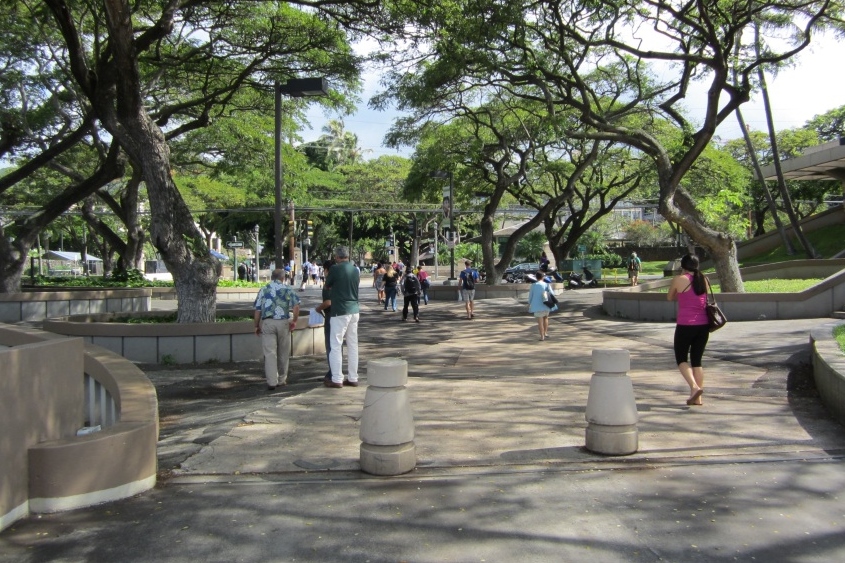
The plan also calls for doubling the usable square footage of classroom and office space, replacing parking lots with garages and closing part of Cullen to create a tree-lined pedestrian walkway by 2020.

What’s more, the campus would meld with the surrounding Third Ward while reducing blight and encouraging more retailers to move in. University officials already are talking with private developers about a “town center” with shops and restaurants on both sides of Scott between Holman and Alabama.

Campus leaders do not know how much everything would cost but estimate the first five-year phase at $300 million, and largely at the university’s expense. The redevelopment plan will be a key piece of an upcoming fundraising campaign, officials said.[ . . .]

The new plan would establish five themed precincts on campus, reflecting the “smart growth” trend elsewhere, with dense housing, retail and office space in village configurations.

The interior of the campus would be almost untouched.

To the north, campus leaders envision an arts village with a sculpture garden, outdoor amphitheater, cafes, galleries and housing, including loft apartments, on what are now parking lots.

About 1.6 million square feet of academic buildings and housing for graduate students would be added to the so-called professional precinct, to the east of the campus core.

Another area, the Wheeler precinct, would be devoted to undergraduates, with plans calling for low-rise residence halls to blend with the nearby University Oaks neighborhood.

To the west would be a Robertson Stadium precinct with 1.9 million square feet in new academic buildings, housing and retail near two proposed Metro light rail lines.

The University’s summary of its master plan — with renditions and video — is here.

Despite the story on the ambitious UH master plan, the Chronicle still ignores the more important story about UH.

The University of Houston in many ways is the most remarkable major public university in Texas. Started in 1927 as a junior college, UH grew quickly during its infancy while being endowed entirely with philanthropic contributions from generous Houstonians, which was made all the more remarkable by the fact that, at the same time, Houstonians were also contributing substantial amounts to the Rice University endowment.

Inasmuch as bustling UH did not even become a state university until 1963, UH has received only a fraction of the endowed capital that the state has provided to its two older public university systems, the University of Texas and Texas A&M University.

As a result, UH routinely provides a comparable contribution to Houston and the state as UT and A&M while operating with far less capital than those two institutions, which means that UH provides “more bang for the educational buck” than either UT or A&M.

With the recent expansion of the MD Anderson Library into the centerpiece of the central campus, along with the development of innovative programs such as the Honors College, UH has already become an increasingly attractive choice for Texas students.

Implementation of the master plan is the next logical step in that evolution.

It’s good that the local newspaper is noticing that, but it makes one wonder how much more benefit UH could contribute to Houston and the state if its endowed capital were on par with that of UT or A&M?

That’s a story that needs to be examined, and here’s hoping that the Chronicle eventually tackles it.

Bainbridge Cubed!

s_bainbridge_5_x_7.jpgA month or so ago, Clear Thinkers favorite Stephen Bainbridge took some time off from blogging while revamping his blog site.
Now, he’s back. And he’s tripled!:

Professor Bainbridge’s Business Associations Blog
Professor Bainbridge’s Journal (Politics, Religion, Culture, Photography, and Dogs)
Professor Bainbridge on Wine

The UH Memorial Service for Ross M. Lence

In a fitting tribute on the final day of classes for the fall semester, the University of Houston will host a memorial service for its late and beloved Professor, Ross M. Lence, at 1:30 p.m., this Friday, December 1 in the AD Bruce Religion Center on the UH campus. Dr. Lence died this past July after a year-long battle with pancreatic cancer.

UH Honors College Dean Ted Estess and several of Ross’ colleagues, former students and friends (including me) will give short remembrances of Ross during the service, which will also include music performed by Honors College students. A reception will follow the service at the Commons of the the Honors College, which is a short walk from the Religion Center. Later that day at 7 p.m., the University of Houston football team will play Southern Mississippi in the Conference USA Championship game at Robertson Stadium on the UH campus, a game that Dr. Lence would not have missed.

Ross Lence was one of the most gifted teachers of our time and a selfless mentor to hundreds of students and colleagues. If you were touched by Ross or simply want to pay tribute to a treasure of our community, then come by the service and reception on Friday afternoon. You will be inspired.

The Blind Side of Big-Time College Football

Last week, the resignation of my friend, Iowa State head football coach Dan McCarney, prompted this post reflecting on how the pressures of big-time college football prompted a resignation that is quite likely contrary to the long term ability of Iowa State to remain competitive in big-time college football.

As if on cue, George Will, in this NY Times book review, provides his view on the new book by Michael Lewis of Moneyball fame, The Blind Side: Evolution of a Game.

In Moneyball, Lewis explored how the small-market Oakland Athletics were able to remain competitive against far richer clubs in Major League Baseball by emphasizing objective evaluation of players and, in so doing, introduced sabremetric statistical analysis to the general public.

As Will notes, Lewis “is advancing a new genre of journalism that shows how market forces and economic reasoning shape the evolution of sports.” Lewis’ latest book involves big-time college football, which — as noted earlier here — has long been a means by which universities in the U.S. have compromised academic integrity to rent athletically-gifted young men to serve as cash cows for the institutions.

As noted in this earlier post, the National Football League reaps the fruits (as if those teams really needed it) of an effectively free farm system that college football provides, while the vast majority of the universities — including Iowa State — either lose money or barely eke out a profit in their football programs.

Moreover, Lewis examines how the winds of change ripple down from the NFL to big-time college football and dictate the course of the college game. One case in point is Lawrence Taylor, who singlehandedly changed the nature of professional football by becoming the prototype of the huge, athletic and extraordinarily fast outside linebacker who could increase the pressure on the quarterback.

At about the same time as Taylor was wreaking havoc on QB’s, Bill Walsh‘s West Coast offense was spreading the field, which made it even more important for teams to find agile offensive linemen to block the likes of Taylor. Most important was to protect the QB’s blind side, so the position of left offensive tackle increased in importance and, as a result, the position’s economic value skyrocketed.

As demand increased in the NFL for the colleges to produce another kind of freak of nature to play what had been an obscure position but now was now one of the most important positions on the field, Lewis explains that the colleges were more than willing to compromise any notion of academic integrity to admit athletes who project to have the physical stature and talent to play the demanding left tackle position.

In short, it’s not just the star QB or running back who gets the royal treatment from the institutions in this day and age — potential left tackles are now included, too. Lewis’ book describes one of those freaks of nature, a freshman tackle at the University of Mississippi with an I.Q. of 80 who bounced from foster home to foster home as a youth.

Just as we should not be surprised that many folks enjoy betting illegally on college football, neither should we be shocked with the corruption in college football that Lewis examines in his book.

One of my uncles who played SEC football during the late 1920’s used to tell me how much money he was paid under the table even in those days. Moreover, there is no question that big-time college football — even as corrupt as it is — is a pretty darn entertaining form of corruption.

As noted in my earlier post, there is a model that would likely minimize the corrupt elements while not affecting the entertainment value of college football much. But it’s going to take leadership and courage from the top of the educational institutions to promote and implement such reform.

Unfortunately, those considerations were not on the minds of the Iowa State administrators last week as they began figuring out how to replace a very good football coach who had just left one of the most difficult jobs in his profession.

Similarly, my sense is University of Miami president Donna Shalala will not be contemplating those matters when she begins her search to replace Larry Coker later this month as head coach of one of the most storied programs in all of big-time college football.

That seems to be the tunnel vision that is generated from the sponsorship of minor league professional football by U.S. academic institutions.