
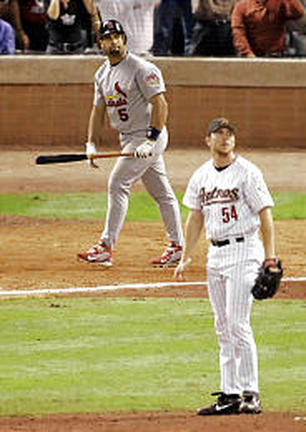
Rubbing salt in the wound

St-Louis-Albert-Pujols-and-Houston-pitcher-Brad.jpgAfter enduring a day of painful memories of Stros previous heartbreaking playoff losses in the final game of the 1980 NLCS, the Game Six of the 1986 NLCS, and Game Seven of last season’s NLCS, my old friend and former Houstonian Dr. Jim Bob Baker of Temple, Texas passes along the following on the heels of Houston’s latest sporting disaster:

I was just over at the physicians’ lounge at the hospital before coming back to the office to finish some things up. ESPN SportsCenter was on the TV there. As an aftermath of the Astros’ loss last night, ESPN graciously also showed highlights from:

The University of Houston’s loss to Joe Montana and Notre Dame in the 1979 Cotton Bowl;
The University of Houston’s Phi Slamma Jamma losing to Jim Valvano and North Carolina State on a tip-in at the buzzer in the 1983 NCAA National Championship Game;
The Houston Rockets‘ 1997 Game Six Western Conference Final playoff loss to Utah on John Stockton’s last-second 3 pointer;
The Houston Oilers’ 1991 NFL playoff loss to Denver on John Elway’s last minute 98 yard drive;

and last but not least:

The Oilers’ 41-38 overtime loss to Buffalo in the 1993 NFL playoffs after leading at halftime 35-3.

Thanks for the memories, ESPN.

Bill Simmons also has this humorous piece on special Houston sports fiascos. And Brian Goff notes that, if you are going to pitch to Pujols in that situation at all, breaking pitches are not the way to go. Finally, it took 24 hours for lifelong Houstonian Mike Falick to gather himself sufficiently to write this post on the latest Houston sports fiasco that he has endured.

It’s not easy being a Stros fan

pujols and Lidge.jpgI get up early for eight Tuesdays in the fall and spring to help cook breakfast for a 300 member men’s group at my family’s church, and the kitchen crew I work with is a pretty tough crowd. So, after the Cardinals’ Albert Pujols stuck the pin in the Stros’ World Series balloon last night, the subject of the comments from the crew members this morning were focused on the Stros, particularly Stros Manager Phil Garner’s dubious decision to pitch to Pujols — rather than walk him — with a two run lead and two out in the top of the ninth inning of the potential National League Championship Series clinching game:

“Of course, you have to pitch to Pujols in that situation,” noted one crew member with more than a touch of sarcasm. “Sanders and Mabry (the much lesser batters who followed Pujols) could have knocked in even more runs.”
“What, not pitch to the best hitter in the National League with two on, two out, a two run lead in the top of the ninth and a World Series on the line?” commented another crew member with an equal amount of sarcasm. “Hell, he was 0 for 4.”
“First pitch (a swinging stike in the dirt) good. Second pitch (over the railroad track over the left field pavilion) bad.”
“One good thing out of this is that Manager Garner has decided to seek some professional assistance. Word has it that he has set up an appointment today with (0-5 Houston Texans’ head coach) Dom Capers.”
“You know, I don’t think the Texans (0-5) are going to make the playoffs this season.”

Add your own comment. It’s good therapy. ;^)

Does Phil Garner read Clear Thinkers?

Garner2.jpgThis NY Times article from over the weekend contains the following blurb from Stros manager, Phil Garner:

Phil Garner praised the Astros’ owner, Drayton McLane, for his willingness to re-sign Carlos Beltran after his scintillating 2004 postseason, but he said he thought the team was better off this season without him. The rookie Willy Taveras has emerged as a fine defensive center fielder and has performed better at the plate than expected.

“I didn’t necessarily think it was a big loss,” Garner said before Saturday’s game. “One of my things that I feel is, if you put so much of your capital in any one player, it’s going to hurt you, in my opinion. So I think it might have been a little bit of a blessing.”

Did Phil read that here first?
By the way, that Taveras has performed well defensively and has hit better than expected is true, although that latter point is a bit frightening, given how bad Taveras’ hitting has been.

Whew!

BerkmanandLidge.jpgOnce again, the Stros are within a game of the first World Series in franchise history.
I take back everything I said about Wily Taveras, who in a reserve role scored the winning run and made a clutch catch on Tal’s Hill to close out the top of the eighth.
Adam Everett is simply the smoothest shortstop ever to wear a Stros uniform, and Eric Bruntlett can flat out trigger a double-play.
And Brandon Backe — while a below-average National League starting pitcher — has a far above-average heart.
By the way, the Stros have now won three out of four games in the NLCS by scoring a total of 13 runs. After scoring five runs in the first five innings of the NLCS, the Cardinals have scored a total of five runs over the past 30 innings.

Interesting conversation about the Stros today

Chris Burke2.jpgWhile riding to the Stros-Cardinals Game 3 of the National League Championship Series today, one of my sons asked whether I thought that Stros manager Phil Garner would play red-hot Chris Burke, who has continued to hit well after his walk-off yak last week to win the National League Division Series over the Braves.

“No,” I said. “He’ll probably play Lamb at first base today because he hits (St. Louis pitcher Matt) Morris well. That means Berkman moves to left field and Burke sits. What Garner should do is put Burke in centerfield and bench Taveras, who is a marginal player. But he will never do that because everyone thinks Taveras is good, which he is not.”

So, what does Phil Garner do? He starts Burke in centerfield in place of Taveras.
Stros win a 4-3 nailbiter to take a 2-1 lead in the National League Championship Series against the Cards.

Interesting Stros’ stat of the day

Brad Lidge.jpgWith his two shutout innings in relief of Roy O during Game 2 of the National League Championship Series last night, Stros closer Brad Lidge — counting the past two NLCS — has not allowed a run to the Cardinals in almost 30 innings over the past two years.
Here’s hoping that the Cardinal players are thinking about that this weekend while trying to hit that nasty slider.

Exploring home run hitting

bbonds3.jpgAs Roy O brings the Stros home from St. Louis in a 1-1 tie in the National League Championship Series, Art De Vany, Professor Emeritus of Economics at the University of California, Irvine, provides this thought-provoking paper (pdf) in which he debunks the popular theory (of which I have never been comfortable) that MLB sluggers’ taking of muscle-enhancing steroids were the primary reason that several old home-run records were broken over the past decade. As Professor De Vany notes here and here:

The latest version of my paper, “Has Home Run Hitting Changed in Major League Baseball” is now up.
I take up the matter of steroids more directly and also such possible influences as “hotter” baseballs, altered ball parks, smaller strike zone and find them all to be lacking. They do not stand up to verifiable tests or statistics. And they shouldn’t because no explanation is required. There has been no increase in MLB home run hitting. Three home run hitting geniuses appeared in a brief time span and will soon be gone. Enjoy them and don’t look for explanations when none are required. The law of home runs and extreme human accomplishment that I develop tell us that we never know when this kind of genius will appear, only that it will be rare and intermittent.

Stros 2005 Review: 2005 NLCS Preview

Stros in St. Louis2.jpgSo, after vanquishing the Braves for the second straight season in the National League Divisional Series, the Stros (89-73) face a 2005 rematch of the thrilling 2004 National League Championship Series against their arch-rival — the St. Louis Cardinals (100-62).
As was the case before the 2004 series, the Cardinals have had the better season (combined RCAA/RSAA of 168 to the Stros’ 75), but the two clubs are surprisingly evenly-matched coming into the NLCS. The Cardinals hit better than the Stros and actually have a slightly stronger pitching staff overall, but the Stros front three starting pitchers are the best in baseball and their key closers are pitching better than the Cards’ main closers at this point. In fact, since bottoming out in late May, the Stros had precisely the same record as the Cards over the final 120 games of the seasons — 74-46 for .617 winning percentage. Thus, the 2005 NLCS — as with last season’s seven game gut wrencher — has all the makings of another close, hard-fought series.

Continue reading

A baseball weekend in Houston for the ages

Chris Burke.jpgUntil this weekend, I really never thought that anything would top this game. But I was wrong.
What can one say about a game in which the following occurred?:

The Stros came back from a 6-1 deficit with only four outs left in the game.
Superstar Lance Berkman lighting a fuse to the Minute Maid Park crowd that exploded when he hit a grand salami — the second one in the game, following the Braves’ Adam LaRoche‘s 3rd inning bomb — to bring the Stros improbably within a run of the lead in the bottom of the 8th inning:
With the Stros within an out of returning to Atlanta for a Game 5 of the series, light-hitting Brad Ausmus — probably the weakest hitting regular National League player over the past five years — ripped a line drive yak to deep left-center (only his fourth home run of the season) that landed about an inch above the yellow home-run line and just a couple of inches beyond the Braves centerfielder Andruw Jones‘ outstretched glove;
Rookie Luke Scott — who was the Stros’ hottest hitter coming out of spring training but who eventually was farmed back to AAA Round Rock for another season of minor league training — coaxing a key walk during the 8th inning rally and then coming within inches of winning the game in the 10th with his own walk-off yak;
The Stros using all of their position players so that burly backup catcher Raul Chavez ended up playing first base;
Every available pitcher in the Stros’ bullpen pitching a total of 13 and 2rds innings and giving up just one run;
Dan Wheeler pitching three innings of masterful relief — his longest stint of the season — almost on fumes by the end the 15th inning;

Clemens v Braves.jpg

As the last Stros pitcher available, 43 year-old Roger Clemens taking hold of his exhausted team and pulling them across the finish line with incredibly unyielding will and three innings of one hit relief pitching; and
25 year-old Chris Burke — a potentially solid National League regular player who has accepted a part-time role on the club while a future Hall of Famer plays out his string at Burke’s primary position — pounding his first walk-off tater of his young career to end the longest Major League Baseball playoff game in history.

Continue reading

Interesting Stros’ stat of the day

Stros celebration2.jpgO.K., so things didn’t go well last night, but the Stros can take some solace in that this interesting Allen St. John Wall Street Journal ($) article notes that the Stros are one of the top teams of the eight clubs in the playoffs in at least one important area — that is, getting the most bang for their buck. Mr. St. John calculates the each playoff team’s cost per win by simply taking a club’s total payroll and dividing that number by the club’s win total during the MLB season.
For example, compared to the Yankees, the Stros are remarkably efficient. The Yanks’ $208 million payroll was by far the highest in baseball, comparable to the combined payrolls of the second-place Red Sox and the Dodgers. Accordingly, the Yankees’ cost per win ($2.2 million) is almost 70% higher than that of the Red Sox ($1.3 million) and a whopping $1.437 million greater than the cost of each Stros’ win.

Continue reading