
The Rule of Law

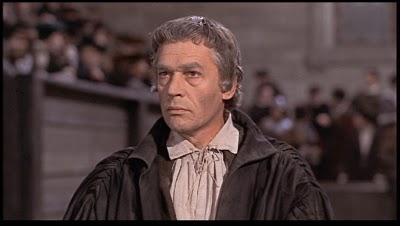
A Man for All Seasons Paul Scofield.jpgIn an insightful scene from the Academy Award-winning movie A Man for All Seasons, one of Sir Thomas More’s apprentices — Richard Rich — confronts Thomas while he is chatting with his wife, daughter, and his daughter’s fiancee, Will Roper, who is an aspiring lawyer.

Rich proceeds to beg Sir Thomas for a political appointment, which Thomas refuses. Sir Thomas knows that Rich is tempted by corruption and would never be able to resist the bribes that he would be offered in such an appointment. During an earlier scene in the movie, Sir Thomas attempts to persuade Rich to pursue a career as a teacher, where he could avoid such temptations and potentially achieve true fulfillment.

An embittered Rich proceeds to leave Sir Thomas and his family to take a political job with Thomas Cromwell, who King Henry VIII has ordered to pressure Thomas to take the King’s oath forsaking Catholicism and the Pope. It is obvious to everyone in the room that the resentful Rich will ultimately betray Sir Thomas, which indeed he does later in the story.

When Sir Thomas’ wife and daughter, as well as Roper, demand that Sir Thomas arrest Rich because of what he will probably do (i.e., betray Thomas), those demands lead to the following exchange in which Sir Thomas lucidly explains the importance of maintaining the rule of law and not trumping up charges even in regard to an unsavory man who will betray him:

A special father

Walter KirkendallI am blessed on this special day for fathers ‚Äì and every other day ‚Äì by my remembrances of a special father.

Resolved: America Should Legalize Drugs

Cato_InstituteJeffrey Miron and Robert DuPont, M.D. debate at the Cato Institute whether the governmental policy of drug prohibition should be continued or ended.

Moneyball

Tyler Cowen on the Great Stagnation

Give’em the Wild Turkey Bird

In our continuing series of creative commercials, Wild Turkey whiskey chimes in with a clever one to start the week.

Wisdom from Terry Teachout

TerryTeachoutMy experience is that good commencement speeches are rare, but I know a good one when I read one. And this one by drama critic Terry Teachout is one of the best that I’ve read in years. Short, clever and insightful, Teachout weaves in a profound exchange from the movie Bull Durham and a funny anecdote about the legendary actor Rex Harrison and Broadway producer Leland Hayward. Then, he concludes with the following sage advice:

If there’s ever a time in life for you to shoot high, it’s now. So take a long, cool look at yourself and say, What do I really want out of life? What would keep me interested until the day I die? Do I have a realistic chance to get it? And if you think you do, then go for it. Work as hard to get it as you worked to get your degree here. Settle later, if you must–but don’t spend the rest of your life eating your heart out because you didn’t give it your very best shot right now.

And that’s that. I congratulate you, members of the Class of 2011, for doing something truly remarkable.

Remember: be proud.

Be professional.

Don’t be bored. Enjoy the moment.

And be sure to get a good lunch.

It’s Tony Time!

Check out this excellent NY Times interactive feature of four, first-time Tony-nominated actors performing a short scene from their respective shows, including Joshua Henry’s knockout performance of “Go Back Home” from The Scottsboro Boys. Here is a video clip of that song from the show. Enjoy!

The Cease-Fire that is long overdue

No more drug warAmerica’s dubious policy of drug prohibition has been a frequent topic on this blog, so I was pleased to see this Mary Anastasia O’Grady/WSJ column (previous posts on O’Grady’s work are here) yesterday on the Global Commission on Drug Policy’s statement last week calling for a “paradigm shift in global drug policy.”

O’Grady’s column is particularly noteworthy because of her citing of this fine Angelo Codevilla’s/Claremont Institute piece that explains how one of the unintended consequences of the failed War on Drugs is the increasing militarization of America’s borders. As Codevilla notes:

A friendly border is like oxygen: when you’ve got it, you don’t think about it. Only when you lose it does its importance seize you. But by then it is difficult to remember the fundamental truth: if borders are friendly, you don’t have to secure them; and if they are unfriendly, you must pay dearly for every bit of partial security, because ever harsher measures produce ever greater hostility.
Thucydides’ account of the Peloponnesian War gives us what may be history’s most poignant description of how a hostile border proved disastrous to a great power. In the war’s 19th year, Sparta put a small garrison in Decelea, in their enemy’s backyard, which, Thucydides tells us, "was one of the principal causes of [the Athenians’] ruin." "[I]nstead of a city, [Athens] became a fortress," with "two wars at once," and in a few years was "worn out by having to keep guard on the fortifications." Having lost a friendly border, Athens turned itself inside out trying to secure an unfriendly one.

For an excellent overview of why America’s drug prohibition policy should be scuttled, check out this Milton Friedman argument. And if you are interested in how a regulatory structure for recreational drug usage could be devised, the University of Chicago’s James Leitzel’s TEDxUChicago presentation below provides a great starting point: