
The Shell Houston Open concluded on Sunday with the top-rated player — Adam Scott (3rd in the World Rankings) — winning the tournament (final leaderboard here) by making a par on the 72nd hole even after pulling his drive into the water. The Chronicle’s Steve Campbell’s postscript on the tournament is here, while earlier posts on the tournament are here.
After seeing how good the Tournament Course at Redstone looked on television last Thursday afternoon, my buddy Jerry Sagehorn and I visited Redstone on Friday morning to check out the tournament and the course. In so doing, we were able to get a close-up look of what ails the local tournament and why it is unlikely ever to be more than a second tier tournament on the PGA Tour (i.e., behind the majors and the first tier tournaments such as the Players and the Memorial).
Although Redstone is impressive in several respects, the facility is located next to a housing development far away from any of the Houston area’s large entertainment or commercial centers. Unlike The Woodlands — which is one of the most beautiful areas of Houston and has luxury hotels, shops, restaurants and one of the best entertainment facilities in the Houston area to offer — the area around Redstone is rather bland and has nominal commercial activity. Accordingly, if you go the SHO at Redstone, you go for the golf only and then leave. There is no ambiance to the area around the course.
But the area around Augusta National is no great shakes, either. So, if the golf course is appealing, then the best golfers might overlook the lack of ambiance and come to the tournament, anyway. Unfortunately, the Tournament Course is not — and likely will never be considered — a great golf course. That is not to suggest that the course does not have some interesting holes. The 18th hole in particular proved to be a challenging finishing hole. Moreover, the spectator viewing lines around the course are really quite good.
However, as the map below denotes, the course is really split into three separate courses. First, the 1st and 18th holes are next to each other and form a long tarmac leading to the other two parts of the course on the other side of a large and unsightly drainage ditch. Then, the 2nd through 9th holes and the 10th through 17th holes form separate loops that are not easily reached from other parts of the course. Adding to the disjointed nature of the course is that the front nine does not end at the clubhouse and the back nine does not start from the clubhouse.

Thus, the players and spectators are required to walk at least a quarter mile from the 1st green to the 2nd tee (this year, the players and caddies got a ride in a golf cart). Similarly, between the 9th green and the 10th tee, there is another long walk of at least 300 yards. And then, after trudging around the first two parts of the course, the players, caddies and spectators must trek another couple hundred yards from the 17th green to the 18th tee.
Thus, despite having some entertaining holes, good sight lines and being in top condition, the Tournament Course at Redstone is simply not an endearing golf course. That was reflected by the crowd on Friday morning, which was a fraction of the size that used to attend the tournament on Friday mornings when the tournament was played at the TPC in The Woodlands. Although the rain on Saturday morning certainly held attendance down on that day, the crowds on the weekend also did not appear on television to be as large as those that used to attend the tournament in The Woodlands. Perhaps reflecting the lower attendance, neither the HGA nor the Chronicle broadly publishes attendance figures as they used to do when the tournament was played in The Woodlands.
So, what can the SHO do to improve the experience for the players and fans? There has been some talk that Redstone is considering building a Houstonian-type resort facility on the property to attract the better golfers such as the Four Seasons Resort does in Dallas, but my sense is that the lack of surrounding amenities makes such a venture about as likely as redevelopment of the Astrodome into a resort hotel.
Can the tournament attract more than two of the top ten, eight of the top 30, and 20 of the top 60 players in the World Rankings? If Shell or Redstone pursues lucrative sponsorship deals with some of the top players in the same manner as Buick has done with Tiger Woods, then maybe those players would play the SHO in the same manner that Woods plays several Buick-sponsored tournaments. But those deals are costly and risky (some players do not stay on top for long), so I doubt that will happen. Finally, the HGA is going to have to address the knotty problem of how to move spectators and players around the long stretches of the course, which — unless resolved — is likely going to deter spectators from making return visits to the tournament.
Thus, my sense is that the SHO is firmly entrenched as a second tier PGA Tour event even after the HGA’s prodigious investment with Redstone. That’s unfortunate because Houston is a golf hotbed and has a rich golfing tradition, and the HGA is a fine charitable organization that had laid a foundation of success for the tournament over a 20 year period in The Woodands. Shell has signed on as the title sponsor of the tournament through 2012, so the next several Houston Opens are going to be key ones for the HGA. Come time to negotiate an extension of that sponsorship arrangement, will Shell have better things to do with its sponsorship dollars than to support an afterthought on the PGA Tour?
Author Archives: Tom
Lessons of the Heart
Following up on recent posts here and here, don’t miss this John E. Calfee/American.com op-ed on how recent research into heart disease treatments has not only changed medicine, but also basic science research:
How do we know where heart attacks come from? The answer lies in feedback from pharmaceutical clinical trials to basic research. Long before the stent trials began to upset received wisdom, massive trials of heart drugs had first validated previously controversial hypotheses and then upset the next generation of hypotheses. Eventually, these trials pushed basic research in unexpected directions. [. . .]
So there is a bit more to this weekís news about stents and heart attacks than meets the eye or is described in the media. We are witnessing another episode in the remarkable story of feedback from drug and device development to basic science. And we can expect more drug-tools to wreak more havoc in scientific understanding of human biology.
Read the entire piece, which is an excellent summary on how clinical research spurs development of better drugs, superior treatment and even better-focused research. Check out the new design of American.com, which has quickly developed into one of the most interesting and insightful on-line magazines.
Junk Loans
Felix Salmon, who authors a very good blog about finance and economics, makes the following observation about the dramatic increase in the amount of leveraged loans held by hedge funds:
[J]unk bonds are rapidly becoming a thing of the past. Today, it’s all about junk loans ñ illiquid instruments which hedge-funds hedge in the equally opaque and non-public CDS (credit default swaps) market. The good news, insofar as there is any, is that if and when a lot of these loans go sour, the impact on the banking system will be much lower than the volume of loans would imply. But the bad news is that ever-larger chunks of corporate balance sheets are now completely unregulated.
I’m not sure I follow the reasoning of Salmon’s final sentence. Privately-owned hedge funds, whose investors are wealthy folks, own a large amount of leveraged loans. That ownership has reduced the risk of loss of lending institutions, which generally do not have the profit margins to take on that sort of risk. Thus, the financing market has developed to shift the risk of these loans to those who can best afford to take the risk, which is a good thing. That large portions of corporate balance sheets are unregulated is one of the reasons that such a market developed in the first place.
A big problem with the Stros
Okay, so Stros skipper Phil Garner — who we already know is not a very good manager — pulls yet another bonehead move and allows besieged reliever Brad Lidge to blow a fine Roy O Opening Day performance by giving up a two-out, top of the 9th inning tater. And that move letting Ausmus bat second while trying to generate a rally in the bottom of the 10th was real smooth, too.
But even more importantly, when did it become acceptable to bat a guy with the two worst OBA seasons in club history at the top of the order in front of Lance Berkman and Carlos Lee, not to mention Morgan Ensberg (.396 OBA in 2006), Chris Burke (.347), and Luke Scott (.426)?
As I noted in my season preview yesterday, Garner’s bullheadedness is going to hurt the Stros this season. Little did I know that it would only take one game to prove it.
“A golfing Zimbabwe?”
The Masters Golf Tournament gets underway on Thursday and the fine Masters website is streaming video of the practice range so that we can watch the pros hit the rock pile in preparation for the tournament. And the NY Times chimes in with this profile on new Augusta National Golf Club chairman Billy Payne. Finally, Golf Digest has its typically thorough preview of the tournament here.
But the prestige of The Masters is simply a signal for Scottish golf writer John Huggan to tweak the controversial changes that have been made to the hallowed course over the past several years:
In what is nothing less than a direct and disrespectful contravention of [Augusta National course designer Alistar] Mackenzie’s and [Augusta National founder Bobby] Jones’ original and delightful philosophy, the Augusta National that will this week host the world’s best golfers resembles nothing more than just another one-dimensional country club. Aerial photographs published in the April issue of Golf Digest graphically portray the tragedy that is the modern Augusta National. In place of what were once spacious and tightly cut fairways, rough has been grown and trees have been planted. What was once the most democratic of courses — one that allowed every standard of player to figure out his own way of playing each hole — has become a golfing Zimbabwe, a misguided dictatorship that has all but eliminated freedom of thought and expression.
Huggan is just getting warmed up, so read the entire article. Huggan better watch it or he will end up at the same place as CBS golf announcer Gary McCord during Master’s week.
James Hamilton on Saudi oil production
Clear Thinkers favorite James Hamilton is thinking about Saudi Arabia’s oil production and that always makes for interesting reading:
Saudi oil production is now down more than 10% from its peak level in 2005; . . . this decline in production has followed an erratic pattern, beginning in October 2005 when oil was selling for $62 and continuing through July 2006 when oil briefly touched $75, making it difficult to see these cutbacks as an effort to stabilize oil prices; . . . the production decline coincided with a doubling in the number of oil rigs employed in Saudi Arabia since 2004 and tripling since 1999.
Has Saudi oil production peaked? Read the entire post. Is Matt Simmons right after all?
Who is running this asylum?
Let’s get this straight.
First, the local hotel market has been overbuilt for years, partly because the city government financed some deals of questionable merit. Heck, most any weekend, it’s easy to obtain a discount rate on a very nice luxury hotel room in downtown Houston.
Then, the private financing market tells us that the redevelopment of the Astrodome into a resort hotel is not financially feasible.
So, given those clear messages, what does the chairman of Harris County Sports & Convention Corp conclude? Explore a financially feasible use for the Dome property, such as demolishing the Dome to save the county the millions it has spent over the past five years mothballing the facility and provide much needed parking for the Reliant Park complex?
No, he would rather do precisely the one thing that will ensure that the county will lose the maximum amount in regard to the Dome property:
The county may consider picking up some costs of transforming the Reliant Astrodome into a luxury hotel or doing the $450 million redevelopment itself if a private effort to carry out the project falls through, a top official said Friday. [. . .]
“From day one, we have always known that it is an option to do this as a publicly developed program,” said Mike Surface, chairman of the Harris County Sports & Convention Corp., which manages Reliant Park. “If I’m looking out for Reliant Park’s interests, I would say, ‘County, you should think about doing this.’ “
And just how would the county pay for such a folly?
No property taxes would go toward the project in any case, he said.
If the county paid for part or all of the project, it would use hotel and sales taxes generated by the hotel complex and other Reliant Park revenue, such as concessions.
Except that Houston already has among the highest hotel and sales tax rates in the country. Moreover, the county doesn’t even own the rights to receive the proceeds from a substantial amount of the concession sales at Reliant Park, such as those the Texans and the Houston Livestock Show & Rodeo generate in their events at Reliant.
Surface, bless his soul, sounds delusional:
Surface said he and some other board members are so confident in the project that the board may look for another developer to step in if Astrodome Redevelopment’s effort fails.
Thank goodness there appears to be at least one stable attitude among Harris County Commissioners toward the proposed Astrodome hotel:
County Commissioner Steve Radack has said, however, that he does not think the project makes sense and will oppose any county participation.
From my vantage point, it appears that Surface floated a trial balloon that Radack mercifully shot down. Hopefully, Radack’s clear statement will put an end to this foolishness. The county needs to move on and consider productive uses of the Dome property rather than chasing rainbows.
Batter up! Stros 2007 Season Preview
Today is Opening Day for Major League Baseball, so it’s time for my fourth annual Stros season preview (previous season reviews are here, here and here). Thankfully, it’s not been as tumultuous an off-season as the previous one, but there still have been several important developments with regard to the club since the end of the 2006 season:
The 2006 post-season recap, with final statistics and grading of each Stros player’s performance;
Analyzing the deals for the new Stros: Carlos Lee and Woody Williams, and Jason Jennings;
A proposed 2006 trade that I’m glad did not occur;
Say what? Alex Rodriguez is not a “good fit” for the Stros, while Adam Everett is?;
One of the favorite former Stros passes away unexpectedly;
The greatest Stros player in history prepares to retire, and a review of the best Stros hitters and pitchers;
Checking in down on the farm;
Is Richard Justice Andy Pettitte’s press agent?;
Is the Chronicle Brad Ausmus’ press agency?;
The risk of relying on Brad Lidge; and
Finally, the initial 2007 club roster.
After the best two-season run in club history in 2004-05 (NLCS and World Series appearances), the Stros in 2006 failed to make the playoffs for the first time in three seasons and for the only the fourth time in the past 10 seasons. The Stros played well down the stretch in 2006, posting a 21-12 record in their final 33 games, including a magical nine game winning streak that propelled the Stros during the final two weeks of the season from 8.5 games back to within a game of overtaking the World Champion Cardinals for the NL Central Division title.
However, the Stros were mediore for most of the rest of the season, including a brutal 42-55 stretch during the middle part of the season when the club’s poor hitting continually pulled down a pitching staff that slowly improved into one of the top staffs in the NL during the season. The overall result was an average National League team, which was reflected by the club’s final 82-80 record.
The trend over the past several seasons is that the Stros have used above-average pitching and defense to compensate for below-average hitting, but the club is tinkering with that approach this season. With the added production from Carlos Lee and the potentially above-average contributions from outfielders Luke Scott and farmhand Hunter Pence, the Stros have the potential to produce the best offense this season since the 2000 club. On the other hand, with the loss of starters Roger Clemens and Andy Pettitte, the Stros starting pitching is a big question mark after front-line starters Roy Oswalt and new acquisition Jennings. While the Stros will likely be better-balanced this season between hitting and pitching, it remains to be seen whether that balance will be the mix necessary to return the Stros to the playoffs.
During Spring Training this year, the competition for several roster spots was as sprightly as it’s been in many seasons. Thus, Pence — who had a great spring — was sent down for seasoning at AAA Round Rock, partly as a result of RF Jason Lane playing reasonably well after a horrid 2006 season. Meanwhile, longtime utility player Eric Bruntlett didn’t even make the club’s roster when the Stros elected to go with a 12 man pitching staff. Nevertheless, manager Phil Garner’s preference for veterans has hurt the clubs that he has managed over the years and and threatens to do so again in 2007 — what other reason than bias for veterans would justify having Wandy Rodriguez and Brian Moehler on the Stros’ pitching staff?
Along those lines, the biggest problem that the 2007 club faces is that 4/9’s of the lineup most days will include veterans C Ausmus, SS Everett, fading Hall-of-Famer Craig Biggio and the pitcher. Between Ausmus, Everett and Bidg, the Stros generated 89 fewer runs than what average National League hitters would have generated in those three positions over the course of the 2006 season. Even with strong offensive production from the other five positions and strong pitching, that many runs is difficult to make up.
Although he is a future Hall-of-Famer, one of the two best Stros players in history and a wonderful fellow, Bidg has no business at this stage of his career being a major-league regular — the Stros have two younger second basemen (Chris Burke and AAA player Brooks Conrad) who project to have better offensive statistics this season than Bidg.
Despite that, Garner not only plans on playing Bidg regularly, he plans on having him be the club’s leadoff hitter. Bidg’s walk rate, strikeout-to-walk ratio and on-base average have all deteriorated well below that of an average NL leadoff man, and his increased power over the past couple of seasons is at least partly an illusion created by the short left-field porch in Minute Maid Park. To top it all off, Bidg has such limited range and arm strength in the field that he has become a far below average defensive player.
Meanwhile, even though Burke isnít nearly as good a player as Bidg was at his age (27), his development has been stunted by the Stros making him into a utility player over the past couple of seasons while indulging Bidg. What is clear is that Burke is a better player than Bidg now and is the Strosí best option at second base. Playing Burke in centerfield ó alongside the somewhat immobile Lee in left and the servicable Luke Scott and Jason Lane in RF ó isn’t fair either to Burke or to the Strosí pitching staff.
How will Burke turn out in centerfield? It’s hard to say, but he is a good athlete and clearly an offensive upgrade over the traded Wily Taveras. Burke projects to produce .348 OBA/.452 SLG/.800 OPS this season, which would be a well above-average performance for an NL centerfielder. But playing Burke in centerfield would be a much better move if it wasnít designed to create space for an inferior player such as Bidg and if the Stros didn’t have to play in Minute Maid Park, which has a gargantuan centerfield. To put this in perspective, there is a big difference between what the Cubs are asking of Alfonso Soriano in the relatively small centerfield of Wrigley Field and what the Stros are asking of Burke in the cavernous centerfield of Minute Maid. Stated simply, the Stros should be playing Burke at his best position of second base where he would be better than Bidg both defensively and offensively.
With Burke in centerfield, that leaves Scott to play right, where he had an incredible second half last season and deserves an opportunity to prove that he is an every day player this season. Scott playing regularly also keeps the Stros from having seven right-handed batters and Lance Berkman in the regular lineup. Moreover, if Scott becomes an every day player, then that gives Garner the flexibility to play Jason Lane or call up Pence to play center and sliding Burke in for Bidg at second base, which clearly gives the Stros a stronger lineup.
Which brings us to Pence, who continues to hit everything that is pitched to him — his most recent fete was hitting a 412 foot Pujols-type blast off of the bedraggled Lidge in the Stros-Round Rock game this past Thursday. Pence will start the season at AAA Round Rock, but if he keeps hitting and 4/9th’s of the Stros’ lineup continues to generate zeros, he’s not likely to be there for long. While the Stros’ limited offensive approach worked in 2005-06 when their pitching staffs those seasons were allowing among the fewest runs of any NL staff, those days appear to be long gone.
The following is the projected Strosí lineup and bench for the 2007 season:
Biggio 2B
Ensberg 3B
Berkman 1B
Lee LF
Scott RF
Burke CF
Everett SS
Ausmus C
Pitcher
Bench: Humberto Quintero (C), Lane, Mike Lamb, Mark Loretta and Orlando Palmeiro.
The run of .300 OBA’s from the 7 hole through the leadoff spot is likely to be a real rally-killer for this offense. Hereís what the lineup would look like if Garner simply played the best players at each position:
Burke 2B
Pence CF
Berkman 1B
Lee LF
Scott RF
Ensberg 3B
Everett SS
Quintero C
Pitcher
Bench: Ausmus, Lamb, Lane, Loretta, and Palmeiro.
The difference between these two lineups is at least 30 runs over the course of a season, and probably more like 40-50. Thatís at least two wins on offense, probably more, plus better defense at second base and centerfield. No team in MLB can turn its back on a three-win improvement, particularly when you consider that the Stros have missed making the playoffs by just one game in two of the last four seasons.
Which brings us back to Bidg. The Stros have decided that heís going to be their regular 2nd sacker until at least he gets 3000 hits, but his presence at leadoff and in the field is a barrier that is preventing the Stros from making the moves necessary to generate and save more runs. Batting leadoff last season, Bidg scored just 79 runs last season. Take away his 21 home runs, and he scored just 58 times. Thatís pretty pathetic for a leadoff hitter.
Thus, in my view, the Stros are not making the hard decisions that are necessary to return to the playoffs in 2007. This looks like a team that is capable of winning between 85-90 wins at best, and is at least equally capable of falling to the 75 win level if the starting pitching doesn’t develop. The saving grace for the Stros is that all of the other NL Central teams appear to have similar limitations this season, so 85 wins just might be enough to win the division. But building a club for 85 wins in a season is not a prescription for continuing the long-term success of the Biggio-Bagwell era throughout the current Berkman-Oswalt era.
Finally, I am going to continue my periodic reviews of the Stros throughout the season, but I’m going to modify routine. Last season, I reviewed the Stros’ progress after each 10% segment of the season, which worked out reasonably well. This season, I’m going to split the 162 game season into eighths, so I will review the club’s progress after each 20 game segment of the season (I’ll do 21-game segments for the first and last eighths). So, look for my first in-season review around April 23rd, give or take a day or two in the event of a postponed game in the first weeks of the season.
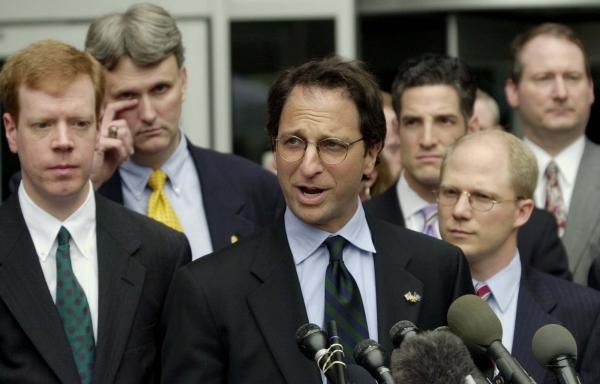
Chris Calger and the Embarrassing Enron Task Force
Remember when the Wall Street Journal characterized the Enron Task Force as having “a good record overall?”
Well, the latest development in that “good record” is that the Department of Justice Criminal Division — the successor to the disassembled Task Force — announced quietly on Friday that it does not oppose former mid-level Enron executive Christopher Calger’s withdrawal of his guilty plea to a highly questionable Task Force indictment and that the DOJ is dismissing the criminal case against Calger altogether.
That announcement didn’t receive the same level of publicity as the Task Force’s various “perp walks” of former Enron executives, now did it?
The indictment against Calger was dubious from the beginning — the judge who handled the hearing to approve the initial plea bargain was flabbergasted when the Task Force prosecutor handling the hearing could not even articulate what action of Calger constituted a crime. Later, this post noted that Calger’s attempt to withdraw his guilty plea exposed several dirty secrets of the Task Force’s multiple abuses of power in regard to its handling of the Enron criminal cases.
So, let’s take stock of the Enron Task Force’s slate.
It procured a deeply flawed conviction that put the nail in the coffin of one of the oldest and most respected U.S. accounting firms, costing tens of thousands of jobs in communities throughout the nation.
Then, the Task Force ruthlessly ruined the careers of four respected former Merrill Lynch executives and sent them to prison for a year before the Fifth Circuit overturned that atrocity.
After two inflammatory trials, the Task Force finally obtained a conviction against former Enron Broadband executive Kevin Howard, only to have that conviction tossed out before an appeal.
The Fifth Circuit — even before the appeal briefs have been filed — has opined that “serious frailties” exist in the conviction of former Enron CEO Jeff Skilling. Moreover, the stress associated with mounting a defense to the Task Force’s questionable case against former Enron chairman Ken Lay almost certainly contributed to his death.
For the past year and a half, DOJ lawyers have been attempting to patch something together to make a case against Howard’s former co-defendants in the Enron Broadband case that the Task Force has already lost once, and serious questions exist as the validity of the Task Force’s controversial prosecution of the NatWest Three.
Meanwhile, as noted earlier here and here, most of the Task Force lawyers who contributed to making this mess have moved on to lucrative careers outside of government.
If the foregoing is a “good record,” then what on earth would constitute a bad one?
The pro-business candidate?
So, Steve Forbes thinks that Rudy Giuliani is the best free market candidate in the upcoming U.S. Presidential election.
Forbes is wrong. As noted in earlier posts here and here, Giuliani has a legacy of dubious prosecutions of businesspeople — most prominently Michael Milken — to further his own career. Forbes’ failure to mention Giuliani’s duplicity in the prosecution of one of the most important and productive businesspersons of the latter part of the 20th century reflects a troubling blindspot and a very short memory.