Houston-based Redstone Companies‘ Tournament Golf Course — the new home course for the PGA Tour’s Shell Houston Open Golf Tournament — opened for play this week, and the Chronicle’s Doug Pike gives the 7,500 yard Rees Jones tract a stellar rating in this review. Inasmuch as the new course is central to the Houston Golf Association’s plan to revive the Shell Houston Open, which had one of its weakest fields in years during this year’s tournament — I am hopeful that the course turns out to be popular among both Tour players and the golfing public. I am scheduled to play the Tournament Course later this month, after which I will post a review, so stay tuned.
A note to Redstone Golf — the website for the Tournament Course is about as unimpressive as a website can be, with hyperlinks that do no work and a paucity of visuals of the product. Might want to spend a few bucks to upgrade that resource, which will be the first impression that many folks will have of the facility.
CNOOC folds on Unocal bid
The China National Offshore Oil Corp Ltd. announced yesterday that it is abandoning its effort to acquire second-tier U.S. exploration and production company Unocal Corp, paving the way for Unocal shareholders to accept Chevron’s competing bid. Here are the previous posts on the battle over Unocal.
Chevron clearly overwhelmed CNOOC in the political arena of this takeover battle, which ended up discounting the value of CNOOC’s superior all-cash bid because of concerns over whether CNOOC could close it anytime soon. Although there will likely be much hand-wringing over the impact to Sino-American economic relations as a result of CNOOC’s failed bid, the reality is that CNOOC screwed the pooch on this one.
Dynegy continues restructuring plan with big asset sale
Houston-based Dynegy, Inc. announced yesterday that it had agreed to sell its natural-gas-processing business for $2.48 billion to Houston-based Targa Resources Inc., the energy company that private-equity firm Warburg Pincus LLC founded. As a part of the deal, Targa Resources will also acquire Dynegy’s storage, transportation, distribution, fractionation and marketing assets.
With this sale, Dynegy becomes solely a power generator that would be a prime acquisition target of other energy companies. The sale is the latest move in a restructuring plan that Dynegy undertook after the company was nearly drawn into its own reorganization case in the the bankruptcy wake of its acquisition target Enron Corp. in late 2001. Last year, Dynegy sold its Illinois Power utility to St. Louis-based Ameren Corp. for $500 million in cash and $1.8 billion in assumed debt and preferred stock.
United Airlines continues to flounder in chapter 11
In a move that almost certainly means that its bankruptcy case filed in December, 2002 will extend well into 2006, United Airlines parent UAL Corp. announced Tuesday that it was delaying the filing its plan of reorganization with the U.S. Bankruptcy Court in Chicago after various interest groups in the case opposed the plan because of its overly aggressive timetable. It is symptomatic of the disheveled financial condition of the airline indurstry that a debtor-company’s creditors — as opposed to its management — are afraid to push the company out of bankruptcy too quickly. Here are previous posts that comment on the United Airlines saga.
Interestingly, United’s labor unions — one of interest groups that bears a substantial amount of responsibility for United’s bankruptcy in the first place — is largely responsible for the delay in United filing is plan and might just tip the reorganization process in such a way to strap United when it emerges from bankruptcy. Over the past few months, a number of private-equity firms and hedge funds have expressed interest in participating in the airline’s refinancing. However, the unions — which are among United’s largest unsecured creditors — prefer not to give up the equity in a reorganized United necessary to attract such private capital. Rather, the unions support a plan that would leverage the reorganized company with debt that would be used to pay a portion of unsecured creditors’ claims. Not surprisingly, United must overcome more than a little skepticism among institutional lenders that it is a prudent investment to risk loaning money to a highly-leveraged carrier coming out of bankruptcy and attempting to compete in the fiercely competitive airline industry.
CIBC puts Enron class action settlement amount over the WorldCom record
Canadian Imperial Bank of Commerce announced today that it has agreed to pay $2.4 billion to settle the class action securities litigation against the bank arising out of the demise of Enron Corp. in late 2001. The CIBC settlement is the largest settlement to date in connection with the Enron securities class action (previous settlements are here, here, here, here and here), and pushes the aggregate amount of such settlements a billion over the $6 billion benchmark established earlier this year in connection with the settlements in the WorldCom class action litigation. Here is the Chronicle article on the settlement.
William Lerach — the lead plaintiffs’ lawyer in the Enron class action — publicly stated in connection with the CIBC settlement that his goal is to have each settling financial institution pay more than previous settlements. That piece of information could not have brought warm and fuzzy feelings to the remaining financial institution defendants in the Enron securities fraud class action, which include Credit Suisse First Boston, Merrill Lynch & Co., Barclays PLC, Toronto Dominion Bank, Royal Bank of Canada, Royal Bank of Scotland, and Deutsche Bank AG.
The Merrill Lynch defendants appeal in the Nigerian Barge case – criminalization of business run amok
T
he Enron-related Nigerian Barge case has been a frequent topic on this blog as a prime example of the Justice Department’s dubious criminalization of common business practices in the post-Enron era.
As a result of that questionable policy, four former Merrill Lynch executives — Daniel Bayly, William Fuhs, James A. Brown, and Robert Furst — are unjustly facing prison sentences of between 2.5 and almost four years.
Although the former Merrill executives are appealing their convictions, both the U.S. District Court and the Fifth Circuit Court of Appeals have rejected their motions to remain free on bond pending disposition of their appeals.
Inasmuch as those motions had substantial merit, and the Nigerian Barge trial was only the second Enron-related case (the Arthur Andersen case was the first) to be tried in the anti-business environment of Houston in the post-Enron era, the denial of those motions without so much as an explanation is highly troubling.
Nevertheless, the Fifth Circuit did at least put the former Merrill executives’ appeal of their convictions on an accelerated track for a ruling on the merits. Consequently, the Merrill executives filed their initial briefs in the appeal late last week. To say that they make interesting reading is an understatement.
Inasmuch as the mainstream media has rendered Enron to social pariah status and condemned most anyone who did business with the former seventh-largest company in the United States, the conventional wisdom has blithely concluded that the Merrill Lynch executives must have been guilty of some crime in connection with the Nigerian Barge deal.
However, the briefs of the Merrill Lynch executives in the Nigerian Barge appeal reveal a stunningly different picture. Rather than even a questionable transaction, the briefs compellingly portray a typical structured finance transaction that the Enron Task Force decided to criminalize through a brazen web of distortion, inadmissible hearsay, suppression of key testimony, opposition to a defense jury instruction on the key issue in the case, and prosecutorial misconduct.
After reading the briefs, one is left with the unmistakable impression that the Justice Department’s prosecution of the Merrill Lynch defendants had nothing to do with truth or justice, and everything to do with demonizing four decent men for their misfortune of having been involved in a rather ordinary structured finance transaction with Enron.
The Nigerian Barge case arose out of a now familiar deal in which Enron sold to Merrill Lynch a financial interest in power-generating barges moored off the coast of Nigeria. The sale took place in late in December 1999 so that Enron could book in 1999 the relatively small amount of $12 million of income generated by the sale.
According to the government’s theory of prosecution, Enron should not have recognized income because the sale of the barge interest was not a “true” sale because Enron — through it’s former CFO Andrew Fastow — had orally guaranteed to the Merrill executives that, if Enron could not find a third party to “take Merrill Lynch out” of its investment, Enron would itself buy back Merrill Lynch’s interest in the barges within six months. Due to this alleged guaranteed Enron “buyback,” the prosecutors contended that Enron did not truly part with any interest in the barges and, thus, should not have recognized any income on the sale. Inasmuch as the former Merrill Lynch executives enabled Enron to book the income on the sale, the prosecution’s theory is that the former Merrill Lynch executives were guilty of conspiracy and wire fraud.
In response to these draconian allegations, the Merrill Lynch executives had a simple reply — they freely acknowledged that Merrill Lynch had not wanted to be a long-term holder of an interest in the barges, and admitted that Enron had therefore assured Merrill Lynch that it would be “taken out” of its investment. But the Merrill Lynch executives insisted that Enron had simply assured them that the “takeout” was to be through a sale to a third party and not through any guaranteed Enron buyback. Even the government acknowledged during the trial that Enron was entitled to recognize a sale — and no crime was committed — if Enron had simply assurred Merrill Lynch that it would arrange a third party to purchase Merrill Lynch’s interest in the barges.
Thus, the entire case turned on the nature of the oral representations that Mr. Fastow made during a late December 1999 conference telephone call that had about a half dozen other participants from Enron and Merrill, including Messrs. Bayly and Furst. In a transparent effort to hide the weakness of its case, the government chose obfuscation over clarity in presenting its evidence on that key call. Incredibly — and despite the fact that Mr. Fastow is a cooperating witness for the government — the Enron Task Force prosecuted its entire case against the Merrill defendants without calling a witness who had any first-hand knowledge of what Mr. Fastow said during that key telephone conference. Rather, the prosecution relied on hearsay testimony and hearsay within hearsay regarding the call, and on witness accounts who testified as to their “understanding” of what Mr. Fastow had said, but who could not remember where that understanding had come from. In so doing, the government intentionally confused the critical distinction between a lawful promise to find a third-party purchaser, on one hand, and an unlawful promise of a buyback, on the other. As Mr. Bayly’s brief notes on page 30 regarding the testimony of key prosecution witness Michael Kopper:
So which was it, according to Kopper, an Enron buyback or a third-party purchaser? Not even Kopper could keep the two accounts straight, at one point offering both versions in the same breath. Enron, he stated, had to “follow through” on its “promises” — the promise to repay, to get them repaid[.]” But those are two very different “promises.” A “promise to repay” suggests an Enron buyback. But a promise to “get them repaid” suggests a third-party purchase. It should give this Court pause, we respectfully submit, that a theory of prosecution might hang on a nuance in second-hand information so delicate that the witness himself cannot keep the “promises” straight.
To make matters worse, while presenting this “shoddy merchandise,” as Mr. Furst’s appellate counsel calls it, the prosecutors suppressed Mr. Fastow’s pre-trial statements to the government in which he admitted that he indeed had not promised an Enron buyback, but had instead told the Merrill executives that they could have a high level of confidence that Enron could arrange a third party to buy the barges from Merrill. When the Merrill defendants attempted to introduce Mr. Fastow’s inconsistent and exculpatory statements under Fed. R. Evid. 806 during the trial, the prosecution again vigorously opposed introduction of that evidence, and the trial court sustained the government’s objection. Finally, when the Merrill defendants requested a theory-of-the-defense jury instruction stating that a promise to find a third-party purchaser would not be illegal, the government also opposed the proposed instruction on this crucial issue in the case, and the trial court again sustained that dubious objection.
Thus, despite the almost 400 pages of briefs, the former Merrill Lynch executives’ argument is simple. The convictions were based almost entirely on inadmissible hearsay, and even that hearsay evidence was hopelessly confused.
Similarly, the District Court’s decision to sustain the prosecution’s objections to the exculpatory Fastow out-of-court statement and the theory-of-defense jury instruction on the key issue in the case denied the jury from considering important information that was favorable to the Merrill defendants.
Finally, the Task Force distorted — similar to the Task Force’s distortion of the obstruction of justice statute in the Arthur Andersen case — the honest services, money or property, and books and records charges in criminalizing an ordinary structured finance business transaction. In regard to that latter point, Mr. Bayly’s brief refers to Judge Easterbrook‘s classic passage on criminalization of ordinary behavior from his opinion in United States v. Walters, 997 F.2d 1219 (7th Cir. 1993):
According to the United States, neither an actual nor a potential transfer of property from the victim to the defendant is essential. It is enough that the victim lose; what (if anything) the schemer hopes to gain plays no role in the definition of the offense. We asked the prosecutor at oral argument whether on this rationale practical jokes violate 1341. A mails B an invitation to a surprise party for their mutual friend C. B drives his car to the place named in the invitation. But there is no party; the address is a vacant lot; B is the butt of a joke. The invitation came by post; the cost of gasoline means that B is out of pocket. The prosecutor said that this indeed violates 1341, but that his office pledges to use prosecutorial discretion wisely. Many people will find this position unnerving * * * . * * * [T]he idea that practical jokes are federal felonies would make a joke of the Supreme Court’s assurance that 1341 does not cover the waterfront of deceit.
As the Enron Task Force’s growing legacy of misconduct continues, it has become abundantly clear that its purpose is something other than to uncover the truth regarding Enron.
This was brought home again this past Friday afternoon in a seemingly innocuous exchange during a status conference in the Task Force’s legacy case against former Enron chaiman Ken Lay, former Enron CEO Jeff Skilling and former chief accountant, Richard Causey. U.S. District Judge Sim Lake asked the lawyers on each side of the case whether they would prefer to sit during the upcoming trial at the table in the courtroom that is closer to the jury box.
Mike Ramsey, Mr. Lay’s counsel, piped up and stated that the defendants preferred the table closer to the jury box because — due to the way in which the tables in the courtroom are situated — the other table would not require witnesses to look at the defendants (and vice versa) while they were testifying.
Although giving no reason for wanting to deny the defendants this basic part of their right to confront witnesses against them at trial, the Task Force prosecutors opposed the defense’s request for the table closer to the jury. Judge Lake has not yet decided which side will get the table, but the Task Force’s knee-jerk response reflects that their true purpose is something other than to assure that the defendants receive a fair trial.
Accordingly, after fumbling the Arthur Andersen appeal, the Fifth Circuit now has two high profile opportunities — the Nigerian Barge appeal and the Jamie Olis appeal — to redeem itself and send the Justice Department a clear message that the federal judiciary will not countenance distortion of criminal statutes and evidence even when the defendant is an unpopular business executive.
For as Thomas More reminds us, if the courts do not stand up for justice and the rule of law in such cases, “do you really think you could stand upright in the winds [of abusive state power] that would blow then?”
In the Nigerian Barge case and the Enron Broadband case, the Enron Task Force is showing us precisely what happens when such winds blow, and the emotional carnage being experienced by the individuals involved and their families is not something that can easily be overlooked as a trade-off of an imperfect system.

Kinder Morgan’s big Canadian deal
Houston-based pipeline operator Kinder Morgan Inc. announced a big bet Monday on the development of the Western Canadian oilfields — the purchase of Vancouver-based Terasen Inc. for $3.1 billion in stock and cash and the assumption of $2.5 billion in debt.
Terasen is the largest natural-gas operator in British Columbia and operates pipelines that connect Alberta, Canada with the Midwestern part of the U.S. and the Canadian West Coast. Kinder Morgan is paying a premium price for the company, almost 24 times Terasen’s estimated 2005 earnings.
Why you should be skeptical of stock analysts
Most readers of this blog already have a healthy skepticism of the opinions of stock analysts. But for those who don’t, please read this NY Times article on several bullish analyst opinions on that black hole of financial loss, the airline industry.
It takes a fairly fertile imagination to reconcile the following excerpt from the Times article with these recent items (here and here) on the airline industry:
[D]eep losses at Delta Air Lines do not deter Jamie Baker, an airline analyst at J. P. Morgan. He maintained an overweight rating even after Delta’s shares were pummeled last week on a fresh warning from its chief executive, Gerald Grinstein, that the airline’s cost-cutting plan was not enough to offset the impact of brutal competition. Delta lost $388 million during the second quarter, and has lost nearly $10 billion this decade.
Without building cash, and without the passage of pension reform legislation now in Congress, Delta was virtually assured of a bankruptcy filing, Mr. Baker conceded in a research note.
Nevertheless, he wrote, “Our call remains that Delta will manage to pull some liquidity strings, make one last and perhaps final run at avoiding Chapter 11, and successfully limp into 2006 while hoping for lower oil prices and improved revenue trends.”
Despite such speculation, stick with Warren Buffet’s analysis of the airline industry. After a particularly unfulfilling investment experience in airline stocks several years ago, Mr. Buffett undertook a study of the airline industry. Taking into consideration the airline industry’s cumulative finances since the day the Wright Brothers took off at Kitty Hawk in 1903, Mr. Buffet concluded that the industry has been, on the whole, utterly unprofitable. In hindsight, Mr. Buffett wryly observed that shooting down the Wright Brothers on that beach would have been a reasonable financial, if not moral, move.
Key tip on airline stocks — wait for Professor Ribstein’s proposed solution to occur before taking a flyer on any airline stock other than Southwest.
The Psychology of Light Rail
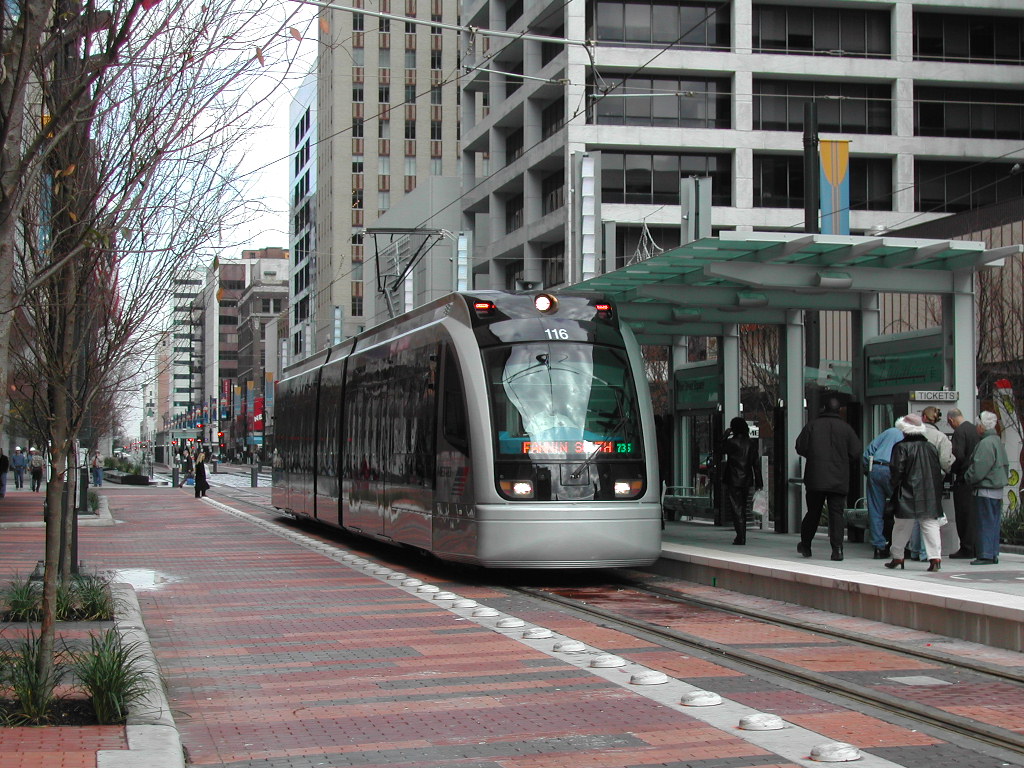
Tory Gattis (Houston Strategies) recently authored this insightful post that explores the vexing question of why many people passionately support light rail in the face of the overwhelming economic arguments against it?
Tory concludes that it has something to do with an unexpressed human psychological need to be liked — sort of like, “Here, check out and play with my light rail toy, and you will probably think better of me.”
Tory is clearly on to something in that there appears to be an element of a civic inferiority complex underlying some folks’ support for light rail. However, Tory’s point still does not explain why people who need mass transit the most — i.e., folks who cannot afford the cost of buying and maintaining a car — support light rail, which certainly does not improve their mobility and, by drawing resources away from mobility projects that would, probably harms it.
My sense is that that question lies somewhere between the human demand for entitlement and lack of viable choices.
As previously noted on this blog, the true economic benefit of light rail is highly concentrated in only a few interest groups — political representatives of minority communities who tout the political accomplishment of shiny toy rail lines while ignoring their constituents need for more effective mass transit, environmental groups that are striving for political influence, construction-related firms that feed at the trough of light rail projects, and private real estate developers who enrich themselves through the increase in their property values along the rail line.
Inasmuch as none of these reasons for mass transit appeal to the part of the electorate who actually need mass transit, this amalgamation of interest groups continues to disguise their true interests behind amorphus claims that the uneconomic rail lines reduce traffic congestion (they do not), curb air pollution (they do not), or improve the quality of life (at least debatable). The literature on all this is public and volumnious — check out demographia.com, cascadepolicy.org, and americandreamcoalition.org.
So, how do these interest groups get away with this? The costs of such systems are widely dispersed among the local population of an area such as Houston, so the many who stand to lose will lose only a little while the few who stand to gain will gain a lot.
As a result, these small interest groups recognize that it is usually not worth the relatively small cost per taxpayer for most citizens who do not use mass transit to spend any substantial amount of time or money lobbying or simply taking the time to vote against an uneconomic rail system.
Meanwhile, the light rail interest groups garner support for light rail from the part of the electorate that actually needs mass transit by simultaneously limiting the mass transit choices and threatening that part of the electorate with loss of the governmental funds for mass transit if they fail to support light rail.
Thus, a referendum on mass transit issues is never promoted with choices between alternatives such as a light rail system, one one hand, and a cheaper and more effective bus-based system system, on the other. It’s simply an “all or nothing” choice, and folks who need mass transit will understandably vote in favor of getting their share of public transportation funds even if it does not improve their mobility one iota.
Indeed, given the cost of light rail systems, one wonders how those citizens who actually need mass transit would vote if the alternative were a light rail system, on one hand, and a new Toyota Prius for each such citizen, on the other? Frankly, the cost of the latter alternative would likely be cheaper than most any light rail plan.
So, at the end of the day, where does that leave us? Is it wrong that people who need mass transit vote in favor of something that does not really address their needs? No, it does not, but it troubles me when they are misled in doing so.
As Anne Linehan and Kevin Whited (blogHouston.net) have repeatedly pointed out, a part of Metro’s pitch for its light rail plan was that light rail would enhance Metro’s bus system and service. Inasmuch as that representation has turned out to be patently false, it seems reasonable that our public officials should at least be required to point out publicly that Metro’s most utilized and efficient mass transit system — i.e., the bus system — will likely continue to erode as Metro continues to invest heavily in light rail.
In the meantime, it would also be nice if public officials would admit publicly that the usual economic justifications for light rail are also dubious. If mass transit users and other citizens want to allow Houston’s public officials to continue to throw money at a light rail system in the face of the economic truth about such a system, then I can live with that result despite my compassion for those citizens who are not being provided the mass transit that they need.
But at least let’s require truth in advertising in connection with having citizens vote on such matters.
A similar sentiment is shared in this interesting Owen Courreges post (Lone Star Times) in which he takes the Chronicle to task for suggesting that Metro’s political opposition — rather than Metro itself — is misleading the public about Metro’s expanded light rail plan.
Finally, Tory points out that we should take some comfort in the fact that Houston’s light rail plan is at least not as big an economic boondoggle as similar plans proposed for Seattle and Denver. Similarly, a couple of commentators to Tony’s post chime in that the marginal cost of the light rail system to Houston area citizens is relatively small for a civic asset that will impress citizens and visitors alike for many years to come. That latter point may have some validity, but let’s make sure that we are talking about the correct marginal cost.
A big difference between the light rail system and the publicly-funded stadiums that Houston has built over the past several years are that the stadiums have tenants who pay the vast majority of the cost of maintaining the facilities.
In comparison, Metro’s light rail system does not come close to generating enough revenue to pay its ongoing costs, as was brought home by Metro’s recent announcement of desultory operating results coupled with the expenditure of $104 million more on the three-year-old rail line to fix problems caused by construction errors and add more rail cars.
In that regard, even the $1.5 million that Harris County spends annually to mothball the Astrodome pales in comparison to underwriting the ongoing cost of the light rail system.
The bottom line is that light rail systems eat voraciously, and any analysis of the true marginal cost of such a system to citizens has to take into consideration the high cost of feeding that appetite.
Daniel Yergin comments on energy prices
Daniel Yergin — energy economist and author of the 1992 Pulitzer Prize winner, The Prize: The Epic Quest for Oil, Money, and Power — writes this sensible Washington Post op-ed in which he reminds us that the current relatively high prices of energy do not mean that the end of the oil age is right around the corner:
Prices around $60 a barrel, driven by high demand growth, are fueling the fear of imminent shortage — that the world is going to begin running out of oil in five or 10 years. This shortage, it is argued, will be amplified by the substantial and growing demand from two giants: China and India.
Yet this fear is not borne out by the fundamentals of supply. Our new, field-by-field analysis of production capacity, . . . is quite at odds with the current view and leads to a strikingly different conclusion: There will be a large, unprecedented buildup of oil supply in the next few years. Between 2004 and 2010, capacity to produce oil (not actual production) could grow by 16 million barrels a day — from 85 million barrels per day to 101 million barrels a day — a 20 percent increase. Such growth over the next few years would relieve the current pressure on supply and demand.
Read the entire op-ed, and then recall Exxon/Mobil CEO Lee Raymond’s observation during a Wall Street Journal interview earlier this year regarding Chevron’s bet of continued high energy prices that underlies the high price it is paying for Unocal:
WSJ: What do you think of ChevronTexaco’s decision to acquire Unocal?
Mr. Raymond: I can never remember an industry consolidating at high prices. But I can remember an industry consolidating at low prices.
WSJ: Some people think prices will keep going up.
Mr. Raymond: Maybe. I’ll bet they’ll be lower at some point.