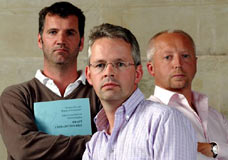
 I gave up hope long ago that the mainstream media would ever provide particularly accurate reports regarding the Enron-related criminal prosecutions.
However, the mainstream media news reports on the plea bargain hearing earlier this week in the Enron-related NatWest Three case (see NY Times, WSJ, Chronicle) are particularly devoid of any meaningful perspective of what really happened in the case (a copy of one of the plea agreements, which is the same as the other two, is here).
The real story of the plea bargain can easily be distilled from the pleadings that are on file in the case. It’s a substantially more nuanced story than what you are hearing from the mainstream media.
The prosecution in the NatWest Three case alleged that the three bankers defrauded NatWest, their former employer, by conspiring with former Enron CFO Andrew Fastow and his sidekick, Michael Kopper, to underpay NatWest for its interest in an entity named Swap Sub, which was an affiliate of one of Enron’s special purpose entities (LJM1) that Fastow and Kopper ran.
Swap Sub was involved in one of LJM1’s primary transactions, which was to hedge Enron’s valuable but highly volatile interest in a technology company called Rhythms NetConnections, Inc (“Rhythms”). The NatWest Three were responsible for overseeing the banking relationship between Enron and NatWest, including NatWest’s interest in Swap Sub. Another investor in Swap Sub was Credit Suisse First Boston (“CSFB”), which owned the same percentage interest in Swap Sub as NatWest.
In early 2000, Fastow and Kopper offered to buy NatWest’s interest in Swap Sub for $1 million. NatWest evaluated its interest in Swap Sub in response to the offer and concluded that its interest was worth zero. At the time, NatWest was in the process of being taken over by Royal Bank of Scotland and, thus, was amenable to disposing of the Swap Sub interest. So, NatWest agreed to accept Fastow’s $1 million offer, Fastow and Kopper created an entity called Southampton specifically to buy NatWest’s interest in Swap Sub, and the deal closed on March 17, 2000.
After NatWest had agreed to accept Fastow’s offer to buy the bank’s Swap Sub interest, Fastow offered to sell a portion of that interest to the three bankers personally for $250,000 upon Southampton’s completion of the purchase of the interest from NatWest. The NatWest Three still worked for NatWest at the time of Fastow’s offer, but they were all contemplating leaving the bank because of the impending takeover by the Royal Bank of Scotland. Inasmuch as acceptance of Fastow’s offer while they were still working for NatWest might run afoul of the bank’s conflict of interest rules, the NatWest Three took an option to acquire the Swap Sub interest rather than buy it outright.
Subsequently, one of the bankers (David Bermingham) resigned from NatWest, exercised the option in late April, 2000 and paid Southampton $250,000 for the interest. At the time that Southampton bought NatWest’s interest in Swap Sub, the NatWest Three did not disclose to NatWest that they had bought the option to acquire a portion of that interest through Southampton. That non-disclosure ultimately became an important fact in the plea bargain of the NatWest Three.
Shortly after Fastow offered to buy NatWest’s interest in Swap Sub for $1 million, Fastow and Kopper — unbeknownst to NatWest or the NatWest Three — offered CSFB $10 million for its interest in Swap Sub. CSFB, like Natwest, also evaluated its interest in Swap Sub at the time of the offer and concluded — as did NatWest — that the interest had zero value.
Inasmuch as Fastow and Kopper didn’t have $10 million to buy CSFB’s Swap Sub interest, they reached an agreement with Enron on March 22, 2000 to unwind the Enron-LJM1 hedge transaction on the Rhythms stock, the result of which was that Enron would buy a large chunk of Enron stock from Swap Sub for $30 million. Inasmuch as the unwind transaction would not close until the end of April, Fastow borrowed $10 million from Enron on March 22nd to pay CSFB for its Swap Sub interest. Neither NatWest nor the NatWest Three knew anything about these developments.
Subsequently, in late April, 2000, Fastow arranged with former Enron chief accountant Richard Causey to close the unwind transaction between LJM1 and Enron on the Rhythms stock. The transaction has since been subject of a substantial amount of scrutiny in the various investigations and litigation relating to Enron and it appears reasonably probable that Enron should not have paid a dime (much less $30 million) to LJM1 for agreeing to unwind the hedge. The best explanation that I have heard is that Fastow and Kopper pulled a fast one on Causey, who received nothing from the unwind transaction.
After receiving the $30 million in connection with the unwind transaction, Fastow used $10 million to repay the loan from Enron that he had used to pay CSFB for its interest in Swap Sub and paid the NatWest Three $7.3 million for their interest in Swap Sub. Fastow spread the balance of the money around to some of his underlings, including Enron treasurer Ben Glisan, who received about $1 million. Glisan’s failure to disclose his receipt of that $1 million eventually led to his termination in early November, 2001 as Enron’s treasurer. It also formed the basis of the criminal case against him.
Interestingly, the first time that the NatWest Three had any indication that the $7.3 million that they had received for their interest in Swap Sub may have resulted from a Fastow fraud on Enron was when they heard that Glisan had been fired in early November, 2001 over his failure to disclose his receipt of $1 million from Southampton.
As a result, the NatWest Three immediately and voluntarily reported everything to the UK Financial Services Authority (the UK equivalent of the Securities and Exchange Commission) — their involvement in the sale of NatWest’s interest in Swap Sub to Southampton, their purchase of the option from Fastow to acquire a portion of that Swap Sub interest, their non-disclosure to NatWest of the option at the time, their exercise of the option and purchase of the Swap Sub interest from Southampton, and their eventual receipt of $7.3 million for that interest.
The UK authorities passed along that information to the SEC and, the next thing you know, the NatWest Three had become the subjects of a criminal complaint filed on June 27, 2002 in Houston (that really encourages voluntary disclosure of information, now doesn’t it?). No US investigator ever contacted the NatWest Three to get their side of the story before filing the criminal complaint against them. UK criminal authorities never pursued any charges against the them.
The Enron Task Force originally alleged that the NatWest Three knew at the time they took the option to acquire a portion of NatWest’s interest in the Swap Sub that Fastow and Kopper were going to unwind the hedge on the Rhythms stock. Thus, the Task Force asserted that the NatWest Three knew that the unwind transaction would make NatWest’s interest in Swap Sub worth far more than either the zero value that NatWest placed on it at the time or the $1 million that Southampton eventually paid NatWest for it.
In that connection, the Task Force contended that the $10 million that Fastow arranged to pay CSFB for its interest in Swap Sub and the $7.3 million that the NatWest Three eventually received for their interest in Swap Sub was conclusive proof that the bankers had defrauded NatWest of the true value of its interest in Swap Sub.
Alas, the government’s theory of the case appears largely to have fallen apart over the past year and a half. NatWest and CSFB’s zero valuations of their respective interests in Swap Sub at the time Fastow offered to buy them proved to be valid and accurate. Given those valuations, the $250,000 that the NatWest Three agreed to pay at the same time to buy a portion of NatWest’s Swap Sub interest was clearly a speculative bet that placed the three bankers at considerable risk of loss of their entire investment.
Similarly, it also turns out that Fastow had a good reason to pay CSFB more for its interest in Sub Swab (i.e., $10 million rather than the $1 million paid to NatWest). At the time, CSFB was providing a myriad of other financial services on Enron-related deals for Fastow. Thus, buying the Swap Sub interest for $10 million was a convenient vehicle for Fastow to curry favor with CSFB. It did not mean that CSFB’s Swap Sub interest was worth anything close to $10 million.
Finally, considerable evidence emerged during the case that confirmed that the NatWest Three knew nothing about Fastow and Kopper’s plan to unwind the Rhythms hedge with Enron when they bought a portion of NatWest’s former interest in Swap Sub. Importantly, that lack of knowledge is consistent with the story that the NatWest Three told to UK Financial Services Authority in November, 2001 immediately after learning of Fastow’s possible fraud on Enron as a result of Glisan’s resignation.
So, after years of litigation, the NatWest Three pled guilty to a single count of wire fraud. The basis of the guilty plea is that the three bankers failed to disclose to NatWest the option that they had taken from Fastow to purchase a portion of NatWest’s interest in Swap Sub at the time that NatWest sold that interest to Southampton.
Importantly, the basis of the plea deal is not that the NatWest Three knew and didn’t tell NatWest that the value of the bank’s Swap Sub interest was going to skyrocket soon after Southampton bought it as a result of Fastow completing the unwind transaction with Enron.
Subject to court approval, the plea bargain provides that the defendants will serve 37 months in prison, that they will pay restitution of $7.3 million to the Royal Bank of Scotland (NatWest’s successor) and that the prosecution will support the defendants’ request that they be allowed to serve their prison sentence in the UK.
Under UK rules pertaining to prison sentences of white collar criminals, it is expected that the three former bankers would be released from their UK prisons after serving approximately half of their sentence.
As the Financial Times’ Martin Wolf observes here, this plea deal appears to be the product of the draconian trial penalty that the three bankers faced if they availed themselves of their right to a trial and lost. Under those circumstances, the defendants were facing possible sentences of 35 years each, although the sentences would likely have been considerably less than that. Nevertheless, the sentences after a trial probably would have been greater than 37 months and, had the NatWest Three defended themselves at trial and lost, the prosecution almost certainly would never have agreed to support a request to serve their prison sentences in the UK.
Thus, on one hand, the defendants could risk a trial in a virulent anti-Enron environment that could result in a long prison sentence that would have to be served in the US prison system thousands of miles away from their families. Or, on the other hand, they could enter into a plea deal that gives them the hope of being able to serve a considerable amount of a much shorter and definite sentence in the UK prison system near their families.
Given those choices, my sense is that the NatWest Three’s choice was a rational and reasonable decision.
It’s simply not a choice that they should have been forced to make.

 Pico Iyer asks an interesting question: Why is service on U.S. airlines so bad compared with that in other U.S. industries? In particular, he asks:


