 Do you recall what we were thinking about three and a half years ago?
Absolutely AIGesque
Reply

Do you recall what we were thinking about three and a half years ago?
 So, while the Houston area was enduring a hurricane, the financial markets were enduring one, too.
As with Enron and Bear Stearns, the demise of Lehman Brothers reinforces the inherently fragile nature of a trust-based business (related posts here).
Larry Ribstein has been insightfully pointing out for years that more regulation of those businesses will not prevent the next meltdown, just as the more stringent regulations added after Enron’s collapse did not prevent Bear Stearns or Lehman Brothers from failing. More responsive forms of business ownership certainly are a hedge to the inherent risk of investment in a trust-based business. Better investor understanding of the wisdom of hedging that risk would help, too.
But as Warren Meyer eloquently wonders, what must Jeff Skilling be thinking about all this? Is Skilling’s inhumane sentence — as well as the barbaric handling of the criminal case against him and other Enron executives — the sacrifice that American society needs to quench its blood thirst to do the same to the leaders of trust-based businesses that suffer the same fate as Enron? I hope not, but . . .
The truth is that Enron — as with Bear and Lehman Brothers — was simply a highly-leveraged, trust-based business with a relatively low credit rating and a booming trading operation that got caught in a liquidity crunch when the markets became spooked by revelations about Andrew Fastow embezzling millions in the volatile months after September 11, 2001.
Fastow’s embezzlement is a crime, but Enron’s demise is not, nor should it be. Beyond the shattered lives and families, the real tragedy here is that an angry mob convicted Skilling, trumping the rule of law and the dispassionate administration of justice along the way. None of us would be able to survive "in the winds that blow" from the exercise of the government’s overwhelming prosecutorial power in response to the demands of the mob.
I continue to hope that Skilling’s unjust conviction and sentence are reversed on appeal. Not only for his benefit, but for ours.
 Mr. Juggles over at Long or Short Capital passes along this fictional thank-you note from Treasury Secretary Hank Paulson to American taxpayers after this week’s seemingly inevitable federal bailout of Freddie Mac and Fannie Mae (prior posts here):
Dear US Taxpayer,
I would like to congratulate you on your recent purchase. I am glad I was able to convince you that now is the ideal time to offer an uncapped backstop on a $5.2 trillion book of mortgages. We here at the Treasury Dept (along with our sisters over at the Fed), appreciate your repeat business. I am confident that this acquisition will be a profitable one; perhaps even more profitable than your recent purchase of JPMorgan’s Bear Stearns’ liabilities!
Please know that we are actively seeking more deals on which we can work together. I am confident we will find more interesting opportunities before the end of the year.
Yours Truly,
Hank Paulson
Herbert Spencer got it right long ago (H/T Bryan Caplan):
"The ultimate effect of shielding men from the effects of folly, is to fill the world with fools."
 Dealbreaker’s essential Opening Bell yesterday included the following note about the connection between the state of Florida and mortgage fraud:
Florida tops 1Q mortgage fraud list (AP)
This is not surprising… Florida is already a key location of the housing bubble. What’s more, Florida tops every fraud list. Hello, Boca Raton? Clearwater? These cities are to fraud what Hungary is to Paprika. It’s an industry. Plus, doesn’t Florida have really lax mortgage/bankruptcy laws as it is?
However, what’s most interesting about Florida is how relatively well the state has turned out given its checkered history. In his fine Throes of Democracy: The American Civil War Era 1829-1877 (HarperCollins 2008) (earlier blog post here), Walter A. McDougall provides the following colorful overview of Florida’s evolution from the epitome of a backwater port:
From the day of the of the pirates to our day of offshore bank accounts, hedonistic resorts, and drug smuggling, Americans have found in the Caribbean an escape from their own laws and morals. The sand spit that Juan Ponce de Leon baptized La Florida was no exception.
 The new Creative Capitalism blog created by Bill Gates, Michael Kinsley and Conor Clarke is quickly making an interesting corner of the blogosphere. Today, Martin Wolf, the associate editor and chief economics commentator at the Financial Times, pens this remarkable blog post about what a company is, and what it is not, under different political systems. In so doing, Wolf provides a an engaging overview of the underlying forces that drive market economies. Read the entire post, but here here is a taste:
First, one has to distinguish the goal of the firm from its role. The role of companies is to provide valuable goods and services – that is to say, outputs worth more than their inputs. The great insight of market economics is that they will do this job best if they are subject to competition. Profit-maximization (or shareholder value maximization, its more sophisticated modern equivalent) is NOT the role of the firm. It is its goal. The goal of profit-maximization drives the firm to fulfill its role.
Second, by creating a competitive market for corporate control, we more or less force companies to maximize shareholder value, or at least behave in ways that the market believes will lead them to do so. . .
 The Texans are the toast of their local cheerleading team, but the unquestioned NFL team of Texas remains the Dallas Cowboys. This Glenn Hunter/D Magazine interview of Cowboys owner Jerry Jones confirms that the Cowboys business model is performing very, very well:
With the Cowboys, you’re said to lead the league in corporate sponsorships. Can you give me an idea how much those relationships are worth each year?
We’ve got significant, long-term relationships with Dr Pepper, Miller Lite, Pepsi, Bank of America. If you would aggregate those key, basic long-term sponsorships, that would exceed $50 million annually. We have smaller relationships through our broadcasting, radio and television.
And for merchandising, would $50 million be a good number?
The wholesale-merchandising area is a very, very proprietary number that has a lot involved with it. Let’s see, how to say this? Our wholesaling and retailing combined, as far as financial viability is concerned, is on par with what we do with sponsorships. They are equal in their contribution to the Cowboys.
 Clear Thinkers favorite and longtime Houstonian Steve Elkington (PGA Tour page here) is now 45 years old and past his prime on the PGA Tour, where he has won a major (the 1995 PGA at Riviera), is a ten time winner (the most recent was in 1999 at Doral). Nevertheless, Elk continues to have one of most elegant golf swings on the Tour and remains quite competitive, reflected by his tie for eighth place through two rounds of this week’s PGA Championship at Oakland Hills outside Detroit.
Mirroring his swing, Elk has also established himself as one of the most fashionable dressers on the Tour. During this first round of the PGA Championship, Elk was resplendent in a white shirt with pink dots and a hard collar, high-rise brown trousers with a windowpane check and long pleats, and green, white and red patent-leather Foot Joy shoes. Elk is continuing the tradition of fellow Houstonians Doug Sanders and the late Jimmy Demaret, both of whom were the fashion plates on the Tour during their respective eras.
As he winds down his PGA Tour career and prepares for the Champions Tour, Elk has established his own website — elksworld.com — where he is displaying and selling the shirts and caps he wears and designs. Elk also provides this slick deck that summarizes the marketing opportunities that businesses can derive by associating with Elk. Rather than selling advertising space on himself or his golf bag, Elk is using his artistic talent and entrepreneurial spirit to start an interesting business. Here’s hoping that he is as successful in that endeavor as he has been during his PGA Tour career.
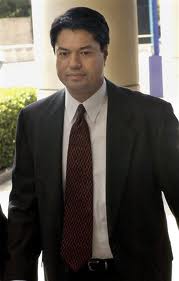 The always-insightful Larry Ribstein points out that Jamie Olis would have been better off providing material support for Osama Bin Laden than working on the beneficial structured finance transaction that ultimately led to his criminal conviction.
The sad case of Jamie Olis remains one of the most egregious abuses of the government’s prosecutorial power during the post-Enron criminalization of business. The relative lack of outrage over it reflects poorly on all freedom-loving Americans.
 Steve Waldman (H/T Felix Salmon) makes a spot-on observation regarding the conventional wisdom that the current downturn in the financial sector of the global economy is the result of too much risk:
One of the more depressing bits of emerging conventional wisdom is the notion that the financial system took on "too much risk" in recent years. I think it is equally accurate to suggest that the financial system took on too little risk. [. . .]
The big central banks, whose investment largely drove the credit boom, were (and still are) seeking safety, not risk. The banks and SIVs that bought up "super-senior AAA" tranches of CDOs were looking for safe assets, not risky assets. We had a housing boom, rather than a Pez dispenser bubble, because housing collateral is (well, was) the preferred raw material for fabricating safe paper. Investors were never enthusiastic about cul-de-sacs and McMansions. They wanted safe assets, never mind what backed ’em, and mortgages are what Wall Street knew how to lipstick into safe assets. The housing boom was born less from inordinate risk-taking than from the unwillingness of investors to take and bear considered risks. Agencies, asset-backed securities, it was all just AAA paper. It was "safe", so who cared what it was funding? [. . .]
. . . We’ve trained a generation of professionals to forget that investing is precisely the art of taking economic risks, then delivering the goods or eating the losses. The exotica of modern finance is fascinating, and I’ve nothing against any acronym that you care to name. But until owners of capital stop hiding behind cleverness and diversification and take responsibility for the resources they steward, finance will remain a shell game, a tournament in evading responsibility for poor outcomes.
Investors’ childlike demand for safety has made the financial world terribly risky. As we rebuild our broken financial system, we must not pretend that risk can be regulated or innovated away. We must demand that investors choose risks and bear consequences. We need more, and more creative, risk-taking, not false promises of safety that taxpayers will inevitably be called upon to keep.
Read the entire piece here. As noted many times on this blog (most recently here), many powerful forces in our society — the government and the mainstream media to name just two — continue to embrace myths that distract from a mature understanding of the nature of risk.
 Walmart opened its first store in Arkansas in 1962. Check out this remarkable Flowing Data video that shows the company stores growing like a wildfire over the ensuing 45 years.
Meanwhile, this BBC video takes a look from above, using satellite tracking and computer imaging, at the daily use of commercial passageways in the UK.